Luca
The Reincarnated Demon King's Host Just Wants to Live in Peace, But the Hero Won't Leave Him AloneLuca, also known as Hero Luca, the Demon Slayer, and the Hero of Algeya, is both the foremost martial protector of his world and a man struggling to possess an ordinary life. His decisive significance lies in the contradiction between those roles: the institutions that celebrate him as a Hero treat him as a vessel for duty and bloodline, while his bond with Theo enables him to claim choice, intimacy, and a future not organized around service.
Identity and Introduction
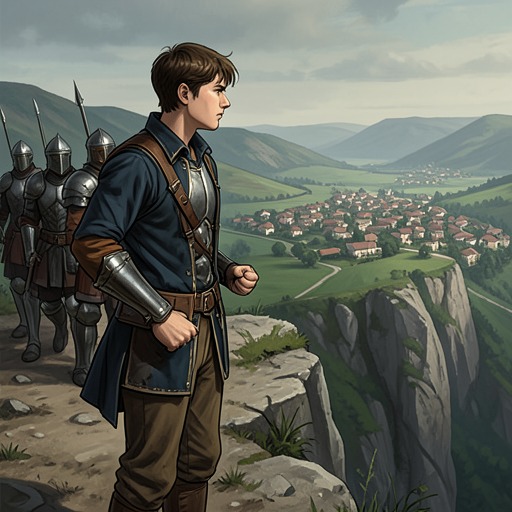
Luca first appears in Leafel with the formal authority of a Hero but without the distance usually associated with that title. He introduces himself as Luca, identifies himself as the Demon Slayer, and names Khal, Avery, Emi, Genevieve, Bryony, and Wicker as his companions; Cargo, the talking hog, adds himself to the introduction after being overlooked. Luca has come to stay with Theo while watching over an injured friend, with the rest of his party lodging at the town tavern. His courtesy is genuine but guarded: he smiles politely while maintaining cold eyes, a contrast that reveals how thoroughly public composure and private vigilance have become part of his heroic identity.
Theo’s first response to Luca is physical and involuntary. Luca’s smile is described as both dazzling and gentle, freezing Theo’s heart before making it race, an effect that marks attraction before either man has articulated a relationship. Luca, meanwhile, is drawn to the fact that Theo does not treat him as a symbol. He tells Theo that Theo is the first person he has met who treated him like a person rather than as the Hero. That recognition is central to Luca’s characterization: the extraordinary warrior is starved not of admiration, but of personhood.
Heroic Power and Public Duty
Luca’s Heroic power is primarily physical. It grants resilience, speed, strength, accelerated healing, and resistance to magic, abilities developed through rigorous training that begins early in life. Eliza started training at twelve, whereas Luca began at five, a difference that helps explain both his extraordinary proficiency and the extent to which heroism has shaped his childhood. His training has not merely prepared him for combat; it has made combat the language in which his body most effortlessly expresses itself.
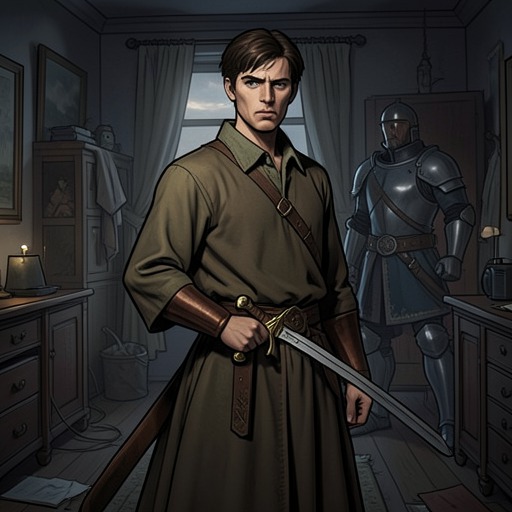
When Theo watches Luca fight, the Hero moves with an apparently seamless flow, his sword functioning as an extension of his arm and his boots barely seeming to touch the ground. The red sheen of the Hero’s sword triggers Theo’s traumatic memory of being stabbed, but the fight soon overwhelms every other thought. Luca’s skill is not only technical. He fights with exhilaration, fearlessness, and an almost reckless boldness that makes him distinct even from Eliza. Malthios recognizes him as a true Hero capable of confronting powers beyond ordinary human scale, while Theo’s own instinctive study of combat forms and Malthios’s combat memory allow Theo to understand the depth of Luca’s mastery.
Yet Luca’s strength is inseparable from institutional exploitation. The court and Eliza regard him as a means of preserving the Heroic line. Julius explains that Eliza wanted Luca to sire the next Hero, something that could not be achieved through either of Julius’s relationships with him. The demand turns Luca’s body, affection, and future into public property. His past relationships had already been made temporary by the Hero’s itinerant life: a childhood relationship with a maid, a squire who ended their relationship when Luca’s departure was announced, and several later affairs formed during brief stays in towns. Luca understands this pattern as the fate of the Hero, but his connection with Theo challenges the assumption that fate must remain a permanent sentence.
Relationship with Theo
Theo and Luca’s relationship begins through a reversal of the usual heroic encounter. Luca is accustomed to being approached as a savior, while Theo initially responds to him as an injured, difficult, desirable person. Their exchanges include conflict and even abuse, but Luca does not interpret Theo’s refusal to flatter him as rejection. Instead, he values the freedom of being addressed without ceremonial reverence. Theo’s hostility, defensiveness, and refusal to treat him as an untouchable champion become evidence that Luca can exist outside the role imposed on him.
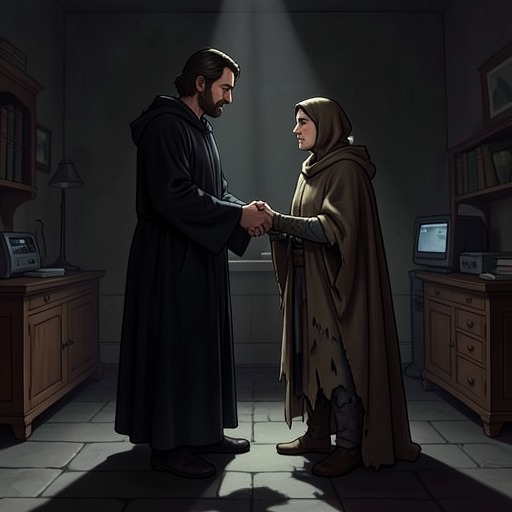
The relationship becomes more serious as both men acknowledge its risks. Theo is secretly the Demon King’s host and knows that no amount of friendship can protect him if the truth is discovered. Luca’s attachment therefore develops under the threat of political judgment, violence, and the possible destruction of Theo’s home. When Theo is summoned to the capital to heal Luca, he understands that answering the summons will end his autonomy: the authorities will learn who he is and where he lives, and the Hero’s party may force him back into service while exposing his secret. Theo goes because Luca may die, and because the institutions that depend on Heroes would simply replace him with another child if he were lost. To Theo, Luca is not expendable, even when the court treats him as such.
Their commitment is expressed through personal objects rather than public ceremony. Theo recalls having marked Luca first and promises to wait for him regardless of how long it takes. Luca answers with his father’s ring, a silver band textured like scales with a dark sapphire set into it. His father had belonged to an adventuring party and died after saving it from a demon attack, leaving Luca with the ring as his sole possession from him. Luca places the ring on Theo’s marriage finger; although Theo expects it not to fit, the band shrinks to sit snugly against his skin. The gesture joins inherited memory to chosen partnership: Luca does not erase his father’s legacy, but redirects its meaning toward a future he selects himself.
Conflict with Eliza and the Court
Luca’s conflict with Eliza is not merely a disagreement between two Heroes. Eliza embodies the older order in which heroic power legitimizes control, sacrifice, and dynastic continuation, while Luca increasingly understands heroism as the defense of a person’s right to live. Her expectation that he continue their bloodline converts kinship into obligation and makes his relationship with Theo a threat to the system’s continuity.
The trial of the Demon King’s Host brings Luca’s divided loyalties into the open. Theo is taken to the capital in magic-dampening handcuffs after the party uses a portal orb, and the court orders him sent to the dungeons. Luca has gone silent after Theo confirms what he is, leaving Theo unable to face him during the arrest. The judicial process treats Theo’s connection to Malthios as guilt, but Luca refuses to reduce Theo to the Demon King’s presence. He declares that Theo is Malthios’s prison and that he himself is Theo’s humble guard, promising not to let Theo out of his sight again.
When Eliza asks whether Luca is choosing to end their bloodline and throw away everything for which he has trained, Luca names the decision as the first choice he has ever made for himself. He chooses a quiet, peaceful life with the man he loves and imagines a world in which those born with the Hero’s gift can choose their fate instead of being bound to duty. Theo then calls him a better Hero than Eliza, turning the court’s definition of heroism against its most authoritative representative. Luca’s rebellion is therefore both intimate and political: he refuses the court’s claim on his body while proposing that the Heroic system itself be remade around consent.
Change and Narrative Significance
Luca’s arc moves from mastery of a prescribed role toward ownership of a self-defined future. At first, he presents the polished face of the Hero while accepting the temporary relationships, travel, and reproductive expectations that supposedly constitute the role’s fate. His bond with Theo reveals the cost of that arrangement. Luca is loved most fully when he is not being worshiped, and he becomes capable of protecting Theo not by simply defeating demons, but by standing beside a person whom the law has marked for punishment.
The people of Leafel reinforce this transformation. When Theo is placed on trial, Micah opens a mirror spell from the town square, showing Imani, Dale, Dmitri and his parents, Nib, Amaya, Hayden, and the people of Leafel gathered in determined solidarity. They demand Theo’s release rather than abandoning him. Luca’s decision is thus supported by a form of family that is neither hereditary nor institutional: a community assembled through care, loyalty, and shared life. Against the court’s bloodline, he chooses chosen family; against heroic succession, he chooses mutual protection; against a future dictated by duty, he chooses one he can inhabit with Theo.