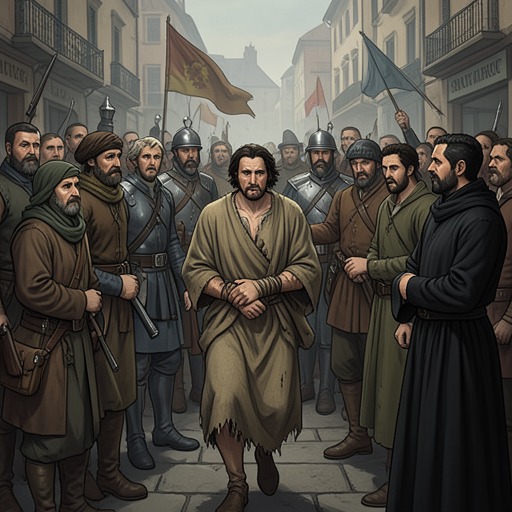
Magic-Dampening Handcuffs
The Reincarnated Demon King's Host Just Wants to Live in Peace, But the Hero Won't Leave Him AloneMagic-Dampening Handcuffs are the physical instruments used to arrest and transport Theo once he is identified as the Demon King’s host. Their decisive significance lies in how quickly they turn a feared secret into an enforceable sentence: the cuffs do not merely restrain Theo’s body, but dramatize the court’s assumption that his connection to Malthios makes him dangerous, guilty, and subject to removal from the community that knows him as a healer.
Identification and Imposition
The handcuffs appear immediately after Theo confirms the truth to Luc. Luc’s face fills with confusion and hurt when he understands that Theo is the Demon King’s host, while Theo cannot bear to look at anyone and apologizes. At that moment, something heavy falls into his lap. He recognizes the objects before opening his eyes, and Avery orders him to put them on, addressing him as a demon. The sequence makes the cuffs part of the revelation itself: Theo’s confession is followed not by investigation or compassion, but by a material command that defines him through the condemned identity.
The restraint also exposes the asymmetry between Theo’s inner reality and the authorities’ response. Theo contains Malthios, and his existence is therefore more complicated than the simple category imposed on him. Yet the cuffs reduce that complexity to a security problem. Once fastened, they make the court’s judgment tangible before the formal trial has even begun, placing Theo in the posture of a captive while the question of his guilt remains officially unsettled.
Function in the Capital Arrest
The cuffs are used as part of a coordinated legal seizure. Avery possesses a magic scroll for communicating with the court mage, and the Hero’s party has been equipped with a Portal Orb, a rare item that opens a portal to a chosen destination only when broken. Within ten minutes of Theo putting on the handcuffs, the party passes through the portal into the capital courtyard, where a dozen knights and the court mage are waiting. The court mage orders Theo taken to the dungeons, confirming that the cuffs are not temporary precautions within Leafel but the first stage of a planned transfer into state custody.
Their presence also changes the emotional geography of the journey. Luc says nothing after Theo’s confirmation, and Theo cannot look at him while being led away. The cuffs therefore stand between them before either man has reached a decision about what the revelation means. Theo’s magic cannot heal the pain of that separation, and the restraint becomes a cruel counterpoint to his identity as a healer: the person whose power is associated with repair is rendered powerless while the authorities move him toward judgment.
Fear, Secrecy, and Public Judgment
The handcuffs acquire their force because Theo has spent much of his life anticipating precisely this discovery. He knows that no amount of friendship would save him if anyone learned what he was, and he has treated escape as a possibility in case concealment failed. Cargo later asks whether Theo will ever tell the others that he is demon spawn, causing Theo’s body to freeze and prompting Malthios to stir within him in an attempt to defend them. The cuffs are the institutional form of the danger that these earlier scenes only anticipate.
Theo’s decision to enter the capital despite that danger is made for Luc. Bryony and the others obtain permission and a portal to retrieve him because they believe he may be able to help Luc, but Theo understands that crossing the portal will end his autonomy. The people in power will know who he is and where he lives; Camden may recognize him; and the authorities may force him back into the Hero’s party, where his secret could be discovered. He nevertheless goes because Luc may die and be replaced by another child whom the system considers expendable. The handcuffs thus punish an act of loyalty: Theo accepts the path that makes his capture possible because Luc is not expendable to him.
Destruction and Reversal
The cuffs remain on Theo until the public confrontation at his trial. The court is prepared to declare Healer Theo guilty for protecting Malthios when a new mirror spell opens beside the court mage. Through it, Micah, Imani, Dale, Dmitri and his parents, Nib, Amaya, Hayden, and the people of Leafel appear in their town square and demand Theo’s release. The community’s intervention directly contests the court’s definition of him. Instead of abandoning Theo as a demon, Leafel presents him as one of its own.
Luc then transforms the meaning of the object through a single physical act. After apologizing to Theo, he pulls back, hooks his fingers around the cuffs, and breaks them with Hero strength, allowing them to fall to the floor. The destruction is not an escape engineered by Theo’s magic; it is Luc’s deliberate refusal to let the restraints determine Theo’s fate. When Mage Syvia protests that Luc cannot simply let the Demon King go free, Luc answers that Theo is Malthios’s prison and that he is Theo’s humble guard, promising never to let Theo out of his sight. The broken handcuffs therefore mark a new arrangement of responsibility: control no longer belongs exclusively to the court, while Luc accepts a personal duty to remain beside Theo and help contain the danger within him.
Narrative Significance
Magic-Dampening Handcuffs embody the conflict between coercive classification and chosen protection. In the capital, they make the state’s fear visible and deny Theo the powers associated with his healing identity. In Leafel’s intervention and Luc’s resistance, that imposed image is challenged by relationships that recognize Theo as a person rather than a vessel to be punished. Their movement from Theo’s lap to the dungeon, and finally to the floor in pieces, gives the object a compact dramatic arc: discovery, confinement, public contest, and release.
The handcuffs also clarify the novel’s central distinction between imprisonment and guardianship. The court treats Theo as a threat whose body must be neutralized; Luc instead describes Theo as Malthios’s prison and himself as the prison’s guard. The physical restraint is broken, but the danger is not denied. What changes is who accepts responsibility for it and whether that responsibility is imposed through force or undertaken through attachment. In that reversal, the cuffs become more than a prison device: they are the object that exposes the court’s failure to distinguish the Demon King from the host who contains him, and the object whose destruction makes a shared, chosen form of protection possible.