Malthios's Return
The Reincarnated Demon King's Host Just Wants to Live in Peace, But the Hero Won't Leave Him AloneMalthios's Return is the turning point at which Theo's concealed connection to the former Demon King becomes an undeniable public fact. Faced with Luc's imminent death, Theo abandons secrecy and self-preservation: Malthios's power passes through him, wings and horns emerge, his fingers become black claws, and the returning Demon King bursts into the open. The transformation saves Theo and Luc from an immediate execution, but it also makes Theo answerable to the capital, the court, and the people who have feared Malthios's name.
Causes and Background
Theo's return to the capital already carried the threat of exposure. He understood that entering through the portal would end his autonomy, reveal where he lived, and place him back within the Hero's party, where Camden could recognize him and the truth about his body might be discovered. He nevertheless went because Luc might die without his healing, and Theo considered Luc irreplaceable even though the institutions surrounding the Hero's party treated heroes as expendable. The journey therefore begins as an act of chosen loyalty under coercion: Theo knows that disclosure may destroy his life, yet refuses to let Luc be sacrificed to the system.
The danger of disclosure is not abstract. Theo knows that friendship would not save him if anyone learned what he was, while Cargo later confronts him directly about whether he will tell the others that he is demon spawn. The question freezes Theo in place and allows Malthios to press forward defensively from within him. His secret is thus both a personal burden and a political liability. Theo is not merely hiding a supernatural condition; he is concealing an identity that the dominant order has defined as grounds for death.
The Return in Battle
The revelation occurs after Tyraz's shadow copies overwhelm the battle. Two copies engage Luc while a third drives a sword into his side. Luc's blue coat darkens with blood, he drops the Hero's sword, and he collapses before Theo can reach him. Theo experiences Luc's pain through his own body, with the wound seeming to burn from his side into his chest. His magic is the only force capable of saving Luc, and desperation finally outweighs the fear that has governed his concealment.
Theo calls on Malthios and feels the demon's power flood through him while retaining control. He strikes the barrier holding him prisoner, sending magic down his arm like lightning and shattering the circle. With no weapon and no plan, he runs toward Luc. The action is not a calculated military maneuver but a rescue undertaken against overwhelming odds, driven by the conviction that Luc must not be allowed to die even if saving him costs Theo everything.
When Tyraz raises his sword over Luc, Theo throws himself between them. Malthios answers immediately. Power surges through Theo a second time; wings unfold from his shoulders, horns grow from his temples, and his fingertips curl into black claws. The force of the transformation blasts outward and sends Tyraz flying back. Luc can only look up at Theo with unfocused eyes, so the scene leaves uncertain whether he understands what he is seeing. The uncertainty does not lessen the revelation's scale: Malthios, identified as the King of all demons, has returned through Theo's body before Luc, Tyraz, the trapped Hero's party, and the wider courtyard.
From Revelation to Trial
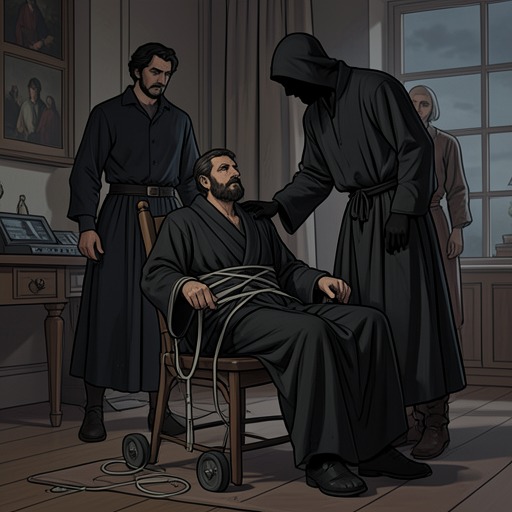
The transformation resolves the immediate threat but creates a larger one. Theo's identity can no longer remain a private secret between himself and Malthios, and the capital responds by treating the matter as a legal and political emergency. The court orders Theo taken to the dungeons, where he is confronted by the court mage and by Julius, Luc's former lover. The trial is explicitly framed as the trial of the Demon King's host, showing that the authorities judge not only Malthios's acts but also Theo's status as the body through which Malthios survives.
The proceedings initially place Theo under the weight of collective accusation. The court agrees that Healer Theo is guilty of protecting Malthios, making his healing identity inseparable from the charge against him. Yet the trial is interrupted by a mirror spell opened from Leafel. Micah stands at the front of the town with his staff raised, while Imani, Dale, Dmitri and his parents, Nib, Amaya, and the people of Leafel gather behind him. Hayden speaks for them and demands Theo's release. Their appearance changes the meaning of the disclosure: Theo is no longer presented only as a demonic threat, because the community he served publicly chooses to witness for him.
Judgment and the New Balance of Power
Malthios's return also exposes the collapse of the old military order. When Luc asks whether Malthios destroyed the demons, Malthios confirms that he destroyed the fortress and everyone inside it, while acknowledging that lesser demons and demon-created monsters may still remain. He adds that there is no longer any need for a Hero. The statement presents the return as both victory and institutional crisis: the Demon King has ended the immediate fortress threat, but his power also makes the established Hero system appear obsolete.
Luc refuses to let that conclusion erase his own duty. After Malthios asks to be addressed by the name his friends gave him, Theo resumes control and returns to his ordinary appearance. Luc then declares that, as the Hero, it is his duty to kill the Demon King, but immediately asserts that he can choose when that duty will be carried out. This postponement is neither a denial of the law nor an immediate act of obedience. It creates a precarious compromise in which Luc preserves the formal obligation while refusing to surrender Theo and Malthios to an automatic execution.
King Alexis ultimately announces the trial's sentence: Malthios is condemned to life in prison, while Healer Theo Bladefoot is free of all charges. The decision separates the host from the being within him, even though the transformation has shown how inseparable their fates are in practice. The people of Leafel cheer through the mirror spell, and Luc turns so that Theo and the gathered community can acknowledge one another. The group expects to reach home before spring if the roads remain clear, giving the judgment a concrete aftermath: imprisonment replaces execution, communal acceptance replaces abandonment, and return to Leafel becomes possible.
Narrative Significance
Malthios's Return reverses the meaning of Theo's hidden identity. Before the battle, concealment appears to be the condition of survival; at the decisive moment, concealment would instead permit Luc's death. Theo's choice to reveal the power inside him turns the secret from a source of shame and danger into the means of rescue. The return therefore joins sacrifice, recognition, and transformation in a single action: Theo saves the person he loves by becoming the figure the world has been taught to destroy.
The event also fractures the simple opposition between Hero and Demon King. Luc remains committed to the Hero's duty, but he delays its final violence; Malthios admits responsibility for destroying the Demon Fortress, yet the court imposes life imprisonment rather than death; Leafel's people know what Theo contains and still demand his release. Justice consequently moves away from a single ritual of execution toward a constrained coexistence shaped by testimony, responsibility, and future choice. Malthios's Return is not merely the restoration of an old enemy. It is the moment when the story's inherited categories become inadequate, and when Theo's life as both healer and host must be recognized as a new political reality.