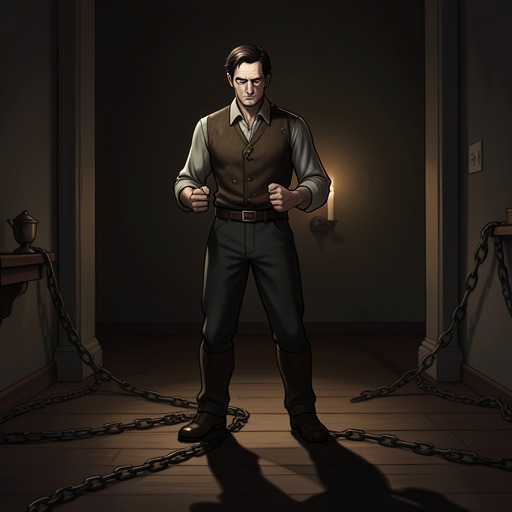
Malthios’s Ascension to Demon King
The Reincarnated Demon King's Host Just Wants to Live in Peace, But the Hero Won't Leave Him AloneMalthios’s Ascension to Demon King is the decisive transformation that converts Malthios’s private grief into a change in the political order of demonkind. The event begins with a wounded commander returning to the throne hall and ends with his wings changing from black to blood red as the watching demons recognize that he has become their new ruler. Its significance is not merely military: the ascension exposes the brutal law governing demon authority, in which sovereignty is earned through death and power rather than inherited through royal blood.
Causes and Background
Malthios enters the throne hall after the destruction of the Pentagram, the group whose members had been his friends and comrades. He throws open the doors while blood streaks his cheeks and throat, more blood leaks from a wound in his shoulder, and his sword remains bare in his hand. The assembled Demon Lords and Novices immediately turn toward him, while Commander Fulton asks what has happened. Malthios does not answer him at first. His attention moves across the chairs until it settles on Naamah, identifying the person he believes responsible for sending the Pentagram into danger.
Naamah’s role in the catastrophe is presented as deliberate concealment rather than simple error. Malthios accuses her of knowing that the Hero would be present and allowing the Pentagram to walk into the encounter blindly. In his account, everyone is dead because Naamah withheld the warning. Her response reveals the political contempt underlying the demon hierarchy: she claims that if the Pentagram had truly been powerful, it would have defeated the Hero, and she declares that none of its members were fit to ascend to Demon King. Her insult singles out Aym, reducing one of Malthios’s dead companions to a dismissive reference even as Malthios is still carrying the immediate shock of the massacre.
The later explanation of Malthios’s past gives the ascension a second foundation. He was not born into a demon royal family, because demons have no royalty in the hereditary human sense. His early life was spent surviving on the streets after his parents abandoned him, and he would have died there if a Demon Lord had not sponsored him. His rise therefore begins in abandonment and dependence, not privilege. The same system that once allowed him to be rescued later makes him eligible to seize the highest position through demonstrated force.
The Retaliatory Assault
Malthios’s answer to Naamah is both accusation and vow. He insists that she has no right to speak the names of the fallen, declaring that they are the reason he is alive and the reason he has become who he is. He then promises to avenge them. The conflict shifts at that moment from a dispute over military responsibility to a personal act of retribution, with the dead Pentagram standing behind every movement of the fight.
Malthios attacks first. His wings launch him forward while blue fire blazes across his body, and Naamah summons a spear to block his strike, opening her wings to counter the force. Several of Naamah’s Novices join her from the edge of the room, turning the confrontation into a dozen-against-one battle. The numerical disadvantage barely registers for Malthios. His vision is filled by the deaths he has witnessed: Aym’s slack, surprised expression; Torq throwing himself in front of Foras; and Kamil smiling at him. Memory does not soften the violence. It concentrates it.
His magic then erupts around him, expanding his fire as he cuts down the Novices. Their blood clings to his body while Naamah retreats, and the fear that crosses her face becomes, for Malthios, a measure of belated justice. When she turns to flee, he drives her to the ground, pins one of her legs with his sword, and tears away her wings. Naamah’s screams do not interrupt his purpose. He removes the second wing as well, then pulls his sword free and sets her body alight. Fire consumes her completely, leaving scattered ashes rather than a body that could become shadows.
The Ascension Itself
After Naamah’s death, Malthios stands over the ashes with blood on the floor and mana still simmering beneath his skin. His power spikes in the same manner it had when he previously ascended to Demon Lord. This recurrence makes the transformation legible to the demons watching him: the violence has not simply ended a vendetta but triggered the next recognized stage of his existence.
His wings open to their full length before the assembled witnesses. Their glossy black feathers change into a dark blood red, a visible mark produced by the deaths he has caused. Most of those present already understand what is happening, and many have apparently been anticipating it since Malthios began killing his own kind. The scene therefore combines revelation with public confirmation. Malthios does not receive a crown, inherit a title, or obtain authority through a council’s appointment; his body becomes the proof of his new status.
The transformation is summarized in the stark declaration that a new Demon King has risen. Later, Malthios explains that the red wings are the consequence of killing many of his own kind in order to ascend. They remain a permanent reminder of how he gained his position, turning victory into an indelible record of bloodshed. His ascension is thus both elevation and stain: the same mark that proves his worthiness also preserves the memory of the comrades and enemies whose deaths made his rule possible.
Demon Law and Personal History
Malthios’s rise also clarifies the difference between succession among demons and succession among humans. He explains that a demon’s position is gained through death and power, and that only someone worthy of the relevant power can ascend to Demon King. His transformation is therefore not a ceremonial promotion but the visible outcome of a violent qualification. When Luc compares this process to being chosen, Malthios can only answer that it happened to him rather than being something he selected. The language of choice is important: he becomes sovereign through his own actions, yet the role arrives as an imposed consequence of those actions.
The event also complicates the idea that Malthios was destined for rulership. His abandoned childhood and years surviving on the streets place him at the lowest edge of demon society before a Demon Lord sponsors him. Nothing in that history promises a throne. His ascent instead follows a harsh meritocratic logic in which survival, sponsorship, combat, and demonstrated power replace bloodline. The system can lift an abandoned child, but it does so through the same violence that makes advancement a record of killing.
Consequences for Malthios and Theo
The new title does not erase the cost of the Pentagram’s destruction. Malthios’s red wings embody the deaths of his own kind, while his recollection of Aym, Torq, Foras, and Kamil keeps the ascension tied to grief rather than detached ambition. His revenge establishes him as Demon King, but it also leaves him carrying the memory of the people he wanted to avenge. Power and mourning are fused in the transformation instead of appearing as separate stages.
That history later becomes part of Malthios’s shared life with Theo. Theo fears that friendship cannot save him if anyone discovers what he is, and Cargo eventually identifies him as the Demon King’s host by directly asking whether he will reveal that he is demon spawn. When Theo is summoned to the capital, he understands that the court could force him into the Hero’s party and expose the truth, yet he accepts the danger because Luc may die. The earlier ascension gives this danger its full meaning: Theo is not merely concealing an unusual magical condition but sheltering the being whose sovereignty was created through the slaughter of demons.
The trial makes that concealed history public. After Theo confirms what he is, he is taken through a portal to the capital, placed in magic-dampening handcuffs, and led toward the dungeons while Luc remains silent. The court declares Healer Theo guilty for protecting Malthios, but the people of Leafel answer through a mirror spell. Micah raises the spell before the gathered villagers, with Imani, Dale, Dmitri and his parents, Nib, Amaya, and others behind him; Hayden then demands Theo’s release. The political order that labels Malthios’s host a criminal is contrasted with a community that refuses to abandon the person it knows.
Memory, Mortality, and Legacy
Malthios’s ascension is repeatedly set against ordinary acts of care that resist the logic of power. After Glefald’s death, the people of Leafel honor his wish for burial in the earth and plant a tree over his body, placing it across from the Watchtower so that it will eventually serve as a second guardian. They preserve his knitwear as mementos, and Theo receives a soft scarf Glefald had made specially for him. Such remembrance creates continuity through nurture and memory rather than conquest, offering a moral counterimage to wings reddened by blood.
The same contrast appears during the party’s encounter with the nested ghost near the Abandoned Well. The rotted structure emits distant cries, and the party discovers a dead child trapped within the supernatural creature. Wicker burns away the nested beast with an oil-soaked, rune-marked torch; once the corpse collapses, a silvery figure of the boy appears above the blackened remains and begs to go home. Theo responds by offering to take him home. The scene distinguishes destruction that releases the dead from destruction pursued for vengeance: both involve fire, but Theo’s magic turns death toward restoration while Malthios’s fire turns an enemy into ashes.
Narrative Significance
As an event, Malthios’s Ascension to Demon King functions as a reversal in which bereavement becomes sovereignty. The wounded commander who returns to accuse Naamah is still acting as a member of the Pentagram, but the killing transforms him into the ruler of the demonkind he has begun to destroy. Its recognition scene is bodily rather than verbal: the witnesses read the change in his wings before the narrative states that a new Demon King has risen.
The ascension also establishes the central contradiction of Malthios’s later existence. He is made powerful by the deaths of his own people, yet his most enduring ties are built through comradeship, shared life, and protection. The blood-red wings certify the authority of the Demon King, but they cannot make the past disappear. Every later question about Theo’s secret, every threat from the court, and every act of communal loyalty returns to the same foundation: Malthios’s rule began as an act of revenge, and the world must decide whether the person formed by that violence can become something other than its continuation.