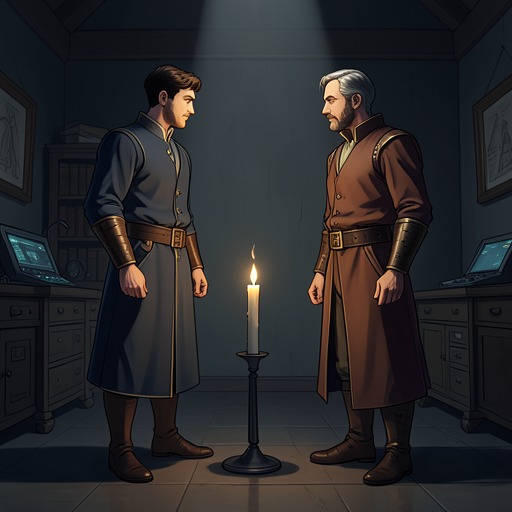
Malthios’s Defeat by Hero Eliza
The Reincarnated Demon King's Host Just Wants to Live in Peace, But the Hero Won't Leave Him AloneMalthios’s Defeat by Hero Eliza marks the military collapse of Malthios’s reign as Demon King and the turning point that carries the conflict beyond a conventional heroic victory. The defeat is prepared by a long demographic and political reversal: mortals grow in number and strength, form kingdoms and alliances, and unite as Algeya, while the Demonkin population remains depleted after Demon Lords killed large numbers of their own kind in failed attempts to become Demon King. By the time the Hero’s party enters Malthios’s territory, only the Demon King’s castle and the surrounding far-northern region remain secure for the demons.
Causes and Background
Malthios recognizes the change before the final assault begins. He watches mortal society expand despite repeated slaughter, with new people replacing those who die, while the demons fail to replenish their forces quickly enough. The contrast exposes a weakness in immortal power: immortality provides unlimited time, but not necessarily the discipline to use that time for growth and improvement. Mortal persistence therefore becomes a strategic force capable of pushing the demons back and constructing a united country around them.
The disappearance of the castle’s scouts intensifies the sense that Malthios’s position is narrowing. The Hero’s party has entered his territory, yet none of the scouts sent to find them returns, including Luvel and Nissle, whom Malthios assumes have fled. When the alarm finally sounds inside the castle, the news reaches him in the library, the one place where he can be alone even though he is not reading. Keplo’s abrupt entrance first irritates him, but the general’s report also awakens something close to excitement. Rather than retreating or allowing his forces to absorb the attack piecemeal, Malthios orders the intruders funneled into the throne room and decides to meet them there himself.
The Assault on the Throne Room
Malthios waits on his stone throne until the doors crash open and six members of the Hero’s party enter. He identifies Eliza immediately through the glow surrounding her body and the reddish blade in her hand, a weapon made and blessed to take the Demon King’s head. Her companions include two fighters, one specializing in close combat and the other in ranged attacks, two mages, and a healer. Malthios does not study their faces because he regards them as collateral damage in the confrontation that matters: the battle between the Demon King and the Hero.
The fight begins without speeches. Malthios immediately tries to separate Eliza from her companions, dropping a column onto the healer so that the mages must concentrate on stabilizing the injured party member. The two fighters soon return, but Malthios deflects them with ease and creates a circle of fire around himself and Eliza, cutting the pair off from the rest of the throne room. The battlefield becomes a deliberately bounded duel, with the survival of the wider party temporarily subordinated to the contest between the two central figures.
Eliza proves more controlled than the previous Hero Malthios had fought. She keeps her power at a level that does not immediately consume her life force, maintaining discipline while pressing the attack. Her amber eyes show no fear, and the gold, red-jeweled hilt of her sword flashes against the blue fire surrounding the duel. Her blade strikes Malthios’s black sword with matched strength, and the collision of their mana cracks the floor beneath them. Both combatants sustain injuries, though neither is initially incapacitated; the damage slows them without deciding the outcome.
Eliza’s Victory
The reversal comes when Eliza’s light suddenly brightens and her mana spikes. Malthios brings his black blade across his body to block the incoming strike, but the weapon shatters like glass. Eliza’s sword then pierces his stomach and remains embedded as he drops to his knees. The attack locks his limbs with burning pain and transforms his confidence in the duel into physical helplessness. Eliza steps closer rather than allowing him to withdraw and commands him to die as Demon King.
Malthios’s defeat is not presented as the end of his will. Even while wounded, he glares up at Eliza and reaches for the sigil inked on his forearm, warning her that she has not seen the last of him. When she pulls the sword free, he forces mana into the sigil as his crown slips from his head and his vision darkens. The gesture makes the scene a victory with an open wound at its center: Eliza wins the throne-room battle and kills the reigning Demon King, but Malthios acts before death can become final closure. His last resolve remains directed toward Algeya and its Hero, whom he still imagines brought low before him.
Immediate Meaning of the Defeat
The battle changes the political balance that had governed the setting. Malthios’s fall follows the rise of Algeya, so the event confirms that mortal consolidation has finally overcome the weakened demon order. Yet the defeat also creates the conditions for the later problem of Malthios’s continued presence. The sigil gives the apparent ending a delayed consequence: the Demon King’s body can be defeated while the conflict survives through what he has set in motion.
The later trial makes the distinction explicit. The court identifies the accused subject as Demon King Malthios, while Theo is judged for protecting him. Theo’s guilt is contested publicly when Micah opens a mirror spell from Leafel and presents the town’s people demanding the healer’s release. The community’s intervention shows that Eliza’s victory does not settle the moral meaning of Malthios’s survival or Theo’s connection to him. The military defeat is therefore followed by a legal and communal struggle over responsibility, protection, and whether the old heroic duty can simply be resumed after the Demon King’s fall.
From Military Defeat to Public Judgment
The consequences of Malthios’s defeat eventually move from the battlefield into a court where the surviving problem is no longer simply whether the Demon King has been overthrown, but how Theo’s protection of him should be judged. The proceedings are made possible by a magic scroll connecting Avery with the court mage and by a Portal Orb, a rare item that opens a portal to a chosen destination only when it is broken. Within ten minutes of Theo putting on the Magic-Dampening Handcuffs, the group reaches the capital courtyard, where a dozen knights and the court mage receive them before Theo is taken to the dungeons. Luc remains silent after Theo confirms what he is, and Theo is unable to look at him; the emotional wound of the defeat has become inseparable from the legal consequences of Malthios’s survival within him. The knight leading Theo to his cell is Julius, Luc’s former lover, whose blank expression mirrors the court mage’s severity.
The trial widens the conflict beyond the defeated king and the accused healer. When the court reaches agreement that Healer Theo is guilty of protecting Malthios, Micah interrupts through a newly opened mirror spell. The larger mirror reveals Leafel’s familiar town square and a crowd gathered behind Micah, including Imani, Dale, Dmitri and his parents, Nib, Amaya, and the people of Leafel. Hayden steps forward and demands Theo’s release on behalf of the town. Their intervention changes Theo’s understanding of the judgment: the community has not abandoned him or reduced him to his connection with the former Demon King. The military victory that once isolated Theo from Luc and the authorities is thus answered by a collective act of witness and loyalty from Leafel.
The Question of a Second Defeat
Malthios’s account of the fortress clarifies that his defeat by Eliza was followed by another decisive act of violence. Asked whether he destroyed the demons, he confirms that he destroyed the Demon Fortress and everyone within it, while acknowledging that a few lesser demons and demon-created monsters may remain at large. He also states that there is no longer any need for a Hero. The declaration reverses the meaning of the earlier victory: Eliza’s triumph ended Malthios’s reign, but Malthios’s later destruction of the fortress claims to end the organized demonic threat that had justified the Hero’s existence.
That claim creates a direct contradiction between military necessity and heroic duty. Luc answers not as a detached witness but as the Hero whose role has been defined by the obligation to kill the Demon King. When Malthios, using the name Mal that Theo gives him, asks Luc to make a good choice, Luc takes control of the decision without denying the duty itself. He declares that it is his duty as the Hero to kill the Demon King, then immediately qualifies that duty by insisting that he also chooses when the killing will occur. The distinction delays execution without erasing the judgment that Malthios remains responsible for the identity and danger attached to the title.
Sentence and Release
The final ruling preserves both accountability and restraint. King Alexis announces the conclusion of the trial of Demon King Malthios, sentencing him to life in prison, while declaring Theo Bladefoot free of all charges. The sentence rejects immediate execution even though the Hero’s duty remains recognized, and it separates Theo’s identity and conduct from Malthios’s culpability. In this form, the aftermath of Eliza’s victory becomes neither a simple pardon nor a return to the old order: Malthios is confined, Theo is released, and the threat is addressed through continuing control rather than another public killing.
The ruling is met by cheers transmitted through the mirror spell from Leafel. Luc turns toward the people who defended Theo and waves with him, converting a private legal crisis into a communal affirmation. He then tells them to expect the group’s return before spring if the roads are clear. The movement from the throne room to the court and finally toward home gives the defeat a delayed structure: Eliza’s sword ends Malthios’s reign, the sigil carries his presence beyond apparent death, and the trial determines that the surviving conflict must be managed through judgment, confinement, and chosen allegiance.
Narrative Significance
Malthios’s Defeat by Hero Eliza functions as a reversal rather than a closed ending. The scene fulfills the conventional promise of the Hero’s quest when Eliza’s blessed sword breaks Malthios’s black blade and pierces the Demon King, but the forearm sigil interrupts the expected finality of that victory. Malthios’s body falls, his crown slips away, and his vision darkens, yet his will reaches forward into the later history of Theo, Luc, and Leafel. The event therefore joins military conquest to reincarnation, legal responsibility, and the possibility of coexistence.
Its deeper contrast lies between Eliza’s controlled use of life-consuming Hero power and Malthios’s conviction that strength alone will secure victory. Eliza wins by managing her power until a sudden increase in light and mana breaks the balance of the duel. Malthios, who has watched mortals grow through persistence and collective organization, is defeated by the same historical pressure he recognized but could not overcome. Yet the aftermath refuses to make victory morally uncomplicated. The court’s life sentence for Malthios, Theo’s release, Leafel’s public defense, and Luc’s decision to postpone execution all show that defeating an enemy does not automatically resolve what the enemy has become, whom he inhabits, or what justice should require afterward.