The Hero’s Party’s Farewell from Leafel
The Reincarnated Demon King's Host Just Wants to Live in Peace, But the Hero Won't Leave Him AloneThe Hero’s Party’s Farewell from Leafel is the decisive parting between Theo and the Hero’s party at the Leafel Watchtower. The scene transforms an ordinary departure into a declaration of chosen attachment: Theo releases the party from any obligation to return, gives Luc a fluorite pendant as a private reminder, and nevertheless makes clear that he will be waiting. The farewell therefore marks both separation and continuity, establishing the promise that later enables Theo and Luc to recognize their relationship as stronger than the heroic duties imposed on them.
Setting and Circumstances
The farewell follows a period in which the Hero’s party has stayed in Leafel while Theo’s connection with Luc has deepened. The departure is emotionally charged because Theo has already experienced Luc as more than a passing companion, even though Luc has described the instability of the Hero’s life. Luc has had several relationships, including a maid in training, a squire who ended their relationship when Luc was announced to be leaving, and other short-lived attachments formed during the party’s temporary stays in towns. He presents this pattern as part of the fate of the Hero: movement makes permanence difficult, while duty determines where he must go.
The leave-taking also occurs against the strain of Theo’s hidden condition. Theo is the Demon King’s host, and Malthios’s presence means that Theo and the Demon King share knowledge of one another’s thoughts and feelings. Theo’s refusal to follow Malthios’s orders has repeatedly provoked threats, insults, and incapacitating headaches, but Malthios cannot simply abandon Theo for another host: the transfer spell took more than a human lifetime to prepare, and Theo’s death would also kill Malthios. Their forced coexistence makes Theo’s attachment to Luc especially dangerous, because separation threatens not only romantic happiness but also Theo’s ability to protect the people and life he has chosen.
The Departure from Leafel
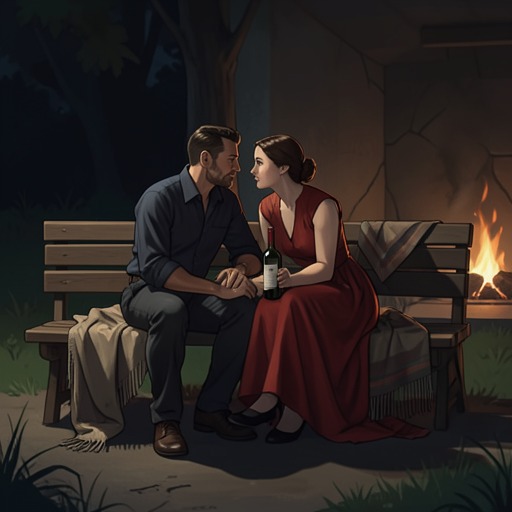
Theo arrives early at the Broken Blade after a restless night. The absence of a warm body beside him makes the coming separation tangible before anyone has left. Imani seats him at a large table and brings fresh scones, while Wicker arrives first from the Hero’s party and rests their head on Theo’s shoulder. Wicker says, “I’ll miss you, Theo,” and Theo replies that he will miss Wicker as well, surprised by the sincerity of his own answer. The exchange shows that the farewell is not limited to Luc; Theo has formed attachments throughout the party, even with people whose presence once represented disruption or danger.
Avery and Emi arrive next and remain silent, a restraint Theo accepts without resentment. Cargo comes before Khal and Luc, and the shadows beneath Luc’s eyes reveal that the Hero has slept no better than Theo. Luc’s shoulders relax when he sees Theo, and he sits on the bench beside him. Genevieve and Bryony arrive later, with Bryony’s damp blond braids suggesting that Veiv has forced her awake with cold water. After breakfast, the party gathers its packs, some of them being strapped to Cargo, and walks quietly through Leafel toward the Watchtower while much of the town is still rising late.
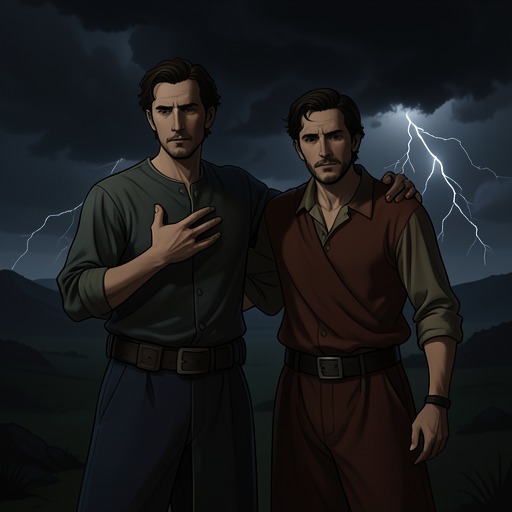
At the Watchtower, Theo stops and states that this is where he leaves the party. He wishes that all of them will return to Leafel well and whole. The formal wording is restrained, but the party answers with unexpected physical affection: Bryony, Wicker, Veiv, and Khal draw everyone into a group hug. Theo does not resist it. The gesture converts the party’s departure from a purely logistical separation into an acknowledgment that Theo has become part of their circle, even though he will not continue along their road.
Theo’s Gift and Promise to Luc
After the group steps back, Luc stands directly before Theo and studies his face as though trying to memorize it, uncertain how to proceed. Theo breaks the hesitation by offering a gift. It is the fluorite spear that Wicker gave him, twisted into metal wire and hung from a chain. Theo tells Luc that he should have something to remind him of Theo and adds that Luc should know Theo will be waiting if he returns.
The object carries several layers of meaning. It originates with Wicker, so Theo gives Luc not merely a personal ornament but a transformed remnant of the party and its shared history. The spear, once a weapon, becomes a pendant: an instrument associated with conflict is remade as a token of memory and patience. Theo’s light tone cannot conceal that the act is unfamiliar territory. He is trying to offer love without turning the gift into a demand, and he explicitly gives Luc permission to continue living if the Hero’s journey leads him elsewhere.
When Luc reaches for Theo, Theo catches his hand and insists that neither of them has anything to be ashamed of. He proposes that they part as friends and says he will not blame Luc if Luc finds someone else, wishing him nothing but the best. This apparent renunciation is the scene’s central contradiction. Theo protects Luc from guilt by denying him any obligation, yet the gift and the promise preserve the possibility of return. Freedom is offered through language, while attachment remains present in the object placed against Luc’s body.
Separation, Return, and the Future They Choose
The farewell’s immediate consequence is absence. The Hero’s party continues its mission, while Theo remains in Leafel rather than following the heroic road. The separation intensifies Theo’s physical and emotional vulnerability: in the following weeks, Malthios remains unstable and insulting, Theo works excessively, sleeps very little, and suffers recurring nightmares of Luc’s broken, blood-covered body. His illness develops amid this strain, showing that the departure is not a clean emotional conclusion but an unresolved wound carried into daily life.
The promise made at the Watchtower later becomes reciprocal. When Theo and Luc meet again, Theo touches the pendant and reminds Luc that he marked Luc first and promised to wait, no matter how long it takes. Luc answers with his father’s ring, a dark sapphire set in scaled silver. The ring is the last thing Luc possesses from his father, who died after saving an adventuring party from a Demon attack. Luc places it on Theo’s marriage finger, and the band unexpectedly contracts to fit. The exchange reverses the emotional direction of the earlier farewell: Theo had sent Luc away with a reminder, but Luc returns with an heirloom and a bodily sign of commitment.
The later conflict reveals how much the farewell has changed. Hero Eliza wants Luc to continue the bloodline and sire the next Hero, a future that cannot be achieved through either Luc’s former male lover Julius or Theo. Luc is therefore pressured to understand his life as an instrument of inheritance. By choosing Theo, he rejects the idea that the Hero’s future must be defined by reproduction and duty. At the trial of the Demon King’s host, Luc describes Theo as the Demon King’s prison and himself as Theo’s humble guard, promising not to let Theo out of his sight. When Eliza accuses Luc of ending their bloodline and abandoning everything for which he trained, Luc answers that this is the only choice he has ever made for himself: to live quietly and peacefully with the man he loves, and to help create a world in which those born with the Hero’s gift can choose their fate rather than remain bound to duty.
Narrative Significance
The farewell is a threshold scene in the Hero’s journey, but it inverts the conventional return to glory. The party leaves Leafel to continue heroic action, while Theo’s remaining in the village affirms another kind of responsibility: care, community, and a life not organized around conquest. The group hug establishes a chosen family, and Theo’s pendant turns departure into a ritual of remembrance rather than a severing of ties.
The event also makes emotional labor visible. Theo tries to keep his tone light while giving Luc the pendant, offers Luc permission to find someone else, and frames his own pain as something Luc need not carry. Luc, meanwhile, arrives exhausted but visibly relaxes at the sight of Theo, revealing feelings that the duties of the Hero normally require him to suppress. Their later reunion and Luc’s refusal of Eliza’s bloodline imperative show that the farewell was not a failed romance interrupted by duty. It was the first clear articulation of a rival future, one based on mutual choice rather than heroic conscription, compulsory inheritance, or the fatal logic of Malthios’s power.
The departure’s deepest reversal is that leaving does not end belonging. Theo remains in Leafel, but the party’s affection follows him; Luc continues the Hero’s road, but the pendant carries Theo with him. When the larger conflict finally places Theo before the court, Leafel’s people gather through a mirror portal to demand his release, and Luc publicly chooses life with Theo over the bloodline imposed by Eliza. The farewell thus functions as the emotional seed of the ending: a quiet promise at the Watchtower grows into a public refusal of inherited duty and a declaration that a shared life can be chosen even in a world built to deny it.