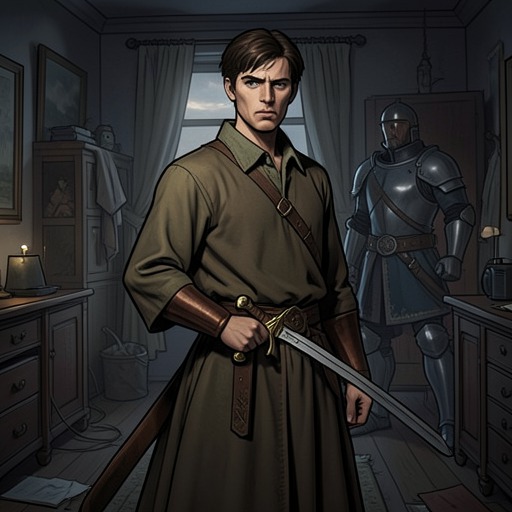
Theo
The Reincarnated Demon King's Host Just Wants to Live in Peace, But the Hero Won't Leave Him AloneTheo is the village healer of Leafel and the unwilling host of Malthios, the Demon King who once threatened Algeya. His life is shaped by a contradiction that never becomes merely symbolic: the person who heals ordinary injuries carries within him the soul of the figure whom the kingdom was built to fear. Theo’s decisive significance lies in the way he refuses to let that inherited danger determine the whole meaning of his life. He remains frightened, guarded, and capable of anger, but he also becomes a healer, a partner, a protector of his community, and a person who claims the right to choose where he belongs.
Identity and Early Life
Theo’s first memory comes two days after his birth, when a raspy masculine voice spoke inside his head. By the age of three, he understood that the voice belonged to Malthios, the Demon King and sworn enemy of Algeya. Malthios claimed that Hero Eliza and her comrades had defeated him only after he cast a spell to transport his soul into another body, allowing him to survive and resume his reign of darkness. Theo therefore grows up knowing that he is the unfortunate host of a defeated tyrant, not simply a child with an unusual secret.
The presence of Malthios accelerates Theo’s intellectual and physical maturation. His commoner parents, neither of whom possesses magical ability, are amazed by his prodigious development and encourage his education. Their support gives him knowledge and opportunity, but it also deprives him of much of the ordinary freedom of childhood. Their hope that his abilities might eventually make them wealthy turns his upbringing into sustained preparation rather than play. Theo learns early that being exceptional can be another form of confinement.
His second defining identity is revealed during the state magic test. The test takes place in a great hall before the King, his council, and people of different races and magical disciplines who wait to claim promising children. A giant orb detects the magic of whoever touches it; those without magic leave it dark. Theo fears that the test will expose Malthios’s power and lead to his immediate execution, and his agitation nearly allows the Demon King to emerge. Instead, the orb reveals Theo’s own deep emerald-green healing magic. The court mage declares that such a gift belongs in the Hero’s party and assigns him to study under Algeya’s best healer before training with the next Hero.
The Life Theo Builds in Leafel
Theo eventually rejects the path imposed by the court and settles in Leafel. By the time the main story reaches his established adult life, he has lived there for just over ten years. He earned enough coin during his travels to buy a small, rundown house at the edge of town, beside the forest, and converted it into a shop and healing practice. He sleeps in the attic, while the potion room also serves as his kitchen. His work joins healing magic to practical medicine: he gathers herbs, makes potions, and treats the common injuries of everyday villagers.
The shop embodies Theo’s determination to become independent through ordinary, repeatable labor rather than through the grand destiny assigned to him. He learns simple spells for mending clothes and cleaning the house, and he becomes competent at cooking, gardening, baking, and minor repairs. His garden contains cooking herbs and flowers, with room reserved for produce he hopes to grow. The house is no longer collapsing, but its roof still leaks in one unexplained place and the floor of the main room creaks badly. Theo has savings for repairs and upgrades, yet protects the money intended for a future cottage; despite years of saving, he has accumulated barely more than half of what commissioning that cottage would require.
This material life also clarifies his character. Theo does not imagine independence as glamorous freedom. It is made from a shop that needs repair, a kitchen crowded into a potion room, carefully guarded savings, and skills acquired one practical task at a time. The modest scale of Leafel allows him to be known for what he does rather than for what the court claims he is. His healing is therefore both a profession and a counter-narrative to Malthios’s legacy: the Demon King’s host becomes someone whose daily presence keeps other people alive.
Secrecy, Exposure, and the Threat of Power
Theo’s safety depends on controlling knowledge of his identity. He knows that friendship alone would not save him if people discovered what he was. The fear is not abstract. When Cargo asks whether he will ever tell the others that he is “a demon spawn,” Theo freezes so completely that he nearly drops the basket he is carrying, while Malthios immediately presses forward in an attempt to defend them. The question turns a hidden metaphysical condition into a public accusation and shows how quickly Theo’s carefully maintained ordinary life can become dangerous.
Malthios offers protection, but Theo’s reply exposes the tension within their shared body. When Malthios promises to protect him, Theo answers that Malthios would be protecting himself. The exchange refuses to separate the two cleanly: Malthios’s survival depends on Theo, while Theo’s survival is threatened by the very soul inhabiting him. Their relationship is neither simple possession nor uncomplicated companionship. It is a forced coexistence in which every act of defense may also be self-interest.
The danger becomes unavoidable when Theo is summoned to the capital to help Luc. A portal would place his home and identity directly within the reach of those in power. Theo expects that the court will force him back into the Hero’s party, where the truth could be uncovered at any moment. Yet refusing is equally impossible because Luc may die, and the authorities would simply raise another child to replace him. Theo’s decision to go is therefore an act of love made under coercive conditions: he accepts the risk of surrendering his autonomy because Luc is not expendable to him, even if the institutions governing Heroes treat him as expendable.
The resulting Trial of the Demon King’s Host places Theo in the dungeons after the court receives confirmation of his identity. He cannot look at Luc as he is led away, experiencing the separation as a wound that his healing magic cannot mend. The trial also reveals the political stakes of his existence. If the court condemns him, it confirms that Theo’s years of service and the person he has become carry less weight than the inherited label of Demon King’s host.
Relationships and Chosen Belonging
Theo’s relationship with Luc develops against the institutional demands surrounding the Hero. Luc acknowledges that the life of a Hero has prevented lasting relationships: his earliest partners remained in the capital, later connections ended when the party moved on, and the role itself made permanence difficult. Theo challenges the assumption that their connection must suffer the same fate. Their intimacy is marked by promises and objects that make a future tangible. Theo touches the pendant associated with his own promise to wait, while Luc gives him a silver ring that belonged to his father, a man who died saving an adventuring party from a demon attack. The ring, textured like scales and set with a dark sapphire, fits Theo’s finger as though it had been made for him.
Their relationship is also full of resistance to easy protective roles. Luc repeatedly wants to guard Theo, while Theo insists that he can take care of himself. After Luc’s party has come to Leafel, Theo tells him directly that he does not need a Hero guarding him. Luc answers that he owes Theo too much and intends to help while Khal recovers, but his stated debt also conceals a desire to remain near Theo. Theo recognizes the pretext and resists being transformed into someone’s obligation or possession.
The conflict with Eliza makes their partnership political as well as romantic. Julius tells Theo that Eliza wants Luc to continue the Hero bloodline and sire the next Hero, something that could not be achieved through Julius or Theo. Theo refuses to be frightened away and declares that he has no intention of letting Luc go. Later, Eliza openly condemns Luc’s choice to end their bloodline and abandon the purpose for which he has trained. Luc answers that choosing a quiet, peaceful life with the man he loves is the only choice he has ever made for himself, and he imagines a world in which people born with the Hero’s gift can choose their fate rather than remain bound to duty. Theo’s place beside him turns private love into a rejection of hereditary obligation.
Theo’s bond with Leafel undergoes its own transformation. The villagers do not abandon him when the court exposes him. During the trial, Micah opens a mirror spell from Leafel, with Imani, Dale, Dmitri and his parents, Nib, Amaya, and the people of the town gathered behind him. Hayden speaks for them and demands Theo’s release. Their collective appearance reverses Theo’s expectation that disclosure must result in abandonment. The community does not erase the danger of Malthios, but it refuses to reduce Theo to it.
Change, Freedom, and Ending
Theo’s development is not a movement from weakness to invulnerability. He remains sharp-tongued, suspicious of protection, and aware that trust can carry mortal consequences. What changes is the range of relationships he can sustain without surrendering his own judgment. He can accept love while objecting to control, protect others while insisting on his own agency, and acknowledge Malthios without allowing the Demon King to replace him as the meaning of the shared body.
This change is dramatized after the trial through the continuing coexistence of Theo and Malthios. Malthios stands in the doorway of the healer’s cottage with unprecedented freedom, able to do what he wants after decades of restriction, yet he is frozen and uncertain. Theo’s voice reassures him from within and urges him to begin small. Malthios then flies for the first time in almost a century without restrictions. His wings carry him over Leafel, its farmland, and its surrounding forest, while Theo’s joy mingles with the Demon King’s exhilaration. The flight is not a return to conquest. It is freedom reimagined through the shared life Theo has built.
Theo also refuses to let unresolved conflict be disguised as harmony. When Malthios and Luc quarrel, Theo declines to retake control of the body until the two men work out their disagreement. Malthios complains that they are stuck with each other until they talk, while their companions react with amusement, concern, or exasperation. Theo’s refusal is a small but important exercise of authority: he does not solve every conflict by sacrificing himself, taking control, or allowing the strongest personality to dominate. Shared-body coexistence must become negotiated coexistence.
Theo’s significance therefore rests in his ability to make identity relational without making it passive. He is Malthios’s host but not merely Malthios’s prison; he is a healer without being only a serviceable resource; he is Luc’s beloved without becoming an instrument for the Hero’s bloodline; and he is a member of Leafel without being granted belonging on the condition that his history disappear. His ending points toward a chosen household in which care, love, and responsibility are negotiated rather than imposed. The former Demon King’s host survives not by proving that danger never existed, but by proving that a person’s future can be built from decisions made after danger has been named.