Theo Bladefoot
The Reincarnated Demon King's Host Just Wants to Live in Peace, But the Hero Won't Leave Him AloneTheo Bladefoot is the healer of Leafel and the human host of Malthios, the Demon King. He lives under the constant threat that discovery will erase every other part of his identity: friendship may not save him, affection may expose him, and the law may define him only by the power inside his body. His decisive act is therefore not merely surviving the revelation, but claiming a chosen name, a chosen home, and a chosen future while continuing to protect the people who would be endangered by his secret.
Identity and the Life He Chose
Theo is publicly associated with the title of healer, but his identity has been repeatedly misnamed and institutionally claimed by others. At court, Mage Syvia introduces him as “Healer Theo Seamsword,” the lost healer who disappeared during training for the Hero’s party thirteen years earlier. Theo rejects that name and the family history attached to it, identifying himself instead as “Theo Bladefoot, Healer of Leafel.” The correction is more than insolence before King Alexis: it affirms that the people who gave him away no longer determine who he is, while Imani and Dale’s acceptance has become part of the family story he chooses to carry.
His private life is structured around concealment. Theo understands that no amount of friendship would protect him if anyone discovered what he was, and this expectation makes every new attachment dangerous. Cargo eventually asks whether he will tell the others that he is “a demon spawn,” forcing the hidden identity into the space between suspicion and confession. Theo’s immediate physical freeze and Malthios’s attempt to take control show that the secret is not an abstract biographical detail; it is a threat capable of governing his body before he can answer for himself.
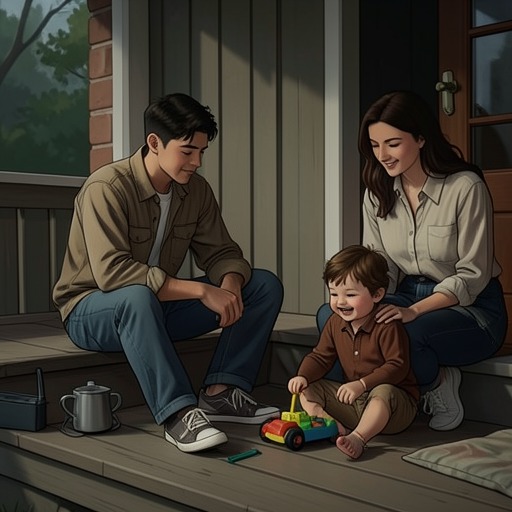
Yet Theo is not simply hiding from society. His life in Leafel gives him a practical identity grounded in work, care, and reciprocity. He gathers ingredients, makes potions, and uses healing magic as an everyday responsibility. Even when he must leave the forest covered in blood, he tries to emerge near the Leafel Watchtower so that the townspeople will not be alarmed. The instinct reveals the scale of his belonging: Leafel is no longer merely a refuge from Hero training, but a community whose fears and safety he actively manages.
Malthios and the Double Body
Theo’s relationship with Malthios makes his identity radically divided without making it simple. In the hidden ravine behind a waterfall, Theo deliberately loosens his control and calls Malthios by name. His eyes flood black, his pupils become red slits, ebony horns grow from his temples, dark red wings unfold, and a pointed tail emerges. Malthios’s mana fills him all at once, an experience Theo finds both exhilarating and terrifying. His reflection smiles without his command, and Malthios greets him through Theo’s tongue, making the mirror a visible image of their shared-body existence.
The coexistence is adversarial, protective, and intimate at once. When an unseen attacker strikes Theo in the forest, Malthios warns him to move before the thin blade pierces his shoulder just above the heart. Later, while Theo is held by Tyraz, Malthios urges him to take over, but Theo first demands to know where they are and how they can escape. Theo does not surrender responsibility simply because Malthios possesses greater demonic power; he remains the person directing the immediate attempt to survive.
Theo’s most important resistance is ethical rather than physical. He knows that his identity as Malthios’s host may make him a target, but he also refuses to reduce Malthios to a force that can be discarded. That refusal culminates when the court tries him for protecting Malthios. Theo’s life demonstrates that host and Demon King cannot be understood solely through the categories of vessel and threat: their bond is also a negotiated form of survival, in which Theo’s judgment, limits, and attachments shape what Malthios can do in the world.
Love, Exposure, and the Hero’s Future
Theo’s relationship with Luc develops against the pressure of the Hero’s prescribed life. Luc explains that his earlier lovers were difficult to keep because the fate of the Hero repeatedly separated him from ordinary relationships. Theo responds by questioning what could make their attempt different, recognizing that affection alone cannot cancel the institutional demands placed on Luc.
When Luc is preparing to leave, Theo tries to redefine their connection as friendship so that Luc will be free to find someone else. Luc does not argue openly. Instead, he raises the pendant Theo made for him to his lips and kisses it while holding Theo’s hand, then promises, “Wait for me, Theo. I swear I’ll come back to you.” The gesture turns an object made by Theo into a pledge carried into separation. Theo later returns that promise, saying that he had marked Luc first and would wait no matter how long it took.
Their relationship also confronts the reproductive and dynastic demands attached to the Hero’s status. Julius warns Theo that Eliza wants Luc to continue their bloodline and sire the next Hero, something that could not be achieved with either of Luc’s male former partners. Theo refuses to be frightened away and declares that he has no intention of letting Luc go. The conflict is therefore not only romantic rivalry. It pits a chosen partnership and a shared domestic future against a system that treats Luc as a biological resource whose intimate life must serve the production of the next Hero.
Luc answers that system publicly after Theo’s identity is revealed. When Eliza accuses him of ending their bloodline and abandoning everything for which he trained, Luc calls his choice the only one he has ever made for himself: to live a quiet, peaceful life with the man he loves. Theo’s significance within that declaration is crucial. He is not the distraction Eliza fears or the criminal category the court prefers. He is the person through whom Luc imagines a world where those born with the Hero’s gift can choose their fate rather than remain bound to duty.
From Attack to Judgment
Theo’s healing is repeatedly presented as active courage rather than passive benevolence. After Tyraz captures him, Theo uses a knife in a single motion, twisting and throwing it at the Demon Lord’s throat. Tyraz’s reflexes turn the attack into a shoulder wound, but the strike creates the opening Theo needs to run through the black-stone corridors of the Demon Fortress. His response to captivity combines magic, improvisation, and the willingness to kill when escape requires it.
The same healer who fights to escape becomes Luc’s rescuer. After Luc is gravely wounded, Theo kneels beside him and applies his magic to a wound that is fatal in placement and complicated by demon magic. He takes time to repair it completely, determined not to be the reason Luc bears another scar. When Luc opens his eyes, Theo’s tears express the cost of healing more clearly than any title: his power can restore the body, but it cannot prevent the emotional damage caused by betrayal, imprisonment, or the fear of losing someone irreplaceable.
Theo’s practical knowledge also unsettles the Hero’s party. To brew a potion from fresh nettles, he slices his wrist and lets his own blood fall into the boiling water. His blood is especially effective because of his healing magic, but the sight horrifies most of the group. The episode makes his body both instrument and evidence: the same unusual condition that enables extraordinary healing also exposes how far his methods stand outside the party’s assumptions about respectable magic.
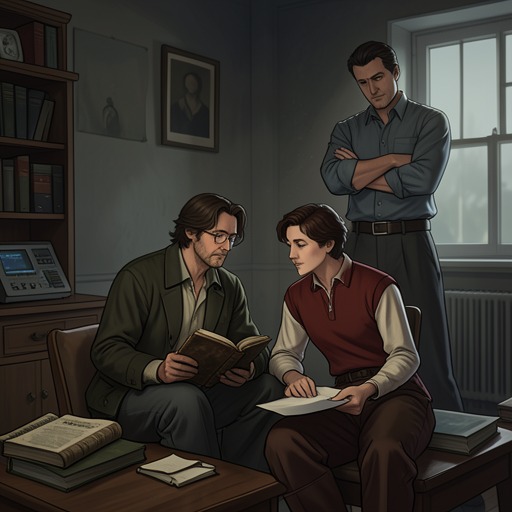
Once the magic-dampening handcuffs are placed on him, the court summons him through a portal orb. The trial is presented as a loss of autonomy before it begins. Theo knows that the authorities will learn who he is and where he lives, that Camden may recognize him, and that they may force him back into the Hero’s party with the truth liable to surface at any moment. He nevertheless goes because Luc may die, and because the institutions around Luc would simply raise another child to replace him. Theo’s choice is made under coercion but not without agency: Luc is expendable to the system, but not to Theo.
Leafel, Recognition, and the Ending
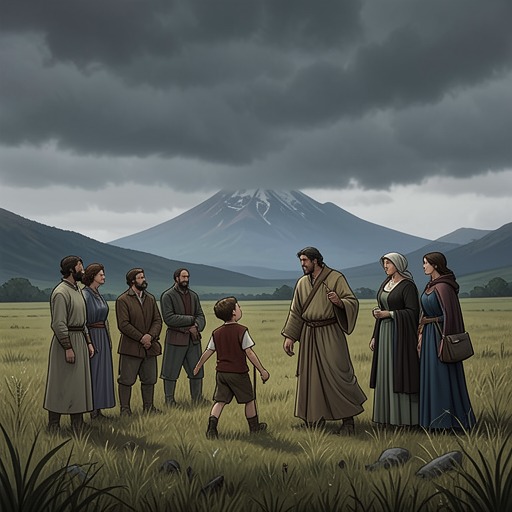
The trial reaches beyond the capital when Micah opens a mirror spell showing the people of Leafel gathered in their town square. Imani, Dale, Dmitri and his parents, Nib, Amaya, and the wider community stand behind Micah, while Hayden bows before the King and demands Theo’s release on their behalf. Their intervention overturns Theo’s expectation that disclosure would make him hateful or abandoned. The community does not erase the danger of his connection to Malthios, but it refuses to let that danger become the whole truth of Theo’s life.
Luc then gives Theo a public defense that reinterprets the host bond. He states that Theo is Malthios’s prison and that Luc is his humble guard, promising not to let Theo out of his sight. The formulation acknowledges the danger without surrendering Theo to it. Luc’s role is not to replace Theo’s judgment or make the court’s decision for him; it is to stand beside the man who contains the Demon King and to make continued shared life an act of responsibility.
Theo’s confrontation with Eliza marks the final break from the Heroic duty system. Eliza frames Luc’s choice as the destruction of a bloodline and the waste of a lifetime of training. Luc answers that a Hero should be able to choose his own fate, and Theo adds that Luc is a better Hero than Eliza. The exchange reverses the court’s moral hierarchy: obedience is no longer treated as the only proof of heroism, while love, protection, and refusal of inherited obligation become heroic forms of action.
The judgment confirms the reversal. King Alexis sentences Malthios to life in prison but frees Theo Bladefoot of all charges. The distinction preserves the seriousness of the Demon King’s threat while recognizing that Theo’s actions cannot be collapsed into Malthios’s identity. Cheers rise through the mirror spell as Luc and Theo wave to Leafel, and Luc expects them to arrive home before spring if the roads are clear. Theo’s ending is therefore a return, but not a return to the role he fled. He comes back as the healer of Leafel, the acknowledged partner of Luc, the protected and protecting member of a chosen community, and a person whose name and future have finally been claimed as his own.