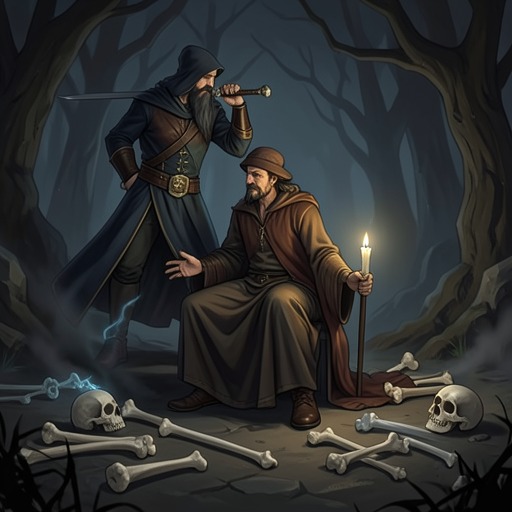
Theo Bladefoot–Wicker
The Reincarnated Demon King's Host Just Wants to Live in Peace, But the Hero Won't Leave Him AloneTheo Bladefoot–Wicker is a life-and-death magical friendship between Theo Bladefoot, the healer of Leafel, and Wicker, a halfling necromancer. Its decisive significance lies in the way their opposed disciplines become complementary rather than hostile: Theo’s magic sustains and repairs life, while Wicker’s magic addresses death and the restless dead. Together, they discover that healing and necromancy can meet in an ethical practice of release, allowing the dead to be understood, comforted, and finally freed rather than merely destroyed.
Formation Through Complementary Magic
Theo’s connection with Wicker develops rapidly during the ghost-touch crisis. Wicker explains that Theo’s healing magic can be applied to ghosts emotionally, easing the mental wounds at the source of their haunting rather than treating a physical body. Theo has never heard of healing being used in this way, but the possibility accords with his knowledge that powerful healers can soothe nightmares and bad memories. The idea also gives their relationship a precise magical structure: Wicker works through death, Theo through life, and the two arts become “two sides of a coin.”
That complementarity is more intimate than simple professional usefulness. Theo recognizes that the bond is deeper than the friendship he has with Nib, even though he has known Wicker for a much shorter time. The difference is not based on duration or ordinary companionship, but on the way their abilities answer one another at the boundary between life and death. Wicker’s necromancy does not make them, in Theo’s eyes, morally alien. Instead, it gives them access to suffering that Theo’s healing can help resolve.
Wicker’s acceptance also reaches beyond magic. Theo carries the hidden burden of hosting the soul of Malthios, the Demon King, and privately understands that this secret could alter how others see him. Yet he believes Wicker would not look at him differently if the truth were discovered. That expectation marks the relationship as one of unusual safety: Theo does not merely trust Wicker’s skill, but anticipates that Wicker can distinguish a person from the dangerous power contained within him.
The Nested Ghost Investigation
The friendship is tested when the party reaches a town surrounded by temporary fencing at dusk. The windows are dark, Wicker senses many ghosts nearby, and Veiv connects the haunting to the season. The investigation leads Theo, Wicker, and their companions to a moss-covered abandoned well whose wooden winch and cover have rotted away. From its intact stone shaft come distant calls and screams, establishing the well as a physical source for the supernatural disturbance and as a sealed space of accumulated suffering.
Theo’s role requires direct contact. When he places his palm on the stone, pain drives him to his knees, and he is overwhelmed by emotions and memories that are not his own: a sunny day in the woods giving way to fear, darkness, repeated pleas for help, hunger, thirst, and despair when the trapped victims understand that no one is coming. The encounter shows why Theo and Wicker need one another. Theo can receive and emotionally reach the haunting, but the experience is nearly incapacitating; Wicker understands the undead threat and knows that the nested corpse must be destroyed before the individual ghost can be released.
Wicker therefore proposes a shared method: destroy the nest first, then use Wicker’s necromancy and Theo’s healing together to put the suffering soul to rest. Theo’s exhaustion does not cancel his willingness to continue, and Luc’s concern for his ability to fight only emphasizes the danger of the work. The pair’s trust is practical as well as emotional. Theo relies on the others to protect him while he approaches the source, and Wicker relies on Theo to do what ordinary violence cannot accomplish.
Trust in the Haunted Glen
The confrontation takes place in a glen where the nested corpse is already pacing. Wicker expects the ghost to focus on Theo, so the party adapts its formation around that vulnerability. Wicker throws an oil-filled lantern at the creature, ignites a torch marked with fire-spell runes, and attacks while Theo raises his green magic. The nested beast flinches from Theo’s power, giving Wicker the opening needed to strike. Their abilities operate in sequence: Theo draws and weakens the supernatural presence, while Wicker delivers the physical and necromantic assault.
The attack is brutal but purposeful. The oil catches on the creature’s rotten flesh and fur, and the fire consumes it until barely a skeleton remains. Once the corpse collapses, the orange fire and Theo’s green magic are joined by a silvery glow. The figure of a boy appears above the blackened remains, clearer than before, with tears visible on his cheeks. His plea to go home transforms the encounter from monster-killing into rescue. Theo crouches with his arms outstretched and tells the child that he can help and take him home.
Theo then collapses the abandoned well itself. Stones crack and fall inward, and he draws the surrounding earth into the opening until only a bare mound remains. He does not know the child’s name and cannot leave a marker, but he offers a prayer to Arriss for the soul’s peace. Wicker’s work has destroyed the nest; Theo’s work has received the ghost’s pain and guided the remaining spirit toward release. The resolution depends on their distinct contributions and confirms the emotional logic of their friendship.
Mutual Recognition and Shared Future
After the well is buried, Theo says he never wants to see another nested ghost. Wicker answers not by minimizing the horror, but by identifying the success within it: they made a good team. Wicker imagines that in another life their work might be exactly this, pairing a necromancer with a healer. Theo accepts the possibility, adding that such a partnership would certainly attract attention. The exchange turns a traumatic mission into a shared vocational image, suggesting that their connection is not accidental or limited to one emergency.
Cargo’s complaint that he has been forgotten briefly interrupts the intimacy, and Wicker includes him by wishing he were part of the partnership too while recognizing that Cargo would be Veiv’s familiar in every life. The moment places Theo and Wicker’s bond within the wider party rather than isolating it from the group. Their closeness is distinctive, but it does not require the exclusion of companions.
Their partnership also continues into ordinary life. After the party returns to Leafel and spring arrives, Theo and Wicker take turns foraging and tending the garden, with Micah and Dmitri helping. The work contrasts with the abandoned well: instead of confronting ghosts in a sealed, dangerous space, they cultivate living growth in the village. Wicker has also taken Micah under their wing and is preparing the paperwork to request the young cat mage as an apprentice, while Theo continues training Micah and Dmitri in healing magic. Wicker’s place in Leafel therefore expands from an alarming newcomer to a working member of the community, and Theo participates in that integration.
Meaning of the Bond
Theo Bladefoot–Wicker is defined by the refusal to divide life and death into simple moral opposites. Theo does not treat Wicker’s necromancy as proof of corruption, and Wicker does not treat Theo’s healing as a complete answer to every form of suffering. The nested ghost episodes make the limitation of each discipline visible: Theo can touch the emotional wound but is endangered by it, while Wicker can destroy the enclosing undead structure but needs Theo to reach the victim within.
The friendship consequently joins courage to vulnerability. Theo must expose himself to memories that are not his own, while Wicker must fight in the exact space where Theo is being overwhelmed. Their confidence is not abstract admiration; it is demonstrated through coordinated action, protection, and the willingness to let the other’s power determine the method of survival. Even Theo’s hidden connection to Malthios becomes part of the bond’s larger implication: both characters are capable of seeing beyond frightening appearances and judging the person who remains within them.
By spring, the relationship has acquired a domestic and communal counterpart. The same two people who once worked beside a screaming well now share seasonal labor, care for the garden, and help establish the next generation of magical training. Their friendship thus survives the supernatural crisis not by remaining frozen in exceptional danger, but by becoming part of Leafel’s everyday life. It represents a chosen alliance between healer and necromancer, life and death, private trust and public service.