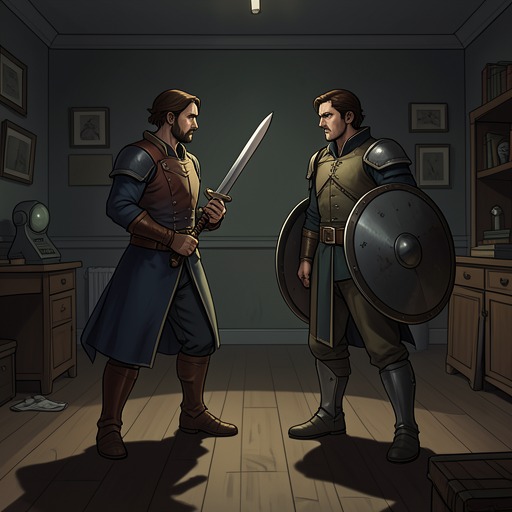
Theo Duels Eliza
The Reincarnated Demon King's Host Just Wants to Live in Peace, But the Hero Won't Leave Him AloneTheo Duels Eliza is the decisive confrontation between Theo and Hero Eliza in which the private choice of Theo and Luc becomes a public test of freedom, identity, and moral control. Eliza challenges Theo to defeat her without transforming into Malthios, making the duel’s true stake larger than survival: Theo must prove that the presence of the former Demon King does not determine his nature, while Luc’s right to choose a peaceful life with the man he loves is placed under the authority of the Heroic duty system.
Causes and Background
The duel grows directly out of the conflict over Luc’s future. Eliza believes that Luc must continue the Hero bloodline and sire the next Hero, a future she considers more important than his personal wishes. Julius reveals that Eliza had previously threatened to take everything from him if he stayed with Luc or joined the Hero’s party, because she wanted Luc free of distractions and directed toward producing an heir. Her demand therefore treats Luc not as a person entitled to choose his relationships, but as a vessel for hereditary duty.
Luc rejects that arrangement openly. When Eliza asks whether he is willing to end their bloodline and discard everything he has trained his whole life for, he answers that choosing a quiet and peaceful life with Theo is the only choice he has ever made for himself. He extends that personal decision into a wider principle, imagining a world in which those born with the Hero’s gift can choose their own fate rather than remain bound to duty. Theo’s defense of Luc intensifies the confrontation: he calls Luc a better Hero than Eliza, provoking her into abandoning restraint.
The challenge is also shaped by Eliza’s earlier history with Malthios. She insists that no one can change a demon’s nature, especially not in the short time Theo has shared his body with Malthios. Her accusation reduces Theo to the threat inside him and assumes that the former Demon King’s violence will eventually break through. Theo’s answer is not an argument about abstract innocence. He accepts the duel and the danger it carries, because losing would mean death for both him and Malthios and would leave Luc’s choice defeated by the same system Theo is resisting.
Terms and Participants
Eliza establishes the condition herself: Theo may win only if he avoids transforming at any point. If Malthios takes control, she declares that she will kill Theo where he stands. The rule makes transformation both a tactical advantage and a moral failure. Theo possesses access to Malthios’s memories and power, but victory requires him to remain responsible for his own body and actions rather than surrendering the fight to the identity feared by everyone watching.
The confrontation takes place before the court, with King Alexis present and mirror magic carrying the scene to Leafel. Luc stands close to Theo and shields him when Eliza lunges, while Khal, Veiv, and Wicker later witness the result through the mirror spell. The political audience matters because Eliza is not merely attacking a private rival. She is attempting to enforce the Hero’s inherited order in front of the people whose judgment will determine whether Luc’s sentence and Theo’s place in the world can stand.
Eliza enters the duel with the Hero’s sword, whose red blade catches the light. Theo fights with the kris. Their weapons embody opposing forms of authority: Eliza’s sword is the established instrument of the Hero, while Theo’s smaller blade accompanies a healer who is being forced to prove that compassion does not make him powerless. The terms also protect Luc from being forced back into the life Eliza has prescribed. If Theo defeats her without transforming, the sentence against him can remain in effect rather than being replaced by execution.
Course of the Duel
Eliza begins with overwhelming speed. The brightening of her magic gives Theo only a moment’s warning before she disappears from his sight and strikes. He dodges the first attack, leaving a crater in the floor, then leans back and uses the kris to block the Hero’s sword. Eliza presses him without allowing any breathing room, her body glowing almost as brightly as Luc’s. When the blade cuts Theo’s arm, the wound burns with the same force he experienced when he previously handled the Hero’s sword during the bandit conflict.
Theo answers the injury with healing magic. Green power rises through him and closes the wound, giving him temporary relief while Eliza attacks again. The exchange establishes the duel’s central rhythm: Eliza converts Hero magic into relentless offense, while Theo survives by combining speed, agility, and healing. His magic can repair damage, but it cannot erase exhaustion. His body is already depleted from earlier fights and from the abuse and confinement endured in Tyraz’s dungeon, and every evasive movement costs him strength.
Malthios’s memories of fighting Eliza help Theo understand the scale of the danger but do not make the battle easy. The former Demon King’s recollection carries an apparently final judgment that they will never win. Theo nonetheless keeps fighting because the condition leaves no alternative. He must remain himself, withstand Eliza’s attacks, and preserve both his own life and Malthios’s without transforming. The shared-body bond turns the duel into a crisis experienced by two consciousnesses at once: Malthios’s fear is not distant commentary but a panic that echoes Theo’s own.
A change appears in Eliza’s performance. While Theo relies increasingly on dodging and puts distance between them, he notices that her light flickers for an instant. He recognizes that she is no longer the Hero who fought Malthios in the past. She is older and weaker, and her mana is tied more closely to her life force. Theo’s position is also different from Malthios’s former one: unlike the Demon King, he is fighting for something immediate and personal. His connection to Luc gives him a reason to endure that Eliza, pursuing duty for its own sake, no longer possesses in the same form.
The duel becomes a contest between two kinds of depletion. Theo’s magic continues to heal superficial wounds, but his muscles ache, his lungs burn, and sweat gathers at the back of his neck. Eliza’s power can produce devastating attacks, yet each use draws more heavily on the life that sustains it. Theo taunts her by suggesting that she is angry because she has failed, striking at the shame beneath her certainty. Eliza responds by treating the fight as an obligation rather than a choice, saying that it is her duty as a Hero and warning that healing has limits.
Eliza then escalates. Her mana spikes as she launches another strike, and Theo initially raises the kris to block. Malthios recognizes the danger and urgently warns Theo to dodge. Theo leaps aside at the last moment and throws the kris with all his strength. Eliza’s sword cuts through the space where he had stood, but the kris reaches her heart. She staggers, drops the Hero’s sword, and collapses onto the grey stone floor as dark blood spreads beneath her.
Mercy, Proof, and Immediate Consequences
Theo does not treat Eliza’s fall as permission to abandon his healer’s duty. He kicks the Hero’s sword out of reach, kneels beside her, and places both hands over the fatal wound. Eliza tries to refuse him, saying that she will not live in shame, but Theo rejects her attempt to decide the outcome of her own injury. For him, healing is an obligation independent of allegiance, judgment, or personal history. He pulls the kris from her heart while keeping his other hand over the wound, then concentrates on repairing the damage.
The healing takes several minutes because the wound has pierced Eliza’s heart. Her resistance gives way to confusion when Theo’s magic succeeds, and her skin closes as the light fades. The reversal is decisive: the woman who declared that she would kill Theo if Malthios emerged is defeated by the very healer she dismissed, yet remains alive because that healer refuses to let victory become execution. Theo’s final instruction is practical rather than triumphant: he tells Eliza to have a blood-replenishing potion administered.
The court’s response confirms the public consequence of the duel. The throne room remains silent immediately after Eliza is healed, but cheers then erupt from the mirror spell connecting the court to Leafel and from Khal, Veiv, and Wicker. Some members of the court and leaders of Algeya nod in approval, while others stand in shock or awe. Theo’s victory therefore changes more than the immediate sentence. It supplies visible evidence that he can confront Eliza without transforming, survive the former Hero’s assault, and still act as a healer toward the person who sought his death.
Reversal of Heroic Authority
The duel turns Eliza’s own standard against her. She presents herself as the guardian of hereditary Heroic duty, defending the bloodline and claiming that Theo’s demon nature cannot be changed. Yet her attack is driven by a prescribed future for Luc, while Theo’s conduct makes room for choice, care, and continued life. Eliza enters the confrontation believing that authority gives her the right to define Luc’s purpose and Theo’s identity; she leaves defeated, wounded, and dependent on the mercy of the person she had reduced to a threat.
Theo’s refusal to transform is the crucial moral and political proof. Malthios remains present throughout the fight, sharing Theo’s danger and panic, but Theo does not allow the former Demon King to take control. The result distinguishes possession from destiny: Malthios’s existence inside Theo creates an extraordinary risk, but it does not dictate Theo’s action. By winning through his own speed, kris, and healing magic, Theo demonstrates that identity can be maintained through choices made under pressure rather than settled by ancestry, reputation, or the nature attributed to an inner companion.
Luc’s position is transformed alongside Theo’s. He had been treated as the next link in a bloodline, with intimacy and partnership characterized as distractions. During the confrontation, however, Luc stands beside Theo and physically shields him when Eliza attacks. Theo’s success protects the possibility Luc had claimed: a quiet life with the man he loves instead of a future imposed by the Heroic system. The cheers from Leafel make that private choice collective, allowing the community to witness a different model of Heroic conduct.
The Duel’s Narrative Significance
Theo Duels Eliza combines rivalry, forbidden love, sacrifice, and recognition in a single public ordeal. Its outer action is a sword fight, but its deeper conflict concerns who may determine a person’s future. Eliza fights for an inherited institution and for the continuation of a Heroic bloodline; Theo fights for survival, for Malthios’s continued coexistence within him, and for Luc’s right to choose a life outside that institution. The duel’s value shift moves from imposed duty toward self-determined responsibility, while death is brought close enough to make mercy an active decision rather than a sentimental reward.
The confrontation also revises the meaning of strength. Eliza’s Hero magic is spectacular but costly, increasingly bound to her aging body and life force. Theo’s power is less absolute: he is exhausted, wounded, and forced to rely on movement rather than domination. His advantage finally lies not in overwhelming Eliza but in endurance, judgment, and the capacity to heal even after striking a fatal blow. The scene’s climax therefore refuses the simple equation of victory with destruction. Theo defeats the former Hero precisely when he chooses not to become an executioner.
The aftermath leaves Eliza alive but ideologically defeated. Her claim that Theo cannot change a demon’s nature is answered by a concrete sequence of actions: Theo resists transformation, overcomes her attack, and restores the life he could have allowed to end. Luc’s sentence can stand under the condition Eliza herself imposed, yet the meaning of that condition has changed. What begins as a threat designed to expose Theo as Malthios ends as public testimony that Theo is neither merely a demon’s vessel nor merely a healer obeying orders. He is a person capable of choosing, fighting, and extending mercy on his own terms.