Two souls in one body
The Reincarnated Demon King's Host Just Wants to Live in Peace, But the Hero Won't Leave Him AloneTwo souls in one body is the defining supernatural and psychological condition of Theo and Malthios. It places a human healer and the former Demon King within one physical form, making identity, bodily autonomy, secrecy, and responsibility inseparable. The condition is feared as a possible death sentence by the surrounding human authorities, yet it also becomes the means through which Theo and Malthios protect one another and revise the meaning of demonhood.
Definition and Hidden Identity
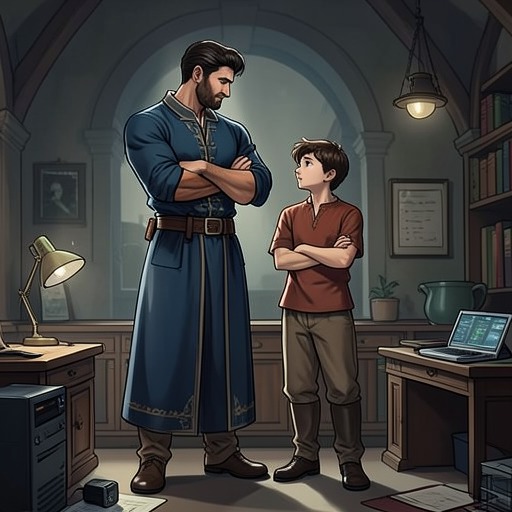
Two souls in one body does not make Theo and Malthios a single personality. Theo explicitly describes them as two separate souls sharing one body, with only one of them in control at a time. Their arrangement therefore creates a divided but continuous subject: the body is shared, while memory, intention, and moral accountability remain contested between its inhabitants. The distinction matters during the trial of the Demon King's Host, when Theo refuses both available public explanations. He neither denies the accusations against him nor accepts that he is simply Malthios; instead, he states that the two souls are separate even though they occupy one body.
For Theo, the shared body is also a concealed identity. He knows that friendship alone cannot save him if others discover what he is, because the truth could transform a healer and companion into a political threat. Cargo's direct question about whether Theo will tell the others that he is demon spawn turns this private fear into an immediate physical crisis: Theo freezes, nearly drops the basket in his hands, and Malthios moves at once in an attempt to defend them. The body's involuntary response exposes how the secret is experienced before it can be explained. Theo's fear is not merely an idea about discovery; it is something that seizes the body they both inhabit.
Control, Dependence, and Bodily Autonomy
The arrangement gives each soul power over the body, but not equal freedom from the other. When Malthios takes control, the transformation is visible and physically forceful. Horns grow from Theo's temples, wings emerge from the shoulders, and one clawed hand can seize an opponent by the throat. During the confrontation with Nissle, Malthios moves their body without hesitation, slams her into the ground, and speaks through their shared mouth with the authority of the Demon King. The scene makes the body a battlefield and a throne at once: Theo remains present within it, while Malthios's return is announced through the body's altered shape and overwhelming power.
Yet control is never simply a matter of one soul overpowering the other. When Tyraz captures Theo, Malthios struggles harder than ever to take over, driven by fear and a fierce desire to protect him. Theo feels that fear as if it were his own, but refuses to surrender control because he has spent his life afraid of discovery and cannot bear to lose command of the only thing still his. The conflict reveals the central paradox of the shared body: Malthios can offer strength and protection, but accepting that protection may also mean relinquishing bodily autonomy. Theo's resistance is therefore neither simple distrust nor ingratitude; it is an attempt to preserve a selfhood that has always been vulnerable to being defined by someone else.
Malthios's voice can nevertheless function as an anchor when Theo's consciousness is threatened. After Theo is exhausted by ghostly memories, Malthios repeatedly recites his title and name to return him to his own awareness. Later, when Tyraz's shadows surround Theo and Luc cannot reach him, Malthios tells Theo that he is still there and has him. These interventions do not erase the division between the souls. Instead, they show intimacy operating across it: Malthios stabilizes Theo without replacing him, and shared embodiment becomes a channel for reassurance as well as danger.
Power, Transformation, and Public Revelation
The most dramatic manifestation of Two souls in one body occurs when Theo is pushed beyond ordinary human limits. Malthios first releases the Demon King's power through their body against Nissle. During the later battle, the power surges again, this time producing horns, wings, and black claws and blasting Tyraz backward. The transformation is no longer a secret internal condition. It becomes a public revelation witnessed by Luc and the surrounding courtyard, confirming that Malthios, the King of all demons, has returned within Theo.
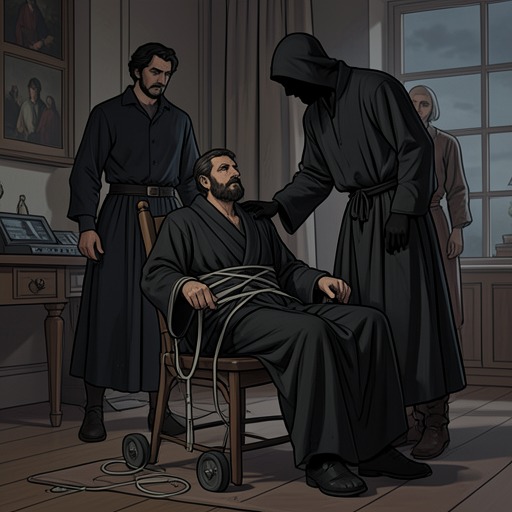
This revelation changes the political meaning of the body. Before it, Theo can attempt to live as a healer while concealing the presence of the Demon King. After it, the authorities treat the shared body as evidence of an existential threat. Theo is taken to the capital through a portal and placed under guard; the court mage orders him sent to the dungeons, and the trial is framed around whether protecting Malthios makes Theo guilty. The magic-dampening handcuffs and the rapid transfer through the portal emphasize that the state responds to the body as an object to contain rather than as a person containing two voices.
Theo's journey to the capital also shows that the shared condition is entangled with choice even before the public trial. He understands that entering the portal will end his autonomy, expose where he lives, and make it possible for the authorities to force him into the Hero's party, where the truth might be discovered. He goes because Luc may die if he refuses. The decision demonstrates that the shared body does not reduce Theo to Malthios's destiny: Theo continues to make costly choices according to his bonds with other people, even when those choices bring the hidden soul closer to exposure.
Mutual Protection and Moral Responsibility
The relationship between the souls is defined most clearly by protection. When Luc questions why Malthios intervened during the attack, Malthios distinguishes their actions carefully. Theo saved Luc by using his body as a shield, while Malthios supplied the mana and stepped in because he was protecting Theo. The answer rejects the assumption that every act of power belongs to the Demon King alone. Theo's compassion and Malthios's strength are separate contributions within one action, and the body's survival depends on both.
Malthios's protective role does not absolve him of his past or make the shared body morally uncomplicated. He remains the former Demon King, and his return carries the memory of violence, political fear, and the destruction associated with his rule. At the same time, Theo's presence alters what Malthios can do and what he wants. After returning to power, Malthios declares an intention to end demonkind's organized order so that Algeya can know peace and children will no longer be made to lose themselves as heroes. Theo's presence is part of the moral pressure behind this decision: their bound souls allow Malthios to feel Theo's grief, and memories of Kamil, Aym, Foras, and Torq remind him of the friends whose loss he will carry and honor.
The shared body therefore creates responsibility without producing a simple fusion of guilt. Theo can be endangered because of Malthios, while Malthios can act through Theo; neither can remain untouched by the other's consequences. The condition forces the story to ask whether a person should be judged solely by the identity housed inside the body, by the actions performed through it, or by the choices made by each soul. Theo's testimony insists on distinction, while the plot repeatedly demonstrates interdependence.
Trial, Recognition, and Significance
At the trial, Two souls in one body becomes a legal and communal question rather than only a private secret. The Hero's party gives conflicting accounts of Theo's conduct: Wicker, Veiv, and Khal emphasize the help he gave them and the fact that Malthios harmed none of them when released, while Avery and Emi interpret his behavior as suspicious or deliberately obstructive. Luc recalls that Theo threw himself over him to defend him from Tyraz's blade before transforming. These testimonies expose the inadequacy of a single label. The same body has been read as healer, companion, suspected traitor, Demon King's host, and protector.
The court's attempt to condemn Theo is interrupted when Micah opens a mirror spell from Leafel. Imani, Dale, Dmitri and his parents, Nib, Amaya, Hayden, and the people of Leafel appear to demand Theo's release. Their intervention supplies a counterweight to the capital's abstract judgment: the people who know Theo through repeated acts of care do not treat the shared body as proof that he is irredeemable. The contrast separates institutional fear from lived relationship and shows that identity is also produced by the community willing to recognize it.
Malthios's later testimony completes the conceptual movement from concealment to acknowledgment. He admits that there is no way to remove him from Theo's body, adding that he would have proposed such a solution when he realized Theo returned Luc's feelings if one had existed. The statement acknowledges both the permanence of the bond and Theo's emotional life as something Malthios has learned to respect. Two souls in one body thus ends not as a cure awaiting separation, but as an enduring shared-body state in which difference remains visible. The condition is dangerous, politically persecuted, and often frightening, yet it also makes possible a form of chosen solidarity: Theo is not reduced to Malthios, Malthios is not left without moral restraint, and each becomes the other's witness, safeguard, and inescapable companion.