We Bleed the Same
The Reincarnated Demon King's Host Just Wants to Live in Peace, But the Hero Won't Leave Him AloneWe Bleed the Same is both a chapter title and a motif that unsettles the boundaries between beings whom the story’s societies rank as enemies, resources, or outsiders. It first appears as a bitter observation amid a village’s destruction; elsewhere, the same recognition is expressed through mercy, rescue, mourning, and the ordinary work of making a home together.
The phrase and Malthios’s early worldview
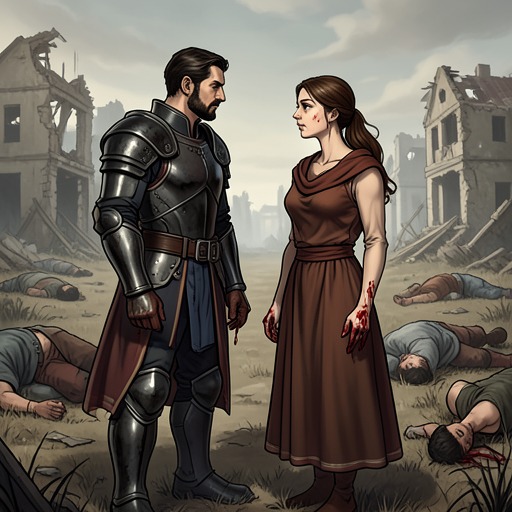
During Malthios’s attack on a village, houses burn, smoke fills the air, and mortals and animals scream as demons kill those who try to flee. The sight offers him only mild satisfaction. He regards mortals as a plague and their pleading irritates him, yet he notices that they and demons bleed the same color. The observation registers physical likeness without yet granting moral kinship: Malthios can recognize a shared body while still denying that mortal lives deserve regard.
That tension gives the phrase its force. Malthios measures existence by power and by a purpose he considers greater than mere survival, asking what value life has if it ends and is not valued. Against that abstraction, the village’s wounded and dying bodies make mortality concrete. Their blood resembles his own kind’s, but his recognition has not yet become compassion.
Mercy across a boundary
A smaller encounter in Leafel turns that contradiction into action. Theo receives a basket of produce from Raf as payment, including potatoes, broccoli, beets, carrots, peas, and blackberries. The food will keep him for a little over a week and save him from spending his coin. Theo privately judges the exchange worth it because it means sparing an “annoying spawn.” His language remains dismissive, but the practical result is mercy: the person he calls a spawn is allowed to live, and the basket that enables that choice becomes a modest sign of reciprocity between them.
The scale differs sharply from Malthios’s burning village, but the ethical movement is related. Neither scene begins with an easy declaration of fellowship. Instead, the story lets a shared need or vulnerability press against the categories characters use to keep others at a distance. In Leafel, survival is negotiated through food and payment rather than through a grand conversion.
Bodies, danger, and companionship
The idea also reaches beyond human and demon conflict. When the Hero’s party arrives in Leafel, Cargo, a talking hog, points out that the others always forget to introduce him. His complaint makes exclusion visible within a group that has gathered to meet Theo: even among companions, recognition is not automatic. The scene answers the horror of Malthios’s earlier vision with comic insistence that Cargo, too, belongs in the introductions.
During the fight with the dire wolves, vulnerability becomes immediate. Luc is pinned beneath the leader’s paw, his sword out of reach, while its jaws snap above him. Before Theo can reach him, a large hand grabs Theo by the hood. Luc breaks the wolf’s jaw with his bare hands, gets to his feet, and kills it with his sword. After the remaining wolves flee, Theo hurries to Luc; Luc tells him he is fine and cups his jaw. The rescue is not an argument about shared blood, but a bodily exchange of danger and care that makes the bond between them legible.
Grief and the meaning of home
The expression’s wider reach is visible in Leafel’s response to Glefald’s death. Rather than use the more usual funeral bonfire, the village honors Glefald’s wish to be buried in the earth beneath a planted tree, following an elven custom. His grave lies across the road from the Watchtower, where the tree may one day serve as another guardian of the entrance. Micah weeps beside the grave, Dmitri puts an arm around his shoulders, and the villagers take turns adding earth. The community makes room for a custom that is not its own and turns burial into a shared act of remembrance.
Glefald’s knitted work carries that care forward in a personal form: the party lays his knitwear out as mementos, and Isabelle gives Theo a scarf Glefald had made for him as a solstice gift. The gray-green wool matches Theo’s eyes. In the scene, what survives is not blood itself but the material traces of a life and the relationships that receive them.
When Theo and Luc return to Theo’s shop, the familiar rooms and the flock waiting in their crates ease the anxiety Theo has carried since leaving home. Micah has placed a heating charm over the birds; Theo greets them, then walks through the rooms while Luc follows with a sun crystal. Theo’s bedroom is now theirs. The return gives the motif a quiet culmination: shared vulnerability is no longer confined to a battlefield or a crisis, but belongs to the daily care through which a home is restored.