the Council
The Reincarnated Demon King's Host Just Wants to Live in Peace, But the Hero Won't Leave Him Alonethe Council is the governing body that helps administer Algeya’s united kingdoms and directs their response to the continuing demon threat. Although it appears as a collective authority beside the King, its decisions reach deeply into individual lives: it classifies children by magical usefulness, assigns them to state service, orders the detention of suspected threats, and presides over the legal crisis surrounding Theo Bladefoot. Its history in the narrative traces a movement from unquestioned wartime conscription toward a more limited, contested form of sovereignty.
Nature and Political Setting
the Council operates from the palace at the center of the capital, a compound divided by a courtyard between the royal residence and the institution where magic users and knights are trained. The latter supplies people who will serve the royals or join the Hero’s party, making education and military administration part of the same political structure. The Council’s power is therefore not confined to issuing laws after the fact; it helps produce the fighters, healers, and magical specialists on whom the kingdom’s security depends.
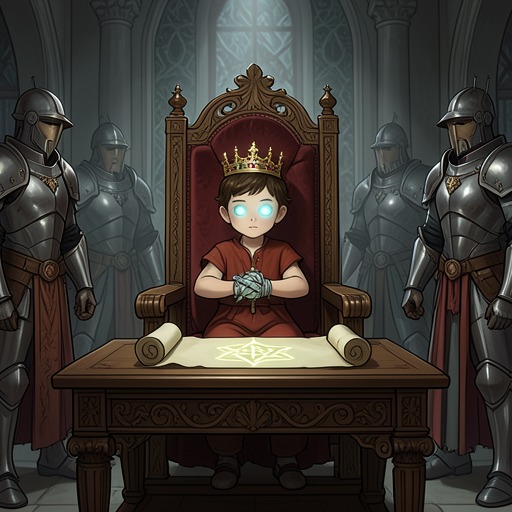
Its authority extends across the kingdoms of Algeya. In the throne room, rulers who are not physically present participate through magic mirror reflections, whose bright golden images allow the different governments to hold council without the exhausting and costly process of opening portals. This arrangement presents unity as a practical achievement, but it also gives the Council a highly visible system for gathering distant powers into one deliberative space. The room’s guards, the King, the court mage, and the glowing representatives of other rulers together embody a government organized around common defense against the remaining Demon Lords.
Regulation of Magic and Heroic Service
The Council’s involvement in Theo’s life begins with the magic test. In the great hall, the King and his council watch as children of different ranks and races wait to touch a central orb that reveals their magical abilities. Those without magic receive no display, while Theo’s healer’s gift shines deep emerald green brightly enough to blind everyone present. The Council does not treat this discovery as a private talent or a family matter. Before the gathered claimants can bid for him, the court mage declares that a gift of this magnitude belongs in the Hero’s party and orders that Theo be taught by Algeya’s greatest healer before entering training with the next Hero.
That decision converts a child into a national resource. Theo’s parents are left disappointed because the result will not benefit them, while Theo himself is taken away under guard to learn from the injured priest who once served in Eliza’s party. The Council’s language of public necessity obscures the coercion of the arrangement: his future is decided in a hall where children are effectively presented for allocation, and his exceptional healing becomes the reason he cannot choose his own path.
The same system later returns for Theo on the day he turns sixteen, when Camden tells him that guards will take him back to the capital to meet the new young Hero and the other companions. The intended plan is prolonged military preparation, followed by a shared obligation to purge the remaining demons and protect the common folk. Theo and Malthios evade that future by leaving before the guards arrive, traveling for two years and settling in a northern village. Their flight becomes the first major refusal of the Council’s claim over Theo’s body and labor.
Enforcement, Surveillance, and Conflict
The Council continues to treat Theo as a missing component of the Heroic system. When Mage Syvia apprehends him, she announces that she will inform the King and Council that the lost healer has been recovered. Theo answers with open hostility, accusing Syvia of kidnapping children and insisting that neither she nor the authorities will prevent him from seeing Luc. The exchange shows that the Council’s official vocabulary of recovery conceals a struggle over whether Theo is a person returning home or an asset being reclaimed.
After Theo’s identity as Malthios’s host becomes known, the Council’s enforcement becomes physical. Magic-Dampening Handcuffs are placed on him under orders from the court mage and Hero Eliza, and his companions are reminded that the authorities cannot be expected to let him go free. A scroll is used to communicate with the court mage, and a Portal Orb transports the party to the capital courtyard, where knights receive them and the court mage orders Theo taken to the dungeons. The speed of this response makes the state’s machinery unmistakable: communication, transportation, armed custody, and imprisonment are already arranged before Theo can meaningfully defend himself.
The Council also pressures the Hero’s party to subordinate personal loyalties to its mission. When members consider reporting the group’s resistance, Wicker points out that the King and Council still need experienced heroes, especially for a mission against the Demon King’s second, and that replacing them with novices would be reckless. Avery answers that the party swore an oath to put the mission first. Their disagreement exposes a central contradiction in the Council’s order: it demands emotional sacrifice from the party while relying on the very bonds of trust and affection that make the party effective.
The One-Year Decree
When the Council demands an audience with Theo, the summons places him once again under formal political scrutiny. King Alexis receives him in the throne room, where the Council’s representatives appear through magic mirrors and the court mage stands nearby. The King argues that Theo cannot simply abandon his duty because his healing gift is vital to the war, though he acknowledges Theo’s attachment to Luc and suggests that service to Luc might serve as an alternative justification.
At the same time, Alexis recognizes the cost of removing the only healer from a small village. Theo explains that he has begun training Micah, who can manage the potions and stores but has only a few weeks of experience using healing magic. Rather than demand permanent service, the King decrees that Theo must serve in the Hero’s party for one year, or until the party has dispatched the demons attempting to rally forces. The decision remains coercive, but it creates a temporal limit and preserves the possibility that Theo can return to Leafel. The Council’s wartime authority is thus moderated by the practical needs of the community it claims to protect.
Trial and Limitation of Authority
The Council’s most consequential appearance comes during the Trial of the Demon King’s Host. After Theo is brought to the capital and placed in the dungeons, Mage Syvia asks whether the court agrees that Healer Theo is guilty of protecting Malthios. The gathered authorities assent, treating association with the Demon King as sufficient grounds for condemnation. Their procedure turns the host bond into a legal identity and places Theo’s choices beneath the shadow of Malthios’s crimes.
The proceedings are interrupted when Micah opens a new mirror spell from Leafel. Behind him stand Imani, Dale, Dmitri and his parents, Nib, Amaya, Hayden, and the people of the village, who demand Theo’s release. Their appearance challenges the Council’s assumption that Theo is isolated or universally feared. Hayden argues that he raised Theo and that Theo should not be judged guilty for the position into which he was born, while also asserting that Theo has shown greater strength and kindness than the authorities condemning him. Leafel’s collective intervention supplies a rival source of legitimacy: not institutional classification, but the testimony of a community that knows Theo as its healer and neighbor.
King Alexis then imposes a decisive limit on the Council. He declares that the fate of Healer Theo belongs solely to Hero Luca, despite objections that Luc is biased because the two were lovers. The ruling does not erase the Council’s accusation, but it removes the final decision from the collective court and entrusts it to a person bound to Theo by affection, duty, and knowledge of the danger. This is an extraordinary exception within the heroic system: the authority to kill the Demon King’s host remains attached to the Hero, yet the timing and exercise of that authority are no longer controlled by the Council.
Judgment and Narrative Significance
Luc confirms that Malthios destroyed the Demon Fortress and the demons within it, leaving only lesser demons and demon-created monsters for competent adventurers to handle. He states that there is no longer any need for a Hero, weakening the institutional rationale that had justified the Council’s control over Theo and the party. Even so, Luc insists that the Hero’s duty is to kill the Demon King, then immediately qualifies that duty by declaring that he alone chooses when it will happen.
The final judgment rejects the Council’s demand for immediate execution. King Alexis announces that the trial of Demon King Malthios ends with a sentence of life imprisonment, while Theo Bladefoot is free of all charges. The decision separates the host from the entity within him and replaces collective punishment with constrained coexistence. It also reveals the Council’s limitation: despite its power to conscript, imprison, and condemn, it cannot finally determine Theo’s fate once the King recognizes Luc’s authority.
The Council therefore functions as both protector and machinery of control. Its institutions preserve cooperation against the Demons, train the Hero’s party, and coordinate the kingdoms through magic mirror governance. Yet the same structures classify a gifted child as state property and treat a healer’s refuge in Leafel as an abandonment of duty. Theo’s resistance, the village’s public solidarity, and Luc’s delayed decision expose the human cost of that order. By the end, the Council still governs, but its verdict has been forced to acknowledge that security, law, and heroic duty cannot completely displace personal consent, communal belonging, or the possibility of a second judgment.