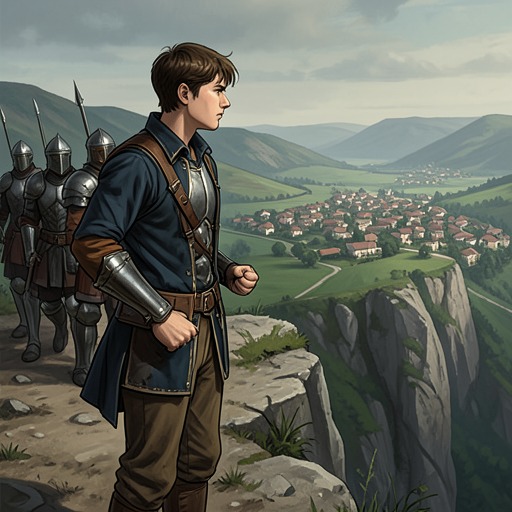
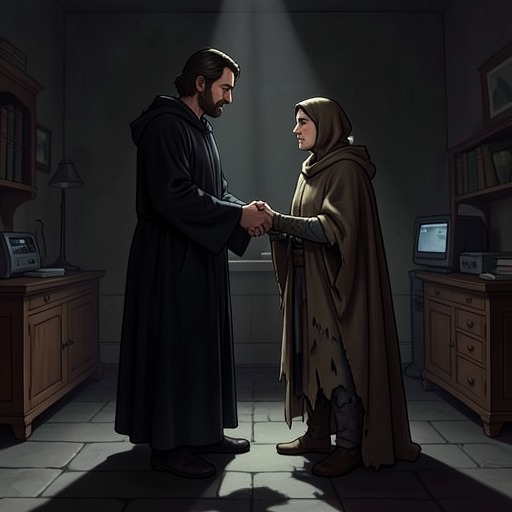
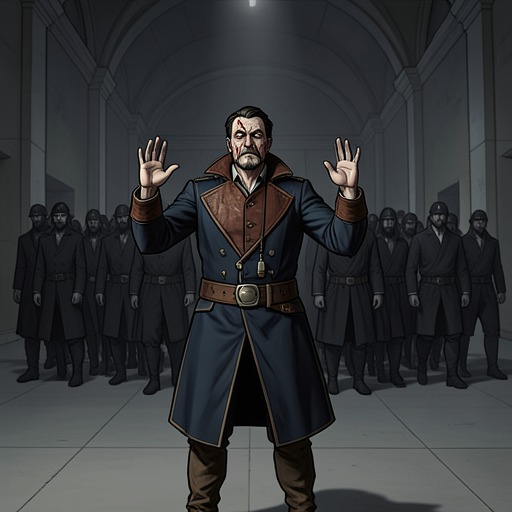
Event 1
Malthios’s Defeat by Eliza
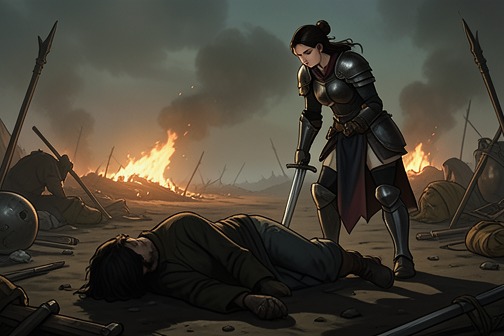
[Malthios’s Defeat by Eliza](entity:event-recall-event-malthios-s-defeat-by-el-0d68277c7a9e) is the decisive historical event that ends the [Demon King](entity:state-recall-state-demon-king-d4ce23d2b4c1)’s open conquest of [Algeya](entity:location-recall-location-algeya-1668b0a6fe56) while preserving the threat he represents in another form. [Eliza](entity:character-recall-character-eliza-6ec11b83dd18)’s victory establishes the [Hero](entity:concept-recall-concept-hero-c363661142b4)’s duty to destroy the Demon King, but [Malthios](entity:character-recall-character-malthios-3bbf03e4fa99)’s survival through soul transfer turns a completed war into a hidden, intimate struggle inside [Theo](entity:character-recall-character-theo-107bd6003b61), making the defeat both a public triumph and the origin of the book’s central crisis.
## Causes and Historical Setting
For centuries, Malthios had been the sworn enemy of the peoples of Algeya. He claimed that he would have conquered the land had a Hero named Eliza not been born; Eliza and her party defeated him before that ambition could be fulfilled. The victory was not merely a duel between exceptional individuals. It shaped the political order of Algeya, where humans, [Elves](entity:creature-recall-creature-elves-75820362b438), [Dwarves](entity:creature-recall-creature-dwarves-b2612857f726), [Orcs](entity:creature-recall-creature-orcs-cc33be96b3c1), and other peoples cooperated under joint laws because the common danger posed by the [Demons](entity:creature-recall-creature-demons-6600dcc7335a) had forced them into unity.
The defeat did not erase the military danger. Remnants of Malthios’s army remained scattered across the land under the command of the surviving [Demon Lords](entity:creature-recall-creature-demon-lords-faedb062c0d5), while the Hero’s party continued protecting ordinary people. The capital’s palace reflects this continuing arrangement: one half houses the King, his family, councils, and balls, while the other trains magic users and knights who may serve the crown or join the Hero’s party. Malthios’s defeat therefore ends one reign without ending the system of fear and defense created by his rule.
## The Defeat and Its Hidden Reversal
The public account says that Eliza defeated Malthios, but a rumor preserves the crucial uncertainty: before dying, Malthios supposedly cast a spell to transport his soul into another body so that he could survive and continue his reign of darkness. That rumor proves true. His chosen host is Theo, whose first memory comes two days after birth, when a raspy masculine voice addresses him as a little host and proposes that they achieve great things together.
Theo does not understand the voice immediately. It takes him until the age of three to recognize that it belongs to Malthios, the Demon King Eliza had defeated. The event thus produces a reversal more complicated than simple victory or defeat. Eliza wins the visible war, but Malthios converts death into concealment, carrying the defeated enemy across the boundary between Demon and human life. Theo’s body becomes both the surviving vessel of a conquered tyrant and the place where that tyrant’s power can be contained.
The transfer also changes the scale of the conflict. Malthios is no longer an external ruler commanding an army from a fortress; he is a voice inside a child, dependent upon the host whose life he has appropriated. Theo grows unusually quickly under the influence of the Demon King’s presence, while his commoner parents, neither of whom possesses magical ability, encourage his education. Their hopes that his prodigious abilities might make them wealthy help turn the aftermath of Malthios’s defeat into Theo’s lost childhood: the boy is pushed toward achievement instead of being allowed to live like the other children in his village.
## Power, Defeat, and the Demon Hierarchy
The event gains further significance from the structure of Demon society that produced Malthios. [Demonkin](entity:creature-recall-creature-demonkin-5aa641de4c0f) stand at the lowest level, possessing little or no mana and serving as common soldiers. Novices are Demonkin gifted with mana by a Demon Lord sponsor; they combine variable magical potential with great physical strength and are trained as combatants. Demon Lords ascend after massive slaughter of innocents, gaining immense mana and wings. The Demon King stands above them, and the transformation into that highest form works only when the Demon is worthy of the power.
Malthios’s defeat therefore interrupts the culmination of a brutal hierarchy rather than ending a conventional monarchy. His fall removes the only Demon King known to Algeya for many years, but the Demon Lords and their remnants preserve the logic of power through slaughter, sponsorship, and conquest. Later descriptions of Malthios’s early life reveal that he had been abandoned as a young child, survived by stealing food, and was eventually taken for [Novice](entity:state-recall-state-novice-f13adec542e6) training by the Demon Lord [Fulton](entity:character-recall-character-fulton-237e141b857f). The scars of that upbringing and the society’s preference for magical strength over blood or parental care complicate the image of the defeated enemy without undoing the danger he caused.
## Consequences for Theo and Algeya
Theo’s existence becomes the concealed consequence of Eliza’s victory. The capital is overwhelming to him, but it affects Malthios differently: crossing its walls causes the Demon King to vibrate with rage because he is physically present in the place he once wished to destroy while unable to unleash destruction upon it. During Theo’s magic test, the threat of discovery becomes immediate. The test is conducted before the King and his council in a great hall where an orb reveals each child’s magical ability; Theo fears that it will expose the Demon King’s magic and lead to his execution. His own magic appears instead, allowing the secret to remain hidden.
That concealment lasts through Theo’s life as the healer of [Leafel](entity:location-recall-location-leafel-ce079facdeeb). The small town knows him for his extraordinary healing and celebrates him alongside its talented swordsman, but it does not know that the healer carries the defeated Demon King. Theo’s practical life is built from ordinary acts that sharply contrast with Malthios’s imperial ambition: he accepts a basket of potatoes, broccoli, beets, carrots, peas, and blackberries as payment for healing a farmer, saving his coin for more than a week while privately judging the arrangement worth enduring for an annoying demon spawn.
The old defeat eventually returns as a legal and political crisis. When Theo’s identity as Malthios’s host is confirmed, he is taken through a portal to the capital and placed on trial as the [Demon King’s Host](entity:state-recall-state-demon-king-s-host-76fd1b21021f). The court initially treats the revelation as grounds for imprisonment, and Theo cannot look at [Luca](entity:character-recall-character-luca-aa8721da92cd) as he is led away. Yet the people of Leafel refuse to abandon him. Through a mirror spell, [Micah](entity:character-recall-character-micah-b7a8af6bb3f9) shows the court a crowd from the town, including [Imani](entity:character-recall-character-imani-3e59d6c7b288), [Dale](entity:character-recall-character-dale-fff2558efe87), [Dmitri](entity:character-recall-character-dmitri-f7165ee439b9) and his parents, [Nib](entity:character-recall-character-nib-c57b21ba9a3c), [Amaya](entity:character-recall-character-amaya-3164488322dd), [Hayden](entity:character-recall-character-hayden-3887fcc3a0d9), and the people of Leafel, who demand Theo’s release.
The trial exposes the difference between historical identity and present action. Luca asks whether Malthios destroyed the demons and the fortress, and Malthios answers that he did, adding that only lesser Demons and demon-created monsters may remain and that there is no longer any need for a Hero. Luca then declares that, as the Hero, it is his duty to kill the Demon King, but insists that he can choose when that will happen. The verdict refuses both unexamined execution and complete denial of responsibility: [King Alexis](entity:character-recall-character-king-alexis-965b76b67eae) concludes the trial of Demon King Malthios with a sentence of life imprisonment, while Healer [Theo Bladefoot](entity:character-recall-character-theo-bladefoot-4a02f215e1d3) is found free of all charges.
## Lasting Significance
The defeat by Eliza is remembered as a completed heroic victory, but the book reveals its incompleteness through [Malthios’s reincarnation](entity:state-recall-state-malthios-s-reincarnatio-bb9947436042). Its central value shift runs from apparent finality to renewed uncertainty, then toward a more difficult form of justice. Eliza’s sword ends Malthios’s public reign; it cannot prevent his soul from becoming a hidden presence in Theo, and it cannot decide whether the host should be treated as the Demon King, his victim, or both.
The event also establishes the contrast between inherited heroic duty and chosen responsibility. Eliza’s victory creates the expectation that every Hero must kill the Demon King, while Luca later accepts that duty without surrendering judgment about when or how it should be fulfilled. The people of Leafel provide the opposing model: instead of defining Theo solely by Malthios’s past, they recognize the healer who has served them and stand publicly beside him.
By the time Theo returns to Leafel with Luca, the consequences of the ancient defeat have been transformed rather than erased. Theo comes home expecting that he might never see his shop again, but finds its familiar scents, his flock cared for, and his rooms prepared for a shared life with Luca. Malthios’s defeat by Eliza therefore remains the origin of the danger, the source of the Hero’s obligation, and the historical wound that the present generation must reinterpret through coexistence, accountability, and the possibility that a defeated enemy can no longer be separated cleanly from the person forced to carry him.
Event 2
Malthios’s Reincarnation into Theo
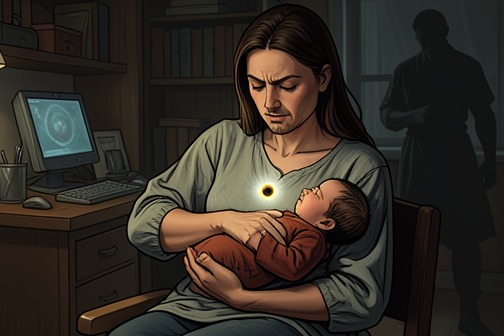
[Malthios’s Reincarnation into Theo](entity:event-recall-event-malthios-s-reincarnatio-8fd36786e588) is the event that creates the novel’s central double identity: the [Demon King](entity:state-recall-state-demon-king-d4ce23d2b4c1) survives his defeat by transferring his soul into an infant, while [Theo](entity:character-recall-character-theo-107bd6003b61) grows up carrying an enemy whom the world believes must be destroyed. The reincarnation is not merely a supernatural escape from death. It produces a shared existence in which Theo’s body, choices, relationships, and future are permanently entangled with [Malthios](entity:character-recall-character-malthios-3bbf03e4fa99)’s unfinished ambition.
## The Soul-Transfer and the Infant Host
Theo’s first memory comes two days after his birth, when a raspy masculine voice speaks inside his head and greets him as a host. He does not initially understand whose voice it is. By the age of three, however, he realizes that the presence is Malthios, the sworn enemy of the people of [Algeya](entity:location-recall-location-algeya-1668b0a6fe56), who had ruled as the Demon King and had been defeated by the [Hero](entity:concept-recall-concept-hero-c363661142b4) [Eliza](entity:character-recall-character-eliza-6ec11b83dd18) and her companions.
Malthios had reportedly cast a spell before dying, transporting his soul into another body so that he could survive and resume his reign of darkness. Theo is that unintended vessel. The event therefore divides Theo’s life from its beginning: he is an ordinary child by birth, yet he is also the hiding place of the most feared figure in the country’s history. The reincarnation creates a threat that is invisible from outside but active within Theo’s consciousness.
## Childhood Under a Hidden Enemy
The presence of Malthios accelerates Theo’s development. His parents are commoners without magical ability, but they are educated and encourage his studies, impressed by the speed with which he grows and matures. Their hopes that his prodigious abilities might make the family wealthy also deprive him of much of an ordinary childhood. His unusual intelligence is thus shaped by two pressures at once: parental ambition from outside and Malthios’s influence from within.
Malthios attempts to begin Theo’s education in evil when Theo is only two, once the child can walk, speak fully, and start learning to read and write. That plan encounters an obstacle: Theo is not an empty body waiting to be reclaimed. His own mind and will develop alongside the reincarnated soul. The resulting conflict is not an immediate possession but a prolonged struggle over whether Malthios can eventually take control of the body and return to the throne of demonkind.
## The Pact and the Burden of Secrecy
After Theo’s magic test, he and Malthios make an agreement. Malthios will stop trying to take over Theo’s mind and body, while Theo will permit him occasional control after completing his training, provided Malthios does nothing against Theo’s wishes. The arrangement is conditional, hidden, and designed around distance from the capital and from the Heroes, where the truth might be discovered. Theo later begins calling the Demon King “Mal,” a name that marks the presence of a personal relationship emerging from an originally hostile possession.
The pact gives Theo a limited form of autonomy, but it does not make the danger disappear. He knows that friendship cannot save him if anyone learns what he is, and when Cargo later asks whether he will tell the others that he is “a demon spawn,” Theo’s body freezes while Mal immediately presses forward in an attempt to defend them. The secret is therefore both psychological and physical: disclosure threatens execution, while fear itself can bring Malthios closer to control.
Theo’s concealment also shapes his choices. When [Bryony](entity:character-recall-character-bryony-77c7475dde0d) brings him through a portal to help the gravely endangered [Luc](entity:character-recall-character-luc-b00cd62cc765), Theo understands that returning to the capital may end his independence. The authorities will know who he is and where he lives, and they may force him into the Hero’s party, where his identity could be exposed. He goes because Luc might die if he refuses. The reincarnation thus turns rescue into self-endangerment: Theo acts out of attachment while knowingly entering the political space most capable of destroying him.
## Recognition, Trial, and Public Exposure
The hidden reincarnation eventually becomes the basis of a public prosecution. The event is formalized in the Trial of the [Demon King’s Host](entity:state-recall-state-demon-king-s-host-76fd1b21021f), after Theo is placed in magic-dampening handcuffs and transported through a portal orb to the capital. He is taken to the dungeons, then brought before a crowded throne room where the court, mirror spells, Eliza, and the Hero’s party witness the proceedings. A magical mirror broadcasts the trial to towns, villages, and cities throughout Algeya, transforming Theo’s private secret into a spectacle of public judgment.
The court announces that Healer [Theo Bladefoot](entity:character-recall-character-theo-bladefoot-4a02f215e1d3) has been revealed as the host of the reincarnated Demon King, Malthios. The accusation collapses the distinction between host and inhabitant: Theo is treated as responsible for protecting the Demon King, even though his life began after Malthios’s defeat and his choices have repeatedly opposed Malthios’s ambitions. The reincarnation has become a legal identity imposed upon him, and the state’s response is to reduce a complicated shared life to a single category of enemy.
That judgment is challenged by [Leafel](entity:location-recall-location-leafel-ce079facdeeb). Through a newly opened mirror portal, [Micah](entity:character-recall-character-micah-b7a8af6bb3f9) casts a spell from the village square while [Imani](entity:character-recall-character-imani-3e59d6c7b288), [Dale](entity:character-recall-character-dale-fff2558efe87), [Dmitri](entity:character-recall-character-dmitri-f7165ee439b9) and his parents, [Nib](entity:character-recall-character-nib-c57b21ba9a3c), [Amaya](entity:character-recall-character-amaya-3164488322dd), [Hayden](entity:character-recall-character-hayden-3887fcc3a0d9), and the people of Leafel gather behind him. Hayden demands Theo’s release on behalf of the village. Their intervention reveals that the host identity has not erased the person Leafel knows: the community distinguishes Theo’s acts, care, and belonging from the inherited identity that the court uses against him.
## Malthios’s Legacy and the Question of Choice
The reincarnation begins as Malthios’s attempt to defeat death and reclaim power, but its consequences move beyond his original design. Theo’s resistance prevents the soul-transfer from becoming a simple restoration of the old Demon King. Over time, Malthios becomes a constrained presence whose conduct is negotiated through Theo’s consent, even as the possibility of bodily takeover remains a source of fear. The shared body makes identity relational rather than singular: neither soul can treat the body as entirely private, yet neither is identical with the political label imposed by outsiders.
The later confrontation makes the event’s central contradiction explicit. Malthios states that he destroyed the [Demon Fortress](entity:location-recall-location-demon-fortress-e361fb201537) and those within it, leaving only some lesser demons and demon-created monsters at large, and concludes that there is no longer any need for a Hero. When Luc asks what should happen, Malthios asks to be called Mal, the name given by his friends and used by Theo, and asks Luc to make a good choice. Theo then regains control while Luc declares that, as the Hero, it is his duty to kill the Demon King, but also insists that he can choose when that will happen.
That decision does not erase the danger of [Malthios’s reincarnation](entity:state-recall-state-malthios-s-reincarnatio-bb9947436042), nor does it make the original soul-transfer harmless. It does, however, refuse the assumption that reincarnation determines destiny. Malthios enters Theo as a would-be conqueror and hidden enemy; the continuing story forces both souls and the surrounding community to confront whether an inherited identity can be separated from present action. The event’s decisive significance lies in that reversal: the Demon King survives inside his intended host, but the life that follows gives the host, his companions, and eventually Malthios himself reasons to choose something other than the old reign of darkness.
Event 3
Theo’s Magic Test
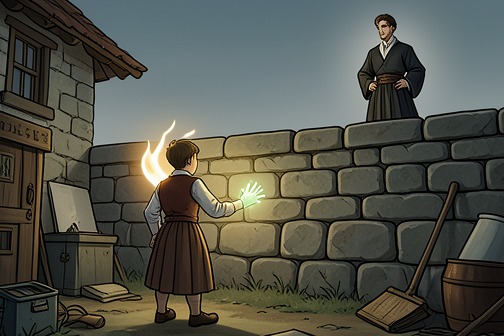
[Theo’s Magic Test](entity:event-recall-event-theo-s-magic-test-e8e06745500f) is the childhood examination that exposes [Theo](entity:character-recall-character-theo-107bd6003b61)’s healing gift and determines the course of his early life. What appears to be an ordinary opportunity for advancement becomes an act of institutional selection: the capital identifies Theo as an exceptional resource, claims him for the [Hero](entity:concept-recall-concept-hero-c363661142b4)’s party, and sends him toward training while remaining unaware that the child also carries the [Demon King](entity:state-recall-state-demon-king-d4ce23d2b4c1) [Malthios](entity:character-recall-character-malthios-3bbf03e4fa99) within his body.## Causes and Background
When Theo was eight, his parents brought him from their small village to the capital of [Rizaah](entity:location-recall-location-rizaah-360dd11565a7), the human-governed kingdom’s center, for a standard magic examination. The family did not even know whether Theo possessed magical ability. His parents hoped that a successful result might earn him sponsorship to an academy or an apprenticeship in a well-paid craft, so the journey began as a practical attempt to secure him a better future rather than as a military summons.
The capital immediately made the test feel less like a private assessment than an encounter with state power. Theo had grown up among forests and farms, with humans as the dominant presence and only occasional contact with other peoples. The capital’s walls, tall buildings, crowds, and mixed races overwhelmed him, and he felt enclosed rather than welcomed. Its palace joined the royal residence and council chambers to the institutions where magic users and knights were trained for royal service or for the Hero’s party. The setting therefore connected Theo’s personal ability to [Algeya](entity:location-recall-location-algeya-1668b0a6fe56)’s wider political order: the kingdoms of the mortal races cooperated because the continuing threat of the [Demons](entity:creature-recall-creature-demons-6600dcc7335a) had made unity necessary, and the Hero’s party remained responsible for defending ordinary people against the remnants of Malthios’s army and the surviving [Demon Lords](entity:creature-recall-creature-demon-lords-faedb062c0d5).
The examination also carried a hidden and far more immediate danger. Theo was already Malthios’s host, and Malthios’s magic felt terrifyingly powerful while also seeming natural because it existed within Theo himself. Theo feared that the test might expose the Demon King’s presence and lead to his execution on the spot. His agitation nearly allowed Malthios to emerge. Behind the public hope of finding a useful talent stood a private struggle over concealment, control, and survival: Theo knew that no amount of friendship would protect him if anyone discovered what he was, and Malthios’s own threats and rages had already made their shared existence violent and inescapable.
## The Examination and Revelation
The test took place in a great hall under the eyes of the King and his council. Children of different social ranks and races waited together while people representing various magical disciplines gathered to claim the most promising candidates. The arrangement made the process resemble an auction, reducing children to the value of the abilities they might contribute. At the center stood a huge orb that sensed a person’s magic through touch. Those without magic left it dark; those with gifts caused it to reveal the nature of their power.
Theo approached the orb in terror, expecting it to expose Malthios rather than reveal anything of his own. Instead, the test confirmed that he possessed an independent magical gift. The orb erupted in a deep emerald-green glow so intense that it blinded everyone present before fading. The result was not a minor or obscure talent. Theo was a healer, and the brilliance of the display immediately caused the people in the hall to compete for him.
The competition ended when an elf in the robes of the court mage spoke over the others. She declared, “My apologies,” before asserting, “But, a person with a gift like this belongs in the Hero’s party. He will be sent to learn from the best healer in Algeya, then enter training with the next Hero when they are of age.” Her decision converted Theo’s success into compulsory placement. The test did not give Theo a choice among schools, crafts, or patrons; it assigned his body and talent to the Heroic institution.
Theo’s parents could do nothing to alter the decision. They stood by disappointed because the result would not benefit them in the way they had hoped. The following day, the court mage and guards escorted Theo to a nearby town, where he was to study under the priest who had served in [Eliza](entity:character-recall-character-eliza-6ec11b83dd18)’s party. The healer had been badly injured in the final battle and had lost the use of both legs. Malthios privately took credit for that injury, reminding Theo that he had dropped a pillar on the healer and adding that he always targeted the healer first. Theo’s new vocation was therefore tied from its first formal appointment to the violence of the war against Malthios.
## Consequences for [Theo and Malthios](entity:relation-recall-relation-theo-and-malthios-24da48fb7937)
The magic test confirmed a division that would govern Theo’s life: he possessed healing magic of his own, but he also housed the Demon King’s power. Malthios’s presence did not disappear when Theo’s independent gift was recognized. Instead, the result gave Theo a public identity that could conceal the private one. He could be known as a healer while remaining vulnerable to discovery as the Demon King’s host.
The event also established the limits of Malthios’s authority. Theo did not reject Malthios’s suggestions because he believed himself morally superior; he simply saw no reason to obey and hated being ordered around. His disobedience repeatedly frustrated the Demon King. Malthios responded with fits that left Theo bedridden with splitting headaches, threats to destroy everything Theo cared about, and insults intended to make him feel worthless and grateful for having been chosen. Yet these tactics changed nothing. Malthios was a prisoner in Theo’s mind and body, while Theo could not have a thought or feeling without Malthios sharing access to it. The test thus became an early demonstration of their mutual imprisonment: the institution claimed Theo from outside, while Malthios contested him from within.
The hostility nevertheless concealed a binding dependence. When Theo asked why Malthios did not simply kill him and move to another host, Malthios explained that transferring himself required a spell that had taken more than a human lifetime to prepare and cast. Even if Theo consented, the process would take years, and Theo’s death would also kill Malthios. The Demon King warned him not to do anything foolish, prompting Theo to mock him for caring and Malthios to reject the familiar name “Mal.” Their exchange reveals that the test did not place a powerful master inside a disposable vessel; it joined two lives whose survival had become inseparable.
## The Hidden Cost of Selection
The capital’s decision gave Theo status as a healer but stripped him of control over the form that status would take. His gift was treated as evidence that he belonged to the Hero’s party, and his future was mapped toward instruction by the greatest healer in Algeya and eventual training with the next Hero. The test therefore began a pattern in which extraordinary ability becomes a reason for others to claim a person rather than a means of granting that person freedom.
That pattern later makes Theo’s fear of disclosure intelligible. Cargo eventually asks whether Theo will tell the others that he is “a demon spawn,” and Theo’s body freezes as Malthios immediately presses toward taking control. When the Hero’s party later comes to retrieve Theo through a portal, he understands that entering the capital will end his autonomy: those in power will know who he is and where he lives, and the court could force him back into the Hero’s party where the truth might be uncovered. The magic test is the origin of that danger. It was the first moment when an institution saw Theo clearly enough to assign him a role, but not clearly enough to recognize the person and secret beneath it.
The consequences extend into Theo’s relationships as well. His identity as a healer is what brings him into contact with [Luc](entity:character-recall-character-luc-b00cd62cc765) and the Hero’s party, while the secrecy imposed by his second identity continually threatens those bonds. Luc later speaks of the fate of the Hero as a life marked by temporary relationships because duty keeps carrying him onward, yet his connection with Theo develops against that prescribed future. Luc gives Theo his father’s silver ring, a textured band with a dark sapphire, and places it on Theo’s marriage finger. The gesture contrasts with the magic test’s institutional claim: the capital assigns Theo to a public destiny, while Luc’s ring marks a chosen bond.
## Narrative Significance
As a plot event, Theo’s Magic Test combines revelation, selection, and entrapment. It reveals that Theo is genuinely gifted rather than merely a vessel for Malthios, but the same revelation makes him valuable to the Heroic system. His emerald healing magic saves him from the immediate fear that the orb will expose the Demon King, while simultaneously directing him toward the people and structures most capable of destroying him if the secret is discovered.
The event also foreshadows the later conflict between imposed duty and chosen life. The court mage’s decision treats Theo’s gift as belonging to the Hero’s party; much later, Luc rejects the demand that he continue the Heroic bloodline and says that he has chosen a quiet, peaceful life with the man he loves. The contrast is central to the story’s moral movement. Theo’s test begins with a child being selected because of what his magic can do for the kingdom. Its long aftermath asks whether a person marked as useful by war, prophecy, or inherited duty can reclaim the right to decide whom that power serves.
The most consequential irony is that the test both conceals and exposes Theo. It conceals Malthios by giving the child a legitimate, independent magical identity. It exposes Theo to the institutions that will later imprison and judge him. When [Leafel](entity:location-recall-location-leafel-ce079facdeeb)’s people finally intervene in his trial and demand his release, their solidarity overturns the capital’s earlier assumption that Theo is primarily a public asset. The child once chosen in a hall where candidates were treated like livestock is ultimately defended as a person whose community, relationships, and chosen future matter more than the role assigned to his magic.
Event 4
Theo’s Escape from Hero Training
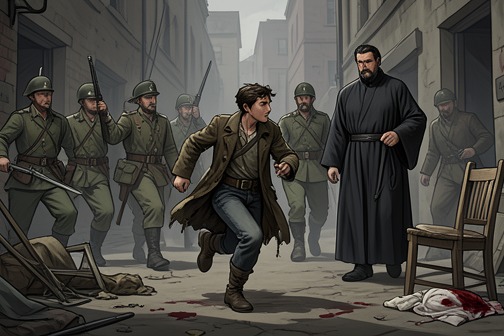
[Theo’s Escape from Hero Training](entity:event-recall-event-theo-s-escape-from-hero-da11c4ca814a) is the turning point at which [Theo](entity:character-recall-character-theo-107bd6003b61) refuses to become part of [Algeya](entity:location-recall-location-algeya-1668b0a6fe56)’s inherited heroic machinery. On the day he reaches legal adulthood, he is expected to return to the capital, meet the new [Hero](entity:concept-recall-concept-hero-c363661142b4), train beside him, and eventually accept responsibility for purging [Demons](entity:creature-recall-creature-demons-6600dcc7335a) and protecting ordinary people. Instead, Theo leaves without a note, travels north with [Malthios](entity:character-recall-character-malthios-3bbf03e4fa99) for two years, and begins the hidden life that will lead him to [Leafel](entity:location-recall-location-leafel-ce079facdeeb). His escape is not a rejection of danger, but a refusal to let institutions decide what his life, body, and future must be used for.
## Causes and Background
Theo’s flight grows out of the impossible condition of being the [Demon King](entity:state-recall-state-demon-king-d4ce23d2b4c1)’s host. Malthios’s magic feels terrifying yet instinctively familiar because it is part of Theo, but the bond also makes both of them prisoners. Theo can neither think nor feel without Malthios knowing it, while Malthios cannot simply abandon the body: the spell that brought him into Theo took more than a human lifetime to prepare, and Theo’s death would kill him as well. Malthios responds to Theo’s disobedience with threats, insults, and fits of rage severe enough to leave Theo bedridden with splitting headaches, yet intimidation never produces obedience. Theo follows his own refusal rather than a higher moral ideal; he hates being ordered around and sees no reason to carry out Malthios’s destructive suggestions.
Their eventual bargain creates the immediate foundation for the escape. Malthios agrees to stop trying to seize Theo’s mind and body, while Theo permits him occasional control on the condition that he do nothing against Theo’s wishes. The arrangement is explicitly postponed until Theo completes his training and gets far from the capital and both past and present Heroes. Escape therefore becomes a negotiated form of coexistence: Theo does not free himself by eliminating Malthios, and Malthios does not secure freedom through domination.
The pressure to remain hidden is intensified by Theo’s knowledge that his identity could destroy him. He believes that no amount of friendship would save him if anyone discovered what he was. Even when Malthios claims he would protect Theo, Theo answers that Malthios would really be protecting himself. This suspicion reveals the emotional logic of the flight: trust is dangerous because every attachment can become a vulnerability, while the public heroic system would treat the host of the Demon King as an enemy to be exposed and destroyed.
## The Obligation Theo Refuses
By the time Theo is fourteen, rumors circulate that a new Hero has been found and trained to replace [Eliza](entity:character-recall-character-eliza-6ec11b83dd18). Hero magic consumes its wielder’s body with extraordinary speed; recorded Heroes rarely survive beyond their twenties, and Eliza is already showing the cost of her battle with Malthios. The search for a successor is thus both political succession and bodily replacement. Theo understands that the new Hero will not simply be another young person: he will be the center of a system demanding training, demon purging, public protection, and eventually the continuation of the heroic line.
[Camden](entity:character-recall-character-camden-901e9f21b9e7) speaks warmly of the Hero’s party and promises that Theo will one day experience its bonds of friendship. Theo already knows that this future is unavailable to him under the terms of his pact with Malthios. His private plan directly contradicts Camden’s vision: instead of joining the new Hero’s companions, Theo will finish his preparation, disappear from the capital’s reach, and avoid both the institutional role and the relationships attached to it.
On Theo’s sixteenth birthday, Camden tells him that the time has come. Guards will collect him the next morning and take him to the capital, where he will meet the young Hero and the other companions. They are to train together until the Hero reaches adulthood, after which the duty of cleansing the remaining Demons and defending common people will pass to them. The timetable makes the coercion plain. Theo is not being invited to discover a vocation; he is being transferred into a predetermined succession, with his adulthood marking the moment at which the state can claim his labor.
## The Journey North
That night, Theo packs his bag with his few belongings and enough food for the road. He leaves no note for Camden because he does not know what explanation could contain the truth. The absence of a farewell is itself part of the escape: Theo cannot make a public argument for his departure without exposing the identity that makes departure necessary.
[Theo and Malthios](entity:relation-recall-relation-theo-and-malthios-24da48fb7937) travel for two years, taking odd jobs from people they meet along the way and deliberately avoiding attention. Their route carries them farther and farther north, away from the capital and from the Heroes who might recognize the danger of Theo’s condition. The journey is practical rather than triumphant. They do not cross the country as celebrated adventurers; they survive by becoming unremarkable, using temporary work and distance as protection.
At last they find a small, peaceful village that seems beyond the reach of both Demons and Heroes. Theo believes he has found the obscurity he sought, though the brief confidence is undercut by the immediate recognition that he may be wrong. The village becomes the beginning of his life as [Theo Bladefoot](entity:character-recall-character-theo-bladefoot-4a02f215e1d3), Healer of Leafel, but the escape never completely removes the threat it was designed to evade. His later fear of discovery, including Cargo’s blunt question about whether he will tell the others that he is demon spawn, shows that the danger has been displaced rather than erased.
## Consequences and Reversal
The escape gives Theo years in which to develop a self outside the Hero’s training structure. He becomes a fast learner and a healer stronger than Camden because he can draw on Malthios’s mana, while deliberately restraining his ability so that no one becomes suspicious. He also studies with Malthios, whose long life and travels across Algeya give him extensive knowledge, and learns hand-to-hand combat and knife work from Sasin. These skills complicate the meaning of flight: Theo is not abandoning competence or responsibility, but choosing what kind of competence to cultivate and for whom it will be used.
His hidden life eventually brings him into contact with [Luca](entity:character-recall-character-luca-aa8721da92cd) and the Hero’s party, making the future he once believed impossible appear in another form. Luca’s history exposes the personal cost of the heroic role: his early lovers remained in the capital, another relationship ended when he was required to leave, and shorter relationships could not survive the Hero’s itinerant fate. Later, Hero Eliza attempts to control Luca’s future more directly, wanting him to continue their bloodline and sire the next Hero. Theo’s escape therefore stands in contrast to the reproductive and dynastic future demanded of Luca. What Theo fled as a child becomes the same system from which Luca must eventually break free.
The reversal is especially clear when Luca recognizes that bringing Theo back means dragging him into the control he once escaped. Theo nevertheless chooses to return rather than let Luca die, accepting that the decision may expose him. The act does not cancel the original escape; it proves that Theo’s later choices belong to him. He can refuse imposed duty and still accept a freely chosen obligation to the person he loves.
## Narrative Significance
The event begins as a classic escape plot but overturns the expected heroic journey. Theo passes beyond the threshold not to claim a public destiny, but to refuse one. His northward movement is an anti-initiation: distance from the capital allows him to become a healer, combatant, partner, and friend before the world can reduce him to a host or a recruit.
That refusal ultimately reshapes the meaning of heroism. When Eliza asks whether Luca will sacrifice the Hero bloodline and everything he trained for, Luca calls his decision to live peacefully with Theo the only choice he has ever made for himself and imagines a world in which those born with the Hero’s gift can choose their fate rather than remain bound to duty. Theo’s escape is the earlier, concealed version of the same claim. Together, their choices replace inherited bloodline, compulsory service, and linear heroic succession with a self-chosen household and a future organized around life rather than obligation.
Event 5
Theo’s Settlement in Leafel
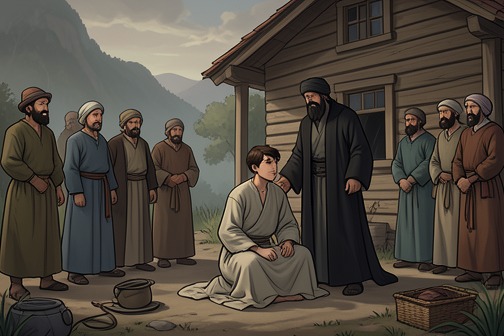
[Theo’s Settlement in Leafel](entity:event-recall-event-theo-s-settlement-in-le-ffabdd2c92c3) is the decisive turn in [Theo](entity:character-recall-character-theo-107bd6003b61)’s life from fugitive travel to self-fashioned belonging. After leaving behind the capital and the [Hero](entity:concept-recall-concept-hero-c363661142b4)’s path, [Theo and Malthios](entity:relation-recall-relation-theo-and-malthios-24da48fb7937) spend two years moving north, taking odd jobs and avoiding attention before settling in [Leafel](entity:location-recall-location-leafel-ce079facdeeb). There Theo builds a healing practice, a home, and a local identity strong enough to outlast the secret he fears will destroy him—though the village’s protection is eventually tested by the return of the powers he fled.
## Flight from the Capital and Search for Safety
Theo’s settlement begins as an act of refusal. On the day he turns sixteen, [Camden](entity:character-recall-character-camden-901e9f21b9e7) tells him that guards will take him back to the capital to meet the new young Hero and train for the future duty of purging the remaining [Demons](entity:creature-recall-creature-demons-6600dcc7335a). Rather than submit, Theo packs his meager belongings and food, leaves without a note for Camden, and travels with [Malthios](entity:character-recall-character-malthios-3bbf03e4fa99). The journey lasts two years and is sustained by odd jobs performed for people along the road, with both companions deliberately avoiding attention as they move farther north.
The destination appears to offer exactly what Theo wants: a small, peaceful village beyond the reach of Demons and Heroes alike. The brief qualification that he thinks this is true—followed by the realization that he is mistaken—foreshadows the settlement’s central tension. Leafel is remote enough to let Theo disappear, but not so isolated that the political and supernatural conflicts of [Algeya](entity:location-recall-location-algeya-1668b0a6fe56) can never find him.
## Leafel and the Healing Practice
Theo’s new life takes shape through work that is practical, local, and independent. Leafel is a small town where travelers rarely pass, although its reputation grows because of the unusually skilled healer living there. The townspeople openly praise Theo, alongside the leader of their modest adventurer party, whose swordsmanship helps protect the settlement from both monstrous and ordinary beasts. They call such protectors Heroes; Theo regards them as a nuisance, a judgment shaped by his determination to remain separate from the heroic institution that once claimed him.
More than ten years after arriving, Theo has earned enough from his travels and healing to buy a small, rundown house at the edge of town, beside the forest, and convert it into a shop. His healing magic is only one part of the business. He also gathers and prepares herbs and potions for the everyday injuries of local people. The building is both workplace and residence: Theo sleeps in the attic, while the potion room also serves as his kitchen. The arrangement expresses his desire for self-sufficiency, but it also shows how narrowly his resources are stretched.
The shop is repaired enough to stand, though it remains visibly imperfect. One section of the roof still leaks despite his inability to discover why, and the floor of the main room creaks badly. Theo has learned ordinary spells for mending clothing and cleaning the house, as well as cooking, gardening, baking, and minor repairs. His garden contains cooking herbs and flowers, with room reserved for produce he hopes to grow. He has savings for repairs and improvements, but refuses to spend the money except in an emergency because he is still trying to save for a future cottage; even after years of work, he is only slightly beyond halfway to the required sum.
## A Home Built Against Exposure
The shop matters because it is the first home Theo has truly possessed. When rain begins and the spring weather changes abruptly, he checks that the garden is prepared before entering. The shop front is crowded with potion shelves and hanging herbs. A short hallway leads to the garden, washroom, loft bedroom, and potion-room kitchen. To an outsider the building might look less rustic than dilapidated, but Theo sees the progress he has made and the labor invested in it. It is home because he built it himself, almost literally, rather than because it was granted to him by a royal, a Hero, or an institution.
That security is psychological as well as material. Theo keeps the possibility of flight alive, saving money and maintaining independence because he knows that friendship alone may not protect him if his nature is discovered. He is not merely hiding a personal secret: Malthios is the reincarnated [Demon King](entity:state-recall-state-demon-king-d4ce23d2b4c1), and Theo understands that the revelation could make him legally and politically expendable. Even when Malthios offers protection, Theo answers that Malthios would really be protecting himself, exposing the distrust that remains within their shared existence.
Leafel therefore becomes a space of selective belonging. Theo allows himself to be known as the village healer while withholding the identity that would transform every ordinary kindness into a potential accusation. His reputation is based on repeated acts of care, yet he believes that those acts may not matter once the feared name inside him is spoken aloud.
## The Village, the Capital, and the Return of Power
The contrast between Leafel and the capital clarifies what Theo has escaped. The capital’s walls, tall buildings, crowds, palace, councils, and training halls represent surveillance and compulsory roles. The palace is divided between the royal residence and the institutions where magic users and knights are trained for royal service or for the Hero’s party. The continuing danger posed by the remnants of Malthios’s army gives that system its public justification, but Theo experiences the capital as a place where his body and magic can be examined, assigned, and controlled.
Leafel seems to reverse that arrangement. Its roads are quiet, its community is small, and its healer’s value is measured through direct service rather than court approval. Yet Theo’s later return to the capital proves that the village exists within the same political order. When [Luc](entity:character-recall-character-luc-b00cd62cc765) is gravely injured by a Demon, Theo agrees to go through a portal despite knowing that doing so will surrender his autonomy and reveal where he lives. He fears that the court will force him into the Hero’s party and expose the truth about him, but Luc’s life matters more to him than his own safety.
Once Theo is identified as Malthios’s host, the capital’s institutions reclaim the authority he had tried to evade. He is taken to the dungeons and later brought before a public trial. The throne room uses magic mirrors to display the proceedings across Algeya, turning Theo’s private identity into a spectacle before the court, the rulers, and the wider population. The home established in Leafel cannot prevent that machinery from reaching him; it can only provide the relationships that make his defense possible.
## Leafel’s Collective Defense and Significance
The settlement’s greatest consequence is revealed when Leafel refuses to abandon Theo. During the trial, [Micah](entity:character-recall-character-micah-b7a8af6bb3f9) casts a mirror spell from the town square, bringing [Imani](entity:character-recall-character-imani-3e59d6c7b288), [Dale](entity:character-recall-character-dale-fff2558efe87), [Dmitri](entity:character-recall-character-dmitri-f7165ee439b9) and his parents, [Nib](entity:character-recall-character-nib-c57b21ba9a3c), [Amaya](entity:character-recall-character-amaya-3164488322dd), [Hayden](entity:character-recall-character-hayden-3887fcc3a0d9), and the people of Leafel into the court’s field of vision. Hayden speaks for the village and demands Theo’s release. The community that once praised Theo as its healer now publicly claims him even after learning that he is the host of the reincarnated Demon King.
This response reverses Theo’s expectation that discovery would erase every bond. His fear had defined Leafel as conditional shelter: a place safe only while nobody knew what he was. The villagers’ intervention demonstrates a different form of protection, one based not on concealment but on collective witness. Theo’s settlement thus changes meaning over the course of the story. It begins as a hiding place chosen by a fugitive, becomes a working home sustained by care, and finally proves to be a community capable of confronting the powers that would reduce him to a dangerous identity.
Theo’s life in Leafel also complicates the moral geography of the novel. The capital claims to defend ordinary people through councils, Heroes, knights, and laws formed against the Demons. Leafel’s people enact protection more personally and more vulnerably, standing behind a healer whom the official system has already judged. The village does not erase Theo’s danger or resolve the conflict with Malthios, but it establishes that belonging can survive the exposure of a stigmatized identity. In that sense, Theo’s Settlement in Leafel is not simply a relocation; it is the foundation of the chosen family and local loyalty that later challenge the authority of the Heroic order.
Event 6
Malthios’s Recruitment as a Novice
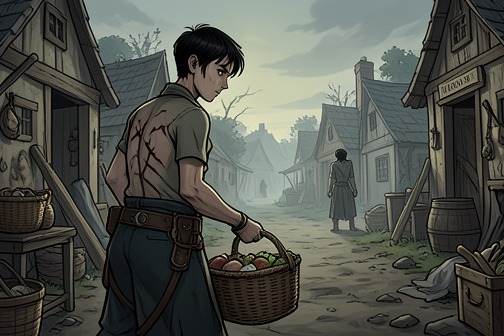
[Malthios’s Recruitment as a Novice](entity:event-recall-event-malthios-s-recruitment-06d67a889e64) marks the first decisive institutional turning point in [Malthios](entity:character-recall-character-malthios-3bbf03e4fa99)’s life. After abandonment and hunger, he is taken from a demon village by a Demon Lord, given mana, and placed among the Novices. The recruitment saves him from immediate starvation, but it does not rescue him from violence: it makes survival conditional on magical potential, physical usefulness, and obedience to a society in which power matters more than blood or family.
## Abandonment and Survival
Malthios begins this part of his history without a secure family or any understanding of why he has been mistreated. He does not remember his parents’ faces, and his earliest memories are associated with pain and scars across his back. Demon society is described as largely indifferent to parental bonds, particularly toward demons with low magical potential, because status is determined by power rather than blood. When Malthios’s parents abandon him before he has reached six years of age, he survives alone in a demon village by stealing food.
His survival is not presented as the result of protection or privilege. Something within him refuses to lie down and die, even though he has no clear sense of how long his life on the streets lasts. The period establishes the stubborn endurance that will later allow him to withstand painful magic, harsh training, and contempt from stronger Novices. Recruitment therefore reaches him at the boundary between neglect and death: he is not sought out because of family standing, but because he is one of the children who has survived long enough to display usable mana.
## The Demon Hierarchy
The recruitment takes place within a rigid hierarchy whose categories determine both social value and military function. [Demonkin](entity:creature-recall-creature-demonkin-5aa641de4c0f) occupy the lowest level, possessing little or no mana or magic but remaining useful as common soldiers. Novices are Demonkin who have been gifted mana by a Demon Lord, also called a sponsor. Their magical potential varies, but their physical prowess makes them particularly effective combatants. Above them stand the [Demon Lords](entity:creature-recall-creature-demon-lords-faedb062c0d5), who ascend through massive slaughter of innocents, gaining immense mana and wings.
The highest rank is the [Demon King](entity:state-recall-state-demon-king-d4ce23d2b4c1). Only Demon Lords know how a demon reaches that form, and the transformation succeeds only when the demon is worthy of the power. No Demon King has existed for many years at the point of Malthios’s childhood. This absence gives the hierarchy an unoccupied summit, while the recruitment system supplies the lower ranks with candidates who may be trained, tested, and consumed by the struggle for advancement.
## [Fulton](entity:character-recall-character-fulton-237e141b857f)’s Recruitment and Training
A Demon Lord named Fulton eventually arrives to take the surviving children whose gift of mana marks them as suitable for training. Malthios survives Fulton’s infusion of mana, although he experiences it as one of the most painful events of his life. The pain is the price of entry into the [Novice](entity:state-recall-state-novice-f13adec542e6) class: mana is not merely discovered in him but bestowed by a stronger demon, making his new capacity inseparable from sponsorship and hierarchy.
Training remains brutal. Higher-level Novices look down on Malthios, and his new position does not erase the humiliation of his earlier deprivation. Yet the institution provides what the streets never did: regular food and a bed every night. This material security is one of the recruitment’s most consequential effects. Malthios is still being shaped for combat, but he is no longer forced to steal each meal or face abandonment without resources.
## The Library and the First Opening
The most important benefit of recruitment is not physical comfort but access to the library. Malthios has tried to teach himself to read throughout his years on the streets, without making much progress. Once inside the training system, he sneaks into the library during breaks even though he is not supposed to be there. His frustration becomes intense enough that he nearly throws the book he is struggling to read.
That moment introduces a different potential in him from the one the demon hierarchy values. The Novice system sees a combatant with mana and physical strength; Malthios seeks knowledge, literacy, and a way to understand the world. His attempt to read also leads to an encounter with a demon girl around his age, whose dark red hair reaches her shoulders. She stops him by gripping his wrist and offers help, admitting that her own ability is limited but better than nothing. Recruitment thus places Malthios not only within a military structure but also within the first social and intellectual connection that can interrupt his isolation.
## Later Consequences
The meaning of the recruitment extends far beyond Malthios’s childhood. The demon society that trains him is the same society in which power, slaughter, and magical rank govern advancement. It gives him the foundations of survival and strength while normalizing the values that make violence a route to authority. His later status as Demon King can therefore be read against this first institutional transformation: before he can become the greatest figure in demon society, he must first be recognized as a child worth converting from Demonkin into a Novice.
The event also becomes part of the knowledge carried by Malthios when he is reincarnated within [Theo](entity:character-recall-character-theo-107bd6003b61). Theo learns that Malthios’s past was not shaped by parental care or an uncomplicated rise through merit, but by abandonment, forced magical transformation, and endurance inside a hierarchy that treated children as resources. That history helps explain both Malthios’s destructive impulses and the fierce insistence on survival that remains present within him.
Recruitment also creates a structural contrast with Theo’s later life. Theo’s emerald healing magic is claimed by the court and directed toward the [Hero](entity:concept-recall-concept-hero-c363661142b4)’s party, while Malthios is claimed by a Demon Lord and directed toward demon training. Both systems identify exceptional children, assign their bodies a public purpose, and subordinate personal choice to an ongoing war. Theo’s later fear that discovery of the Demon King’s presence will lead to execution is rooted in this same political order: the opposing sides differ in ideology and method, but both treat extraordinary individuals as instruments of collective defense.
## Narrative Significance
As an event, Malthios’s Recruitment as a Novice combines rescue, coercion, and initiation. It interrupts one form of death without ending the conditions that produced Malthios’s suffering. Food and shelter replace theft and exposure; magical power replaces helplessness; training replaces aimless survival. At the same time, the recruitment makes violence the language through which Malthios can gain recognition.
The event is therefore a dark origin story rather than a simple elevation. Malthios is given a place in the world only after the world has measured him for usefulness. His persistence, his painful acceptance of mana, and his clandestine pursuit of literacy reveal a person who exceeds the role assigned to him, even while that role supplies the means by which he will eventually reshape the fate of both demons and humans.
Event 7
Formation of the Pentagram
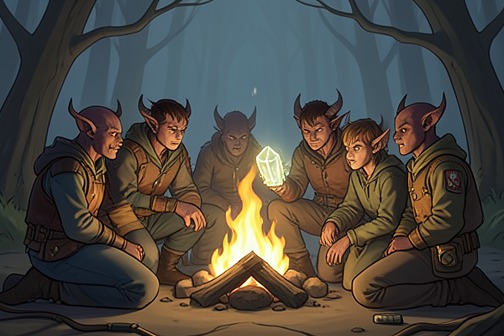
[Formation of the Pentagram](entity:event-recall-event-formation-of-the-pentag-3cc3b60f57ae) is the decisive moment when [Malthios](entity:character-recall-character-malthios-3bbf03e4fa99) stops surviving alone and becomes part of a chosen alliance. The group emerges from an act of protection, expands through mutual recognition, and establishes the principle that power is not merely inherited or bestowed by a sponsor but can be built through people who fight for one another. Its later history is shadowed by the fact that the same alliance eventually produces [Demon Lords](entity:creature-recall-creature-demon-lords-faedb062c0d5) and becomes inseparable from Malthios’s rise to [Demon King](entity:state-recall-state-demon-king-d4ce23d2b4c1).
## Conditions in Demon Society
[The Pentagram](entity:organization-recall-organization-the-pentagram-52f60bc5f5a8) forms within a demon society organized according to magical hierarchy and physical strength. [Demonkin](entity:creature-recall-creature-demonkin-5aa641de4c0f) occupy the lowest level, possessing little or no mana and serving mainly as common soldiers. Novices are Demonkin who have received mana from a Demon Lord sponsor; the gift gives them differing magical potential and formidable physical prowess. Demon Lords ascend after massive slaughter of innocents, gaining immense mana and wings, while the method of becoming a Demon King is known only to Demon Lords and succeeds only when the demon receiving that power is worthy of it. At the time of Malthios’s youth, no Demon King had existed for many years.
Malthios enters this system from its most precarious edge. His parents abandoned him before he was six, and he survived in a demon village by stealing food until a Demon Lord named [Fulton](entity:character-recall-character-fulton-237e141b857f) selected the children who had survived the gift of mana and trained them as Novices. Receiving mana was among the most painful experiences of his life, and training offered safety only in a limited sense: stronger Novices despised and bullied the weaker ones. Malthios had already learned that demon society allowed the strong to prey on the helpless, and he regarded that order with hatred because it reproduced the abandonment that had nearly killed him.
## The Founding Encounter
The immediate beginning of the Pentagram is Malthios’s struggle to teach himself to read in a library where he was not supposed to be. He had tried to learn during his years on the streets, but made little progress. As a [Novice](entity:state-recall-state-novice-f13adec542e6), he secretly returned to the library during breaks, becoming increasingly frustrated with the book before him. When he nearly threw it, a red-haired demon of about his age caught his wrist and offered help. [Kamil](entity:character-recall-character-kamil-88c659fbf1a3) sat beside him and placed the book across both their knees, turning instruction into the first quiet gesture of companionship in the group’s formation.
That fragile connection is tested almost immediately. A stronger Novice and his companions corner Malthios, mock him as a runt, and prepare to beat him. Before the blow lands, a small antlered demon with dark curls attacks the aggressor and sends him flying into his companions. [Aym](entity:character-recall-character-aym-bc4f15f5be03) does not intervene because of an existing obligation or reward; they simply refuse to accept five against one as fair fighting. Their defense gives Malthios something he has rarely been offered: protection extended without a demand for payment.
Malthios refuses to remain a passive beneficiary of that protection. When Aym is threatened, anger raises his mana, and he reaches toward it instead of recoiling. Blue flames burst from his fists. The power is not presented as a clean escape from demon violence, since it answers brutality with the possibility of greater brutality, but it gives Malthios the means to stand beside the person who stood in front of him.
## The Five Become a Unit
The group takes recognizable shape when three more Novices arrive: Kamil, the red-haired learner who first helped Malthios; [Torq](entity:character-recall-character-torq-7e92679e994e), a large dark-skinned demon with ram-like horns who delights in fighting; and [Foras](entity:character-recall-character-foras-2260f2d99951), a taller, slighter demon with damp-looking dirty-blond hair whose dry judgment balances Torq’s enthusiasm. Kamil greets Malthios as someone she has already decided will fit among them, while Torq treats the confrontation as an opportunity for combat and Foras reprimands him when his forceful friendliness unsettles Malthios.
The newcomers turn an isolated defense into collective action. Three of the hostile Novices are killed and dissolve into shadows, while the last attempts to flee and is driven against a wall by Kamil’s wind magic. The victory does not merely settle a personal quarrel. It demonstrates the practical value of the alliance: each member contributes a distinct strength, and the group can defeat opponents who would have overwhelmed an individual Novice.
Afterward, one of the smaller demons explains the group’s governing idea: they rely on one another so they can advance and become Demon Lords, because no one can hope to win without fighting for something. Malthios initially finds the claim almost impossibly simple. His disbelief reflects the world that formed him, where power has meant domination, abandonment, and the arbitrary favor of someone stronger. The others insist that strength can instead be organized around mutual dependence.
Kamil then formally presents Malthios to Aym, proudly identifying him as the one she has mentioned and asking whether he is a good fit. Aym studies him before granting the concise judgment that he has potential. Kamil answers with triumph, punches the air, and declares that the Pentagram is assembled. The name marks a transition from five individuals caught in a fight to a deliberate fellowship with a shared future.
## Consequences and Later Meaning
The Pentagram gives Malthios his first durable experience of chosen family and shared purpose, but its founding also establishes the logic that will govern his later life: isolated power is vulnerable, while coordinated power can rise through an unforgiving hierarchy. The alliance is therefore both refuge and instrument. It protects its members from immediate violence, yet it also aims directly at the status of Demon Lords, a rank whose ascent is tied to slaughter and immense magical power.
The group’s founding acquires tragic force when Malthios later kills his own kind and his mana spikes as it did during his ascension to Demon Lord. His black wings open to their full length and change to dark blood red before the watching demons recognize that a new Demon King has risen. The scene turns the Pentagram’s original promise inside out: the bullied Novice who needed allies becomes the supreme figure in the hierarchy that once made him helpless.
The event also remains connected to the human life Malthios later inhabits as the Demon King’s host. Within [Theo](entity:character-recall-character-theo-107bd6003b61)’s mind and body, Malthios is powerful but imprisoned, and Theo’s disobedience teaches him the limits of his control. Theo experiences the Demon King’s magic as terrifying yet natural, while refusing Malthios’s demands because he hates being ordered around and sees no point in obeying them. Their shared existence contrasts sharply with the Pentagram’s voluntary ideal: Malthios once sought advancement through companions who chose to stand with him, but later becomes trapped in a bond where neither host nor indwelling king can think or feel without the other knowing.
The Pentagram’s founding also casts a long shadow over later communities. In [Leafel](entity:location-recall-location-leafel-ce079facdeeb), townsfolk from many races greet Theo with waves and smiles even though he rarely speaks, rarely smiles, and dislikes physical contact. His reserve began as a defense against provoking Malthios and remains partly a precaution against having to flee again. The warmth of Leafel offers a social alternative to the demon hierarchy, just as the Pentagram once offered Malthios an alternative to solitary survival.
The group’s legacy is further refracted through Theo’s role as a healer and member of the [Hero](entity:concept-recall-concept-hero-c363661142b4)’s Party. When [Khal](entity:character-recall-character-khal-3b2ff6449c13) suffers a basilisk wound, Theo cuts an X across each puncture with a hot knife and uses calm emerald magic to destroy the poison, enduring Khal’s screams because he cannot spare magic to ease the pain. Later, when the Hero’s Party prepares to depart, Theo sees [Eliza](entity:character-recall-character-eliza-6ec11b83dd18) and must suppress fear and rage while trying to protect [Luc](entity:character-recall-character-luc-b00cd62cc765) from the person who harmed him. These scenes echo the Pentagram’s founding question—what is strength for?—but answer it through care, restraint, and responsibility rather than conquest.
## Narrative Significance
As a threshold event, the Formation of the Pentagram marks the passage from enforced survival into chosen belonging. Malthios enters the scene as a neglected child shaped by pain, a Novice whose worth is measured by magical potential. He leaves it as a recognized member of a unit whose members identify potential in him and promise advancement through mutual reliance. The ritual is informal—a book shared across two knees, a body thrown between victim and attacker, a hand on a shoulder, and Kamil’s shouted declaration—but those gestures perform the work of initiation.
The event’s central contrast is between the strong-picking-on-the-weak order Malthios despises and the collective strength the Pentagram invents for itself. Its members do not erase violence from demon society; they learn to survive and rise within it. That contradiction explains both the group’s appeal and its ominous future. The Pentagram is Malthios’s first answer to helplessness, a community founded when someone intervenes for no reason and others choose to join. It becomes the emotional and political foundation from which his later transformations—from abandoned child to Novice, Demon Lord, and finally Demon King—can be understood.
Event 8
The Pentagram’s Ascension to Demon Lords
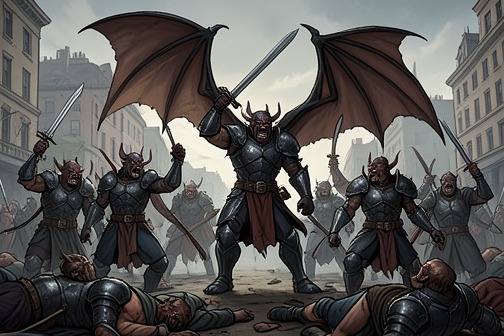
[The Pentagram’s Ascension to Demon Lords](entity:event-recall-event-the-pentagram-s-ascensi-8f847e6de5ea) is the decisive initiation of [Malthios](entity:character-recall-character-malthios-3bbf03e4fa99) and the other members of the Pentagram into the highest ordinary rank of demon power. Their advancement is not a ceremonial promotion but a state-sanctioned massacre: they are sent into a mortal city with orders to kill every living thing, and the completion of that slaughter triggers the bodily and magical transformation known as Demon Lord ascension. The event gives the group wings and immense mana, but it also exposes the cruelty built into demon society’s hierarchy and marks the beginning of Malthios’s enduring refusal to accept that cruelty as natural or inevitable.
## Hierarchy and Conditions
Demon society recognizes several routes and limits of advancement. [Demonkin](entity:creature-recall-creature-demonkin-5aa641de4c0f) occupy the lowest position, possessing little or no mana or magic but remaining useful as common soldiers. Novices are Demonkin granted mana by a Demon Lord, often called a sponsor. That gift gives them varying magical potential and considerable physical strength, making Novices valuable combatants while leaving them dependent on the stronger demon who empowered them.
[Demon Lords](entity:creature-recall-creature-demon-lords-faedb062c0d5) stand above Novices because they have undergone a transformation powered by mass slaughter. Killing innocents produces a surge of mana, and the demon’s body responds by growing wings and gaining immense magical strength. The final rank is the [Demon King](entity:state-recall-state-demon-king-d4ce23d2b4c1), a form whose method of ascension is known only to Demon Lords and which requires the demon itself to be worthy of the power. At the time of the event, no Demon King had existed for many years. The hierarchy therefore presents violence not merely as a tool of government or warfare, but as the recognized mechanism by which demons become more than they were.
Malthios had already survived the painful granting of mana by [Fulton](entity:character-recall-character-fulton-237e141b857f) and endured the harsh training imposed on Novices. His rise with the Pentagram is consequently both a personal advancement and a collective one. The five members are not merely rewarded for military service; they are being tested against the defining law of their society, a law that equates the destruction of innocent life with magical worth.
## The Massacre and Transformation
[The Pentagram](entity:organization-recall-organization-the-pentagram-52f60bc5f5a8) is sent to a large mortal city with direct instructions to kill every living thing encountered. Commander Ovrtu tells them that they will know when the killing is sufficient, leaving the threshold of success to the magical response of their own bodies rather than to a stated number of victims. The order turns an entire city into an instrument of advancement and makes the participants responsible for recognizing the moment when annihilation has fulfilled its purpose.
The slaughter ends quickly from Malthios’s perspective. When he kills the last mortal, his clothing and sword are coated in blood. His magic then seems to explode through him, and his mana swells to twice its original size before releasing its pressure in a violent physical change. Two feathered wings unfold from his shoulders, tearing through his armor and shirt. The transformation brings sudden bodily pain: his joints and fangs ache as though he has undergone an abrupt growth spurt, while his muscles become stretched and sore. Unsure how to use the new wings, he stumbles toward the city’s front gate rather than mastering them immediately.
The transformation is shared by the other members of the group. [Kamil](entity:character-recall-character-kamil-88c659fbf1a3) waits at the gate with white wings speckled by red-brown blood and embraces Malthios when she sees him. [Torq](entity:character-recall-character-torq-7e92679e994e) displays dark golden wings, [Foras](entity:character-recall-character-foras-2260f2d99951) has wings the soft cream color of his hair, and [Aym](entity:character-recall-character-aym-bc4f15f5be03)’s are dark, only slightly lighter than the pitch-black wings spread from Malthios’s shoulders. Torq supports Foras, while Aym follows close behind, showing that the group emerges together but not without physical and emotional strain.
Their immediate condition is mixed. Kamil reports that they are shaken but not hurt, and Torq agrees, although Torq also admits that the surge of mana caused a moment of nausea. The bodies of the new Demon Lords have survived the ordeal, but the experience has left its mark in ways that physical invulnerability cannot erase. Their wings are visible proof of success, while the blood staining those wings preserves the cost of the achievement in the same image.
## Recognition and Moral Conflict
The group initially celebrates the transformation. Kamil calls out that they succeeded, and Torq proudly invites attention to the new wings. Yet the celebration is interrupted by the recognition that the event was not simply a difficult mission. Aym looks back toward the city and remarks that the killing was too much. When Torq clarifies that the problem is not the nausea but the slaughter itself, the conversation shifts from bodily survival to moral judgment.
Torq says that it is terrible that killing is the only way demons can evolve, and Kamil agrees that the system feels outdated. She compares demon society unfavorably with mortal societies, observing that mortals have some things better. This response is significant because the newly ascended demons do not interpret their transformation as proof that the system is righteous. Their success confirms the rule’s effectiveness, but it does not remove their ability to see the rule as cruel.
Kamil goes further by suggesting that the demons might find another way to evolve. She tells Malthios that they have already changed what they were taught and become stronger for it, asking why the same possibility should not apply to the method of advancement itself. Her argument turns the ascension into an ideological challenge. If the Pentagram can question the practice immediately after benefiting from it, then demon nature is not as fixed as demon authority claims.
Malthios resists that conclusion. He turns away from Kamil and says, “A demon can’t change their nature,” treating the brutality of the system as an essential fact rather than a reformable institution. Kamil rejects his fatalism, telling him that if any one of them could change, it would be him, because of his stubbornness. Their exchange establishes a lasting contrast within the group: Kamil imagines moral transformation as another form of growth, while Malthios initially responds to the evidence of demon violence by accepting it as destiny.
## Consequences and Narrative Significance
The ascension gives the Pentagram the power and status associated with Demon Lords, but it also binds their identity to a massacre they cannot reinterpret as harmless. They leave the city alive, stronger, winged, and recognized as successful, while carrying the knowledge that their promotion required the destruction of every mortal inside it. The event therefore joins triumph and contamination rather than allowing one to cancel the other.
For Malthios, the transformation becomes an important precursor to his later relationship with demon power. His black wings and enlarged mana demonstrate that he possesses the capacity expected of a Demon Lord, yet his discomfort with the slaughter—and Kamil’s insistence that demons can change—foreshadow his eventual conflict with the values of Demon society. The event does not immediately make him a reformer; instead, it shows the contradiction from which that possibility will develop.
The Pentagram’s ascension also provides a structural counterpoint to Malthios’s later rise as Demon King. Demon Lord advancement is publicly legible: the massacre produces a visible bodily sign, and the group can identify the transformation in one another. [Demon Kinghood](entity:state-recall-state-demon-kinghood-3a01a071b062) is more secretive and selective, known only to Demon Lords and dependent on worthiness. The first ascent thus establishes the violent ladder of demon power before later events test whether Malthios can transcend the ladder’s assumptions rather than merely climb it.
The event’s deepest significance lies in its refusal to separate power from the institutions that authorize it. The wings are beautiful and distinctive, yet they emerge through armor, clothing, blood, pain, and the destruction of a mortal city. The Pentagram has reached the rank that demon society values most beneath Demon Kinghood, but the new Demon Lords immediately discover that advancement has not made the governing principle any less monstrous. Their question—whether demons can change their nature—becomes the moral problem that the transformation leaves unresolved.
Event 9
The Hero’s Party’s Arrival in Leafel
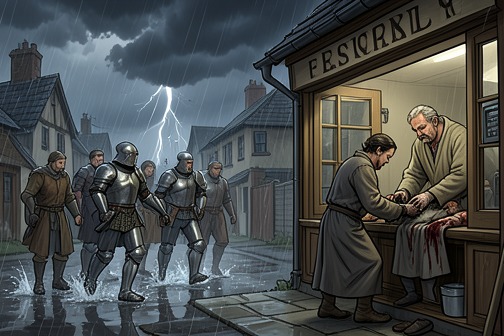
[The Hero’s Party’s Arrival in Leafel](entity:event-recall-event-the-hero-s-party-s-arri-fe177d6d9911) marks the moment the secluded life of [Theo](entity:character-recall-character-theo-107bd6003b61), the village healer, is breached by the very power charged with hunting the [Demon King](entity:state-recall-state-demon-king-d4ce23d2b4c1) within him. Their storm-soaked arrival at his shop forces Theo to choose between flight and treatment, while the injured [Khal](entity:character-recall-character-khal-3b2ff6449c13) turns an ideological threat into an immediate medical obligation. The encounter also begins the chain of trust, suspicion, intimacy, and political conflict that eventually pits [Luc](entity:character-recall-character-luc-b00cd62cc765)’s chosen life with Theo against the bloodline and duty demanded by [Hero](entity:concept-recall-concept-hero-c363661142b4) [Eliza](entity:character-recall-character-eliza-6ec11b83dd18).
## Causes and Background
The arrival occurs during a violent storm, when Theo is preparing dinner in the potion-room kitchen after returning from a café trip with [Nib](entity:character-recall-character-nib-c57b21ba9a3c). The domestic scene is unusually calm: the stew is cooking, thunder and lightning soothe Mal’s restlessness, and Theo has placed a bucket beneath a roof leak as a precaution. That fragile ordinary life depends on concealment. Theo knows that no amount of friendship would save him if anyone discovered what he was, and Mal’s presence beneath his skin makes escape an ever-present necessity rather than a distant possibility.
The party’s approach immediately activates that fear. A hammering on the front door is powerful enough to nearly shake the shop, and the force on the other side feels almost equal to the power hidden within Theo. Mal identifies the visitors as Heroes in a bitter warning, while Theo recognizes that the arrival cannot be ignored: as [Leafel](entity:location-recall-location-leafel-ce079facdeeb)’s healer, he is expected to answer emergencies. Mal offers to take control if the visitors attack, but Theo decides that an attack will mean running. The threshold therefore becomes a literal and moral boundary. Opening the door may expose him to the people most likely to destroy him, yet refusing it would violate the healer’s role that gives his life in Leafel its meaning.
## The Party at Theo’s Door
Seven young adventurers stand on the porch, soaked and bloody as though they have come directly from battle. Their appearance presents a compact image of the wider world beyond Leafel. The largest member is a broad warrior wearing a leather kilt and shoulder armor, and three companions are required to support him. A raven-haired woman in scale armor and a revealing white dress carries a scepter and appears to be a priestess mage with faery or nymph ancestry. A shorter elf with blond braids wears green and leather and carries a bow and quiver. A female dwarf, whose dark hair and cheek-length sideburns are arranged in rows of braids, carries a staff; beside her is a black, pot-bellied pig larger than a footstool, whose intelligent eyes make him more than a conventional animal companion.
The remaining members are a blond human man in the white robe associated with powerful or royal mages and a much shorter, concealed figure in a patched black coat, hood, beaked leather mask, and blank dark lenses. At the front stands Luc, the person who has been trying to break down Theo’s door and the one Theo instantly recognizes as the Hero. Luc is taller than Theo, broad and well trained, and wears a gold-edged navy coat beneath light leather armor protecting his vital areas. The sword at his side appears to Theo to be merely an ornate, gemmed blade, but Mal recognizes it as Eliza’s sword. Its presence makes the Demon King tremble inside Theo and turns Luc from an injured traveler into a direct emblem of the force that once defeated and continues to threaten Mal.
The immediate request is medical. The party explains that their companion has been bitten by venomous demon spawn a day earlier, and that all their healing efforts have failed. Local townspeople have directed them to Theo because he is said to work miracles. Theo asks whether the party has its own healer, though he already understands the answer: it was supposed to be him. Luc grows impatient because Khal is running out of time, while Mal warns Theo not to help people who would hunt or hurt them if they learned the truth. Theo nevertheless acknowledges that he has no choice and tells the party to bring Khal inside.
## The Emergency and the First Value Shift
Theo’s potion-room kitchen is not large enough for seven visitors and a giant pig. The party sweeps his cooling dinner onto the floor so Khal can be placed on the massive oak table, transforming the healer’s private home into an emergency ward. Khal’s body reveals the seriousness of the danger. Tusklike fangs and reddish skin suggest that he is partly orc, a hardy ancestry that has delayed the poison’s progress, but two puncture marks on his torso have darkened purple, and spreading veins show that the venom is advancing. His normally tan complexion is ashen, and sweat covers him.
This act of treatment changes the meaning of the arrival. At the door, the party represents surveillance, violence, and possible execution; around the table, its injured member becomes a patient whose life depends on Theo’s skill. Theo’s fear does not disappear, and Mal remains ready to defend them, but professional duty overrides self-preservation. The party that has arrived as a threat is temporarily reorganized by the logic of care. Theo’s decision does not resolve the danger of discovery. Instead, it binds him to the very people who may later determine his fate.
## Relationships and Conflicting Futures
The arrival begins [Theo and Luc](entity:relation-recall-relation-theo-and-luc-6c31719ecbcf)’s relationship under conditions shaped by danger rather than freedom. Luc later describes a history of short-lived relationships: his first two long relationships were with people who lived in the capital, followed by several romances during extended stays in other towns. He presents this instability as part of the fate of the Hero. The statement reveals that Luc’s personal life has already been subordinated to movement, training, and public obligation, while Theo’s life in Leafel offers the possibility of continuity. Their attraction therefore develops against two incompatible forms of time: the Hero’s recurring departures and Theo’s rooted daily work.
That conflict eventually becomes institutional. [Julius](entity:character-recall-character-julius-2b9b6a5d3dd6), Luc’s former lover, explains that he was threatened into refusing Luc’s invitation to join the party because Hero Eliza wanted Luc to continue the Heroic bloodline and sire the next Hero. Julius believes that such a future could not be achieved with either of them. Theo rejects the warning and declares that he has no intention of letting Luc go. The party’s first arrival thus contains the later struggle in embryo: Luc is treated by the system as a vessel for succession, while Theo understands love as a reason to resist that assigned future.
The bond is ultimately expressed through chosen symbols rather than inherited office. Theo carries an [Arriss Pendant](entity:object-recall-object-arriss-pendant-f3335bf1f7f9) and tells Luc that he marked him first, promising to wait no matter how long it takes. Luc answers with his father’s ring, a scaled silver band set with a dark sapphire. His father died after saving an adventuring party from a demon attack, leaving the ring as Luc’s only possession from him; when Luc places it on Theo’s marriage finger, the band contracts to fit. The object links Luc’s family history of heroic sacrifice to a different future, one in which memory is preserved through partnership rather than through the production of another Hero.
## From Arrival to Public Confrontation
The party’s arrival also establishes the pattern by which Theo’s secret becomes increasingly difficult to contain. Cargo later asks whether Theo will tell the others that he is demon spawn, forcing the concealed identity into direct social space. Theo has already assumed that discovery would make friendship useless, and the question makes that fear bodily: he freezes, his fingers nearly release the basket he is carrying, and Mal immediately presses forward to defend them. The arrival at the shop is therefore not an isolated rescue scene but the beginning of a disclosure crisis in which every new relationship can become evidence against Theo.
When Luc later requires urgent help, Theo must travel toward the capital despite knowing that entering it will end his autonomy. Those in power would learn where he lived, the court mage might recognize him, and [Camden](entity:character-recall-character-camden-901e9f21b9e7) could identify him; Theo expects to be forced into the Hero’s party, where his secret might be exposed at any moment. He goes because Luc might die, and because the authorities would simply raise another child to replace an expendable Hero. Theo’s decision reverses the original scene’s terms: the man who first arrived at his door as an agent of danger becomes the person for whom Theo willingly enters danger himself.
That movement culminates in the Trial of the [Demon King’s Host](entity:state-recall-state-demon-king-s-host-76fd1b21021f). After Theo’s identity is confirmed, the party uses a court mage’s message, a twin, and a rare portal orb to reach the capital within ten minutes of Theo being fitted with magic-dampening handcuffs. The court orders him taken to the dungeons, and Julius is among the knights receiving him. Yet Leafel refuses to abandon the healer. Through a large mirror spell, [Micah](entity:character-recall-character-micah-b7a8af6bb3f9) shows the court the town square, where [Imani](entity:character-recall-character-imani-3e59d6c7b288), [Dale](entity:character-recall-character-dale-fff2558efe87), [Dmitri](entity:character-recall-character-dmitri-f7165ee439b9) and his parents, Nib, [Amaya](entity:character-recall-character-amaya-3164488322dd), [Hayden](entity:character-recall-character-hayden-3887fcc3a0d9), and the people of Leafel demand Theo’s release. The frightened stranger who once stood outside Theo’s door has become part of a community willing to cross a political boundary for him.
## Consequences and Significance
The arrival’s deepest consequence is the creation of a relationship that contests both the Hero’s institution and the Demon King’s expected nature. Eliza insists that Luc would be throwing away everything he has trained for and ending their bloodline by choosing Theo. Luc answers that choosing to live peacefully with the man he loves is the only choice he has ever made for himself, and that the world should allow those born with the Hero’s gift to choose their fate instead of being bound to duty. Theo then names Luc a better Hero than Eliza, shifting heroism from obedience and reproduction toward protection, self-determination, and care.
The scene also gives the book its central contrast between imposed identity and chosen belonging. Theo is a healer whose work begins in a cramped kitchen, with a ruined dinner, a dying patient, and an enemy presence trembling inside him. Luc is a Hero whose official value is measured by training, succession, and expendability. Their meeting does not erase either danger: Theo remains vulnerable as the Demon King’s host, and Luc remains caught within a system that claims his future. But the arrival makes their eventual alliance possible. What enters Leafel as a bloodied party seeking a miracle leaves behind the first conditions for a family, a community, and a future defined by choice rather than by inherited war.
Event 10
Khal’s Basilisk Poisoning and Rescue
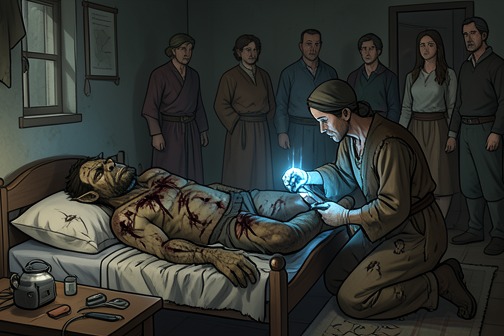
[Khal’s Basilisk Poisoning and Rescue](entity:event-recall-event-khal-s-basilisk-poisoni-44b5553a1983) is the crisis that brings Healer [Theo](entity:character-recall-character-theo-107bd6003b61) into direct service of [Luc](entity:character-recall-character-luc-b00cd62cc765)’s [Hero](entity:concept-recall-concept-hero-c363661142b4)’s Party. A day after [Khal](entity:character-recall-character-khal-3b2ff6449c13) is bitten by a basilisk, the party carries him into Theo’s cramped home, where darkening wounds and spreading venom make death appear imminent. Theo saves the half-orc through a dangerous, painful treatment that requires him to reveal the full force of his healing magic in front of the very Heroes who would hunt him if they learned what he was. Khal’s survival establishes Theo as an indispensable healer, begins the party’s trust in him, and turns a medical emergency into the first major test of his divided loyalties.
## Causes and Background
The party arrives at Theo’s door because ordinary healing has failed. Luc explains that their friend was bitten by a venomous demon spawn the previous day and that the group’s efforts have not worked, while the surrounding townsfolk have directed them to the healer reputed to work miracles. The party has no healer of its own; the role is supposed to belong to Luc, but he cannot treat Khal. Their need is therefore both immediate and structural: Khal is dying, and the Hero’s Party has reached the limit of its available skills.
Theo understands the danger before he agrees to help. Mal warns that these are the people who would hunt and hurt them if they discovered Theo’s true nature, and Theo knows that no amount of friendship would save him if the secret became public. Nevertheless, he concludes that he has no choice and orders the party to bring Khal inside. The decision places his safety beneath Khal’s life, but not without resistance. Theo resents having to display his powers before the Heroes, while Mal reminds him that he chose this situation by allowing the party into his home.
The emergency is made more alarming by Khal’s condition and by the setting in which Theo must work. Theo’s potion-room kitchen is not large enough for the entire party and the enormous pig accompanying them. The companions push his cooling dinner onto the floor to make room for Khal on the massive oaken table, turning the healer’s domestic space into an improvised treatment room. Khal’s tusklike lower fangs and reddish skin identify him as partly orc, a hardy heritage that has delayed the poison’s progress but has not stopped it.
## The Poison and Khal’s Condition
When the dwarf mage begins removing Khal’s armor, Theo sees two puncture wounds on the warrior’s torso. They are no longer bleeding, but each has turned dark purple, and discolored veins are spreading beneath the surrounding skin. Khal’s normally tan complexion has become ashen, and sweat covers him as he lies unconscious. Mal identifies the attacker as a basilisk and states that Khal should already be dead. The diagnosis makes the wound more than a conventional injury: basilisks are demon-made creatures, and their blood and venom contain dark magic.
The party has attempted revival spells rather than a targeted treatment. [Emi](entity:character-recall-character-emi-6cd72baa2831), the priestess, has been casting them every hour with [Avery](entity:character-recall-character-avery-3f30ea9cdcd5) and [Veiv](entity:character-recall-character-veiv-2ba6a25fcbd2), while Avery insists that their healing spells have been sufficient. Khal’s body contradicts that confidence. The masked party member supports Theo’s earlier assessment by pointing out that the injured man is still in danger, and Theo realizes that herbs or potions have not been used to slow the venom. Mal recommends vynnil root for lasting damage but warns that Theo will need to throw all his healing talents into the treatment.
The diagnosis creates a sharp contrast between the party’s public identity and its actual vulnerability. These are the Heroes who are expected to confront demon-made threats, yet one of their own lies helpless before poison they cannot remove. Theo, a fugitive from the heroic path and a hidden demon host, becomes the only person capable of addressing the crisis. The party’s dependence on him begins not through shared ideals or formal allegiance, but through Khal’s failing body on Theo’s kitchen table.
## Emergency Treatment
Theo starts by cutting an X across each puncture wound with a hot knife, causing fresh red blood to spill from injuries that had stopped bleeding. Khal jerks awake under the incision, and his companions lunge forward to pin him down. Theo discards the knife and raises both hands over the wounds, allowing his magic to rise. The procedure is deliberately invasive: he opens the poisoned flesh so the venom can be reached, then applies healing power directly to the source of the damage.
Theo’s magic appears calm, glowing deep emerald around his hands, but its calmness contains the possibility of sudden destruction. He recognizes that the same qualities associated with still water, summer weather, and the moments before dawn can become chaos in an instant. The party murmurs nearby while he works, and Luc’s attention remains fixed on him. Theo is forced to manage two dangers at once: Khal’s basilisk venom and the scrutiny of a Hero whose recognition could expose him.
The healing is the most difficult wound Theo has ever treated. Khal repeatedly jerks against the silk restraints and the grip of his companions, screaming as Theo destroys the poison without having enough magic left to ease the pain. Theo’s arms begin to shake, the only visible sign of his exhaustion, but he continues until the last of the venom dissipates. The presence of demon magic in basilisk blood makes the treatment especially demanding, because Theo must overcome an active supernatural poison rather than merely close damaged tissue.
Once the venom is gone, Theo redirects his power to remove Khal’s pain temporarily, allowing the warrior’s large body to relax against the table. He then calls for vynnil root and sprinkles the powder over the wound, treating it with the practical precision of seasoning food. The gesture joins the extraordinary and the ordinary: emerald magic has neutralized a poison that should have killed Khal, while a humble medicinal powder is used to guard against lasting damage. Rescue is therefore presented as both miracle and craft, dependent on knowledge, endurance, and the willingness to endure another person’s pain.
## Recovery and Return to Duty
Theo’s intervention does not end with the poison’s disappearance. The party returns less than three minutes after the initial request, bringing a rented horse and cart so Khal can be transported to the [Broken Blade](entity:location-recall-location-broken-blade-7199f39a563c). Emi removes the silk bands, and Theo takes away the pads covering the injury so he can inspect the flesh directly. The wound bleeds when uncovered, but his green magic finds no remaining poison, and within a minute the punctures close. Luc and Veiv help Khal sit upright, while Theo gives him a bowl of broth and prescribes one more day of bedrest followed by two days of light movement.
The recovery plan is deliberately measured rather than triumphant. Khal has survived a venom that should have killed him, but Theo does not confuse survival with immediate readiness. The healer treats restored function as something that must be tested and protected. Khal’s gratitude is direct, yet Theo’s authority is expressed through practical limits: food, rest, gradual movement, and continued observation are as necessary as the original burst of magic.
The next day, Khal is already at breakfast in the Broken Blade, eating an enormous meal of bacon and eggs and reporting that he has been stretching and walking. He is eager to return to training, but Theo performs a further examination before granting permission. Placing a hand over the site of the former wound, he lets green light wash across the room and scans Khal’s entire body. Finding no abnormality, Theo clears him to return to duty while advising him to maintain his water intake. Khal then rises, towering over the party, and announces that the break is over, prompting groans from everyone except Emi. His restored strength converts the crisis into a visible return of ordinary group life.
## Consequences for Theo and the Party
Khal’s rescue makes Theo useful to the Hero’s Party in a way that cannot be dismissed as rumor. The party came because townspeople said he worked miracles, but it leaves with concrete evidence: he diagnosed a basilisk wound, neutralized demon-tainted venom, closed the damage, and monitored the patient through recovery. Khal’s survival therefore changes Theo’s position from an isolated village healer to a person whose skills the party may depend upon when conventional heroic resources fail.
That usefulness carries a concealed cost. During the treatment, Theo has to expose the scale and character of his magic before people who would become his enemies if they learned he was a demon host. His fear is not abstract. He knows that friendship would not protect him from discovery, and later Cargo asks whether he will tell the party that he is demon spawn. The question freezes Theo and brings Mal forward, showing that the rescue has created intimacy and suspicion at the same time. Every successful act of healing makes Theo more visible; every act of visibility threatens the secret that keeps him alive.
The event also establishes a recurring ethical pattern in Theo’s story. He does not help because the party is safe for him, trustworthy in every respect, or politically harmless. He helps because Khal is dying and because Theo possesses the ability to prevent that death. Later, when Luc is endangered in the capital, Theo again accepts the loss of his autonomy because Luc might die without him. The basilisk crisis is the first clear instance of this principle: Theo’s healer’s duty overrides his instinct to run, even while Mal correctly identifies the people around Khal as potential hunters.
## Wider Narrative Significance
The poisoning exposes the limits of the heroic system as well as the strength of individual care. Luc’s party possesses warriors, a priestess, mages, revival spells, and the authority associated with Heroes, yet repeated healing attempts cannot stop the basilisk venom. The answer comes from Theo, whose hidden identity places him outside the system the party represents. The supposed enemy’s power is therefore not simply destructive; in Theo’s hands, knowledge associated with demon magic helps him understand and overcome a demon-made poison.
This contradiction becomes important as the story moves toward later conflicts over identity and allegiance. Theo’s work in the kitchen is not a public declaration, and the party does not yet know what he is. Their dependence begins through the body of Khal, whose danger forces them to recognize competence before they can categorize the person providing it. The later court proceedings, where Theo is imprisoned for protecting [Malthios](entity:character-recall-character-malthios-3bbf03e4fa99), reveal the political opposite of this scene: the capital treats his hidden connection to the [Demon King](entity:state-recall-state-demon-king-d4ce23d2b4c1) as grounds for judgment, while the immediate crisis allows his actions to be understood through their life-saving result.
Khal’s recovery also gives the party a reason to remember Theo not merely as a suspicious village healer but as the person who returned one of their own to full health. At the Broken Blade, Khal’s appetite, height, command to resume training, and the companions’ collective complaints provide the event’s final image. The danger that filled Theo’s kitchen with blood, restraints, and spreading purple veins has been replaced by familiar irritation and shared routine. The rescue thus carries two outcomes at once: Khal is restored, and Theo is drawn closer to the people whose acceptance he needs but cannot safely trust.
Event 11
The Hydra Hunt
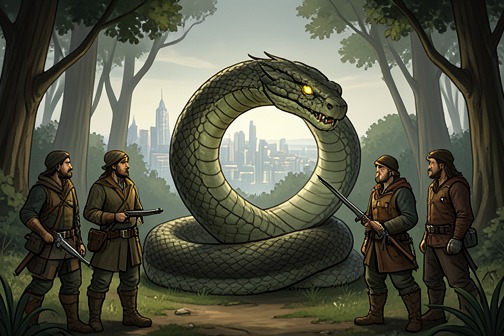
[The Hydra Hunt](entity:event-recall-event-the-hydra-hunt-57467812844b) is the [Hero](entity:concept-recall-concept-hero-c363661142b4)’s party’s northern mission to deal with a hydra spotted near [Leafel](entity:location-recall-location-leafel-ce079facdeeb). Although [Luc](entity:character-recall-character-luc-b00cd62cc765) later reports that the creature was defeated easily, its disorientation and apparent search for something suggest that it was not acting independently. The episode therefore links an apparently manageable monster encounter to [Tyraz](entity:character-recall-character-tyraz-d0813c0c4748)’s continuing efforts to create attacks and regain power, while its departure from Leafel forces Luc and [Theo](entity:character-recall-character-theo-107bd6003b61) to confront the incompatibility between emerging domestic intimacy and the Hero’s inherited duty.
## Causes and Background
The immediate cause of the hunt is a report delivered to the Hero’s party through [Micah](entity:character-recall-character-micah-b7a8af6bb3f9). A high-ranking monster, specifically a hydra, has been seen heading north, and the party is asked to intervene because it is the highest-ranked adventuring group in the area. The assignment arrives just as Theo has planned to show Luc around Leafel, take him to [Fox Tales](entity:location-recall-location-fox-tales-551227903e88), and introduce him to [Nib](entity:character-recall-character-nib-c57b21ba9a3c). That interrupted plan matters because Luc has been gradually wearing down Theo’s resistance; the mission arrives at the moment when private familiarity might have become a settled routine.
The timing also exposes the structural force governing Luc’s life. Theo recognizes before Luc speaks that Luc cannot remain in Leafel forever. Luc is not merely a powerful adventurer choosing whether to accept a job. He is the Hero, and the party’s status makes dangerous requests part of his ordinary existence. The hydra’s movement northward thus activates the larger system of heroic obligation that repeatedly removes Luc from the possibility of an uncomplicated personal life.
## Course of the Mission
Micah is sent to notify the rest of the party, while Luc remains with Theo long enough to acknowledge their imminent separation. His dark hair is still disordered from sleep and his expression is sorrowful, details that place the public mission against the intimacy of the morning. Theo tells him that he knew this would happen and that Luc cannot stay indefinitely. Luc answers by catching Theo’s hand and promising, “I’ll be back. I promise.” The promise gives the departure an emotional stake beyond the practical completion of the quest.
The party then comes to collect Luc after the meal. Theo escorts him to the front door and sees the other members offer their farewells. Luc’s blue eyes linger on Theo sorrowfully before he leaves along the road toward the dangers awaiting him. The scene ends without a displayed battle, concentrating instead on the departure that the hydra mission causes. In narrative terms, the unseen combat is less important than the visible cost of accepting it: Luc must leave the person and place toward which he has begun to turn.
When Luc returns, he tells Theo that the hydra was dealt with easily and that the local adventurer party probably could have managed it. The creature was disoriented and kept becoming distracted, as though it were searching for something. This report revises the meaning of the assignment. The hydra was dangerous enough to justify intervention, but its conduct was abnormal enough to imply direction, manipulation, or a purpose that neither Luc nor Theo can identify from the encounter alone.
## Demonic Implications
Theo immediately wonders whether a demon is behind the hydra’s behavior, and Mal stirs with sudden interest at the suggestion. Luc considers the demonic explanation the most likely one. He connects the hydra to long-standing rumors that Tyraz, the second of the [Demon King](entity:state-recall-state-demon-king-d4ce23d2b4c1), is responsible for demon and demon-creature attacks and is attempting to gather enough power to continue the war.
This interpretation expands the hunt from a local act of monster control into a fragment of the continuing conflict between the Hero’s forces and demonkind. The hydra’s distraction becomes a clue that the creature may have been displaced or used as part of a larger design. The party can defeat the immediate threat, but easy victory does not equal resolution; the unexplained behavior leaves the strategic danger intact and points toward an enemy operating through repeated attacks rather than a single open confrontation.
The conversation also raises the rumor that [Malthios](entity:character-recall-character-malthios-3bbf03e4fa99) has reincarnated himself. Luc reports that [Eliza](entity:character-recall-character-eliza-6ec11b83dd18) believes such a return would already be known, because the host would have to be Theo’s age or older and Malthios would therefore have seized power again by then. The statement is based on an assumption about the Demon King’s return and the age of the host, an assumption that carries dramatic irony because Theo is in fact connected to Malthios. Within the scene, however, the hunt is treated as evidence for Tyraz’s activity rather than proof that Malthios has returned.
## Separation and Consequences
The party’s departure turns Luc’s promise into an object of uncertainty. After closing the door, Theo presses his forehead against the cool, smooth wood and convinces himself that he will never cross paths with Luc or his friends again. He reasons that Luc’s quest will carry him far from Leafel and that, during his travels, the Hero will meet many more beautiful people with whom he might form bonds of fate and find a perfect happily ever after. The hydra mission therefore produces an emotional value shift: the possibility of a relationship gives way, at least in Theo’s fearful interpretation, to anticipated abandonment.
Theo’s conclusion contrasts with Luc’s certainty. Luc says he will return; Theo imagines the road taking him permanently away. The difference is not simply romantic insecurity. It reflects the unequal pressures surrounding them. Luc has a party, a mission, and a role that demands movement, while Theo’s life is rooted in Leafel and shaped by his work as a healer. The hunt makes their incompatible temporal rhythms visible: one life proceeds through quests and departures, the other through continuity, waiting, and the preservation of a home.
The promise nevertheless becomes part of the relationship’s foundation. Luc’s later return confirms that the separation is temporary, while the memory of his departure gives their attachment a recurring pattern of absence and reunion. The event’s lasting consequence is therefore double. On the public level, the Hero’s party removes a hydra and uncovers signs of Tyraz’s wider campaign. On the private level, Luc’s departure tests whether a connection formed in Leafel can survive the obligations that define him.
## Narrative Significance
The Hydra Hunt adapts the quest pattern while quietly resisting its conventional reward. The Hero receives no glorious on-page triumph in the available account; the hydra is handled easily, and the decisive dramatic movement lies in the road out of Leafel. The expected heroic progression from call to victory is displaced by the emotional aftermath, where the cost of answering the call is measured in separation rather than in bodily defeat.
The episode also foreshadows the conflict between heroic bloodline duty and chosen intimacy. Luc’s earlier relationships ended or became impossible because the Hero’s travels prevented lasting attachment. Later, Hero Eliza explicitly pressures him to preserve the Hero’s bloodline and produce the next Hero, while Luc rejects that imposed future in favor of a quiet life with Theo. The hydra mission is an early instance of the same system at work: a public emergency interrupts private happiness, and Luc must decide whether returning to the person he loves can be treated as a duty of equal seriousness.
In that sense, the hunt is both an external adventure and a test of narrative direction. The party travels north to answer the world’s demand for a Hero, but Luc’s promise points toward a different kind of return, one centered not on conquest or inherited succession but on Theo and Leafel. The hydra is defeated; the larger war remains. More importantly, Luc’s departure establishes that the relationship’s future will depend on whether he can come back from the heroic road without allowing that road to dictate the whole shape of his life.
Event 12
Theo’s Fever and Collapse
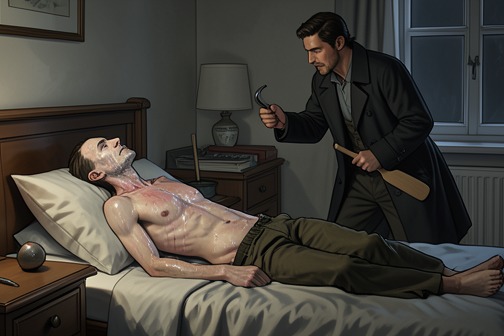
[Theo’s Fever and Collapse](entity:event-recall-event-theo-s-fever-and-collap-6d4708b72789) marks the moment when [Theo](entity:character-recall-character-theo-107bd6003b61)’s carefully maintained independence fails under the combined strain of supernatural conflict, emotional fear, and self-imposed labor. His illness is not an isolated medical incident: it grows from weeks of poor sleep, constant headaches, intrusive pressure from [Malthios](entity:character-recall-character-malthios-3bbf03e4fa99), excessive work, and recurring nightmares of [Luc](entity:character-recall-character-luc-b00cd62cc765) dead. The collapse exposes the cost of treating endurance as protection, while the care Theo receives from [Leafel](entity:location-recall-location-leafel-ce079facdeeb)’s people begins to challenge his belief that friendship cannot save him.
## Causes and Accumulated Strain
The episode follows several weeks in which Theo is unable to recover from Malthios’s persistence. Malthios continues pressing against him mentally, leaving Theo with a constantly hurting head, while Theo refuses to let him out into the forest to release his unstable energy. Malthios responds with hissed insults rather than cooperation, so Theo tries to drown the conflict in work. He goes to bed late, rises too early, and sleeps very little between those hours. [Hayden](entity:character-recall-character-hayden-3887fcc3a0d9)’s daily visits add another pressure: although Hayden attempts to help, he also keeps offering flirtatious comments and suggestions, giving Theo no genuine quiet.
The deeper wound is Theo’s fear for Luc. A constant tightness in his chest accompanies nightmares in which Luc’s body is broken and blood-covered, his blue eyes glassy and unseeing. The nightmares make the later reunion more than a pleasant surprise: they establish that Theo has been repeatedly living through Luc’s imagined death before Luc appears in the room alive. The event therefore joins supernatural burden to attachment anxiety. Theo’s body gives way after his mind has spent weeks rehearsing catastrophe.
The illness also belongs to Theo’s larger strategy of concealment. He has learned to keep distance from the people of Leafel because he expects that disclosure of his nature as the [Demon King](entity:state-recall-state-demon-king-d4ce23d2b4c1)’s host would destroy the life he has built. He knows that no amount of friendship would save him if the truth were discovered, and he remains guarded partly so that he can run again if necessary. His reserved manner and refusal of closeness are thus forms of self-protection, but the fever makes such control impossible. The body reveals what Theo’s social performance has hidden.
## Collapse in Leafel
The immediate symptoms appear on a clear, warm day. Theo wakes sweaty and clammy, with his head swimming, yet he still tries to feed himself and prepare medicinal tea. He manages only bread with jam and cannot summon the energy to cook. Looking after the garden and shop becomes a sequence of pauses while he waits for the spinning in his head to stop. By nearly noon, he realizes that he lacks the strength to make food or do much of anything else. He knows that returning to bed without eating might leave him unable to rise again, so he forces himself into town.
The journey takes him to the [Broken Blade](entity:location-recall-location-broken-blade-7199f39a563c), which is warmly lit and almost empty while most people are working or eating at the [Fox Tales](entity:location-recall-location-fox-tales-551227903e88). [Imani](entity:character-recall-character-imani-3e59d6c7b288) is organizing bottles and tankards behind the bar when she sees him leaning heavily in the doorway. Theo tries to reassure her, but his speech falters and his mind is no longer fully clear. Before he can properly ask for help, the world tilts and blacks out. The collapse is abrupt in physical terms, but narratively it is the final consequence of a long period in which Theo has treated exhaustion as something that can be mastered through discipline.
When Theo regains consciousness, he is back in his own bed, wearing only his undershorts beneath the blankets, with a cool cloth on his forehead. His vision will not fully clear. He is simultaneously too warm and freezing cold, and the headache intensifies into a throbbing pain whenever he tries to sit up. Imani is beside him, checking his temperature and watching him with worry. Her gentle scolding identifies the practical cause of the crisis: Theo has pushed himself too far.
Imani immediately organizes continuing care rather than accepting Theo’s attempt to minimize the problem. She tells him that [Dale](entity:character-recall-character-dale-fff2558efe87) will bring food and sit with him while she serves dinner at the tavern, and that she will prepare tea to reduce the fever. Theo insists that she need not go to the trouble and tries to sit up, but her glare stops him. His instinct is still to reject dependence; her response makes clear that, in Leafel, care is not an intrusion to be apologized for but a responsibility willingly shared.
## Recovery Through Communal Care
The first stage of recovery is practical and intimate. The medicinal tea begins lowering the fever, and warm soup restores enough strength to make Theo sleepy. Dale helps him lie down, replaces the damp cloth on his forehead, and settles by the window with a sun crystal while working on his jewelry-making case. Theo hopes to sleep without nightmares, but the episode does not treat healing as an instant cure. His body improves through repeated, ordinary acts performed by other people.
The following morning, sunlight enters through the open curtains and the fever is greatly reduced. Imani returns with fresh lemon and blackberry muffins from [Amaya](entity:character-recall-character-amaya-3164488322dd) as a get-well gift. Theo eats three with almost feral eagerness, a concrete sign that appetite and strength are returning, then manages to go downstairs with Imani’s assistance. He can shower without help, but the effort consumes nearly all his remaining energy, so he willingly returns to bed.
Imani changes the sheets and makes another pot of medicinal tea. She offers to read, but Theo asks her to talk instead, allowing a form of companionship that demands no performance from him. She tells him about Dale’s brother in the underground dwarven city of Ironshed, a famous weapon smith; Dale’s new recipes for the summer menu; and her sister’s recent birth of twins. These details widen the sickroom beyond Theo’s fever and nightmares. Leafel’s life continues around him through family news, food, work, and song, and Theo is temporarily included in that continuity rather than left alone with the secrets inside him.
Imani eventually sings a song about returning home to warm fires after long journeys. Theo drifts toward sleep while the song fills the day, but his last thoughts remain fixed on Luc’s eyes. The contrast is central to the event: communal care makes rest possible, yet the person Theo most fears losing remains the emotional center of his illness. Recovery can stabilize his body without quieting the attachment that caused his nightmares.
## Luc’s Return and Emotional Resolution
When Theo wakes again, it is dark and the fever has risen once more. He finds himself looking into a pair of blue eyes, with cool fingers touching his face and a smile showing bright teeth. Luc has returned to him. Theo’s body reacts before his mind catches up: he throws his arms around Luc, buries his face in Luc’s coat, and breathes in its earthy scent mixed with warm spice. His first unguarded words are an assurance that Luc is alive and safe.
Luc embraces him, one hand against his back and the other cradling the back of his head. He tells Theo that he is there and that he promised he would be. The promise directly answers the nightmares in which Luc appeared dead. The reunion does not erase the fever, but it changes the emotional meaning of the sickbed: Theo is no longer waiting helplessly for an imagined disaster, because the person at the center of his fear has come back.
Luc removes his clothes and gets into bed beside Theo, using his body heat to drive away the lingering chill. Theo rests against Luc’s chest and falls asleep without having to force himself to do so; before sleep takes him, Luc kisses his forehead and wishes him goodnight. The scene closes the episode through physical reassurance rather than argument or explanation. Theo’s defenses, normally expressed through silence, distance, and readiness to flee, give way to an instinctive embrace and trust in another person’s presence.
## Consequences and Narrative Significance
The fever establishes that Theo’s independence has become self-destructive when it denies every form of rest and assistance. He is capable of controlling dangerous magic, resisting Malthios’s commands, and performing difficult healing, but he cannot simply will away the effects of sleeplessness, fear, and isolation. His calm magic, described as serene while still capable of becoming chaos and destruction, mirrors the larger pattern of the episode: outward control can conceal an unstable reserve of force.
The collapse also clarifies the difference between Theo’s expectations and Leafel’s response. Theo believes that friendship will not protect him if his identity is exposed, and he keeps people at a distance in case he must flee. Yet when he collapses, Imani and Dale do not demand that he prove his usefulness or explain his secrets. They bring food, tea, clean sheets, a cool cloth, conversation, and patient company. Their care does not depend on the political status that later threatens him. The sickbed therefore becomes an early demonstration that Theo’s chosen home can offer something stronger than the conditional protection he expects from the world.
At the same time, the event foreshadows the costs of returning to the [Hero](entity:concept-recall-concept-hero-c363661142b4)’s party. Theo will later understand that going to the capital to save Luc means surrendering his autonomy and exposing where he lives; he accepts that danger because Luc is not expendable to him. The fever episode supplies the emotional groundwork for that decision. Luc’s imagined death has already made the choice bodily before it becomes political: Theo’s health collapses under the fear of losing him, and his recovery culminates in Luc’s return.
The episode’s structure moves from concealed pressure to involuntary disclosure, from solitary labor to communal care, and from nightmares of Luc’s death to Luc’s living body beside Theo. Its decisive change is not that Theo becomes fully comfortable with dependence, but that dependence becomes undeniable and survivable. The people of Leafel can carry him when he cannot carry himself, while Luc’s presence gives the exhausted healer the first truly peaceful sleep the crisis has allowed.
Event 13
Cargo’s Discovery of Theo’s Secret
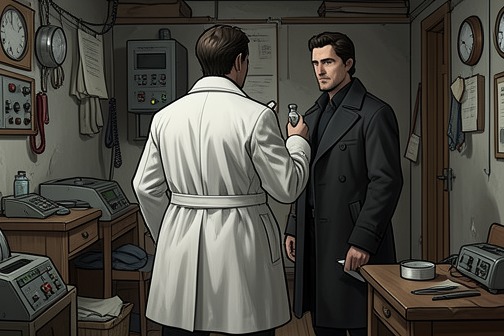
[Cargo’s Discovery of Theo’s Secret](entity:event-recall-event-cargo-s-discovery-of-th-46e66ad8a00e) is the decisive private revelation in which Cargo recognizes that [Theo](entity:character-recall-character-theo-107bd6003b61) is the host of the reincarnated [Demon King](entity:state-recall-state-demon-king-d4ce23d2b4c1), [Malthios](entity:character-recall-character-malthios-3bbf03e4fa99), and deliberately refuses to expose him. The event matters because Theo has built his life around concealment: he speaks little, avoids physical contact, and keeps emotional distance from the people of [Leafel](entity:location-recall-location-leafel-ce079facdeeb) in case he must flee again. Cargo’s knowledge does not remove the danger surrounding Theo’s identity, but it introduces a different possibility—that the truth can be seen and still met with judgment based on conduct rather than stigma.
## Circumstances of the Discovery
The discovery occurs during an ordinary medical round, not during a battle or a confession. Theo has been checking prescriptions and preparing treatments for Leafel’s residents, including medicine for [Glefald](entity:character-recall-character-glefald-56a6ec6b20a2), hand cream for the blacksmith Jep, and remedies for Farmer [Raf](entity:character-recall-character-raf-1a9812291de2)’s seasonal hay fever. Because Theo is still recovering and might collapse, Cargo accompanies him while [Wicker](entity:character-recall-character-wicker-4eaf8f5b7dfe) and [Veiv](entity:character-recall-character-veiv-2ba6a25fcbd2) handle his other chores. The practical setting is important: Cargo encounters Theo in the role he has chosen for himself, a healer serving a mixed-race town, rather than in the role imposed on him by the powers pursuing the Demon King.
As they walk toward town, Cargo remarks that the people of Leafel are already fond of Theo, with the notable exceptions of [Avery](entity:character-recall-character-avery-3f30ea9cdcd5) and [Emi](entity:character-recall-character-emi-6cd72baa2831). Theo answers that their dislike is no fault of his and describes himself as inherently unlikable. The exchange exposes the defensive identity Theo has cultivated. Leafel’s townsfolk wave and smile at him, while Theo responds with solemn nods because he rarely speaks, rarely smiles, and does not want to become physically or emotionally close to anyone. In his youth, this reserve protected him from Malthios because Theo never knew what might provoke the demon; later, it remained a means of keeping himself ready to run. Beneath that restraint lies the knowledge that no amount of friendship could save him if anyone learned what he was.
## Cargo Names the Hidden Identity
Cargo breaks through that concealment with a direct question about whether Theo will tell the others that he is demon spawn. Theo’s body freezes, his fingers nearly releasing the basket, and Malthios immediately stirs within him, attempting to take control so that they can defend themselves. Theo tries to conceal the meaning of Cargo’s words, asking what he means while his heart pounds in his throat. The physical reaction makes the secret visible before Theo can explain it: the danger is not theoretical, and even an apparently casual question threatens the entire life he has built in Leafel.
Cargo explains that he can smell the demon within Theo. At first, he had assumed the scent was merely residue from [Khal](entity:character-recall-character-khal-3b2ff6449c13)’s wound, but it has remained. He therefore identifies Theo as the unlucky person who became the Demon King’s host. Cargo’s perception depends on his animal senses; he says that he can smell demons and traces of magic and can also perceive connections that ordinary people cannot. The discovery is consequently not produced by an accidental overheard confession or a magical test. It comes from Cargo’s sustained sensory observation of Theo and from the failure of the demonic presence to disappear.
Theo responds by stating the moral and political meaning of the revelation: he is the enemy, the thing the others are fighting. His words show how completely he has absorbed the public logic of the Demon King conflict. He does not initially argue that Malthios is separate from him or that his own actions should matter more than his condition; instead, he presents the host identity as sufficient evidence of guilt. Cargo’s question has forced Theo to confront the distance between the healer he is in Leafel and the condemned figure the wider world would see.
## Silence as Protection
Cargo does not report Theo. He explains that Theo is a good person who is hurting nobody and is, literally, doing the opposite by healing people. This judgment places Theo’s actions above the category assigned to his body. Cargo also recognizes Theo’s connection to [Luc](entity:character-recall-character-luc-b00cd62cc765), describing it as a powerful thread between people who are meant to meet and insisting that neither deity nor demon can interfere with it. When Theo fears that the connection may exist only because Luc is destined to kill him, Cargo answers that this would be a complication, not the reason for their bond.
Cargo’s silence is therefore active rather than passive. He knows the truth, understands that it could result in Theo’s death, and still chooses to protect him because the evidence before him is Theo’s conduct and his relationship with Luc. The scene contrasts Cargo’s independent perception with the institutions that later reduce Theo to a legal category. Cargo can smell the Demon King, but he does not treat that scent as the whole person. His decision becomes an early counterexample to the belief that Theo’s hidden identity must determine every moral judgment made about him.
The exchange also gives Theo an unusual form of relief. He has spent years assuming that discovery would mean flight, punishment, or death, and has kept Leafel at emotional distance precisely to limit the damage when that moment came. Cargo’s knowledge does not expose him to the town; it remains safe with the snarky pig. For the first time, Theo is known by someone who has access to the truth and chooses not to weaponize it. The relief is complicated, because Cargo’s acceptance cannot guarantee safety, but it weakens the absolute isolation on which Theo’s survival strategy depends.
## Consequences for Theo’s Public Identity
The secret remains dangerous even after Cargo accepts it. When Theo later enters the capital to help Luc, he understands that his autonomy is ending: the authorities will know who he is and where he lives, and the [Hero](entity:concept-recall-concept-hero-c363661142b4)’s party may force him to resume his place among them. He goes because Luc may die, even though the journey creates the exact conditions under which Theo’s identity can be revealed. Cargo’s private protection thus stands against a much larger machinery of official recognition.
At the capital, Mage [Syvia](entity:character-recall-character-syvia-1e34b1c5407f) introduces him as the lost healer who disappeared while training for the Hero’s party thirteen years earlier. The label is already wrong to Theo because it restores the family name and institutional identity he abandoned when he fled. Later, the trial openly declares that Healer [Theo Bladefoot](entity:character-recall-character-theo-bladefoot-4a02f215e1d3) is the host of the reincarnated Demon King, Malthios. The public revelation confirms the danger Cargo had privately identified, but the responses are radically different. The court hears shouts demanding execution, while Cargo had heard the same truth and concluded that Theo was helping people.
The contrast becomes clearest when the people of Leafel intervene through [Micah](entity:character-recall-character-micah-b7a8af6bb3f9)’s mirror spell. [Imani](entity:character-recall-character-imani-3e59d6c7b288), [Dale](entity:character-recall-character-dale-fff2558efe87), [Nib](entity:character-recall-character-nib-c57b21ba9a3c), [Amaya](entity:character-recall-character-amaya-3164488322dd), [Dmitri](entity:character-recall-character-dmitri-f7165ee439b9) and his parents, and the wider town appear before the court, with [Hayden](entity:character-recall-character-hayden-3887fcc3a0d9) demanding Theo’s release. Their presence shows that Theo’s relationships in Leafel have not been erased by the truth. Cargo’s earlier decision anticipates this wider refusal to let the label of Demon King’s host replace the healer they know. What begins as one companion’s confidential acceptance becomes part of a collective defense of Theo’s lived identity.
## Narrative Significance
The event establishes selective disclosure as a central pattern in Theo’s story. Theo does not control every revelation of his identity: Cargo detects it, the capital authorities expose it, and the trial broadcasts it across [Algeya](entity:location-recall-location-algeya-1668b0a6fe56). Yet the moral consequences differ according to the person receiving the truth. Cargo treats the secret as knowledge requiring responsibility; the court treats it as proof of guilt; Leafel treats Theo’s years of care as evidence that the imposed category cannot exhaust who he is.
Cargo’s discovery also externalizes the conflict between [Theo and Malthios](entity:relation-recall-relation-theo-and-malthios-24da48fb7937). Theo freezes and Malthios pushes forward to defend them, showing that the hidden identity is not merely a social secret but a condition of shared embodiment. Even so, Cargo’s response does not demand that Theo separate himself from Malthios before he can deserve protection. He recognizes the demon, the host bond, Theo’s goodness, and Theo’s connection to Luc together. That refusal to simplify Theo anticipates the later emotional and political struggle over whether a person can be held responsible for a monstrous power living within him.
Most importantly, the discovery changes the meaning of being seen. Theo expects recognition to become a sentence. Cargo turns it into confidentiality, and Leafel later turns it into solidarity. The event does not solve the threat posed by Malthios or prevent the trial, but it gives the story a crucial counterforce to fear: someone learns the worst fact about Theo and still chooses to remain on his side.
Event 14
Glefald’s Terminal Relapse
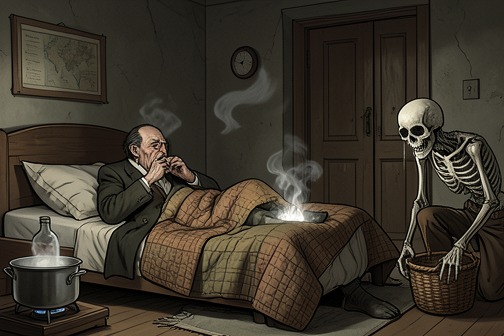
[Glefald’s Terminal Relapse](entity:event-recall-event-glefald-s-terminal-rela-1a62f07b3e37) is the deathbed diagnosis that turns an apparently routine visit into a reckoning with irreversible illness. When [Theo](entity:character-recall-character-theo-107bd6003b61) reaches the Watchtower, he finds [Glefald](entity:character-recall-character-glefald-56a6ec6b20a2) skeletal beneath a quilt, coughing through the night and surrounded by steam from a boiling pot. Theo’s healing knowledge identifies what Glefald has concealed: the rot in his lung has returned so severely that death is near. The event binds medical failure, personal guilt, and farewell preparation together, while showing that Theo’s role as a healer includes witnessing suffering that magic cannot ultimately remove.
## Causes and Background
Theo’s visit begins as an ordinary errand. He has brought a bottle of oil for Glefald and carries a basket of food for a picnic, with some of the load slung over Cargo’s flank. He has delayed visiting because [Hayden](entity:character-recall-character-hayden-3887fcc3a0d9)’s presence makes the Watchtower emotionally difficult for him, and that avoidance has consequences when [Micah](entity:character-recall-character-micah-b7a8af6bb3f9) answers the door and reports that Glefald has been coughing all night. The relapse is therefore discovered not through a summons but through Theo’s belated return.
The Watchtower’s treatment is already under way when Theo arrives. A small burner warms a pot, and steam drifts through Glefald’s room while the elf lies pale and skeletal against his pillow. Glefald admits that this is not his first turn of illness, but the severity of his condition makes clear that the current episode is not a minor recurrence. Theo’s healer’s instincts take control immediately: he leaves his basket outside with Cargo, follows Micah upstairs, and begins examining Glefald with magic.
## Diagnosis and Immediate Care
Theo asks whether Glefald intended to send for him while moving his hand slowly above the elf’s chest and lighting the room with magic. He orders Micah to prepare throat-cure tea with plenty of honey and a splash of whiskey, then confronts Glefald with the conclusion he can no longer soften: Glefald is dying, and the lung rot did not simply grow back overnight. The accusation carries anger because Glefald knew the danger and said nothing, but it also exposes Theo’s self-reproach. He believes he should have noticed the deterioration sooner and blames himself for staying away.
Glefald asks how long he has. Theo answers with a brutally short estimate: a month, if that. The precision is not comforting, but it gives the dying elf a limited period in which to make practical decisions. Theo offers to inform Hayden and the others, yet Glefald refuses that immediate intervention, choosing to tell them himself that night and to send a message to the [Adventurer’s Guild](entity:organization-recall-organization-adventurer-s-gui-104453e22888) requesting a replacement for his post.
Theo cannot reverse the illness, but he can reduce its pain. He advises Glefald to keep adding the oil to the steam, explaining that it will ease the cough and make breathing less painful, and tells him to send for help if the pain becomes too severe. The treatment is modest beside the prognosis, but its modesty is the point: Theo’s magic and medical skill remain meaningful without becoming a cure for death. Glefald’s room contains both care and defeat, with the steam offering temporary relief while the disease continues toward its known end.
## Glefald’s Farewell Preparation
The diagnosis immediately changes Glefald’s relationship to the Watchtower. He does not merely receive treatment; he begins arranging what will happen after his death. His message to the Adventurer’s Guild will request a replacement, while his personal promise to tell Hayden and the others that evening gives him control over how his condition is disclosed. The event thus preserves Glefald’s agency even as his body loses strength.
A black-and-white cat named Muffins enters the scene as another part of the life Glefald is preparing to leave behind. Muffins has lived in the Watchtower since she was a kitten, and Glefald jokes that he hopes his replacement will like cats. Theo reassures him that the others will not let anything happen to her. The detail makes the impending vacancy concrete: Glefald is not only leaving a duty, but also a familiar room, a dependent animal, and a small community whose care must continue without him.
Glefald’s gratitude gives the scene its emotional counterweight. After Theo promises continued help, Glefald tells him that he is lucky to have met him. Theo is unable to remember leaving the Watchtower, collecting his basket, or walking back to his shop. The diagnosis has therefore produced a second shock beyond the medical fact itself: it strips ordinary movement of meaning and leaves Theo suspended between professional composure and grief.
## Theo’s Guilt and the Limits of Healing
Theo responds to Glefald’s relapse with disproportionate self-condemnation. He sees his absence as a failure of duty and believes he should have caught the deterioration at its beginning. The guilt becomes still more severe because he is sheltering the being responsible for the elf’s suffering: [Malthios](entity:character-recall-character-malthios-3bbf03e4fa99), the [Demon King](entity:state-recall-state-demon-king-d4ce23d2b4c1), lives within Theo as his host. Theo’s private logic turns the relapse into an indictment of his entire existence, extending from one missed visit to the belief that he deserves to die for protecting the source of Glefald’s illness.
Malthios interrupts that descent, growling at Theo so loudly that he flinches. Their shared body makes the crisis structurally intimate: Theo cannot regard the responsible power as a distant enemy, because Malthios is present inside him and can answer his self-hatred. Yet the event does not erase responsibility or cure the disease. It instead establishes the contradiction that defines Theo’s healing burden. He can diagnose, soothe, and accompany; he cannot restore a ruined lung to health or make mortality obey compassion.
The relapse also exposes how Theo’s protective walls are failing. Before reaching the Watchtower, he has been trying to remain emotionally detached, but the villagers’ affection and physical embraces have already begun to unsettle that isolation. Glefald’s frailty and final thanks make detachment impossible. Theo’s professional response becomes an expression of attachment, and his failure to save Glefald becomes painful precisely because Glefald is no longer merely a patient.
## Consequences and Narrative Significance
Glefald’s Terminal Relapse establishes a clear countdown of approximately one month and initiates the process by which the Watchtower will require a replacement. It also places Hayden and the other members of the local community before an impending loss that Glefald intends to announce himself. The consequences are administrative, domestic, and emotional at once: a post must be filled, Muffins must be protected, and the people connected to Glefald must prepare for his absence.
As a turning point, the event contrasts with the later political crisis surrounding Theo’s identity. Theo fears that no amount of friendship will save him if anyone discovers what he is, while Glefald’s bedside scene shows friendship operating in the face of a different kind of inevitability: it cannot prevent death, but it can make suffering less lonely and preserve a person’s choices. This distinction becomes central to Theo’s developing understanding of care.
The event also anticipates the novel’s broader challenge to heroic and dynastic expectations. [Luc](entity:character-recall-character-luc-b00cd62cc765) later rejects the demand that he continue the [Hero](entity:concept-recall-concept-hero-c363661142b4)’s bloodline and chooses a peaceful life with Theo, declaring that people born with the Hero’s gift should be able to choose their fate. Glefald’s diagnosis supplies an earlier, quieter version of the same conflict with imposed roles and limited time. Against institutions that treat people as replaceable—the Watchtower can receive a replacement, and the Hero’s system can raise another child—Theo and Glefald insist on the irreducible value of one particular life, even when that life cannot be prolonged.
Event 15
The Battle that Destroyed the Pentagram
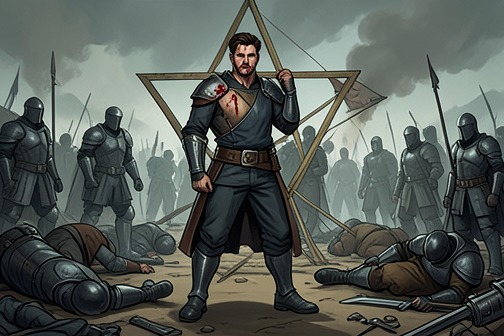
[The Battle that Destroyed the Pentagram](entity:event-recall-event-the-battle-that-destroy-7359a9b1b8ba) is the decisive military and emotional catastrophe of [Malthios](entity:character-recall-character-malthios-3bbf03e4fa99)’s early reign. What begins as a routine assault on a small mortal settlement becomes the encounter that destroys the Pentagram as a living group, kills most of its members, and leaves Malthios carrying the memory of their deaths. Its significance reaches beyond the battlefield: years later, the recollections of [Kamil](entity:character-recall-character-kamil-88c659fbf1a3), [Aym](entity:character-recall-character-aym-bc4f15f5be03), [Torq](entity:character-recall-character-torq-7e92679e994e), and [Foras](entity:character-recall-character-foras-2260f2d99951) return as accusations against the immortality that had made their future seem unlimited, while the same history helps explain the grief and severity surrounding Malthios’s later identity as the [Demon King](entity:state-recall-state-demon-king-d4ce23d2b4c1).
## Causes and Battlefield Context
The battle occurs after the Pentagram has been placed in command of a large battalion composed of [Demonkin](entity:creature-recall-creature-demonkin-5aa641de4c0f) and Novices. Malthios serves as Commander, while the other members act as his seconds. The unit has already proved highly effective, destroying towns and cities and penetrating farther into mortal territory than any comparable force. That record makes the mission appear familiar rather than exceptional. The target is a small, unassuming town barely larger than a village, and the attack begins under the assumptions of a campaign the demons have carried out many times before.
The mortals, however, refuse the expected pattern of flight and terror. They are a mixture of races and are not individually more powerful than the attackers, yet they fight back with axes, short swords, arrows, and modest magic from several mages. Their resistance carries strategic meaning before its cause is understood: something has given them the resolve to hold their ground. Several Demonkin and at least one [Novice](entity:state-recall-state-novice-f13adec542e6) fall in the opening violence, and the apparently minor settlement becomes the site of a battle whose scale is defined less by the town itself than by the force driving its defenders.
## The [Hero](entity:concept-recall-concept-hero-c363661142b4)’s Appearance and the Failed Retreat
Malthios recognizes the turning point when a figure enters the field whose presence can be felt across the battlefield. The figure is not especially tall, but has the body of a hardened warrior and a radiance resembling sunlight beneath the skin. The sword in the figure’s hand is better made than any weapon previously seen in the town. Aym identifies the figure as the Hero, transforming the encounter from a local clash into a confrontation between the established demonic order and the champion capable of challenging it.
Malthios responds by ordering the troops to intensify their attack, but Kamil immediately grasps the danger and argues that the group must flee. Her judgment rests on a known hierarchy of power: only a Demon King can stand against a Hero. Malthios nevertheless chooses to remain behind while Kamil, Aym, Torq, and Foras withdraw the battalion. He directs them to call the retreat and get the troops to the transport circle within five minutes, with flight as a last resort if the situation becomes desperate.
The withdrawal is organized through the distinct skills of the Pentagram. Torq sounds the horn, its note cutting through the battle noise. Aym begins opening the transport circle, their magic lighting the golden ember of their eyes. Kamil prepares throwing knives and uses wind to control their movement. Foras gathers sparking mana around his hands, while Torq stands beside him with his great war hammer. The troops move toward the circle, but the mortals rally, and most of the Novices converge on the Hero in an attempt to obscure the figure’s radiance.
The attempted retreat collapses when a blast of magical energy tears across the battlefield. [Demons](entity:creature-recall-creature-demons-6600dcc7335a) fall like scattered leaves. Malthios braces himself, as does Torq, with Foras clinging to him for support; Aym is hurled into a tree, causing the transport circle to wink out, and Kamil is thrown sprawling before catching herself. The Novices are not merely defeated: they are killed, their bodies charred before dissolving into shadows. With the escape route gone and the Hero temporarily nowhere in sight, the surviving members have no safe withdrawal left to them.
## Destruction of the Pentagram
Malthios pulls Kamil to her feet and calls for Aym, intending to carry the injured member away. The battle then assumes the suspended, almost unreal quality of a fatal recognition. A figure appears beside Aym, and the Hero’s sword pierces their body. Malthios knows that body intimately, having shared it in sexual union, and therefore experiences the wound not as an impersonal casualty but as the destruction of someone whose strength and certainty he knows from within. He tries to scream, but no sound emerges.
The Hero charges again. Torq answers by making the ground react to his magic, sending roots and rocks exploding upward, while Foras adds a rain of ice shards. The Hero evades both attacks and cuts through [Torq and Foras](entity:relation-recall-relation-torq-and-foras-b8afec67d80a). Torq throws himself in front of Foras in an attempt to shield him, turning their final exchange into an act of protection as well as a failed counterattack. The pair’s deaths complete the collapse of the group’s physical defense and leave Malthios exposed as the last effective combatant.
Malthios recovers from his paralysis and attacks with a sword whose motion sends a whip of blue fire through the air. The Hero blocks the strike and closes the distance. Malthios surrounds himself with fire and manages to withstand the Hero’s blows for a time, but the disparity in speed and strength is unmistakable. A strike catches him in the shoulder and throws him backward, with his wings barely keeping him from falling. The battle has become not a contest he can win but a narrowing choice between death and flight.
Kamil makes that choice for him. When the Hero’s attack leaves Malthios vulnerable, wind catches beneath his wings and hurls him upward and away. Kamil has raised her hands to summon it, sacrificing her position to save him. She smiles at him with the same wide, genuine expression associated with their first meeting, and the Hero’s sword cuts through her neck while she is still smiling. Her death gives the retreat its final meaning: Malthios survives because Kamil deliberately sends him out of danger, but survival is purchased through the annihilation of the people he was meant to lead.
## Escape, Grief, and Historical Consequences
Malthios’s instincts carry him away from the battlefield at great speed. He flies blindly for a long time before landing on a mountainside ledge after the sun has set. His shoulder continues to ache even though it should have healed long before, making the injury a physical remainder of a battle that has exceeded ordinary demonic endurance. He falls to his knees and only gradually realizes that his face is wet with tears.
Those tears are made of blood. Demons weep differently from mortals, and the text treats demonic crying as the equivalent of a wound: grief has forced Malthios into a condition his body and nature are not meant to sustain. He looks into the dark sky and screams, an ending that refuses military triumph, strategic explanation, or consoling closure. The commander who ordered the attack and the retreat is left not with a victory, but with the knowledge that the entire Pentagram has been destroyed while he alone escapes.
The later account of Malthios’s memory makes the battle a long-term source of remorse. Immortals had arrogantly assumed that they possessed endless years, but Malthios comes to regret not using the fifty years after ascension more fully. The bright memories that return to him include Kamil’s laugh, Aym’s soft smile when they first woke, Torq’s warmth as he crushed the group in a hug, and Foras’s dry humor. These recollections are eventually replaced by darker memories, so that the battle does not remain a single past event; it becomes the organizing wound through which Malthios experiences the passage of decades and the cost of his former certainty.
## Later Reinterpretation and Narrative Significance
The battle’s importance is confirmed by Malthios’s later actions and by the public consequences of his survival. Much later, when he speaks of the destruction of the [Demon Fortress](entity:location-recall-location-demon-fortress-e361fb201537), he acknowledges that he destroyed the fortress and everyone there, while allowing that lesser demons and demon-created monsters may still remain. He also states that there is no longer any need for a Hero. That declaration gives the earlier battle a grim structural echo: the former victim of the Hero’s assault ultimately becomes the figure capable of ending the organized demonic stronghold, but the power to do so is inseparable from the losses that shaped him.
The event also clarifies why Malthios’s later trial cannot be reduced to a simple question of guilt or innocence. He is eventually sentenced to life in prison as the Demon King, while Healer [Theo Bladefoot](entity:character-recall-character-theo-bladefoot-4a02f215e1d3) is cleared of all charges. The decision follows a public intervention by the people of [Leafel](entity:location-recall-location-leafel-ce079facdeeb), who use a mirror spell to demand [Theo](entity:character-recall-character-theo-107bd6003b61)’s release, and [Luc](entity:character-recall-character-luc-b00cd62cc765)’s insistence that the Hero’s duty to kill the Demon King does not determine when the killing must occur. The legal aftermath therefore contrasts with the Pentagram battle’s absolute logic: on the battlefield, the Hero’s sword decides life and death in an instant; in the trial, responsibility, protection, and future coexistence remain open to judgment.
As a plot event, The Battle that Destroyed the Pentagram combines military defeat, sacrifice, recognition, and irreversible loss. Its value shift is stark: Malthios begins with command, an effective battalion, and the confidence of a familiar campaign, then loses the transport route, his forces, his companions, and his certainty that immortality provides time enough for everything to be repaired. [The Pentagram](entity:organization-recall-organization-the-pentagram-52f60bc5f5a8)’s destruction is thus both a tactical defeat and the end of a chosen family. Its aftermath lives in Malthios’s blood tears, his decades of regret, and the later struggle to decide whether a Demon King must be destroyed or whether the cycle that produced such devastation can be interrupted.
Event 16
The Hero’s Party’s Farewell from Leafel
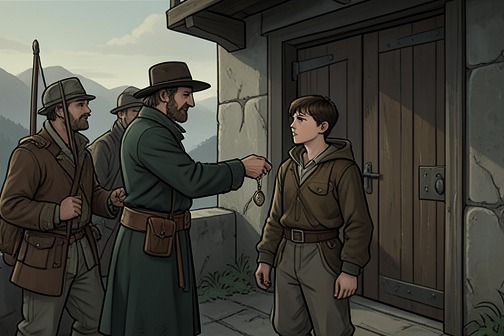
[The Hero’s Party’s Farewell from Leafel](entity:event-recall-event-the-hero-s-party-s-fare-9e38d873f4b6) is the decisive parting between [Theo](entity:character-recall-character-theo-107bd6003b61) and the [Hero](entity:concept-recall-concept-hero-c363661142b4)’s party at the [Leafel Watchtower](entity:location-recall-location-leafel-watchtower-445b76b722ca). The scene transforms an ordinary departure into a declaration of chosen attachment: Theo releases the party from any obligation to return, gives [Luc](entity:character-recall-character-luc-b00cd62cc765) a fluorite pendant as a private reminder, and nevertheless makes clear that he will be waiting. The farewell therefore marks both separation and continuity, establishing the promise that later enables [Theo and Luc](entity:relation-recall-relation-theo-and-luc-6c31719ecbcf) to recognize their relationship as stronger than the heroic duties imposed on them.
## Setting and Circumstances
The farewell follows a period in which the Hero’s party has stayed in [Leafel](entity:location-recall-location-leafel-ce079facdeeb) while Theo’s connection with Luc has deepened. The departure is emotionally charged because Theo has already experienced Luc as more than a passing companion, even though Luc has described the instability of the Hero’s life. Luc has had several relationships, including a maid in training, a squire who ended their relationship when Luc was announced to be leaving, and other short-lived attachments formed during the party’s temporary stays in towns. He presents this pattern as part of the fate of the Hero: movement makes permanence difficult, while duty determines where he must go.
The leave-taking also occurs against the strain of Theo’s hidden condition. Theo is the [Demon King](entity:state-recall-state-demon-king-d4ce23d2b4c1)’s host, and [Malthios](entity:character-recall-character-malthios-3bbf03e4fa99)’s presence means that Theo and the Demon King share knowledge of one another’s thoughts and feelings. Theo’s refusal to follow Malthios’s orders has repeatedly provoked threats, insults, and incapacitating headaches, but Malthios cannot simply abandon Theo for another host: the transfer spell took more than a human lifetime to prepare, and Theo’s death would also kill Malthios. Their forced coexistence makes Theo’s attachment to Luc especially dangerous, because separation threatens not only romantic happiness but also Theo’s ability to protect the people and life he has chosen.
## The Departure from Leafel
Theo arrives early at the [Broken Blade](entity:location-recall-location-broken-blade-7199f39a563c) after a restless night. The absence of a warm body beside him makes the coming separation tangible before anyone has left. [Imani](entity:character-recall-character-imani-3e59d6c7b288) seats him at a large table and brings fresh scones, while [Wicker](entity:character-recall-character-wicker-4eaf8f5b7dfe) arrives first from the Hero’s party and rests their head on Theo’s shoulder. Wicker says, “I’ll miss you, Theo,” and Theo replies that he will miss Wicker as well, surprised by the sincerity of his own answer. The exchange shows that the farewell is not limited to Luc; Theo has formed attachments throughout the party, even with people whose presence once represented disruption or danger.
[Avery](entity:character-recall-character-avery-3f30ea9cdcd5) and [Emi](entity:character-recall-character-emi-6cd72baa2831) arrive next and remain silent, a restraint Theo accepts without resentment. Cargo comes before [Khal](entity:character-recall-character-khal-3b2ff6449c13) and Luc, and the shadows beneath Luc’s eyes reveal that the Hero has slept no better than Theo. Luc’s shoulders relax when he sees Theo, and he sits on the bench beside him. [Genevieve](entity:character-recall-character-genevieve-b111d6158efa) and [Bryony](entity:character-recall-character-bryony-77c7475dde0d) arrive later, with Bryony’s damp blond braids suggesting that [Veiv](entity:character-recall-character-veiv-2ba6a25fcbd2) has forced her awake with cold water. After breakfast, the party gathers its packs, some of them being strapped to Cargo, and walks quietly through Leafel toward the Watchtower while much of the town is still rising late.
At the Watchtower, Theo stops and states that this is where he leaves the party. He wishes that all of them will return to Leafel well and whole. The formal wording is restrained, but the party answers with unexpected physical affection: Bryony, Wicker, Veiv, and Khal draw everyone into a group hug. Theo does not resist it. The gesture converts the party’s departure from a purely logistical separation into an acknowledgment that Theo has become part of their circle, even though he will not continue along their road.
## Theo’s Gift and Promise to Luc
After the group steps back, Luc stands directly before Theo and studies his face as though trying to memorize it, uncertain how to proceed. Theo breaks the hesitation by offering a gift. It is the fluorite spear that Wicker gave him, twisted into metal wire and hung from a chain. Theo tells Luc that he should have something to remind him of Theo and adds that Luc should know Theo will be waiting if he returns.
The object carries several layers of meaning. It originates with Wicker, so Theo gives Luc not merely a personal ornament but a transformed remnant of the party and its shared history. The spear, once a weapon, becomes a pendant: an instrument associated with conflict is remade as a token of memory and patience. Theo’s light tone cannot conceal that the act is unfamiliar territory. He is trying to offer love without turning the gift into a demand, and he explicitly gives Luc permission to continue living if the Hero’s journey leads him elsewhere.
When Luc reaches for Theo, Theo catches his hand and insists that neither of them has anything to be ashamed of. He proposes that they part as friends and says he will not blame Luc if Luc finds someone else, wishing him nothing but the best. This apparent renunciation is the scene’s central contradiction. Theo protects Luc from guilt by denying him any obligation, yet the gift and the promise preserve the possibility of return. Freedom is offered through language, while attachment remains present in the object placed against Luc’s body.
## Separation, Return, and the Future They Choose
The farewell’s immediate consequence is absence. The Hero’s party continues its mission, while Theo remains in Leafel rather than following the heroic road. The separation intensifies Theo’s physical and emotional vulnerability: in the following weeks, Malthios remains unstable and insulting, Theo works excessively, sleeps very little, and suffers recurring nightmares of Luc’s broken, blood-covered body. His illness develops amid this strain, showing that the departure is not a clean emotional conclusion but an unresolved wound carried into daily life.
The promise made at the Watchtower later becomes reciprocal. When Theo and Luc meet again, Theo touches the pendant and reminds Luc that he marked Luc first and promised to wait, no matter how long it takes. Luc answers with his father’s ring, a dark sapphire set in scaled silver. The ring is the last thing Luc possesses from his father, who died after saving an adventuring party from a Demon attack. Luc places it on Theo’s marriage finger, and the band unexpectedly contracts to fit. The exchange reverses the emotional direction of the earlier farewell: Theo had sent Luc away with a reminder, but Luc returns with an heirloom and a bodily sign of commitment.
The later conflict reveals how much the farewell has changed. Hero [Eliza](entity:character-recall-character-eliza-6ec11b83dd18) wants Luc to continue the bloodline and sire the next Hero, a future that cannot be achieved through either Luc’s former male lover [Julius](entity:character-recall-character-julius-2b9b6a5d3dd6) or Theo. Luc is therefore pressured to understand his life as an instrument of inheritance. By choosing Theo, he rejects the idea that the Hero’s future must be defined by reproduction and duty. At the trial of the Demon King’s host, Luc describes Theo as the Demon King’s prison and himself as Theo’s humble guard, promising not to let Theo out of his sight. When Eliza accuses Luc of ending their bloodline and abandoning everything for which he trained, Luc answers that this is the only choice he has ever made for himself: to live quietly and peacefully with the man he loves, and to help create a world in which those born with the Hero’s gift can choose their fate rather than remain bound to duty.
## Narrative Significance
The farewell is a threshold scene in the Hero’s journey, but it inverts the conventional return to glory. The party leaves Leafel to continue heroic action, while Theo’s remaining in the village affirms another kind of responsibility: care, community, and a life not organized around conquest. The group hug establishes a chosen family, and Theo’s pendant turns departure into a ritual of remembrance rather than a severing of ties.
The event also makes emotional labor visible. Theo tries to keep his tone light while giving Luc the pendant, offers Luc permission to find someone else, and frames his own pain as something Luc need not carry. Luc, meanwhile, arrives exhausted but visibly relaxes at the sight of Theo, revealing feelings that the duties of the Hero normally require him to suppress. Their later reunion and Luc’s refusal of Eliza’s bloodline imperative show that the farewell was not a failed romance interrupted by duty. It was the first clear articulation of a rival future, one based on mutual choice rather than heroic conscription, compulsory inheritance, or the fatal logic of Malthios’s power.
The departure’s deepest reversal is that leaving does not end belonging. Theo remains in Leafel, but the party’s affection follows him; Luc continues the Hero’s road, but the pendant carries Theo with him. When the larger conflict finally places Theo before the court, Leafel’s people gather through a mirror portal to demand his release, and Luc publicly chooses life with Theo over the bloodline imposed by Eliza. The farewell thus functions as the emotional seed of the ending: a quiet promise at the Watchtower grows into a public refusal of inherited duty and a declaration that a shared life can be chosen even in a world built to deny it.
Event 17
Malthios’s Ascension to Demon King
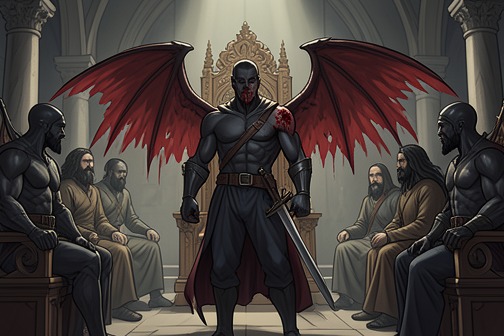
[Malthios’s Ascension to Demon King](entity:event-recall-event-malthios-s-ascension-to-224c8fb24a2b) is the decisive transformation that converts [Malthios](entity:character-recall-character-malthios-3bbf03e4fa99)’s private grief into a change in the political order of demonkind. The event begins with a wounded commander returning to the throne hall and ends with his wings changing from black to blood red as the watching demons recognize that he has become their new ruler. Its significance is not merely military: the ascension exposes the brutal law governing demon authority, in which sovereignty is earned through death and power rather than inherited through royal blood.
## Causes and Background
Malthios enters the throne hall after the destruction of the Pentagram, the group whose members had been his friends and comrades. He throws open the doors while blood streaks his cheeks and throat, more blood leaks from a wound in his shoulder, and his sword remains bare in his hand. The assembled [Demon Lords](entity:creature-recall-creature-demon-lords-faedb062c0d5) and Novices immediately turn toward him, while Commander [Fulton](entity:character-recall-character-fulton-237e141b857f) asks what has happened. Malthios does not answer him at first. His attention moves across the chairs until it settles on [Naamah](entity:character-recall-character-naamah-dad44180c7cf), identifying the person he believes responsible for sending the Pentagram into danger.
Naamah’s role in the catastrophe is presented as deliberate concealment rather than simple error. Malthios accuses her of knowing that the [Hero](entity:concept-recall-concept-hero-c363661142b4) would be present and allowing the Pentagram to walk into the encounter blindly. In his account, everyone is dead because Naamah withheld the warning. Her response reveals the political contempt underlying the demon hierarchy: she claims that if the Pentagram had truly been powerful, it would have defeated the Hero, and she declares that none of its members were fit to ascend to [Demon King](entity:state-recall-state-demon-king-d4ce23d2b4c1). Her insult singles out [Aym](entity:character-recall-character-aym-bc4f15f5be03), reducing one of Malthios’s dead companions to a dismissive reference even as Malthios is still carrying the immediate shock of the massacre.
The later explanation of Malthios’s past gives the ascension a second foundation. He was not born into a demon royal family, because demons have no royalty in the hereditary human sense. His early life was spent surviving on the streets after his parents abandoned him, and he would have died there if a Demon Lord had not sponsored him. His rise therefore begins in abandonment and dependence, not privilege. The same system that once allowed him to be rescued later makes him eligible to seize the highest position through demonstrated force.
## The Retaliatory Assault
Malthios’s answer to Naamah is both accusation and vow. He insists that she has no right to speak the names of the fallen, declaring that they are the reason he is alive and the reason he has become who he is. He then promises to avenge them. The conflict shifts at that moment from a dispute over military responsibility to a personal act of retribution, with the dead Pentagram standing behind every movement of the fight.
Malthios attacks first. His wings launch him forward while blue fire blazes across his body, and Naamah summons a spear to block his strike, opening her wings to counter the force. Several of Naamah’s Novices join her from the edge of the room, turning the confrontation into a dozen-against-one battle. The numerical disadvantage barely registers for Malthios. His vision is filled by the deaths he has witnessed: Aym’s slack, surprised expression; [Torq](entity:character-recall-character-torq-7e92679e994e) throwing himself in front of [Foras](entity:character-recall-character-foras-2260f2d99951); and [Kamil](entity:character-recall-character-kamil-88c659fbf1a3) smiling at him. Memory does not soften the violence. It concentrates it.
His magic then erupts around him, expanding his fire as he cuts down the Novices. Their blood clings to his body while Naamah retreats, and the fear that crosses her face becomes, for Malthios, a measure of belated justice. When she turns to flee, he drives her to the ground, pins one of her legs with his sword, and tears away her wings. Naamah’s screams do not interrupt his purpose. He removes the second wing as well, then pulls his sword free and sets her body alight. Fire consumes her completely, leaving scattered ashes rather than a body that could become shadows.
## The Ascension Itself
After Naamah’s death, Malthios stands over the ashes with blood on the floor and mana still simmering beneath his skin. His power spikes in the same manner it had when he previously ascended to Demon Lord. This recurrence makes the transformation legible to the demons watching him: the violence has not simply ended a vendetta but triggered the next recognized stage of his existence.
His wings open to their full length before the assembled witnesses. Their glossy black feathers change into a dark blood red, a visible mark produced by the deaths he has caused. Most of those present already understand what is happening, and many have apparently been anticipating it since Malthios began killing his own kind. The scene therefore combines revelation with public confirmation. Malthios does not receive a crown, inherit a title, or obtain authority through a council’s appointment; his body becomes the proof of his new status.
The transformation is summarized in the stark declaration that a new Demon King has risen. Later, Malthios explains that the red wings are the consequence of killing many of his own kind in order to ascend. They remain a permanent reminder of how he gained his position, turning victory into an indelible record of bloodshed. His ascension is thus both elevation and stain: the same mark that proves his worthiness also preserves the memory of the comrades and enemies whose deaths made his rule possible.
## Demon Law and Personal History
Malthios’s rise also clarifies the difference between succession among demons and succession among humans. He explains that a demon’s position is gained through death and power, and that only someone worthy of the relevant power can ascend to Demon King. His transformation is therefore not a ceremonial promotion but the visible outcome of a violent qualification. When [Luc](entity:character-recall-character-luc-b00cd62cc765) compares this process to being chosen, Malthios can only answer that it happened to him rather than being something he selected. The language of choice is important: he becomes sovereign through his own actions, yet the role arrives as an imposed consequence of those actions.
The event also complicates the idea that Malthios was destined for rulership. His abandoned childhood and years surviving on the streets place him at the lowest edge of demon society before a Demon Lord sponsors him. Nothing in that history promises a throne. His ascent instead follows a harsh meritocratic logic in which survival, sponsorship, combat, and demonstrated power replace bloodline. The system can lift an abandoned child, but it does so through the same violence that makes advancement a record of killing.
## Consequences for Malthios and [Theo](entity:character-recall-character-theo-107bd6003b61)
The new title does not erase the cost of the Pentagram’s destruction. Malthios’s red wings embody the deaths of his own kind, while his recollection of Aym, Torq, Foras, and Kamil keeps the ascension tied to grief rather than detached ambition. His revenge establishes him as Demon King, but it also leaves him carrying the memory of the people he wanted to avenge. Power and mourning are fused in the transformation instead of appearing as separate stages.
That history later becomes part of Malthios’s shared life with Theo. Theo fears that friendship cannot save him if anyone discovers what he is, and Cargo eventually identifies him as the Demon King’s host by directly asking whether he will reveal that he is demon spawn. When Theo is summoned to the capital, he understands that the court could force him into the Hero’s party and expose the truth, yet he accepts the danger because Luc may die. The earlier ascension gives this danger its full meaning: Theo is not merely concealing an unusual magical condition but sheltering the being whose sovereignty was created through the slaughter of demons.
The trial makes that concealed history public. After Theo confirms what he is, he is taken through a portal to the capital, placed in magic-dampening handcuffs, and led toward the dungeons while Luc remains silent. The court declares Healer Theo guilty for protecting Malthios, but the people of [Leafel](entity:location-recall-location-leafel-ce079facdeeb) answer through a mirror spell. [Micah](entity:character-recall-character-micah-b7a8af6bb3f9) raises the spell before the gathered villagers, with [Imani](entity:character-recall-character-imani-3e59d6c7b288), [Dale](entity:character-recall-character-dale-fff2558efe87), [Dmitri](entity:character-recall-character-dmitri-f7165ee439b9) and his parents, [Nib](entity:character-recall-character-nib-c57b21ba9a3c), [Amaya](entity:character-recall-character-amaya-3164488322dd), and others behind him; [Hayden](entity:character-recall-character-hayden-3887fcc3a0d9) then demands Theo’s release. The political order that labels Malthios’s host a criminal is contrasted with a community that refuses to abandon the person it knows.
## Memory, Mortality, and Legacy
Malthios’s ascension is repeatedly set against ordinary acts of care that resist the logic of power. After [Glefald](entity:character-recall-character-glefald-56a6ec6b20a2)’s death, the people of Leafel honor his wish for burial in the earth and plant a tree over his body, placing it across from the Watchtower so that it will eventually serve as a second guardian. They preserve his knitwear as mementos, and Theo receives a soft scarf Glefald had made specially for him. Such remembrance creates continuity through nurture and memory rather than conquest, offering a moral counterimage to wings reddened by blood.
The same contrast appears during the party’s encounter with the nested ghost near the Abandoned Well. The rotted structure emits distant cries, and the party discovers a dead child trapped within the supernatural creature. [Wicker](entity:character-recall-character-wicker-4eaf8f5b7dfe) burns away the nested beast with an oil-soaked, rune-marked torch; once the corpse collapses, a silvery figure of the boy appears above the blackened remains and begs to go home. Theo responds by offering to take him home. The scene distinguishes destruction that releases the dead from destruction pursued for vengeance: both involve fire, but Theo’s magic turns death toward restoration while Malthios’s fire turns an enemy into ashes.
## Narrative Significance
As an event, Malthios’s Ascension to Demon King functions as a reversal in which bereavement becomes sovereignty. The wounded commander who returns to accuse Naamah is still acting as a member of the Pentagram, but the killing transforms him into the ruler of the demonkind he has begun to destroy. Its recognition scene is bodily rather than verbal: the witnesses read the change in his wings before the narrative states that a new Demon King has risen.
The ascension also establishes the central contradiction of Malthios’s later existence. He is made powerful by the deaths of his own people, yet his most enduring ties are built through comradeship, shared life, and protection. The blood-red wings certify the authority of the Demon King, but they cannot make the past disappear. Every later question about Theo’s secret, every threat from the court, and every act of communal loyalty returns to the same foundation: Malthios’s rule began as an act of revenge, and the world must decide whether the person formed by that violence can become something other than its continuation.
Event 18
Malthios’s Defeat by Hero Eliza
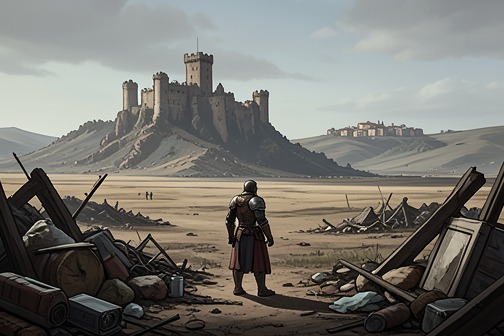
[Malthios’s Defeat by Hero Eliza](entity:event-recall-event-malthios-s-defeat-by-he-3d4776025e29) marks the military collapse of [Malthios](entity:character-recall-character-malthios-3bbf03e4fa99)’s reign as [Demon King](entity:state-recall-state-demon-king-d4ce23d2b4c1) and the turning point that carries the conflict beyond a conventional heroic victory. The defeat is prepared by a long demographic and political reversal: mortals grow in number and strength, form kingdoms and alliances, and unite as [Algeya](entity:location-recall-location-algeya-1668b0a6fe56), while the [Demonkin](entity:creature-recall-creature-demonkin-5aa641de4c0f) population remains depleted after [Demon Lords](entity:creature-recall-creature-demon-lords-faedb062c0d5) killed large numbers of their own kind in failed attempts to become Demon King. By the time the [Hero](entity:concept-recall-concept-hero-c363661142b4)’s party enters Malthios’s territory, only the Demon King’s castle and the surrounding far-northern region remain secure for the demons.
## Causes and Background
Malthios recognizes the change before the final assault begins. He watches mortal society expand despite repeated slaughter, with new people replacing those who die, while the demons fail to replenish their forces quickly enough. The contrast exposes a weakness in immortal power: immortality provides unlimited time, but not necessarily the discipline to use that time for growth and improvement. Mortal persistence therefore becomes a strategic force capable of pushing the demons back and constructing a united country around them.
The disappearance of the castle’s scouts intensifies the sense that Malthios’s position is narrowing. The Hero’s party has entered his territory, yet none of the scouts sent to find them returns, including [Luvel](entity:character-recall-character-luvel-c4c2298ed8f2) and [Nissle](entity:character-recall-character-nissle-3db92c538b90), whom Malthios assumes have fled. When the alarm finally sounds inside the castle, the news reaches him in the library, the one place where he can be alone even though he is not reading. [Keplo](entity:character-recall-character-keplo-57c7f47905e7)’s abrupt entrance first irritates him, but the general’s report also awakens something close to excitement. Rather than retreating or allowing his forces to absorb the attack piecemeal, Malthios orders the intruders funneled into the throne room and decides to meet them there himself.
## The Assault on the Throne Room
Malthios waits on his stone throne until the doors crash open and six members of the Hero’s party enter. He identifies [Eliza](entity:character-recall-character-eliza-6ec11b83dd18) immediately through the glow surrounding her body and the reddish blade in her hand, a weapon made and blessed to take the Demon King’s head. Her companions include two fighters, one specializing in close combat and the other in ranged attacks, two mages, and a healer. Malthios does not study their faces because he regards them as collateral damage in the confrontation that matters: the battle between the Demon King and the Hero.
The fight begins without speeches. Malthios immediately tries to separate Eliza from her companions, dropping a column onto the healer so that the mages must concentrate on stabilizing the injured party member. The two fighters soon return, but Malthios deflects them with ease and creates a circle of fire around himself and Eliza, cutting the pair off from the rest of the throne room. The battlefield becomes a deliberately bounded duel, with the survival of the wider party temporarily subordinated to the contest between the two central figures.
Eliza proves more controlled than the previous Hero Malthios had fought. She keeps her power at a level that does not immediately consume her life force, maintaining discipline while pressing the attack. Her amber eyes show no fear, and the gold, red-jeweled hilt of her sword flashes against the blue fire surrounding the duel. Her blade strikes Malthios’s black sword with matched strength, and the collision of their mana cracks the floor beneath them. Both combatants sustain injuries, though neither is initially incapacitated; the damage slows them without deciding the outcome.
## Eliza’s Victory
The reversal comes when Eliza’s light suddenly brightens and her mana spikes. Malthios brings his black blade across his body to block the incoming strike, but the weapon shatters like glass. Eliza’s sword then pierces his stomach and remains embedded as he drops to his knees. The attack locks his limbs with burning pain and transforms his confidence in the duel into physical helplessness. Eliza steps closer rather than allowing him to withdraw and commands him to die as Demon King.
Malthios’s defeat is not presented as the end of his will. Even while wounded, he glares up at Eliza and reaches for the sigil inked on his forearm, warning her that she has not seen the last of him. When she pulls the sword free, he forces mana into the sigil as his crown slips from his head and his vision darkens. The gesture makes the scene a victory with an open wound at its center: Eliza wins the throne-room battle and kills the reigning Demon King, but Malthios acts before death can become final closure. His last resolve remains directed toward Algeya and its Hero, whom he still imagines brought low before him.
## Immediate Meaning of the Defeat
The battle changes the political balance that had governed the setting. Malthios’s fall follows the rise of Algeya, so the event confirms that mortal consolidation has finally overcome the weakened demon order. Yet the defeat also creates the conditions for the later problem of Malthios’s continued presence. The sigil gives the apparent ending a delayed consequence: the Demon King’s body can be defeated while the conflict survives through what he has set in motion.
The later trial makes the distinction explicit. The court identifies the accused subject as Demon King Malthios, while [Theo](entity:character-recall-character-theo-107bd6003b61) is judged for protecting him. Theo’s guilt is contested publicly when [Micah](entity:character-recall-character-micah-b7a8af6bb3f9) opens a mirror spell from [Leafel](entity:location-recall-location-leafel-ce079facdeeb) and presents the town’s people demanding the healer’s release. The community’s intervention shows that Eliza’s victory does not settle the moral meaning of Malthios’s survival or Theo’s connection to him. The military defeat is therefore followed by a legal and communal struggle over responsibility, protection, and whether the old heroic duty can simply be resumed after the Demon King’s fall.
## From Military Defeat to Public Judgment
The consequences of Malthios’s defeat eventually move from the battlefield into a court where the surviving problem is no longer simply whether the Demon King has been overthrown, but how Theo’s protection of him should be judged. The proceedings are made possible by a magic scroll connecting [Avery](entity:character-recall-character-avery-3f30ea9cdcd5) with the court mage and by a [Portal Orb](entity:object-recall-object-0dafc4da8ec2), a rare item that opens a portal to a chosen destination only when it is broken. Within ten minutes of Theo putting on the [Magic-Dampening Handcuffs](entity:object-recall-object-b7061ed073db), the group reaches the capital courtyard, where a dozen knights and the court mage receive them before Theo is taken to the dungeons. [Luc](entity:character-recall-character-luc-b00cd62cc765) remains silent after Theo confirms what he is, and Theo is unable to look at him; the emotional wound of the defeat has become inseparable from the legal consequences of Malthios’s survival within him. The knight leading Theo to his cell is [Julius](entity:character-recall-character-julius-2b9b6a5d3dd6), Luc’s former lover, whose blank expression mirrors the court mage’s severity.
The trial widens the conflict beyond the defeated king and the accused healer. When the court reaches agreement that Healer Theo is guilty of protecting Malthios, Micah interrupts through a newly opened mirror spell. The larger mirror reveals Leafel’s familiar town square and a crowd gathered behind Micah, including [Imani](entity:character-recall-character-imani-3e59d6c7b288), [Dale](entity:character-recall-character-dale-fff2558efe87), [Dmitri](entity:character-recall-character-dmitri-f7165ee439b9) and his parents, [Nib](entity:character-recall-character-nib-c57b21ba9a3c), [Amaya](entity:character-recall-character-amaya-3164488322dd), and the people of Leafel. [Hayden](entity:character-recall-character-hayden-3887fcc3a0d9) steps forward and demands Theo’s release on behalf of the town. Their intervention changes Theo’s understanding of the judgment: the community has not abandoned him or reduced him to his connection with the former Demon King. The military victory that once isolated Theo from Luc and the authorities is thus answered by a collective act of witness and loyalty from Leafel.
## The Question of a Second Defeat
Malthios’s account of the fortress clarifies that his defeat by Eliza was followed by another decisive act of violence. Asked whether he destroyed the demons, he confirms that he destroyed the [Demon Fortress](entity:location-recall-location-demon-fortress-e361fb201537) and everyone within it, while acknowledging that a few lesser demons and demon-created monsters may remain at large. He also states that there is no longer any need for a Hero. The declaration reverses the meaning of the earlier victory: Eliza’s triumph ended Malthios’s reign, but Malthios’s later destruction of the fortress claims to end the organized demonic threat that had justified the Hero’s existence.
That claim creates a direct contradiction between military necessity and heroic duty. Luc answers not as a detached witness but as the Hero whose role has been defined by the obligation to kill the Demon King. When Malthios, using the name Mal that Theo gives him, asks Luc to make a good choice, Luc takes control of the decision without denying the duty itself. He declares that it is his duty as the Hero to kill the Demon King, then immediately qualifies that duty by insisting that he also chooses when the killing will occur. The distinction delays execution without erasing the judgment that Malthios remains responsible for the identity and danger attached to the title.
## Sentence and Release
The final ruling preserves both accountability and restraint. [King Alexis](entity:character-recall-character-king-alexis-965b76b67eae) announces the conclusion of the trial of Demon King Malthios, sentencing him to life in prison, while declaring [Theo Bladefoot](entity:character-recall-character-theo-bladefoot-4a02f215e1d3) free of all charges. The sentence rejects immediate execution even though the Hero’s duty remains recognized, and it separates Theo’s identity and conduct from Malthios’s culpability. In this form, the aftermath of Eliza’s victory becomes neither a simple pardon nor a return to the old order: Malthios is confined, Theo is released, and the threat is addressed through continuing control rather than another public killing.
The ruling is met by cheers transmitted through the mirror spell from Leafel. Luc turns toward the people who defended Theo and waves with him, converting a private legal crisis into a communal affirmation. He then tells them to expect the group’s return before spring if the roads are clear. The movement from the throne room to the court and finally toward home gives the defeat a delayed structure: Eliza’s sword ends Malthios’s reign, the sigil carries his presence beyond apparent death, and the trial determines that the surviving conflict must be managed through judgment, confinement, and chosen allegiance.
## Narrative Significance
Malthios’s Defeat by Hero Eliza functions as a reversal rather than a closed ending. The scene fulfills the conventional promise of the Hero’s quest when Eliza’s blessed sword breaks Malthios’s black blade and pierces the Demon King, but the forearm sigil interrupts the expected finality of that victory. Malthios’s body falls, his crown slips away, and his vision darkens, yet his will reaches forward into the later history of Theo, Luc, and Leafel. The event therefore joins military conquest to reincarnation, legal responsibility, and the possibility of coexistence.
Its deeper contrast lies between Eliza’s controlled use of life-consuming Hero power and Malthios’s conviction that strength alone will secure victory. Eliza wins by managing her power until a sudden increase in light and mana breaks the balance of the duel. Malthios, who has watched mortals grow through persistence and collective organization, is defeated by the same historical pressure he recognized but could not overcome. Yet the aftermath refuses to make victory morally uncomplicated. The court’s life sentence for Malthios, Theo’s release, Leafel’s public defense, and Luc’s decision to postpone execution all show that defeating an enemy does not automatically resolve what the enemy has become, whom he inhabits, or what justice should require afterward.
Event 19
Malthios’s Rebirth as Theo’s Host
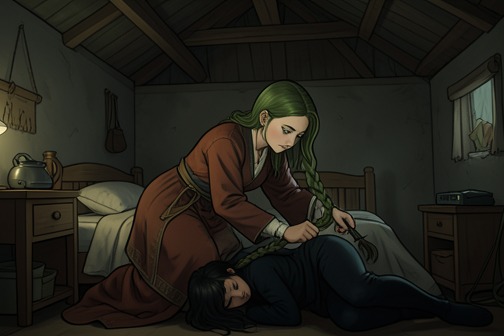
[Malthios’s Rebirth as Theo’s Host](entity:event-recall-event-malthios-s-rebirth-as-t-2e070446c028) is the decisive supernatural event that reshapes the entire conflict between the former [Demon King](entity:state-recall-state-demon-king-d4ce23d2b4c1) and the human healer [Theo](entity:character-recall-character-theo-107bd6003b61). [Malthios](entity:character-recall-character-malthios-3bbf03e4fa99) survives by being reborn within a host, but the result is not a simple restoration of power: he awakens trapped inside a developing human body, dependent on Theo’s consent and vulnerable to the boy’s resistance. Their antagonistic bond becomes the hidden structure beneath Theo’s life, his fear of discovery, and the later question of whether Malthios must be destroyed or can be contained without sacrificing Theo.
## Rebirth and Loss of Physical Agency
When Malthios finally awakens, he experiences existence as weight, darkness, and disembodied perception. He cannot move his limbs or see independently; instead, he looks outward through another body, first seeing the beams of a cottage roof and a green-eyed human woman leaning over him. His attempted attack produces no result. The only movement available to him is an infant’s chubby hand reaching for the woman’s braid, a humiliating contrast between the power he once possessed and the helpless body into which he has been placed.
The rebirth spell has succeeded, but it has not restored Malthios as an autonomous being. He is now housed within a mortal host whose body is still growing. Malthios immediately interprets the arrangement as a problem of control, assuming that the host can eventually be mastered and that the two of them can pursue great aims together. His first impulse is therefore strategic rather than affectionate: he regards Theo as a vessel to command, not as a person with an independent will.
## Theo’s Resistance and the Shared Body
The first years establish the central limitation of the host bond. Theo possesses powerful magical potential for a mortal, but Malthios cannot simply seize his body. He can attempt to pressure Theo into actions that test obedience, yet the human repeatedly resists. Even when Theo suffers a lapse of control that briefly gives Malthios an opening, Theo manages to force him back and reclaim the body. The former Demon King is consequently not the sovereign presence he imagines himself to be, but a consciousness confined by the will of the person who physically carries him.
This constraint produces constant antagonism. Malthios finds the arrangement infuriating, especially when Theo begins to acknowledge him rather than merely endure an unexplained presence. The human body also carries emotional reminders of Malthios’s former life: Theo’s auburn hair and fluorite-green eyes recall [Kamil](entity:character-recall-character-kamil-88c659fbf1a3), while his reserved, prickly demeanor evokes [Aym](entity:character-recall-character-aym-bc4f15f5be03), his dry humor resembles [Foras](entity:character-recall-character-foras-2260f2d99951), and his stubborn resolve recalls Tori. Those similarities dredge up memories Malthios had tried to leave behind, making Theo’s presence both a prison and an involuntary archive of the relationships he once possessed.
Their conflict becomes more personal when Malthios urges Theo to retaliate against village children who have bullied him. After Theo flees instead, Malthios tries to take control and condemns what he sees as weakness. Theo answers that the ability to suppress Malthios proves otherwise, but the force of the reply is undermined by his crying. The exchange exposes the asymmetry of their situation: Malthios has power, experience, and intimidation, while Theo possesses the decisive authority over the shared body. Theo’s outburst, insisting that his name is Theo and that Malthios should use it, is the first clear demand that the supposed vessel be recognized as a person.
## Secrecy, Fear, and Recognition
The host bond makes Theo’s identity dangerous. He understands that friendship alone would not save him if anyone discovered what he was, because the truth would define him as the vessel of the Demon King rather than as the healer and community member he has become. His secrecy is therefore not merely private embarrassment; it is a survival strategy shaped by the knowledge that exposure could lead to coercion, imprisonment, or execution. Malthios’s presence intensifies that danger while also making complete isolation impossible, since the hidden demon is the one companion who knows Theo’s condition from within.
Cargo eventually voices the concealed truth directly, asking Theo whether he will ever tell the others that he is demon spawn. Theo’s body freezes and his fingers nearly drop the basket he is carrying. The physical shock arrives before any explanation, revealing how deeply the secret governs his daily life. Malthios immediately stirs and tries to move forward to defend them, but Theo can only respond with a question while his heart pounds in his throat. The scene turns revelation into a bodily crisis: the threat is not abstract, and being recognized as the host could alter every relationship around him.
When [Bryony](entity:character-recall-character-bryony-77c7475dde0d) later brings a portal and permission to retrieve Theo, he understands that entering the capital will end his autonomy. The powerful people there will know where he lives, and [Camden](entity:character-recall-character-camden-901e9f21b9e7) will recognize him; they may force him back into the [Hero](entity:concept-recall-concept-hero-c363661142b4)’s party, where the truth about Malthios could be exposed. Theo still chooses to go because [Luc](entity:character-recall-character-luc-b00cd62cc765) may die if no one intervenes. His decision shows the host bond operating within a larger moral conflict: protecting Luc requires Theo to risk the discovery that could destroy his own life.
## Public Judgment and the Choice to Delay Death
The consequences of the rebirth eventually become public in the Trial of the [Demon King’s Host](entity:state-recall-state-demon-king-s-host-76fd1b21021f). With a court mage, knights, a rare [Portal Orb](entity:object-recall-object-0dafc4da8ec2), and magical restraints involved, Theo is transported to the capital and taken to the dungeons after confirming what he is. The court treats the host condition as a criminal matter before it treats Theo as an individual. His emotional pain is sharpened by Luc’s silence and by the sight of [Julius](entity:character-recall-character-julius-2b9b6a5d3dd6), Luc’s former lover, among those escorting him.
Theo’s private bond with Malthios is then placed against the political judgment of the court. [Leafel](entity:location-recall-location-leafel-ce079facdeeb) refuses to abandon him. [Micah](entity:character-recall-character-micah-b7a8af6bb3f9) opens a powerful mirror spell from the village square, with [Imani](entity:character-recall-character-imani-3e59d6c7b288), [Dale](entity:character-recall-character-dale-fff2558efe87), [Dmitri](entity:character-recall-character-dmitri-f7165ee439b9) and his parents, [Nib](entity:character-recall-character-nib-c57b21ba9a3c), [Amaya](entity:character-recall-character-amaya-3164488322dd), [Hayden](entity:character-recall-character-hayden-3887fcc3a0d9), and the people of Leafel gathered behind him. Hayden demands Theo’s release on behalf of the town. Their intervention changes the meaning of the host identity: the person the court sees as a threat is also a healer whose community publicly claims him.
Malthios further complicates the judgment by admitting that he destroyed the [Demon Fortress](entity:location-recall-location-demon-fortress-e361fb201537) and those within it. He argues that only a few lesser demons and demon-created monsters may remain and that there is no longer any need for a Hero. Luc nevertheless declares that, as the Hero, it is his duty to kill the Demon King. The statement appears to return the host bond to its original logic of inevitable destruction, but Luc immediately adds that he can choose when that duty is fulfilled. The distinction between duty and timing creates the possibility of restraint without denying the danger Malthios represents.
Malthios asks Luc to call him Mal, the name given by his friends and used by Theo, and asks him to make a good choice. Theo then retakes control, while Luc turns to the silent observers and commits himself to a decision that preserves both responsibility and time. The final judgment sentences Demon King Malthios to life in prison while clearing Healer [Theo Bladefoot](entity:character-recall-character-theo-bladefoot-4a02f215e1d3) of every charge. The result neither treats Malthios as harmless nor condemns Theo for carrying him. It transforms execution into containment and separates the host’s moral responsibility from the demon’s identity.
## Narrative Significance and Aftermath
The rebirth reverses the usual hierarchy between a Demon King and a human host. Malthios begins with the expectation that Theo will be an instrument, yet Theo’s resistance makes the human body the governing power. Physical confinement gradually exposes Malthios to memories, vulnerability, and forms of dependence that his former status had concealed. Theo, meanwhile, is not simply liberated by possessing control; he must live with the knowledge that the consciousness inside him can endanger everyone he loves.
The event also turns identity into a continuing negotiation rather than a fixed revelation. Cargo’s question, Leafel’s public defense, and the capital trial each stage the same secret differently: as stigma, as communal knowledge, and as a legal accusation. By the ending, the host bond has not disappeared, but its meaning has changed. Malthios remains dangerous and is sentenced to life imprisonment, while Theo returns to the protection of a community that recognizes him as more than the body containing an enemy. The rebirth thus initiates the story’s central possibility: that survival may require neither simple innocence nor simple destruction, but a difficult coexistence governed by resistance, attachment, and chosen restraint.
Event 20
Glefald’s Death
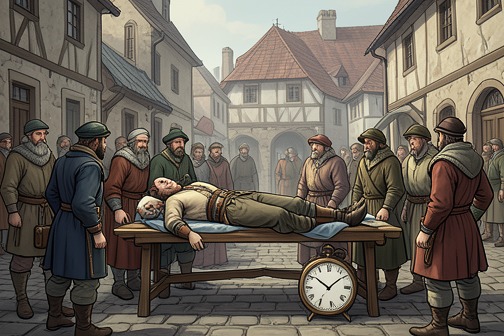
[Glefald’s Death](entity:event-recall-event-glefald-s-death-d65f833a894d) marks the end of an illness that [Theo](entity:character-recall-character-theo-107bd6003b61)’s healing could delay but not defeat. [Glefald](entity:character-recall-character-glefald-56a6ec6b20a2) dies after his remaining time has narrowed to days, and the community’s response turns that unavoidable loss into a shared ceremony of memory, continuity, and belonging.
## Terminal Illness and the Limits of Healing
While the townsfolk of [Leafel](entity:location-recall-location-leafel-ce079facdeeb) suspected that something was wrong with Glefald, they did not know that his days had dwindled to single digits. Theo’s constant healing had extended the elf’s life beyond his original estimate of one month, carrying him to almost twice that span, but the improvement could not reverse the [Lung Rot](entity:state-recall-state-lung-rot-282e9758f447). Glefald knew that his strength was beginning to fail and said he would soon choose a day to die if the disease did not take him first. Isabelle planned to tell the people of Leafel so they could say goodbye, while Glefald resisted allowing the Watchtower to be overwhelmed by well-intentioned visitors.
His death therefore follows a period of conscious preparation rather than a sudden reversal. Glefald remains aware of the approach of death and retains some control over how the village will meet it. Theo’s role is equally defined by care and limitation: he can ease suffering and extend time, but he cannot make Glefald immortal. The event exposes the healer’s burden in its clearest form, because devotion succeeds only in giving Glefald more time and a gentler passage, not in changing the final outcome.
## Glefald’s Passing at the Watchtower
Glefald dies three days after Theo learns how little time remains. Theo spends almost an entire twenty-four hours at the Watchtower, watching the elf slowly fade and doing everything possible to relieve his pain. Muffins the cat never leaves Glefald’s side, apparently offering what help companionship can provide. Isabelle, [Micah](entity:character-recall-character-micah-b7a8af6bb3f9), and Cade come and go with food and other necessities, while [Hayden](entity:character-recall-character-hayden-3887fcc3a0d9) keeps watch in a chair beside the door, his solemn expression revealing the gravity of the vigil.
The death itself is registered at dawn. The first rays of the new day enter through the window when Theo notices that Glefald’s chest has stopped moving. Theo rises with his lower back aching from the long hours in the chair and tells Hayden that Glefald is gone and that everyone should rest. Hayden thanks him as Healer Theo and leaves to inform the others. The exchange is restrained, but its restraint gives the scene its force: after a night spent opposing pain, the final act is recognition, exhaustion, and the acceptance that care has reached its limit.
Theo returns to his shop while his flock pecks through the garden, then goes upstairs to sleep. Even in that immediate aftermath, his grief is connected to absence: as he lies down, he wishes for [Luc](entity:character-recall-character-luc-b00cd62cc765)’s presence for the thousandth time. Glefald’s death thus does not stand alone as a medical or local event. It intensifies Theo’s awareness of the people he loves, the people who are absent, and the fragile life he has made in Leafel.
## Burial, Ritual, and Renewal
The funeral takes place one day later. Most burials in this world are bonfires, through which the soul of the dead is released with smoke and sparks rising into the sky. Glefald chooses another tradition: burial in the earth, with a tree planted above his body so that his remains will nourish new life. This is an elven custom, and the people of Leafel willingly honor it.
The location gives the ritual a public and protective meaning. Glefald is buried across the road from the Watchtower, so that when the tree grows tall it will serve as a second guardian of Leafel’s entrance. His death therefore becomes a continuation of his service to the village rather than a disappearance from it. The Watchtower guards the settlement in the present; the planted tree promises a living, growing form of guardianship in the future.
The funeral gathers nearly every layer of Glefald’s community. The adventurer party lowers him into the earth, except for Micah, who is too slight to take part but stands at the grave clutching his staff, tears running down his face. Everyone takes a turn adding a shovelful of soil. Theo intends to abstain, yet Cade extends the shovel to him, making participation unavoidable. The gesture brings the healer into the communal labor of mourning: he has tended Glefald’s body in illness, and now he helps return it to the earth.
After the sapling is planted, Liffey, [Raf](entity:character-recall-character-raf-1a9812291de2)’s wife and the village’s only other elf, sings in her own language. Theo cannot understand the words, but he understands their emotion. The song crosses the boundary between individual grief and inherited cultural practice, allowing Leafel to honor Glefald through an elven voice while the wider community stands beside it. The ritual does not explain death away; it gives the living a shared form through which they can endure it.
## Memory and Theo’s Belonging
Glefald’s handmade knitwear extends the funeral beyond the grave. The party places the clothing he made over the years on a blanket, inviting people to choose pieces as mementos. These objects preserve the ordinary labor of a life that might otherwise be reduced to illness and dying. They allow the villagers to carry Glefald forward in material form, converting private craft into distributed remembrance.
Theo is turning toward [Nib](entity:character-recall-character-nib-c57b21ba9a3c)’s shop, where spiked tea and quiet company await, when Isabelle calls him back and presents a special gift. Glefald had made a scarf for Theo as a solstice present. Its wool is dyed the same grey-green as Theo’s eyes and feels exceptionally soft in his hands. Theo can manage only a brief expression of thanks, but the scarf makes the loss intimate: Glefald had been thinking of him not merely as a healer or villager, but as someone worthy of a personal gift intended for a future celebration.
At the grave, Theo touches the pendant around his neck and looks toward the familiar blue sky. He cannot pray for himself, but he can pray for Glefald, hoping that the elf has found peace after suffering for so long and that a better place exists beyond death. Yet the thought turns back toward Leafel. Theo cannot imagine anywhere better than the village itself. Glefald’s funeral consequently confirms a belonging Theo has previously treated as precarious: Leafel is not simply where he works or hides, but the home against which even the afterlife is measured.
## Narrative Significance
The event establishes a contrast between two forms of contact with the dead. Glefald receives a deliberate, culturally recognized burial beneath a tree, surrounded by mourners who name, touch, sing for, and remember him. Later, the journey toward [Ashenhave](entity:location-recall-location-ashenhave-e8779224b0b8) reveals a different aftermath of death: a town enclosed by temporary fencing, dark windows, and ghostly presences, followed by the discovery of a moss-covered, abandoned well from which distant screams seem to echo. There, death has not been peacefully incorporated into communal memory; it has become a supernatural disturbance.
That contrast clarifies the importance of Glefald’s funeral. The village’s customs do not deny mortality, but they place it within relationships and renewal. By contrast, the neglected well and the nearby haunting show what can happen when the dead remain trapped, unheard, or improperly released. The later destruction of the nested beast leaves a faint figure of a crying boy who begs to go home, and Theo offers to take him home. Glefald’s burial and the ghost’s release are different episodes, yet both treat the dead as persons requiring acknowledgment rather than as mere threats.
Glefald’s Death also deepens the story’s examination of identity and disclosure. Theo believes that no amount of friendship would save him if people discovered what he was, and Cargo later directly asks whether he will tell the others that he is demon spawn. Theo’s fear of rejection gives special weight to the fact that Leafel gathers around Glefald without demanding that grief be hidden or made convenient. When Theo later faces judgment as the host of [Malthios](entity:character-recall-character-malthios-3bbf03e4fa99), the people of Leafel appear through a mirror spell and demand his release, proving that the communal bonds embodied at Glefald’s funeral can survive a far more dangerous revelation.
The death is therefore both an ending and a measure of the community’s ethics. Glefald’s final days expose the limits of healing; his vigil demonstrates care without false promises; his burial joins elven tradition to Leafel’s collective life; and the tree promises that absence can become protection rather than erasure. For Theo, the scarf, the grave, and the blue sky together make mortality inseparable from home. Glefald dies, but the forms of care surrounding him ensure that he remains present in the village’s future.
Event 21
Luvel’s Attack on Theo
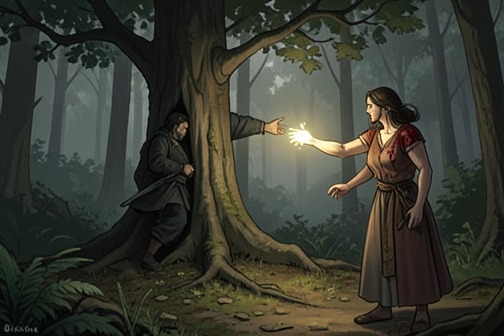
[Luvel’s Attack on Theo](entity:event-recall-event-luvel-s-attack-on-theo-3ec16b34075b) is the assassination attempt that brings the hidden danger around [Theo](entity:character-recall-character-theo-107bd6003b61)’s bond with [Luc](entity:character-recall-character-luc-b00cd62cc765) directly into Theo’s woodland refuge. What begins as a nearly invisible strike against an isolated healer becomes a revelation of [Luvel](entity:character-recall-character-luvel-c4c2298ed8f2)’s allegiance, a test of [Theo and Malthios](entity:relation-recall-relation-theo-and-malthios-24da48fb7937)’s shared control, and the moment when [Malthios](entity:character-recall-character-malthios-3bbf03e4fa99) personally reasserts the overwhelming power of the former [Demon King](entity:state-recall-state-demon-king-d4ce23d2b4c1).
## Causes and Background
Theo is gathering moss from a tree with a new harvesting knife when he senses a cold, prickling warning at the back of his neck. Malthios immediately commands him to move, but Theo can shift only slightly before a weapon pierces his shoulder just above his heart. The wound is serious enough to draw blood, yet Theo’s green healing magic rises at once and begins closing it. The attack therefore establishes both the precision of the assassin and the unusual resilience provided by Theo’s healing ability and Malthios’s warning.
The attacker has not approached openly. The surrounding trees and rocks appear empty until the air shimmers ten feet away and a tall figure materializes. Theo recognizes the intruder as a demon from their appearance: ivory-white horns curl around the ears, pale feathers resemble dead flesh, long blond hair frames a narrow face, and a skeletal body is concealed beneath black clothing. Blue light burns in the slitted pupils of their black eyes. Malthios identifies the demon as Luvel, once his best assassin and the Lord of the Invisible Blades.
Luvel’s presence implies that Malthios’s concealment inside Theo has become vulnerable to the wider demon world. Theo had believed that demons would have found them earlier if Malthios had somehow been tracked, but Luvel reveals that the attack is not random. Luvel has been gathering information for Lord [Tyraz](entity:character-recall-character-tyraz-d0813c0c4748), and the assassin escaped an attack by the [Hero](entity:concept-recall-concept-hero-c363661142b4)’s party carrying something that could lead directly to Theo.
## The Pendant and the Threat to Theo
Luvel displays the fluorite pendant hanging from a chain. Theo had given it to Luc when Luc departed, choosing a stone that matched Theo’s eyes. In Luvel’s possession, the intimate token becomes a tracking device and a weapon of psychological intimidation. Luvel explains that a tracking spell led from the pendant straight to Theo, turning Luc’s keepsake into the physical link by which the enemy found him.
The pendant also allows Luvel to infer [Theo and Luc](entity:relation-recall-relation-theo-and-luc-6c31719ecbcf)’s relationship. Luvel remarks that the Hero is not known to have a lover and concludes that only a lover would give him such a token to remember its giver. The assassin threatens not merely to kill Theo but to leave his body strung up for Luc to discover. This transforms the attack from a private assassination into a deliberate attempt to injure Luc through Theo and to expose the danger created by their attachment.
Theo’s response marks the scene’s first reversal. Fear and anger seize him when Luvel demonstrates knowledge of Luc, but the threat also clarifies what Theo is protecting. Instead of remaining the wounded target, Theo allows his control over the shared body to slip. His smile and defiant reply signal that Luvel has mistaken Theo’s vulnerability for helplessness and has failed to understand what is contained within him.
## Malthios Takes Control
When Malthios takes over, his mana floods Theo’s body. Horns and wings grow, a black sword appears in their hand, and blue flames lick across their limbs. Luvel’s shock and fear reveal that the assassin recognizes the transformation as the return of Malthios’s power. The encounter is no longer an attack on a solitary healer; it is a confrontation with the Demon King inhabiting Theo, temporarily acting through Theo’s body.
Malthios greets Luvel as an old subordinate and recalls that Luvel had crawled back to Tyraz despite the two demons never having got along. Luvel rejects the claim that the figure before them is truly Malthios, arguing that a genuine Demon King would not be weak, controlled by a mere mortal, or turned away from the destiny to which he had been crowned. Luvel further threatens to kill Malthios and carry his head to Tyraz, believing that such a victory would force Tyraz to bow.
The fight immediately disproves Luvel’s assessment. Luvel gathers mana and sends half a dozen invisible blades slicing through the air, but Malthios deflects every one with an effortless sweep of the black sword. The blades cut into the earth and the branches overhead rather than Theo’s flesh. Malthios identifies Luvel’s dependence on concealment and distance as a weakness, recalling that the assassin had always run and hidden instead of meeting him in direct combat.
Malthios then launches himself with his wings. The sword and mana strike with enough force to leave a crater and cleave several trees in two, although Luvel dodges and loses part of a wing to the edge of the attack. The landscape records the difference between Luvel’s method and Malthios’s: invisible weapons rely on surprise, while Malthios answers them with visible, overwhelming force.
## Luvel’s Death and Immediate Consequences
Luvel continues to condemn Malthios for allowing a mortal to control him and for hiding behind the mask of Theo’s lover. Malthios refuses to treat the accusation as a present concern, answering that tomorrow’s problem can wait because Luvel is the problem of today. He also judges Luvel’s weakness as evidence that demons generally have become too careless to withstand the Hero and the Hero’s party.
The final exchange turns the attack into an execution. Malthios dives toward Luvel as the assassin hurls another barrage of unseen blades. One blade cuts across their cheek, but the magic surrounding them deflects the rest. Blue flames engulf Luvel, whose scream is quickly cut short when Malthios severs their head from their body. Both body and head dissolve into shadows before falling to the earth, eliminating the assassin and preventing any ordinary recovery from the wound.
The fluorite pendant survives the destruction. Malthios finds it glittering in the grass after the battle and picks it up, mocking Luc’s involvement by remarking that he had warned Theo that the boy was trouble. When Theo resumes control, he rejects the implication that Luc is to blame. The pendant consequently returns to Theo not as the tool that enabled Luvel’s victory, but as the recovered evidence of Luc’s connection and the object through which that connection nearly cost Theo his life.
## Narrative Significance
The event combines pursuit, discovery, and rivalry. Luvel’s tracking spell discovers Theo through an intimate object, while the attack forces the concealed truth of Theo’s shared body into the open before an enemy who knew Malthios from his former reign. The assassin’s attempt to exploit Theo’s love for Luc instead gives Malthios the occasion to defend Theo and demonstrate that his power has not disappeared simply because his existence is now bound to a mortal host.
The scene also stages a conflict over control. Luvel describes Malthios as a Demon King controlled by a mere mortal, but the battle shows a more complicated arrangement: Theo can permit Malthios to take command, and Malthios can act with devastating force, yet Theo remains able to reclaim control afterward. Their shared body is therefore neither simple possession nor simple domination. It is the condition through which Theo survives the attack and Malthios defeats a former agent of the demonic order.
The pendant supplies the event’s central irony. A gift associated with Luc’s departure, memory, and affection becomes the means by which Luvel locates Theo and threatens to turn Theo’s death into a message for Luc. Yet the same pendant is recovered after Luvel’s defeat. Its meaning shifts from vulnerability to continuity: the relationship it exposes creates danger, but it also helps define what Theo and Malthios choose to protect. Luvel’s death closes the immediate assassination attempt while leaving the broader danger of Tyraz, the demons, and the Hero’s response unresolved.
Event 22
Luc’s Poisoning and Recovery
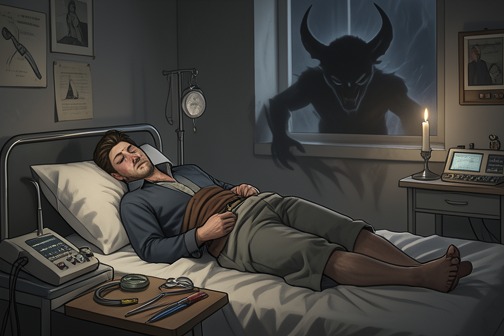
[Luc’s Poisoning and Recovery](entity:event-recall-event-luc-s-poisoning-and-rec-f8aac39bc140) is a rescue event in which [Luc](entity:character-recall-character-luc-b00cd62cc765)’s life becomes the immediate price of [Theo](entity:character-recall-character-theo-107bd6003b61)’s concealed identity. A demon’s attack leaves Luc unconscious with a deadly fever, and Theo must travel to the capital, where his identity as the [Demon King](entity:state-recall-state-demon-king-d4ce23d2b4c1)’s host may be recognized, because Luc is not expendable to him even if the authorities treat Heroes as replaceable. The episode turns a medical emergency into a decisive test of love, duty, secrecy, and self-sacrifice.
## Causes and Background
The crisis occurs nearly three weeks after the [Hero](entity:concept-recall-concept-hero-c363661142b4)’s party has departed for the capital. Theo has begun to bear Luc’s absence more easily because he believes the journey is relatively safe, but [Micah](entity:character-recall-character-micah-b7a8af6bb3f9) and [Dmitri](entity:character-recall-character-dmitri-f7165ee439b9) arrive at his door wide-eyed and out of breath, revealing that the expected danger has already found Luc. A demon struck Luc in the face with an unknown substance just before the party reached the capital. Luc is not waking, has developed a deadly fever, and has not responded to anything the capital mages have attempted.
The circumstances echo an earlier medical crisis in [Leafel](entity:location-recall-location-leafel-ce079facdeeb), when a companion had been bitten by venomous demon spawn and the townspeople sent for Theo because they believed he worked miracles. The repeated demand for Theo’s healing establishes both his public role as Healer Theo and the burden attached to it: when ordinary healing fails, other people’s survival is placed in his hands. Luc’s poisoning raises that burden to its most personal form, because the patient is not merely a member of the Hero’s party but the person whose absence has already wounded Theo.
## The Attack and the Race to the Capital
[Bryony](entity:character-recall-character-bryony-77c7475dde0d) and [Wicker](entity:character-recall-character-wicker-4eaf8f5b7dfe) explain that the attacker was small, roughly Wicker’s height, with the lower face hidden behind a scarf and what appeared to be a single horn in the center of the forehead. Mal immediately identifies the assailant as [Nissle](entity:character-recall-character-nissle-3db92c538b90), described as one of the most dangerous assassins after [Luvel](entity:character-recall-character-luvel-c4c2298ed8f2) and as someone whose poison concoctions are deadly. This recognition changes the emergency from an unknown illness into a targeted demonic attack with very little time remaining. Mal can name measures that might ease the effects, but no certain cure; Theo will have to force his healing magic against the poison itself.
The journey through the portal is therefore also a threshold into exposure. Theo understands that once he steps into the capital, his autonomy will be gone: people in power will know who he is and where he lives, and [Camden](entity:character-recall-character-camden-901e9f21b9e7) will recognize him even if the court mage does not. He expects to be forced back into his place in the Hero’s party, where the truth about him could be discovered. Yet refusing to go would mean allowing Luc to die while the authorities simply raised another child to replace him. Theo’s decision is immediate and absolute because Luc is expendable to the system, but not to Theo.
## Theo’s Healing of Luc
At the capital, [Eliza](entity:character-recall-character-eliza-6ec11b83dd18) initially stands between Theo and the bed, while Camden asks her to trust him and accept that Theo can heal [Luca](entity:character-recall-character-luca-aa8721da92cd). Once Eliza moves aside, Theo sees Luc clearly and rushes to him. Luc’s skin has lost its normal glow, his face is ashen beneath the fever, his dark hair is stuck to his forehead, and his eyes move restlessly beneath their lids. His cheek feels cold to Theo, and Mal estimates that only a couple of hours remain.
Theo begins the healing with Wicker and Cargo encouraging him, while simultaneously removing the limit on Mal’s mana and allowing its full force to flood through him. The room fills with green light. Mal warns him not to shift forms, but Theo refuses to moderate the attempt as long as Luc is safe. The healing becomes an act of sustained concentration rather than a single miraculous gesture: Theo remains fixed on Luc while the poison works through his body, ignores the aches caused by holding his position, endures a dry throat and gathering sweat, and relies on Mal to remind him to breathe so that he does not lose himself in the magic.
The value at stake shifts visibly during the treatment. At the beginning, Luc’s life is sliding toward death while Theo’s secrecy and autonomy remain intact. During the spell, Theo spends his own strength to reverse that movement. Color returns to Luc’s skin, his breathing eases, and the restless motion beneath his closed eyes stops. Theo continues until the final magical scan finds no trace of poison. The cure is therefore defined not merely by Luc’s survival but by the complete cleansing of the toxin, achieved only after Theo refuses to leave even a small remnant behind.
## Collapse and Immediate Consequences
The moment the scan comes up clean, relief and exhaustion overwhelm Theo. He releases a sound like a dry sob and collapses onto the bed beside Luc, with Luc’s face as the last thing he sees before darkness takes him. His collapse gives the recovery its cost: Theo saves Luc, but the act consumes his energy and mana so thoroughly that he cannot remain conscious afterward. The scene makes healing resemble combat, with Theo’s body serving as the battlefield and his own endurance functioning as the final resource.
Luc’s recovery also exposes the limitations of the capital’s established powers. The capital mages cannot help him, while Theo, whose identity must remain hidden, succeeds through a dangerous combination of personal skill and Mal’s unrestricted mana. The rescue consequently strengthens Theo’s position as a healer while increasing the danger surrounding him. His ability to save Luc is proof of his value, but it is also evidence that could draw attention to what he is.
## Narrative Significance
The poisoning is structured as a rescue plot, but its deeper conflict is between institutional duty and chosen attachment. The Hero’s party can imagine replacing Luc with another child; Theo rejects that logic by treating Luc as singular and irreplaceable. His choice is not framed as abstract heroism. It is made under the knowledge that saving Luc may return Theo to the Hero’s party and place the truth of his demonic nature within reach of the court.
The episode also develops the story’s recurring pattern of selective disclosure and threatened identity. Theo knows that friendship alone cannot save him if anyone discovers what he is, yet Luc’s danger makes concealment impossible as a practical priority. The poisoning does not resolve that secret; instead, it forces Theo to act in a way that makes the secret increasingly precarious. His healing therefore produces a double result: Luc returns from the edge of death, while Theo moves closer to the political and personal consequences of being known as the Demon King’s host.
The event’s final image holds those outcomes together. Luc’s face is restored to life, and Theo loses consciousness beside him. Love succeeds, but only through exhaustion, exposure, and the willingness to spend everything available in a body already divided by Mal’s presence. The recovery is thus both a medical victory and a turning point in Theo’s understanding of what he will risk for Luc.
Event 23
Theo and Luc’s Union
[Theo and Luc’s Union](entity:event-recall-event-theo-and-luc-s-union-959da45368f0) is the turning point at which their relationship becomes an openly chosen partnership rather than an uncertain attraction. After [Theo](entity:character-recall-character-theo-107bd6003b61) returns alive from confronting [Luvel](entity:character-recall-character-luvel-c4c2298ed8f2), [Luc](entity:character-recall-character-luc-b00cd62cc765)’s fear of losing him breaks through restraint: he kisses Theo with complete abandon, confesses that he wants Theo to be his “now and after I defeat the demons,” and rejects the idea of any future that does not include him. Their union therefore joins intimacy to defiance. It promises a private life together while placing that promise against the public demands of the [Hero](entity:concept-recall-concept-hero-c363661142b4)’s role, inherited duty, and the expected continuation of Luc’s bloodline.
## From Fear of Loss to Open Confession
Luc’s emotional change begins at the [Leafel Watchtower](entity:location-recall-location-leafel-watchtower-445b76b722ca), where Theo emerges from the forest bloodied but alive. Luc has been waiting outside with the adventurer party and other familiar figures, visibly strained by lack of rest and angrily confronting [Hayden](entity:character-recall-character-hayden-3887fcc3a0d9) before Theo appears. The moment Luc sees Theo, his attention breaks away from every other conflict. Theo returns Luc’s pendant, and Luc responds by crushing him in a hug so forceful that it lifts Theo’s feet from the ground. His immediate concern is not an explanation of how Theo survived a battle with a demon of Luvel’s level, but whether Theo is physically safe; he runs his hands over Theo’s body and urgently asks whether he is all right.
The reunion becomes their first kiss. Luc grips the back of Theo’s neck and kisses him with a force that makes the surrounding world disappear, while Theo, who has never been kissed before, freezes in uncertainty before yielding to the experience. The scene’s value shifts from threatened loss to embodied certainty. Luc’s exhaustion, physical urgency, and fear pass directly into the contact between them, while Theo’s racing heart and inability to breathe register a response that has not yet been organized into a declaration. Their connection is recognized first through the body and only afterward through language, making the kiss the emotional and structural bridge between peril and commitment.
## The Commitment Is Named and Accepted
When Theo asks what has overcome him, Luc gives the feeling a clear form. He says that he thought he would never hold Theo again or see him smile, and that he no longer wants to hold back. He declares that he wants Theo to be his after the defeat of the demons and insists that there is no one else for him. The confession is not merely an admission of affection; it is a claim about the future. Luc places Theo inside the life he intends to continue beyond the war, while Theo recognizes that Luc has already made a place for himself in Theo’s heart.
Theo answers with caution rather than effortless romantic confidence. He explains that he has never done this before and that physical intimacy may take time to become comfortable. This hesitation does not undo the confession. Instead, it establishes that acceptance will include Theo’s limits as well as Luc’s desire. Luc then asks directly whether Theo accepts the confession and agrees to be his from that day onward. Theo answers by touching the pendant he gave Luc and recalling that he had promised to wait for him. The pendant thus becomes a reciprocal sign: Luc has carried Theo’s token, while Theo treats that earlier promise as his own prior act of choosing Luc.
Luc seals the commitment with his father’s ring. The ring is silver, textured like scales, and set with a dark sapphire; it is the only thing Luc possesses from his father, an adventurer who saved his party from a demon attack but died in the process. Luc places the ring on Theo’s marriage finger, where it unexpectedly contracts to fit. The gesture makes their union both personal and symbolic. Luc gives Theo an inheritance tied to sacrifice and heroic history, but redirects its meaning toward a relationship chosen in the present. When Theo worries that he is difficult to love and might hurt Luc unintentionally, Luc answers that loving Theo has been the easiest thing he has ever done. Their engagement is consequently founded not on an idealized promise of safety, but on Luc’s conscious acceptance of Theo’s danger and complexity.
## A Love That Rejects the Heroic Script
The union carries a political conflict because Luc’s family and institution treat his body and future as instruments of Hero continuity. [Julius](entity:character-recall-character-julius-2b9b6a5d3dd6) reveals that Hero [Eliza](entity:character-recall-character-eliza-6ec11b83dd18) once ordered him to refuse Luc’s invitation to join the party, threatening to take everything from him if he did not let Luc go. Julius believes Eliza wants Luc to continue their bloodline and sire the next Hero, something that could not be achieved with either Julius or Theo. This revelation defines the obstacle facing [Theo and Luc](entity:relation-recall-relation-theo-and-luc-6c31719ecbcf) as more than personal jealousy or social disapproval: their relationship threatens a succession system built around reproduction, inherited power, and compulsory service.
Luc’s choice is later challenged openly by Eliza before the court. She asks whether he is truly choosing to end their bloodline and throw away everything for which he has trained his whole life. Luc answers that this is the only choice he has ever made for himself. He chooses a quiet and peaceful life with the man he loves and imagines a world in which those born with the Hero’s gift can choose their fate instead of being bound to duty. Theo stands beside him while Luc keeps an arm around his waist, transforming their private commitment into a public declaration. The union therefore opposes a linear heroic future—training, service, reproduction, succession—with a different future based on shared domestic life and self-determination.
## Domestic Promise and Lasting Consequences
After the confession and exchange of tokens, Theo and Luc continue their intimacy in a deliberately ordinary setting. They kiss again and have to stop when their physical desire becomes difficult to ignore. Theo then pulls Luc from bed to show him the garden, while Luc refuses to put on a shirt and instead drapes it over Theo. The flock is still outside, and even the difficult hen named Two takes to Luc, allowing him to scratch her head. Luc remarks that the place feels newly alive and asks whether Theo has abandoned the plan to build a cottage. The garden, the flock, and the unfinished cottage offer a concrete image of the future Luc has chosen: not merely a declaration made under the pressure of danger, but a shared life rooted in [Leafel](entity:location-recall-location-leafel-ce079facdeeb).
The consequences extend beyond the scene itself. Luc’s promise to remain with Theo later becomes an answer to the accusation that Theo is controlled or merely possessed by the [Demon King](entity:state-recall-state-demon-king-d4ce23d2b4c1). Luc identifies Theo as the Demon King’s prison and himself as Theo’s humble guard, promising not to let Theo out of his sight. In court, Eliza interprets Luc’s decision as the destruction of the family line, whereas Luc interprets it as the beginning of a broader freedom for future Heroes. Theo’s union with Luc thus changes the meaning of both men’s identities: Theo is no longer approached only as a dangerous host, and Luc is no longer defined solely by heroic inheritance.
The event’s decisive significance lies in its double movement from private tenderness to public refusal. Luc’s past relationships were limited by travel and by the fate assigned to a Hero, but his commitment to Theo is presented as the relationship that can endure beyond those conditions. Theo’s returned pendant, Luc’s father’s sapphire ring, the kiss after presumed loss, and the choice of a quiet life all convert desire into an oath. Their union does not erase the dangers surrounding them; it gives those dangers a shared answer. Love becomes the means by which Luc rejects compulsory bloodline duty and claims a future with Theo on chosen terms.
Event 24
Theo’s Reinstatement into the Hero’s Party
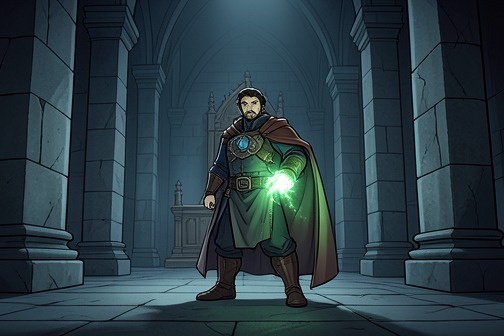
[Theo’s Reinstatement into the Hero’s Party](entity:event-recall-event-theo-s-reinstatement-in-f9c7248c25d3) is a coerced return to the institution he had escaped, imposed after the court identifies him as the lost healer and claims his magic for the national war effort. The decree does not restore the old order completely: it limits his service to one year or until the immediate demon threat is ended, while acknowledging that [Leafel](entity:location-recall-location-leafel-ce079facdeeb) needs him. The event therefore functions as both conscription and partial concession, forcing [Theo](entity:character-recall-character-theo-107bd6003b61) back onto the [Hero](entity:concept-recall-concept-hero-c363661142b4)’s path without entirely erasing the community and identity he built for himself.
## Causes and Background
The reinstatement begins when Theo crosses a portal into the capital after leaving Leafel, expecting neither the unfamiliar transition nor the hostile reception awaiting him. The passage feels less like a grand magical journey than like stepping through a doorway: the warmth of a summer day disappears, replaced by the cold of a stone hall. There, an elf court mage confronts him with an intimidation display, pressing her mana against him without openly attacking. The scene establishes that Theo has crossed from the ordinary life of a village healer into a political space where power is exercised through ceremony, surveillance, and threat.
At the throne room, Mage [Syvia](entity:character-recall-character-syvia-1e34b1c5407f) introduces him as Healer Theo Seamsword, also known as the lost healer who vanished during Hero training thirteen years earlier. The name exposes the distance between the person Leafel knows and the identity the court claims. Theo has not merely been absent from an assignment; he has rejected the life designed for him as a child. His response is therefore a direct challenge to the system that made the Hero’s party compulsory. He states that he wanted freedom, that he was forced to join, and that the authorities made a five-year-old accept a life of danger and pain before he could make his own decisions. He condemns the adults who turn children into instruments for their wars and explains that he took his magic to a place where it could do useful work: Leafel.
The speech provokes shouting and outrage, but it also clarifies the event’s central conflict. Theo’s healing is treated by the state as a strategic resource, while Theo understands it as a personal gift that should serve people rather than institutions. His refusal is not a rejection of healing or responsibility. It is a rejection of ownership. The distinction matters because the court can portray his departure as abandonment of duty only by ignoring the care he has already provided in Leafel.
## The Decree and Its Conditions
[King Alexis](entity:character-recall-character-king-alexis-965b76b67eae) refuses to let Theo simply walk away from what he calls his duty to [Algeya](entity:location-recall-location-algeya-1668b0a6fe56). He argues that Theo’s gifts are vital to the struggle against the demons and invokes Theo’s attachment to Hero [Luca](entity:character-recall-character-luca-aa8721da92cd) as another reason for service. Yet the King also recognizes the competing claim of Leafel. He asks whether anyone can manage the village in Theo’s absence, implicitly admitting that the healer’s obligation is not limited to the kingdom’s military objective.
Theo answers that he has begun training [Micah](entity:character-recall-character-micah-b7a8af6bb3f9) in healing. Micah can manage the potions and stores, but has had only a few weeks of experience using healing magic itself. This detail prevents the reinstatement from becoming a clean transfer of responsibility. Leafel has someone capable of beginning the work, but not someone ready to replace Theo fully. The village’s dependence on him becomes part of the legal calculation, and the care system he created there gives his refusal practical as well as moral weight.
King Alexis then issues the compromise that defines the event: Theo must serve in the Hero’s party for one year from that day or until the party has dispatched the demons attempting to rally forces. Theo accepts with the formal acknowledgment, “Aye, I do,” followed by “your Majesty.” The time limit is crucial. It does not make the appointment voluntary, but it prevents the decree from claiming Theo’s entire future. The order converts indefinite conscription into a bounded obligation, leaving open the possibility that his life in Leafel can resume after the campaign.
The decree also exposes the monarchy’s mixed position. The King cannot release Theo because the state’s military needs override Theo’s autonomy, yet he cannot treat Leafel as irrelevant because a small town’s survival depends on its healer. The result is neither full liberation nor total submission. Theo is sent back into the Hero’s party under terms that acknowledge, however imperfectly, that his life contains obligations the court did not create.
## Return to a Contested Future
The reinstatement carries an immediate personal consequence for Theo and Luca. King Alexis permits Theo to return to Luca and asks how the Hero is faring. Theo explains that Luca will resume training the next day and may be ready to depart on his quest within a few days. The exchange places the romantic relationship inside the machinery of the quest: Theo is not recalled only as a healer, but also as the person attached to the Hero. The court recognizes that bond while attempting to use it as leverage.
That pressure becomes clearer when [Julius](entity:character-recall-character-julius-2b9b6a5d3dd6), Luca’s former lover, explains why he did not join Luca’s party. He says that [Eliza](entity:character-recall-character-eliza-6ec11b83dd18) warned him away and threatened to take everything from him if he refused, because she wanted Luca to continue the Heroic bloodline and sire the next Hero. Julius believes that such a future cannot be achieved with either of them. The warning reveals that Theo’s reinstatement is entangled with a larger dynastic expectation: Luca is valued not only as a person or warrior, but as a vessel for hereditary continuity.
Theo refuses to be frightened away. His determination to remain with Luca opposes both the court’s compulsory service and Eliza’s attempt to regulate Luca’s intimate life. The reinstatement thus produces a paradoxical future. Theo is forced into the Hero’s party, but his presence also strengthens his claim to a life with Luca that is not organized around bloodline, marriage, or the production of another Hero. Luca’s earlier history reinforces the cost of the official path: his first serious relationships ended because the demands of the Hero’s life made lasting attachment impossible, and he described such instability as the fate of the Hero.
The personal commitment between Theo and Luca is marked by objects rather than public approval. Theo reminds Luca that he had promised to wait for him, while Luca gives Theo a ring that belonged to his father, an adventurer who died after saving his party from a demon attack. The scale-textured band, set with a dark sapphire, fits Theo despite his expectation that it would not. Against the court’s language of duty and succession, the ring offers another model of continuity: chosen attachment, inherited memory, and a promise that does not depend on producing a future Hero.
## Later Judgment and Political Meaning
The reinstatement does not settle Theo’s conflict with the Heroic system; it postpones and enlarges it. When Theo is later identified as the host of [Malthios](entity:character-recall-character-malthios-3bbf03e4fa99), the authorities treat his body and shared existence as a public danger. A trial titled Trial of the [Demon King’s Host](entity:state-recall-state-demon-king-s-host-76fd1b21021f) sends him to the capital in restraints and places him in the dungeons. The earlier decree’s conditional respect for Leafel gives way to a more severe question: whether Theo’s protection of Malthios makes him guilty of protecting the [Demon King](entity:state-recall-state-demon-king-d4ce23d2b4c1).
The threat becomes communal when the court prepares to condemn him. Through a mirror spell, Micah appears in the capital with [Imani](entity:character-recall-character-imani-3e59d6c7b288), [Dale](entity:character-recall-character-dale-fff2558efe87), [Dmitri](entity:character-recall-character-dmitri-f7165ee439b9) and his parents, [Nib](entity:character-recall-character-nib-c57b21ba9a3c), [Amaya](entity:character-recall-character-amaya-3164488322dd), [Hayden](entity:character-recall-character-hayden-3887fcc3a0d9), and the people of Leafel behind him. Leafel does not abandon its healer. Its inhabitants demand Theo’s release, turning his private resistance into a public claim of belonging. The community that Theo chose becomes a political counterweight to the court that claims his service.
The final judgment distinguishes between [Theo and Malthios](entity:relation-recall-relation-theo-and-malthios-24da48fb7937). After Malthios destroys the [Demon Fortress](entity:location-recall-location-demon-fortress-e361fb201537) and declares that there is no longer any need for a Hero, [Luc](entity:character-recall-character-luc-b00cd62cc765) states that it remains his duty to kill the Demon King, but insists that he can choose when that will happen. He describes Theo as Malthios’s prison and himself as the humble guard who will not let Theo out of his sight. King Alexis ultimately sentences Malthios to life in prison while finding Theo free of all charges. The ruling does not erase the danger surrounding the shared body, but it rejects automatic guilt by association and recognizes the possibility of controlled coexistence.
The court’s decision also marks a challenge to the system that caused the reinstatement. Eliza protests that Luca is throwing away everything he was trained for and ending their bloodline. Luca answers that choosing to live peacefully with the man he loves is the only choice he has ever made for himself, and that the world should become one in which those born with the Hero’s gift can choose their fate rather than remain bound to duty. In this light, Theo’s forced return becomes part of a larger transformation: the event first demonstrates the power of compulsory service, then helps expose why that power must be limited.
## Consequences and Significance
The immediate result of the decree is that Theo leaves Leafel and re-enters the dangerous orbit of the Hero’s party. His departure is emotionally costly because he does not know when, or whether, he will return. Yet the later trial reveals that the village has not merely waited passively for him. Its people organize, appear before the court, and demand his release, showing that Theo’s duty to Leafel was reciprocal rather than one-sided.
The reinstatement therefore occupies a deliberately unstable place in Theo’s arc. It is a threshold crossing into the role he once rejected, but not an acceptance of the identity imposed upon him. His earlier flight remains justified by the court’s treatment of children, while his return becomes an act performed under protest and within a fixed limit. The event turns the Hero’s journey inside out: instead of receiving a call and choosing adventure, Theo is compelled into service and must fight to make any later choice his own.
Its ultimate consequence is institutional as well as personal. Theo survives the court’s attempt to reduce him to a dangerous host, Malthios is confined rather than simply used to justify Theo’s execution, and Luca chooses a shared peaceful future over heroic bloodline. The journey that began with Theo’s forced appointment ends by strengthening the principle he defended in the throne room: healing, love, and heroic power cannot be made morally legitimate by removing the bearer’s right to choose.
Event 25
The Departure of the Hero’s Party
[The Departure of the Hero’s Party](entity:event-recall-event-the-departure-of-the-he-e6f9ac3404f6) is the threshold event in which [Theo](entity:character-recall-character-theo-107bd6003b61) joins [Luc](entity:character-recall-character-luc-b00cd62cc765) and the others on their renewed demon-hunting quest, leaving the capital for the open road. Its decisive significance lies in the collision between public duty and private choice: Luc must continue serving as a [Hero](entity:concept-recall-concept-hero-c363661142b4), but he refuses to let the institution surrounding that role dictate whom he loves, whether he must produce a successor, or what his life will become after the demons are defeated.
## Causes and Background
The departure becomes possible after Luc is cleared to return to his quest, making the party’s exit from the capital necessary almost immediately. Preparation begins with training and practical equipment. Luc takes Theo to the armory to find a weapon, rejecting Theo’s belief that his existing knives will be sufficient against a demon. Theo, meanwhile, accepts the responsibilities of his new position as the party’s healer. He is determined not merely to accompany the group, but to improve the quality of life on the road, beginning with meals that would otherwise consist largely of traveler’s rations.
The mission takes place within a wider political and military crisis. The [Demon King](entity:state-recall-state-demon-king-d4ce23d2b4c1) has been defeated, but remnants of his army remain scattered across the land under the leadership of surviving [Demon Lords](entity:creature-recall-creature-demon-lords-faedb062c0d5). The Hero’s party therefore continues to protect ordinary people from a threat that has not disappeared with the fall of its former ruler. The capital’s palace makes that institutional structure visible: one half houses the King, his family, councils, and balls, while the other trains magic users and knights who will serve the royals or enter the Hero’s party. Luc and his companions leave not as independent wanderers alone, but as representatives of a system that claims their labor for the protection of the realm.
## Departure from the Capital
The morning of departure arrives with breakfast delivered to the party’s room. Luc eats with his characteristic ferocity, while Theo thinks ahead to the practical demands of travel and the care of the group. In the courtyard, every member carries a pack, including Cargo, whose saddlebags are strapped around his round middle. The court mage [Syvia](entity:character-recall-character-syvia-1e34b1c5407f) is present to see them off, and [Eliza](entity:character-recall-character-eliza-6ec11b83dd18) stands nearby, turning what should be a ceremonial beginning into a confrontation.
Eliza attempts to retain authority over Luc, and the conflict exposes the pressure placed upon him to continue the Heroic bloodline. [Julius](entity:character-recall-character-julius-2b9b6a5d3dd6) has already warned Theo that Eliza wants Luc to sire the next Hero, something that cannot be achieved through either of Julius’s or Theo’s relationships with him. The demand reduces Luc’s future to hereditary service, treating love and family as instruments of succession. Luc finally refuses to accept that arrangement. He declares that he appreciates what Eliza has done for him but that their relationship of control is ending once the demons are defeated; his life, he insists, is not hers to command.
The exchange becomes deliberately cruel, with Luc answering Eliza’s concern for bloodline by pointing out that she could have children herself if she valued reproduction so highly. He then turns away from her and returns to the party. Rather than allow the argument to delay their movement, he takes Theo by the wrist and pulls him toward the gate, while the others scramble to follow. Syvia’s warning that the King’s will may change with the seasons underscores the danger still hanging over them: leaving the capital does not mean escaping royal authority, but it does create physical distance from its immediate surveillance.
The procession through the capital is charged with public recognition. People part to make way for the party, some bowing and others offering friendly waves. Theo, already uncomfortable with the crowded city, finds the attention more oppressive than before. Luc remains oblivious to the display, keeping his grip on Theo’s wrist until they reach the open road and the capital begins to recede behind them. The gesture makes the departure intimate as well as political: Luc does not merely lead the party away; he visibly chooses to keep Theo beside him.
## The First Road and the New Party Dynamic
The party’s first night is spent in a farmer’s hay barn amid the farmland surrounding the capital. The farmer and her wife provide a pot of stew for supper and eggs, bacon, and toast the following morning. As autumn approaches, the weather is cooling, but the sun still carries the force of summer. By midday, the travelers reach the forest, where the shade offers relief from the heat and marks their fuller transition from settled political space into the uncertain geography of the quest.
The group is tense, and Theo believes the tension centers on his presence. Conversation is sparse. [Wicker](entity:character-recall-character-wicker-4eaf8f5b7dfe) attempts to fill the silence with aimless observations about whatever the party passes, but no one directly addresses the strain. Theo resents the way the role of “group mother” seems to have fallen to him, yet he also acts on it. At a stream, he orders everyone to wash before they determine how to hunt dinner. His authority is domestic and practical rather than martial, but it is precisely through such acts that he begins to function as the party’s healer and caretaker.
The contrast between the party’s public image and its private life is central to the event. In the capital, the group is watched, honored, and politically managed. On the road, its survival depends on food, cleanliness, equipment, shade, shelter, and mutual cooperation. Theo’s presence shifts the meaning of the quest from a formal heroic assignment toward a shared household in motion. The party’s journey is still organized around demons and danger, but its daily continuity increasingly depends on the care he provides.
## Love, Bloodline, and Chosen Futures
The departure is also the public beginning of [Theo and Luc](entity:relation-recall-relation-theo-and-luc-6c31719ecbcf)’s attempt to build a future together under conditions that make such a future difficult. Luc has already described the loneliness imposed by the Hero’s role: his earliest long relationships belonged to people living in the capital, while later romances ended because the party stayed only briefly in each town or because departure made permanence impossible. He presents this instability as the fate of the Hero, but his relationship with Theo challenges that pattern.
Theo promises to wait for Luc regardless of how long it takes, touching the pendant that symbolizes his prior commitment. Luc answers with a family heirloom: a silver ring textured like scales and set with a dark sapphire, the only possession he has from his father, who died after saving an adventuring party from a demon attack. Luc places the ring on Theo’s marriage finger, where it unexpectedly contracts to fit. The object links inheritance to chosen commitment. Eliza wants Luc to continue a biological line of Heroes; Luc instead passes forward a ring associated with sacrifice, memory, and love, creating a bond that does not depend on producing a successor.
This is why the road departure functions as more than the opening of another adventure. The conventional quest would send the Hero away from home in order to restore an established order. Here, Luc leaves the capital while rejecting the order’s claim over his intimate life. Theo’s hoped-for destination is not another throne or heroic monument, but [Leafel](entity:location-recall-location-leafel-ce079facdeeb): the small home where they might live without demons or mages breaking down the door. The journey therefore contains two competing futures, one defined by bloodline and institutional duty, the other by peace, partnership, and a home built outside the capital’s control.
## Consequences and Narrative Significance
The immediate consequence is that the Hero’s party becomes a traveling unit with Theo as its healer and Luc openly aligned with him. Their route begins through farmland and forest rather than through the ceremonial spaces of the capital, and their first shared problems are material ones: food, shelter, washing, equipment, and the management of strained relationships. The departure turns Theo from a protected or contested figure into an active member of the party whose care affects how the group lives.
The event also establishes the conflict that later returns in the trial of the [Demon King’s Host](entity:state-recall-state-demon-king-s-host-76fd1b21021f). Theo’s identity as [Malthios](entity:character-recall-character-malthios-3bbf03e4fa99)’s host eventually brings him before the court in the capital, where Luc must decide how to reconcile the Hero’s duty to kill the Demon King with his commitment to Theo. When the court later demands judgment, people from Leafel appear through a mirror spell to demand Theo’s release, proving that the home and community Theo imagined as a refuge have become a political force of their own. The departure is therefore the first movement toward the community that will defend him when the heroic institution turns against him.
At the trial’s conclusion, Luc declares that he will fulfill his duty to kill the Demon King, but that he alone will choose when that happens. He describes Theo as Malthios’s prison and himself as the humble guard who will never again let Theo out of his sight. Faced with Eliza’s accusation that he is abandoning the future for which he trained, Luc answers that choosing a quiet and peaceful life with the man he loves is the only choice he has ever made for himself. [King Alexis](entity:character-recall-character-king-alexis-965b76b67eae) consequently sentences Malthios to life in prison and frees Theo of all charges. The party’s departure thus points toward a transformed meaning of heroism: not the unquestioning continuation of bloodline and command, but the possibility that those born with the Hero’s gift can choose their own fate while still protecting others.
Event 26
The Bandit Ambush
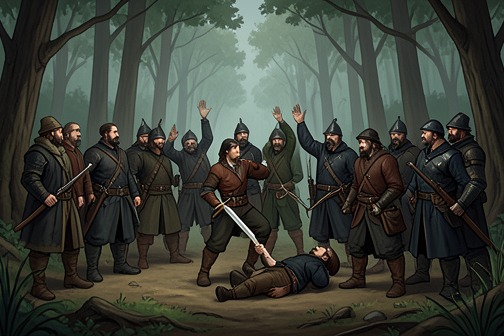
[The Bandit Ambush](entity:event-recall-event-the-bandit-ambush-0d3b2e564e29) turns an unguarded pause in the [Hero](entity:concept-recall-concept-hero-c363661142b4)’s party’s northward journey into a hostage crisis, then a bloody fight for survival. The attack tests the party’s discipline and exposes the danger of a world where human desperation can become organized violence.
## Causes and First Contact
After the party had cleared a mountain range and returned to camping in the forest, [Bryony](entity:character-recall-character-bryony-77c7475dde0d) and [Wicker](entity:character-recall-character-wicker-4eaf8f5b7dfe) went to hunt and forage while the others set up camp. The group was not keeping watch, and [Veiv](entity:character-recall-character-veiv-2ba6a25fcbd2) had not yet cast her usual protective spells. [Theo](entity:character-recall-character-theo-107bd6003b61) received a sharp warning from Mal only seconds before roughly thirty rough-looking figures emerged among the trees, several with crossbows ready. The bandits had already seized Bryony and Wicker: Bryony had a sword at her throat, while Wicker was held off the ground. Faced with those immediate threats, the party stood armed but did not attack. At the bandit leader’s warning, [Luc](entity:character-recall-character-luc-b00cd62cc765) dropped his sword, and the others followed.
## The Captors’ Intentions
The bandit leader quickly turned the party’s surrender into a calculation of value. Recognizing Luc as the Hero, he dismissed the possibility that the identification would secure their release: Luc and the others could instead be sold back to someone willing to pay for them. He singled out [Avery](entity:character-recall-character-avery-3f30ea9cdcd5), [Emi](entity:character-recall-character-emi-6cd72baa2831), and Veiv, and described the orc and elf as valuable on the slave market; even the halfling, Wicker, was treated as a saleable curiosity. The threats make the ambush more than a robbery. The party’s names, roles, and differences become prices in a market built on coercion.
The leader’s control is made physical when he stands before Theo holding the Hero’s sword. He recognizes it and uses its point beneath Theo’s chin to make him look up. Luc twitches beside Theo, but Theo hopes he will keep his composure rather than provoke the armed captors. The weapon that identifies Luc’s heroic office is now in an enemy’s hand, turned against Theo; the party’s earlier surrender has not protected its members, only left them exposed to the bandits’ plans.
## Resistance and Counterattack
The captors’ control turned increasingly violent. When a guard kicked Theo in the ribs for speaking, Luc jerked toward him despite being bound hand and foot. A crossbow sounded; its bolt buried itself in Luc’s thigh. Bryony cried out, and Theo’s attention fixed on the dark stain spreading across Luc’s trousers as he tried to judge the wound’s severity. The shot made the cost of restraint immediate: Luc’s attempt to protect Theo had given the bandits another opportunity to hurt him.
The bandit leader then pulled Theo up by his cuffs and threatened to sexually assault him in front of Luc. With Luc wounded and the party still captive, Theo recognized that waiting risked further harm. He had to act before anyone else was hurt, though he could only hope the others would be ready to move when a chance appeared.
That chance came when a shout rose from the guards surrounding the three magic users and a large black figure barreled through them like a battering ram. Theo seized the distraction. He grabbed the Hero’s sword and drove it into the bandit leader’s chest, then pulled it free and threw it down beside Luc. Touching the sword caused searing pain throughout Theo’s body; Mal shouted in his mind, and Theo thought he might die. Even so, he did not release the weapon. The blade that had been used to threaten him became the instrument that broke the standoff.
Luc immediately tore free of his bonds with Hero strength, while Wicker moved to release Bryony. [Khal](entity:character-recall-character-khal-3b2ff6449c13) broke the ropes binding him to a tree, seized two nearby bandits, and smashed their skulls together. Theo drew one of his concealed knives and attacked despite his handcuffs hampering him. Luc tried to reach him, but the fight was too chaotic for them to regroup. The party’s response was swift and collective: a sudden opening became a full counterattack before the bandits could recover from their shock.
The fighting lasted only moments. Although the bandits had numbers and crossbows, the party had skill, magic, and Cargo. When the struggle ended, the eight party members and Cargo stood amid bandits who were dead or too badly wounded to rise. They were splattered with blood and remained keyed for further violence rather than feeling that the slaughter had satisfied them. Khal recovered quickly enough to direct the others to gather their belongings and find somewhere to wash before making camp and getting food. Cargo, already eating the leg of a dead bandit, said he was fine.
## Aftermath and Retelling
The ambush later became one of the dangers the party recounted together. After they returned to [Leafel](entity:location-recall-location-leafel-ce079facdeeb), Wicker told the villagers about the adventures of their quest, including the bandit attack, while the others supplied details. The retelling placed the capture among the party’s shared trials, even as Theo left other parts of the journey untold. In this way, the ambush survives not only as a brief, violent interruption of their northward journey but as part of the story the companions carried home.
Event 27
The Dire Wolf Attack
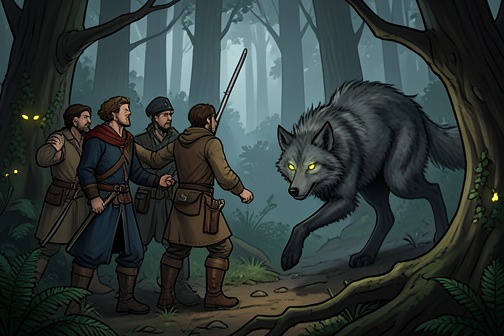
[The Dire Wolf Attack](entity:event-recall-event-the-dire-wolf-attack-7634d1c34dd1) transforms a threatened evening forage into a running fight against a demonic pack, exposing both the danger of the creatures and the way the party’s different abilities become essential to surviving them. The encounter brings the travelers close to being overwhelmed: escape is improvised, the pack’s leader turns the danger inward, and the decisive reversal comes only when [Luc](entity:character-recall-character-luc-b00cd62cc765) reaches the clearing and kills it.
## Warning and Ambush
The attack comes after a day in which [Theo](entity:character-recall-character-theo-107bd6003b61) has felt watched. He asks [Malthios](entity:character-recall-character-malthios-3bbf03e4fa99) whether he senses anyone concealing themselves; Malthios confirms that someone is nearby, but advises waiting until she is off guard. The persistent unease carries into the evening. Luc is unusually clingy, displeased that Theo goes to forage with [Wicker](entity:character-recall-character-wicker-4eaf8f5b7dfe) and [Khal](entity:character-recall-character-khal-3b2ff6449c13), while [Bryony](entity:character-recall-character-bryony-77c7475dde0d) proves effective at hunting small game and Khal takes charge of hunting. Theo and Wicker are left gathering roots as the early sunset limits their time. In that divided attention, neither Theo nor Malthios notices the new threat before it is close.
Wicker seizes Theo’s forearm as the hairs at the back of his neck prickle. Yellow eyes glow from the undergrowth. Malthios identifies the attackers as another demonic creation: dire wolves. Wicker recognizes the immediate imbalance; before they can summon anything, the two foragers will be outnumbered. Khal’s unmistakable heavy footfalls offer a moment to act, and Theo shouts for him to run for help. Theo and Wicker flee in the opposite direction from camp, drawing the pack after them rather than letting it reach their companions unopposed.
The wolves emerge as huge, dark-grey bodies with long fangs and red demon sigils on their foreheads. There are too many to count, and the dense trees and undergrowth are the only thing preventing them from surrounding the fugitives. Theo carries his light sword, but against creatures of this size it seems nearly useless. Wicker calls for a plan; Theo, who has not been told what the plans entail, has to improvise while they run. The contrast between the party’s joking familiarity and the practical urgency of the chase gives way to a simple fact: the trees, not their weapons, are buying them time.
## The Leader’s Threat
The fugitives take refuge in a tree, but the pack does not give up. At least thirty wolves gather beneath them. The largest, with a white ruff and a body bigger than a shire horse, steps into the clearing. Malthios urgently warns Theo not to look at it. The attack therefore carries a second danger beyond the wolves’ numbers and strength: the leader can affect those who meet its gaze. The warning becomes tangible when [Avery](entity:character-recall-character-avery-3f30ea9cdcd5)’s eyes glow yellow like the leader’s and he raises a hand toward the tree.
Bryony shouts for Avery to stop. Theo and Wicker jump clear just before Avery’s lightning bolt strikes the treetop and splinters the trunk. The group’s escape from one threat nearly drops them into another: Theo braces for the forest floor, but Luc catches him in his arms. Khal catches Wicker, who ends up perched on his shoulder. Bryony has knocked Avery unconscious with her bow, interrupting the immediate danger of his attack. When Avery begins to come around, Theo heals him and warns him not to meet the leader’s gaze, explaining that the wolves can make him their unwilling instrument. Avery’s brief confusion and restored, normal eyes mark how abruptly control has shifted.
## The Battle Turns
The wolves draw back to assess the newcomers, then attack again. Luc takes the leader while the others engage the pack. Theo’s light sword proves more useful than its size suggested: he cuts the wolves’ leg tendons, crippling them so his companions can finish the fight. When one wolf slashes Khal’s arm, Khal kills it with his axe, and Theo heals the claw marks within seconds. The fight is not a single contest between Luc and the leader; it depends on the group holding off the pack, treating injuries, and protecting one another while Luc advances.
The leader pins Luc beneath a massive paw, leaving his sword out of reach, and snaps its dripping jaws above him. Before Theo can move, a large hand grabs him by the hood. Luc, meanwhile, catches the wolf’s upper and lower jaws in his bare hands and breaks them. The leader staggers with its jaw at an unnatural angle; Luc gets to his feet, retrieves his sword, and delivers the killing blow. The remaining wolves flee when their leader falls. The clearing is left strewn with wolf corpses, beside the smoking, splintered pine tree that Avery’s bolt struck.
## Aftermath and Significance
Luc rejoins the group and sheaths his sword. Theo hurries to him, checking him with glowing magic; Luc says he is fine, apart from bruises. Relief gives way to familiar teasing when Theo objects to being touched by Luc’s wolf-slobber hand. Luc laughs, as do Bryony, Khal, and [Veiv](entity:character-recall-character-veiv-2ba6a25fcbd2), and puts an arm around Theo’s shoulders as he leads the group back to camp. That return is the immediate consequence of the victory: the travelers survive the ambush, and their attention can turn from combat to rest.
At camp, Cargo has remained behind with the belongings and magic wards. The exhausted party does not butcher Khal’s deer; instead, they boil water and make a filling soup with the roots and mushrooms Theo and Wicker gathered before the attack, seasoning it and adding crumbled traveler’s biscuit until it becomes a dumpling-like broth. As they eat, Wicker explains the rest of the plans. The meal does not erase the danger, but it places the battle within the ordinary work of continuing the journey: gathering food, guarding camp, sharing what was learned, and making preparations together. The attack’s reversal depends not on one fighter alone, but on warning, rescue, healing, and coordinated resistance—especially the discovery that the leader’s gaze can turn a companion into a threat.
Event 28
Nissle遭遇战
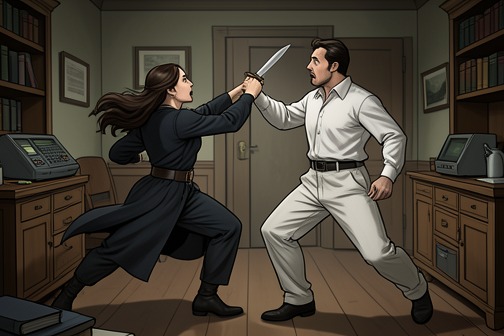
[Nissle](entity:character-recall-character-nissle-3db92c538b90)’s encounter with [Theo](entity:character-recall-character-theo-107bd6003b61) is both an assassination attempt and a sudden exposure of the [Demon King](entity:state-recall-state-demon-king-d4ce23d2b4c1) concealed within him. Nissle believes she has cornered a vulnerable human; instead, her attack gives [Malthios](entity:character-recall-character-malthios-3bbf03e4fa99) the opening to reclaim their shared body and kill her, leaving Theo to confront what that violence means to him.
## Causes and Background
Theo’s secret is a source of constant danger. He knows that friendship cannot protect him if others discover what he is, and even after settling in [Leafel](entity:location-recall-location-leafel-ce079facdeeb) as a healer he keeps that possibility in mind. His growing connections to the town do not erase the risk: the more people come to rely on him, the more there is to lose if his identity is exposed. Earlier, Cargo directly asks whether Theo will tell the others that he is a demon spawn, bringing the concealed truth into the open between them without making it public.
The danger becomes immediate after [Luc](entity:character-recall-character-luc-b00cd62cc765) is poisoned. Nissle later explains that she believed poisoning the [Hero](entity:concept-recall-concept-hero-c363661142b4) would be a reliable way to draw Theo out, because she had learned that he was Luc’s lover. Her information came from [Luvel](entity:character-recall-character-luvel-c4c2298ed8f2), who had mentioned that the demons recovered a trinket pointing to the relationship. Luvel never returned to report further. Nissle’s visit thus connects the poisoning of Luc, the evidence identifying Theo as his lover, and Luvel’s disappearance into one deliberate effort to reach Theo.
## The Confrontation
The encounter follows a fight with dire wolves. While gathering nettles away from the others, Theo senses that he is being watched, stops, and calls Nissle by name. She drops from a tree in front of him. Her black eyes have slit pupils that glow purple; a jagged horn rises from her forehead, a scarf covers the lower half of her face, and pale lavender feathered wings mark her as a demon. Bottles and pouches hang from the belt at her waist.
Nissle identifies Theo as the Hero’s lover and makes clear that she came to kill him. She is also searching for Luvel, who has not returned. Theo answers that Luvel is dead and that he killed them. Nissle rejects the claim and lunges at him. The exchange lasts only moments, but the accusation and answer expose the immediate stakes: Theo has already defended himself against one demon, and Nissle intends to make him pay for it.
## Malthios Takes Control
At Theo’s call, Malthios’s power surges through their body. Horns grow from Theo’s temples and wings from his shoulders as Malthios takes control without hesitation. He seizes Nissle by the throat and slams her to the ground. The transformation makes the concealed arrangement visible: Theo is not merely a human healer facing a demon, but the host of the Demon King.
Nissle recognizes him and begs for forgiveness, saying that she did not know who he was. Malthios answers that her ignorance does not excuse what she did: she hurt someone Theo holds very dear. He also reminds her that Luvel made the same mistake by picking a fight, and tells Nissle that she can imagine what happened to them. The power dynamic reverses completely. Nissle arrived intending to kill Theo; once Malthios emerges, she is the one at his mercy, and the authority of the Demon King is enough to make her recognize him even as she pleads.
Malthios crushes Nissle’s throat. Theo experiences the blood running over their fingers and finds the sensation deeply unpleasant; Nissle’s body then dissolves into shadows, as Luvel’s had. Malthios stands and examines their claws. His remark that it is strange that demons all bleed the same color turns the aftermath toward a question of shared nature, rather than leaving the killing as a simple victory.
## Consequences and Significance
The encounter confirms that Nissle’s attack on Luc was intentional, and that the demons were using the Hero’s vulnerability to draw Theo into danger. It also shows that the object recovered by Luvel had helped expose Theo’s romantic connection to Luc, even though the exact nature of the trinket remains unspecified. Nissle’s death removes the demon who came to kill Theo, but Malthios’s intervention introduces a different cost: Theo has once again felt the violence of their shared body from within.
That cost matters because Theo asks whether Malthios is sure he is still all right with killing demons. The question follows the blood on their hands and Malthios’s observation that both demons and humans bleed the same color. The scene therefore holds two truths together: Malthios protects Theo by killing an attacker, yet the act unsettles Theo rather than resolving his unease about killing. Nissle’s failed ambush becomes a sharp instance of the conflict at the center of their coexistence—Malthios can defend the host he loves, but Theo must live with the bodily and moral aftermath of that defense.
Event 29
Wicker身份揭露
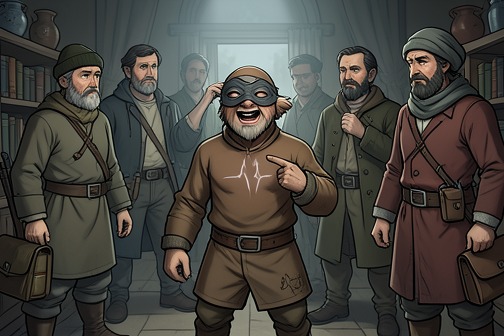
[Wicker](entity:character-recall-character-wicker-4eaf8f5b7dfe) identity disclosure is the scene in which the masked halfling’s hidden nature is exposed to the [Hero](entity:concept-recall-concept-hero-c363661142b4)’s party and then placed within the group’s existing bonds of trust. Wicker is revealed as a necromancer living in a liminal condition: death has taken parts of the body and the ordinary signs of life, while magic continues to sustain what remains. The disclosure therefore changes the party’s understanding of Wicker without erasing the person they already know.
## The Question Behind the Mask
The revelation begins when [Theo](entity:character-recall-character-theo-107bd6003b61) asks Wicker about the carefully preserved map they have been carrying and whether their long travels began while they were alive or continued afterward. The others react as though Theo has asked something impossible, but Wicker laughs and recognizes that a healer would notice what ordinary companions had missed. [Avery](entity:character-recall-character-avery-3f30ea9cdcd5) immediately demands to know whether Wicker is undead, magic sparking around his clenched fist. Theo then points out the decisive physical evidence: Wicker has no heartbeat.
Cargo is the one person who does not seem surprised. As a hog with enough awareness to sense the [Demon King](entity:state-recall-state-demon-king-d4ce23d2b4c1) within Theo, Cargo has already understood that Wicker is different, yet he refuses to expose a secret merely because he knows it. His view is that trust belongs to Wicker to grant or withhold. This stance quietly parallels Theo’s own fear that no amount of friendship will save him if the truth of what he is becomes known. The disclosure thus places two concealed identities beside one another: Wicker’s unusual body and Theo’s dangerous connection to [Malthios](entity:character-recall-character-malthios-3bbf03e4fa99).
## Wicker’s Liminal Condition
Wicker explains that they are a necromancer whose magic takes a part of them when they die, allowing them to continue living until nothing remains. They are not truly undead, but neither are they fully alive again. The statement defines Wicker’s condition as an ongoing threshold rather than a simple transformation from life to death. Their existence is sustained by the same magic associated with their death, making survival inseparable from bodily loss.
The physical demonstration makes the explanation impossible to dismiss as metaphor. When Wicker removes a glove, the party sees that the wrist ends in bare white bone, flexing beneath their gaze. The loss began with the heartbeat. Wicker had been a sickly youngling who was not expected to live long, and later lost both hands when people tried to kill them. Their dry remark that the attackers had, in a sense, succeeded gives the disclosure its grim humor while also revealing the violence that produced the body the party has been interpreting through a mask, gloves, and guarded familiarity.
Wicker says that the face has not yet been lost, although scars remain, and adds that some people find it entertaining to torture someone who cannot die. The mask consequently does not conceal a monstrous identity so much as protect a person marked by repeated abuse. It also controls how much of Wicker’s condition others are permitted to see. The scene moves the mask from a mystery object to part of a survival practice shaped by illness, attempted murder, scars, and the continuing threat of cruelty.
## The Party’s Test of Trust
[Luc](entity:character-recall-character-luc-b00cd62cc765) asks whether the mask is connected to the loss of Wicker’s face, but his tone carries pity rather than anger. That response matters because the group has just learned something that could have been treated as contamination, deception, or danger. Instead of demanding that Wicker prove their harmlessness, Luc responds to the suffering behind the concealment. [Khal](entity:character-recall-character-khal-3b2ff6449c13) likewise says that the party is glad Wicker is with them, acknowledging the pain required to reach the life they now share.
[Emi](entity:character-recall-character-emi-6cd72baa2831) voices the practical and social challenge directly by asking whether the party is simply expected to accept this. Luc answers with a challenge of his own: Wicker is still Wicker, the friend they know and trust. His formulation separates identity from bodily status. The group’s acceptance does not deny Wicker’s altered condition; it refuses to make that condition the sole meaning of the person. Avery remains uncertain but ultimately nods, and the party continues traveling rather than expelling Wicker or treating them as a threat.
Theo responds through touch, pressing an arm against Wicker’s shoulder because Wicker uses physical contact to show affection. The gesture may also offer the warmth of the living as a reminder of what Wicker’s magic and losses have placed at risk. In that moment, touch becomes a form of recognition more immediate than explanation: Theo does not repair Wicker’s body or solve the condition, but he meets the person within it.
## Contrast with Theo’s Concealed Identity
The disclosure is especially significant because it occurs while Theo is himself concealing Malthios, the Demon King, within his body. Theo knows that discovery could destroy the protection offered by friendship, and Cargo’s earlier question about whether he will tell the others makes the danger explicit. When Cargo calls him a demon spawn, Theo freezes and Malthios moves at once to take control and defend them. Theo’s fear is not abstract; it is a bodily shock followed by the threat of losing autonomy.
Later, Theo is compelled to enter the capital to save Luc, fully aware that the journey will surrender his autonomy and reveal who he is and where he lives. The court can force him into the Hero’s party, and the truth about Malthios may be discovered at any moment. Unlike Wicker’s disclosure, which is met by friends who choose to remain friends, Theo’s revelation leads to imprisonment, a trial, and judgment as the Demon King’s host. The contrast shows that acceptance is not produced by truth alone. It depends on the community receiving the truth and on whether that community values a person beyond the danger attached to their identity.
## Narrative Consequences and Significance
Wicker’s disclosure changes the party’s knowledge but does not break its structure. The group continues onward toward a town enclosed by temporary fencing, where darkened windows and the presence of ghosts announce another encounter with the boundary between life and death. Wicker’s own liminal existence therefore echoes the atmosphere of the journey: the party is moving through a world in which the dead may remain present, bodies may be altered by magic, and appearances cannot reliably distinguish safety from danger.
The event also establishes a counterpoint to the later public defense of Theo. When the court moves against Theo, the people of [Leafel](entity:location-recall-location-leafel-ce079facdeeb) appear through a mirror spell and demand his release, proving that they have not abandoned him despite the monster beneath his skin. Wicker’s private disclosure anticipates that larger act of communal recognition. In both cases, the decisive question is not whether the concealed condition is real, but whether friendship survives knowledge of it.
The scene’s value shift is from suspicion to renewed belonging. At first, Wicker’s missing heartbeat and skeletal wrist threaten to redefine them as an outsider or a danger. By the end, Luc’s declaration preserves Wicker’s social identity, while the party’s continued travel makes acceptance an action rather than a sentiment. Wicker remains physically incomplete and metaphysically unresolved, but the disclosure confirms that neither death nor stigma has the authority to decide who counts as a friend.
Event 30
灰烬港鬼触危机
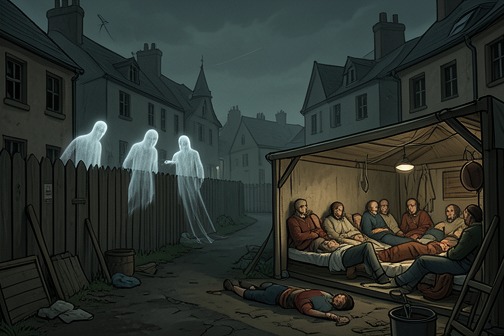
[Ashenhave’s Ghost-Touch Crisis](entity:state-recall-state-ashenhave-s-ghost-touch-96bd064d66ad) transforms a seasonal haunting into a test of communal survival, medical endurance, and the ethics of dealing with the dead. The danger is not limited to a single apparition: ghosts have afflicted residents for a month, leaving a dozen victims in a makeshift infirmary while the town retreats behind barriers. [Theo](entity:character-recall-character-theo-107bd6003b61)’s healing and the party’s practical cooperation stabilize the living, but the crisis ultimately reveals a more intimate tragedy beneath the haunting: a dead child trapped inside a monstrous nested corpse, still asking to be taken home.
## Arrival at a Town Under Siege
Dusk is falling when Theo and the adventuring party approach [Ashenhave](entity:location-recall-location-ashenhave-e8779224b0b8). Temporary fencing surrounds the town’s main section, and the darkened windows of the farms and houses resemble dead eyes. The party senses numerous ghosts nearby, while [Veiv](entity:character-recall-character-veiv-2ba6a25fcbd2) explains that this is the season when such manifestations are expected. The barriers therefore represent both a customary precaution and evidence that the town’s defenses have been overwhelmed; [Avery](entity:character-recall-character-avery-3f30ea9cdcd5) is also right to question why the local adventurer’s guild has not provided a magical defender.
The town’s suspicion extends even to the arriving rescuers. A voice refuses them immediate entry and demands proof that they can survive the night in the open before any discussion takes place in the morning. Avery regards the condition as outrageous, but [Wicker](entity:character-recall-character-wicker-4eaf8f5b7dfe) recognizes the motive beneath it: the townspeople are frightened, and ghosts become especially terrifying when they have been wronged. The encounter establishes the crisis as both a supernatural threat and a breakdown of trust, with Ashenhave forced to treat potential help as another unknown danger.
## The Ghost-Touch Infirmary
Once admitted to the inn, Theo finds the main room stripped of its ordinary purpose. Tables and chairs have been pushed against the walls, leaving rows of bedrolls for at least a dozen victims. The air carries the ghost-touch like old blood, rust, and fresh grave dirt. The victims’ exposed skin is grey and blue, while their lips, eyelids, and nostrils look almost frostbitten, turning the haunting into a visible medical condition rather than an abstract fear.
The most severely affected patient is [Ala](entity:character-recall-character-ala-cea47a8695d3), the town witch, a half-elf who was touched while saving a child on the first night of the attacks. The ghost passed through her rather than merely brushing against her, and the distinction explains why her condition has advanced so far. Theo immediately orders the barren fireplace lit, recognizing warmth as a means of slowing the touch, and begins scanning her with magic. His instructions are direct and urgent because Ala is almost gone, while the other victims have suffered lesser contacts that have worsened gradually over time.
Theo heals throughout the night. After Ala’s color returns to her face, he pauses only long enough to eat sandwiches and drink tea offered by Geg, the goblin innkeeper who has come to like him despite their uneasy first interaction. [Garris](entity:character-recall-character-garris-439ef76cd87e), the town’s chief, and Everett, a guard, remain beside Theo while he works. At dawn, as farmers come downstairs for breakfast, they watch in awe while Theo completes the healing of the final two victims. He is so exhausted that he stands and sways against the wall, yet he continues giving aftercare instructions: the room must remain warm, the patients will experience fever-like symptoms for several days, consciousness should return soon, herbal tea will help combat the fever, and cool cloths will be useful. The immediate value shift is from near-death and helplessness toward survival, but the recovery remains dependent on continued communal care.
## A Coordinated Defense
Healing the victims does not end the crisis. Garris asks whether the ghosts can actually be stopped, and Wicker answers with cautious confidence after studying several of them during the night. The party therefore divides the response between treatment, protection, and investigation. Veiv and Avery undertake to place ghost wards on every house, farm, and shop. Veiv admits that Avery’s wards are not yet as effective as hers, but insists that they will be far better than no protection at all. Avery’s lack of training in folk magic becomes a practical weakness, while Veiv treats the emergency as an opportunity for him to broaden his abilities; she argues that every mage should possess a foundation in every style of magic.
This arrangement gives the crisis a civic scale. Theo’s healing addresses bodies already touched, while the wards protect the town’s homes and livelihoods, and Wicker studies the supernatural pattern behind the attacks. The party does not solve the emergency through a single display of force. Instead, it supplies the specialized labor Ashenhave lacks: a healer for the afflicted, ward-makers for the settlement, and an investigator capable of distinguishing ordinary ghosts from a deeper source of haunting.
## [The Abandoned Well](entity:location-recall-location-the-abandoned-well-7f33067526e3) and the Nested Ghost
The investigation leads the party to a moss-covered well in a small glen. Its stone structure remains intact, but the wooden winch and cover have rotted away. From the opening comes a distant, echoing sound that may be a call or a scream, making the well a physical threshold between the town’s present danger and the buried history beneath it. The location’s decay mirrors the crisis itself: something once built to contain and provide for a community has become an exposed conduit for voices from the dead.
At the glen, the nested corpse is already pacing in the open. Wicker throws a lantern at its feet, coating it in oil, then ignites a rune-marked torch. Theo’s magic rises in green light as the creature recoils, and Wicker uses the opening to strike it with the burning torch. The fire catches on rotten flesh and fur, while the nested beast shrieks loudly enough to seem capable of reaching the town. Repeated blows reduce the creature to a barely recognizable skeleton, and the flames finally consume the blackened bones.
The destruction of the body does not immediately resolve the haunting. After the fire fades, a silvery glow joins the orange embers and Theo’s green magic. A clearer figure appears above the remains: a boy, weeping, whose faint voice asks to go home and reminds Theo of a promise. Theo does not treat the apparition as merely another hostile ghost. He crouches, opens his arms, and offers to take the child home. The confrontation thus changes from extermination to release. The monstrous form must be destroyed, but the spirit within it must still be recognized and guided.
## Death, Memory, and Restoration
The crisis is placed within a wider culture of mourning by [Glefald](entity:character-recall-character-glefald-56a6ec6b20a2)’s funeral, held after his death. Most burials in [Leafel](entity:location-recall-location-leafel-ce079facdeeb) are bonfires intended to free the departed soul through smoke and sparks, but Glefald chooses burial in the earth with a tree planted over his body so that his death can feed new life. The people of Leafel honor this elven custom, placing his grave across from the Watchtower so the eventual tree will become a second guardian of the entrance. The ritual contrasts sharply with the ghosts of Ashenhave: Glefald’s body is deliberately situated, remembered, and given a future purpose, whereas the nested child remains trapped in a corrupted and unquiet form.
The funeral is communal rather than private. The adventurer party lowers Glefald into the ground, except for [Micah](entity:character-recall-character-micah-b7a8af6bb3f9), who is too slight to help but stands at the grave clutching his staff with tears on his face. Everyone takes a shovelful of earth, including Theo when Cade hands him the shovel. Liffey, [Raf](entity:character-recall-character-raf-1a9812291de2)’s wife and the only other elf in the village, sings in her own language after the sapling is planted. Theo cannot understand the words, but understands their emotion, and he touches the pendant around his neck while hoping Glefald has found peace. For Theo, Leafel remains the best place imaginable, even as he wonders whether there is a better place beyond death.
Glefald’s memory also survives materially. The party distributes the knitwear he made over the years, spreading it across a blanket so residents can choose mementos. Isabelle gives Theo a scarf made especially for him, originally intended as a solstice gift, its wool dyed grey-green to match his eyes. The scarf later travels with Theo during the autumn journey toward the mountains, tucked in his knapsack as [Luc](entity:character-recall-character-luc-b00cd62cc765) worries about his light clothing. Its warmth becomes a quiet continuation of Glefald’s care, linking an accepted death and a remembered friend to the later work of confronting restless dead.
Ashenhave’s Ghost-Touch Crisis therefore joins bodily rescue, local governance, exorcism, and funerary memory into one sustained movement. The town’s barriers and dark windows express isolation; Theo’s night of healing restores the living; Veiv, Avery, and Wicker rebuild defensive capacity; and the destruction of the nested corpse opens the possibility that the dead child can finally return home. The event’s deepest resolution is not simply that a monster burns. It is that death is given a place, a name, a ritual, or a guide, so that the dead no longer have to remain a danger to the living.
Event 31
嵌巢鬼魂净化
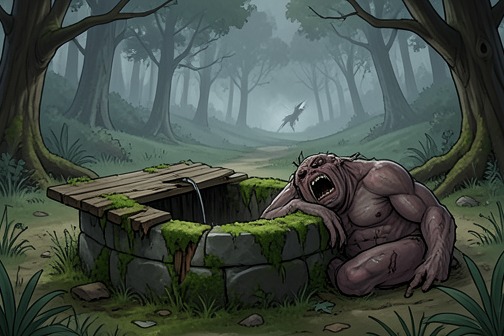
The purification of the nested ghost turns a grotesque haunting at an abandoned well into a rescue of the child spirit trapped within it. With [Wicker](entity:character-recall-character-wicker-4eaf8f5b7dfe)’s knowledge of ghost rites, Cargo’s protection, and [Theo](entity:character-recall-character-theo-107bd6003b61)’s healing magic, the companions destroy the creature that is stirring up the surrounding ghosts, then close the well itself. The encounter ends not with triumph over a monster alone, but with a ghost finally released and a dangerous place removed from the landscape.
## Background and the Well
As dusk fell, the party approached a town ringed by temporary fencing. The farms along the road had dark windows, and Wicker sensed ghosts nearby; [Veiv](entity:character-recall-character-veiv-2ba6a25fcbd2) noted that the season made their presence unsurprising and suggested the barriers might have been erected for that reason. The threat was thus already part of the town’s surroundings before the companions reached its source.
Cargo warned the group as they came to the edge of a small glen. Across it stood a moss-covered well: its wooden winch and cover had rotted away, although the stone structure remained intact. Theo thought he heard distant calling and screaming from within or beyond it. Wicker could not tell at first whether the well itself was the source, but the appearance of a large shadow soon made the danger visible. It was a decaying deer corpse joined to the rotting hind legs of a bear, with bones protruding at unnatural angles and old blood matted in the remaining fur.
Wicker identified the creature as a nested ghost. Their explanation gave the encounter its stakes: a ghost that haunts a place for long enough may nest in available corpses, and the other attacking ghosts are stirred up by the one that has nested. Destroying the powerful spirit could release the others from its influence, but the corpse was protecting its source. The well and the creature therefore formed a single problem: the companions needed to keep the beast occupied while reaching the place where the haunting began.
## Diverting and Burning the Creature
Wicker directed the group toward the well, while they and Cargo drew the creature away and Theo went by another route. The plan immediately became dangerous. Though mostly rotten, the beast was fast, and it pursued Theo. He could not be sure why it singled him out: perhaps it sensed [Malthios](entity:character-recall-character-malthios-3bbf03e4fa99) inside him, or perhaps it was drawn to the strong smell of healer’s magic.
Theo turned and threw holy water at the creature. Where it struck, flesh and bone steamed and bubbled as if scalded; the ghost shrieked. Cargo bit into one of its hind legs and dragged it away from Theo, giving him the opening to run for the well. The air there was intensely cold, and cobwebs hung from the stones. Even with his companions buying him time, reaching the source meant approaching the site of the haunting directly.
The confrontation continued when Theo returned with Cargo and Wicker. The nested corpse was already pacing the glen, so there was no need to hide. Wicker threw a lantern at its feet, coating it in oil; after speaking a rune, they ignited a torch and the group attacked from either side. Cargo stayed close to Theo, since Wicker expected the ghost to focus on him. As soon as Theo entered the glen, he heard a child’s voice pleading to go home.
Theo raised his magic, whose green light outshone the torch, and the beast flinched. Wicker used that hesitation to swipe the torch across the oil-soaked corpse. The flames caught in the rotten flesh and fur. Wicker struck it twice more with the torch, which had been marked with fire-spell runes to make its flames burn hot and bright. The creature’s shrieks, the burning corpse, and the cracking bones mark the shift from pursuit to destruction: the source of the other ghosts’ unrest was being consumed.
## The Child’s Release
When the flames died, the nested beast had collapsed into a blackened skeleton. The companions waited several heartbeats. A silvery glow then appeared alongside the orange firelight and Theo’s fading green magic, and the figure of a boy formed above the remains. He was clearer than before, with tears on his cheeks, and asked to be taken home, reminding Theo that someone had promised him this.
Theo crouched, held out his arms, and offered to help. The boy met his eyes for another heartbeat before running into them. As Theo held him, his magic washed over the spirit; Theo felt the pain melt away as the figure faded. This is the encounter’s decisive release: the child does not merely disappear with the corpse, but reaches Theo and is met with an act of healing.
Malthios responded with bitter anger at the cruelty mortals could inflict. Theo shared the anger over the child’s suffering, while recognizing that nothing could undo it and that other innocents might suffer in the future. The scene therefore refuses to treat purification as a simple erasure of harm. The ghost can be released, but the suffering that made his plea necessary cannot be reversed.
## Closing the Source
The boy’s release did not end the work. Wicker still sensed ghosts and believed they were the nested spirit’s victims. They were less powerful, but Wicker did not want to leave them unrestful. Using salt, incense, a torch, and the runes traced with their spoon, Wicker performed a further rite at the well. They sprinkled salt counterclockwise around its rim, lit five sticks of incense and placed them among the stones, then used their magic before instructing Theo to toss the torch into the opening.
Wicker planned to have Veiv destroy the well the following day. Theo instead drew on Malthios’s mana and brought the stones down into the opening, then collapsed the surrounding earth into it. The well disappeared beneath a bare mound of dirt. Theo wished he knew the child’s name so he could leave a marker, and prayed to Arriss for the boy’s peace. The wish for a name and memorial stands in contrast to the well’s anonymous dead: its closure prevents future hauntings, but cannot give the child an identity the companions never learned.
On the walk back toward town, Theo said he hoped never to see another nested ghost. Wicker answered by recognizing that they had made a good team, imagining that in another life the work might have been theirs. Their exchange closes the event on companionship rather than victory. The sequence also recalls [Leafel](entity:location-recall-location-leafel-ce079facdeeb)’s distinct customs for honoring the dead: at [Glefald](entity:character-recall-character-glefald-56a6ec6b20a2)’s funeral, his wish for burial beneath a planted tree was honored, and his knitted work was shared as mementos. The child at the well receives no known name or planted marker, but Theo’s care, prayer, and destruction of the source give the haunting a form of closure. The cleansing restores some order to a town facing seasonal ghosts without pretending that the dead, or the living, can be spared every consequence of cruelty.
Event 32
Ashenhave Pumpkin Festival
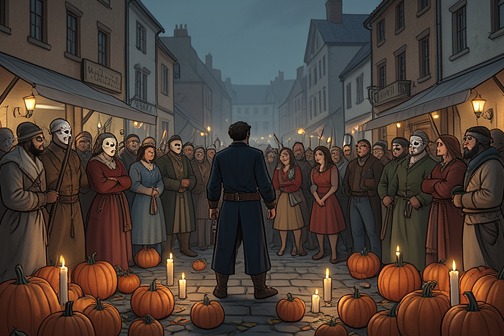
[Ashenhave Pumpkin Festival](entity:event-recall-event-ashenhave-e456ae92512f) is the yearly autumn celebration that welcomes the [Hero](entity:concept-recall-concept-hero-c363661142b4)’s party as honored guests while the town remains marked by its recent ghost crisis. Its decorations, offerings, masks, candles, and crowded streets create a ritualized space where the community publicly commemorates the dead and celebrates continued life. Beneath that communal display, the festival also exposes [Theo](entity:character-recall-character-theo-107bd6003b61)’s unease with heroic celebrity and culminates in a private moment of intimacy between [Theo and Luc](entity:relation-recall-relation-theo-and-luc-6c31719ecbcf).
## Causes and Setting
Three days after the nested ghost was destroyed and the boy’s spirit was released, [Ashenhave](entity:location-recall-location-ashenhave-e8779224b0b8) held its annual pumpkin festival. The timing gives the celebration a double meaning. It belongs to the town’s established seasonal calendar, yet it follows directly upon encounters with ghosts, a haunted well, and a creature formed from the dead. The festival therefore does not erase death from Ashenhave; it gives death a recognized place within public life.
The town had recently seemed almost emptied by fear. When the party first approached, temporary fencing surrounded the main section, farm windows were dark, and both Mal and [Wicker](entity:character-recall-character-wicker-4eaf8f5b7dfe) sensed numerous ghosts nearby. The festival reverses that earlier image of defensive isolation. Instead of barred or lifeless streets, Ashenhave becomes a gathering place for residents and visitors from surrounding towns. The contrast makes the celebration feel like a communal recovery as well as a recurring custom.
## Ritual and Public Celebration
People traveled from neighboring towns in unusually large numbers because rumors had spread that the Hero’s party would attend. Ashenhave was decorated with dried cornstalks, sunflowers, orange mums, colored gourds, and pumpkins. Some pumpkins had been hollowed out and carved with faces, with candles placed inside them for the coming night. The decorations join harvest imagery to the season’s preoccupation with death: the same autumn setting contains ripened fields, fading daylight, carved faces, and the illumination of small flames.
An altar stood in the town square where people could light candles and leave offerings for deities or departed loved ones. Leather masks were common, and the air was heavy with spices. These details make the festival more than entertainment. The altar provides a formal outlet for remembrance, while the masks and candlelight transform ordinary public behavior into a ritual performance. In a town that has had to confront restless dead, the community responds not only by fighting ghosts but also by naming, honoring, and incorporating the dead into its seasonal observance.
The party was treated as the festival’s guests of honor. Their presence brought prestige and additional excitement, but it also altered the scale of the event. Ashenhave’s yearly custom became a public spectacle centered on famous visitors, allowing the town to celebrate its own traditions while displaying its connection to heroic history. The arrangement places the party between ordinary festivalgoers and symbolic figures: they are physically present among the people, yet their status makes simple participation difficult.
## Theo and Luc at the Festival
Theo finds the crowd overwhelming. Everyone wants to meet the Hero’s party, and although the other members handle the attention with greater ease, Theo feels his tongue seize up and experiences himself as an impostor. His discomfort is intensified by the conflict between his public identity and his private understanding of himself. He does not feel like a hero, and he longs instead for the quiet of his cottage, where his concerns would be supper, a book, and avoiding [Hayden](entity:character-recall-character-hayden-3887fcc3a0d9).
[Luc](entity:character-recall-character-luc-b00cd62cc765) repeatedly shields him from the crowd by remaining at his side and redirecting attention toward himself. When young people begin flirting with Luc, Luc responds by sitting behind Theo, wrapping his arms around Theo’s waist, and resting his chin on Theo’s head. The gesture is affectionate and protective, though Theo also feels slightly belittled by their difference in height. That mixture of gratitude and embarrassment captures the relationship’s texture: Luc offers visible reassurance, but his protection can also underline Theo’s vulnerability in public.
As Theo’s homesickness deepens, Luc tightens his embrace and nuzzles into Theo’s hair. Theo pinches him for disturbing it, yet admits that the affection helps. The exchange turns the festival’s public performance into a small private refuge. Luc cannot remove Theo from the obligations of the celebration, but he can make the crowded space bearable by giving Theo a physical and emotional point of return.
## The Festival’s Private Turning Point
Night arrives quickly, with sunset’s golden orange giving way to darkness and the town glowing with candles whose flickering lights resemble stars fallen to earth. The festivities are expected to continue until morning, but the romantic atmosphere also marks a change in the evening’s direction. Luc’s hands begin to wander over Theo’s body, and Theo decides that he has had enough of people for the night, instructing the group not to seek him unless someone is dying or one of them is about to be.
Theo leaves the square through darker streets and immediately senses Luc behind him. Luc turns him toward the nearest wall and kisses him with desperate intensity. The desire that has been building since Theo’s fight with Everett flares into an overwhelming need for physical closeness and mutual marking. Theo’s response is decisive rather than hesitant: he orders Luc to the room, and the two of them slip through the nearly empty streets to the inn while the town remains absorbed in the festival.
The scene shifts the festival’s central value from public recognition to private choice. In the square, the party belongs to Ashenhave’s spectators; outside it, Theo and Luc reclaim one another. The candles, masks, and altar establish a world of communal ritual, but the lovers’ flight through the streets creates a counter-ritual of their own, one founded on desire, possession, and the need to affirm their bond away from heroic scrutiny.
## Consequences and Significance
Ashenhave Pumpkin Festival does not resolve Theo’s larger anxiety about his identity, his dangerous connection to Mal, or the fate imposed upon the Hero’s party. Instead, it makes those pressures visible against a setting designed for celebration. Theo is welcomed as part of a celebrated group while feeling that he does not belong to the heroic image surrounding him. The festival’s praise therefore intensifies rather than cures his sense of imposture.
At the same time, the celebration demonstrates Ashenhave’s capacity to rebuild communal life after supernatural disruption. Earlier barriers, dark windows, and ghostly presences give way to visitors, music-like festivity, offerings, candlelight, and shared attention. The community does not defeat death by pretending it is absent; it places remembrance beside harvest and celebration, then continues living.
The event also clarifies the contrast between Luc’s public role and his private future. Elsewhere, Luc’s history as a Hero has been presented as a life of temporary relationships shaped by departure, while Hero [Eliza](entity:character-recall-character-eliza-6ec11b83dd18) later pressures him to preserve the Heroic bloodline. At Ashenhave, his conduct with Theo points in another direction. His embrace, his determination to stay close, and the lovers’ withdrawal from the crowd anticipate Luc’s later declaration that he chooses a quiet life with the man he loves rather than submitting to inherited duty. The festival is thus a small but revealing step toward a future defined by chosen intimacy instead of public obligation.
Event 33
Demon Ambush and Theo’s Capture
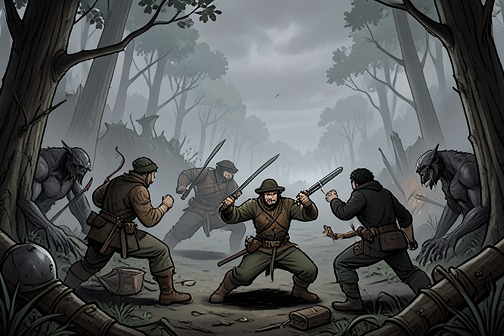
The [Demon Ambush and Theo’s Capture](entity:event-recall-event-theo-7f1c649df18a) is the turning point in the [Hero](entity:concept-recall-concept-hero-c363661142b4)’s party’s approach to the [Demon Fortress](entity:location-recall-location-demon-fortress-e361fb201537): a prepared expedition becomes a desperate battle, and [Theo](entity:character-recall-character-theo-107bd6003b61) is separated from the people trying to protect him. The demons’ sudden focus on his healing magic exposes him as a target; [Tyraz](entity:character-recall-character-tyraz-d0813c0c4748)’s appearance then converts the battlefield into a hostage trap, with Theo taken away through the shadows while [Luc](entity:character-recall-character-luc-b00cd62cc765) can only watch.
## Approach and Vulnerability
The party knew concealment would not secure its approach. [Avery](entity:character-recall-character-avery-3f30ea9cdcd5) was right that the demons would sense them before they reached the fortress. He and [Veiv](entity:character-recall-character-veiv-2ba6a25fcbd2) masked Luc’s magic with spells, but the scent of a Hero could not be hidden. The group nevertheless continued through a barren forest along a narrow path, under a grey sky threatening snow. The cold and exposed route made the planned approach feel precarious even before the demons appeared.
The journey had already demanded a detour after a storm-triggered rockslide blocked the quickest northern route. The party spent almost two weeks on the road, and the altered path took them across a small mountain range. On its second day, Theo noticed Avery’s labored breathing and called for a break despite Avery’s glare and Veiv’s objection that they were nearly past the peak. That moment shows the practical strain of the expedition: keeping the party moving mattered, but Theo was already alert to a companion’s physical limits.
Theo’s importance as a healer had been established well before the fortress approach. When the Hero’s party first sought him out, a friend had been bitten by venomous demon spawn, and their efforts to heal the victim had failed. The townspeople had directed them to Theo because they believed he worked miracles; the party had no healer of its own, and Theo understood that he was the one they needed. His healing role was therefore not incidental to the expedition. It was both the reason the party depended on him and, as the ambush reveals, a vulnerability the demons could exploit.
## The Ambush and the Changing Target
Mal sensed danger first, with Cargo following seconds later. Cargo warned the party, and within moments weapons were drawn and the group was surrounded. The first attackers were weak [Demonkin](entity:creature-recall-creature-demonkin-5aa641de4c0f), the lowest order of demon, with little mana but enough numbers to threaten the party by sheer force. The Hero’s party responded with a practiced formation: Avery, [Emi](entity:character-recall-character-emi-6cd72baa2831), and Veiv held the center beside Cargo, ready to support with magic; [Khal](entity:character-recall-character-khal-3b2ff6449c13), Luc, and [Wicker](entity:character-recall-character-wicker-4eaf8f5b7dfe) guarded the flanks; [Bryony](entity:character-recall-character-bryony-77c7475dde0d) stayed with the mages, bow in hand; and Theo took a shield position beside Luc and the other defenders.
The fighting was sustained and chaotic. [Demons](entity:creature-recall-creature-demons-6600dcc7335a) fell to blades, arrows, magic, and bone, while Wicker repeatedly summoned skeletons, most of them humanoid. Theo had never experienced a large battle firsthand. His earlier fight with bandits seemed slight by comparison, and even the dire wolves now recalled the difficulty of managing his flock on a bad day. Yet memories of battles from [Malthios](entity:character-recall-character-malthios-3bbf03e4fa99) helped keep the noise and confusion from overwhelming him.
A blade nicked Theo’s wrist as he deflected an attack. His magic healed the superficial wound almost without conscious thought, briefly casting green light across the fight. Luc looked toward him with concern, but Theo smiled in reassurance. That small act changed the demons’ behavior: instead of continuing to hammer at the whole formation, they concentrated their attacks and appeared to try to separate Theo from the party. Luc noticed the shift and called Theo’s name. Malthios, already aware of the danger, warned that Theo would be targeted.
## Tyraz’s Intervention
As the ranks of lesser demons began to thin, the party hoped it might capture one and force it to lead them to the fortress. That prospect vanished when at least thirty stronger demons, armed with better weapons and greater mana, emerged from the trees. These novice demons filled the space between Theo and his friends. The battered party faced the new arrivals in a tense pause, neither side making the first move.
Then Malthios warned Theo, and a cold presence closed in behind him. A clawed hand gripped Theo’s throat. He recognized Tyraz from Malthios’s memories: a Demon Lord with long grey hair, yellow slit pupils, pale horns, and a handsome face twisted by an evil smile. Tyraz was the one demon Malthios had nearly feared. Theo dropped his sword when Tyraz tightened his hold. Across the battlefield, Luc met Theo’s eyes; the fear there made clear how little the party could do while Theo was in the Demon Lord’s grasp.
Tyraz explained that he had come to ensure the party could not simply defeat his forces and escape. He called Theo “insurance” in case any of the others survived the fight. Shadows gathered around them, cold against Theo’s skin, and Tyraz’s claws drew blood as his grip tightened. Luc ran toward Theo while the novice demons closed around the rest of the party. The shadows muffled the sounds of the battle, leaving Theo unable to hear anything but Tyraz’s laughter.
Tyraz then addressed him as a healer and said, “Let’s leave them to it, little healer. You and I have more important things to attend to.” Malthios told Theo that he was still there and would protect him. The reassurance did not stop the shadows from enveloping them. Theo felt unable to breathe, as if submerged underwater, with Tyraz’s grip the only solid sensation. When the shadows cleared, Theo collapsed to the floor, struggling to breathe. Tyraz released him and remarked that he had expected more from the Hero’s rumored lover, then suggested that Theo would wish to have been killed instead of facing whatever Tyraz had planned.
## Resistance and Consequences
Theo did not surrender once Tyraz’s grip loosened. As the shadows began curling around him again, he called on his magic and drew a knife in one motion, trying to strike before Tyraz could take control. The Demon Lord’s reflexes were too fast: the blade lodged in his shoulder instead of his throat. Theo ran through a corridor of black stone lit only by pale, glowing crystals. With no windows and identical empty doorways on either side, the passage offered no obvious route to safety.
The capture fractures the party at the exact moment it begins to hope for a way into the fortress. The demons have already made Theo their priority; Tyraz’s intervention makes that threat personal and deliberate, removing the healer from Luc’s protection and leaving the rest of the party to fight the remaining attackers without him. At the same time, Theo’s attempted knife strike keeps the scene from reducing him to a passive hostage. The ambush ends not with his rescue but with his flight into the fortress corridors, carrying the conflict from the open forest into Tyraz’s territory.
Event 34
Tyraz Tortures Theo
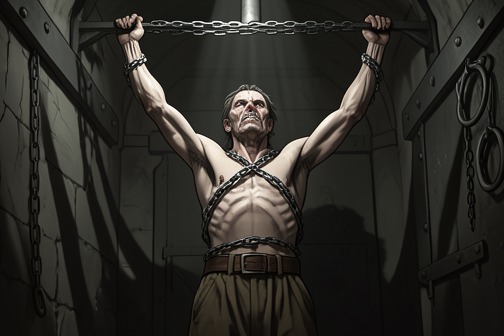
[Tyraz Tortures Theo](entity:event-recall-event-tyraz-theo-701daaacbd67) is the captivity episode in which [Tyraz](entity:character-recall-character-tyraz-d0813c0c4748) attempts to break [Theo](entity:character-recall-character-theo-107bd6003b61) physically, psychologically, and politically. Chained in a dungeon cell inside the demon fortress, Theo is treated as both a captive healer and a strategic hostage: Tyraz wants to test the limits of Theo’s restorative magic, exploit his love for [Luc](entity:character-recall-character-luc-b00cd62cc765), and use his suffering to weaken the [Hero](entity:concept-recall-concept-hero-c363661142b4). The torture therefore becomes more than an act of cruelty. It is Tyraz’s attempt to prove his claim to power, control the battle outside the cell, and force Theo’s hidden bond with [Malthios](entity:character-recall-character-malthios-3bbf03e4fa99) into the open.
## Captivity and Immediate Stakes
Theo begins the episode restrained in a dungeon, with his hands stretched painfully above his head and cold biting into his bare arms. Shadows trail across his body, and the cell’s confinement leaves him replaying his failed attempt to escape. He recognizes the decisive danger of giving Mal control: once Malthios takes over, Theo believes there will be no returning to his own autonomy. Even so, Mal’s voice keeps him from spiraling as they review the demon fortress and Tyraz’s abilities, particularly the Demon Lord’s shadow magic. Their conversation establishes that Theo is not enduring the captivity alone, although the shared body also makes every threat a conflict over control.
Tyraz enters before Theo can prepare himself. The shadows curl around the Demon Lord’s boots, slide up Theo’s leg, hip, and chest, and force his head upward so that he meets Tyraz’s glowing yellow gaze. Theo refuses to flinch. Tyraz reads that defiance as an invitation to escalate, addressing him as a small, restrained toy and presenting the torture as an experiment in endurance. He emphasizes that he has never tortured a healer before and wonders how long Theo’s magic will last if he keeps cutting into him until his mana is depleted. Theo’s healing capacity, ordinarily a means of preserving life, is thus recast by Tyraz as a resource to be exhausted.
The threat is also sexualized and personal. Tyraz says that after disposing of the Hero, he will keep Theo for his own entertainment, while Luc dies knowing that Theo remains in Tyraz’s possession. He frames Theo’s love for Luc as something that can be punished through the body. Theo answers not with submission but with contempt, spitting in Tyraz’s face and rejecting his title. The gesture matters because it denies Tyraz the emotional victory he seeks: even while physically restrained, Theo retains the power to define the meaning of the encounter.
## Tyraz’s Claim to the [Demon King](entity:state-recall-state-demon-king-d4ce23d2b4c1)’s Crown
Tyraz calls himself the new Demon King and treats Theo as the ideal captive for that new reign. Theo directly challenges the claim by insisting that there is only one Demon King, Malthios, and that Tyraz is merely a would-be successor who cannot ascend. Tyraz responds that Malthios is dead after falling to the Hero [Eliza](entity:character-recall-character-eliza-6ec11b83dd18). In his account, Malthios had been the greatest of the demons, but his death has left the crown and its power available to whoever can seize them.
Tyraz’s explanation exposes the logic behind the torture. He considers the defeat of the new Hero proof of his right to rule, especially because even Malthios failed to defeat a Hero. His ambition is presented as a hierarchy of strength: the one who can overpower the Hero deserves the crown. Theo turns that logic back against him, arguing that if the greatest demon fell to a Hero, Tyraz has no reason to assume that he can succeed where Malthios failed. The exchange makes the cell a miniature contest over legitimacy. Tyraz possesses restraints, shadow magic, and institutional authority within the fortress, but Theo possesses knowledge of Malthios and the confidence to expose the gap between Tyraz’s boast and his actual standing.
The argument also creates dramatic irony around Malthios’s supposed death. Tyraz speaks of Malthios as a dead predecessor, while Mal is present within Theo and reacts to the conversation. Theo’s defense of Malthios is consequently both a provocation and a concealed truth. Tyraz believes he is torturing an ordinary mortal who once loved the Hero; he does not understand that the person he dismisses as a captive carries the presence of the very Demon King whose name he claims.
## The Physical Torture and Mal’s Vigil
Tyraz follows his threats with violence. A blow snaps Theo’s head to the side, dislocates his jaw, and breaks his nose. Theo’s magic immediately illuminates the cell with a green glow as the forming bruise heals, the bleeding stops, and his jaw clicks back into place. The speed of recovery frustrates Tyraz’s expectations. Rather than making Theo helpless, the healer’s power turns each injury into evidence that the torture has not yet achieved its purpose.
Tyraz then cuts Theo’s visible skin with his claws. Theo’s magic heals the wounds almost before the blood can escape, and Tyraz becomes more intrigued than frustrated by the apparently inexhaustible supply of mana. The scene converts healing into a cruel cycle: Tyraz creates injury, Theo repairs it, and the repair permits Tyraz to continue. The body’s resistance is therefore inseparable from its vulnerability. Theo can close the wounds, but he cannot prevent the next cut, and the repeated assault steadily erodes consciousness even as it leaves little lasting mark on the skin.
Mal remains with Theo throughout the torture. At first, Mal speaks about memories from home and about the months spent traveling with the Hero’s party. When he runs out of other things to say, he recites the names of people Theo misses: [Imani](entity:character-recall-character-imani-3e59d6c7b288), [Dale](entity:character-recall-character-dale-fff2558efe87), [Micah](entity:character-recall-character-micah-b7a8af6bb3f9), [Nib](entity:character-recall-character-nib-c57b21ba9a3c), [Dmitri](entity:character-recall-character-dmitri-f7165ee439b9), [Wicker](entity:character-recall-character-wicker-4eaf8f5b7dfe), [Bryony](entity:character-recall-character-bryony-77c7475dde0d), [Veiv](entity:character-recall-character-veiv-2ba6a25fcbd2), [Khal](entity:character-recall-character-khal-3b2ff6449c13), Cargo, and [Avery](entity:character-recall-character-avery-3f30ea9cdcd5). The names become a second form of endurance. They remind Theo that his life is not contained by the cell, but they also intensify the pain of separation until the names blur together in his thoughts while Tyraz repeatedly carves him open. Mal’s companionship cannot stop the violence, yet it prevents Tyraz from becoming the only voice Theo hears.
The episode consequently gives the shared-body bond a practical, life-preserving function. Theo keeps control and continues to resist, while Mal supplies memory, encouragement, and emotional presence. Earlier, Theo had understood that no amount of friendship could save him if people discovered what he was, and Mal had promised to protect him, only for Theo to reply that Mal would be protecting himself. During the torture, that distinction becomes less stable. Their survival is shared: Mal’s alarm and Theo’s endurance are responses from two consciousnesses trapped in one threatened body.
## The Hostage as a Weapon Against the Hero
The torture reaches its strategic purpose when another Demon Lord arrives with news that the first legion has engaged the invading forces and that [Keplo](entity:character-recall-character-keplo-57c7f47905e7) was dueling the Hero when the messenger departed. Tyraz is angered that the attackers entered without an alarm, but he quickly reveals that he had anticipated the possibility. He explains that he took the Hero’s lover precisely so that Theo could serve as a sacrifice before Luc.
Tyraz’s shadows unlock Theo’s cuffs, but freedom is only an illusion. Blood rushes painfully back into Theo’s arms, knots form in his shoulders from the prolonged restraint, and the shadows immediately secure his arms behind his back and coil around his throat. Tyraz escorts him toward the confrontation as a living message: the Hero may fight outside, but the Demon Lord believes he controls the person Luc loves. Theo’s body is made into the battlefield’s hostage signal, and his healing magic becomes part of the spectacle Tyraz intends to display.
This use of Theo depends on the secret that governs his entire position in the story. Cargo has already asked whether Theo will tell the others that he is demon spawn, and the question leaves Theo frozen because discovery could destroy the safety he has built. Theo likewise understands that entering the capital will end his autonomy: those in power will know who he is and where he lives, and [Camden](entity:character-recall-character-camden-901e9f21b9e7) could force him back into the Hero’s party, where the truth might emerge at any moment. He nevertheless chooses danger when Luc may die, because Luc is not expendable to him even if the political system can replace one child with another. Tyraz exploits exactly this refusal to treat Luc as expendable.
## From Private Secret to Public Judgment
The fortress captivity leads into a wider crisis after Theo’s identity is confirmed. He is brought to the capital in restraints through a portal and placed in the dungeons while Luc remains silent, unable to meet his gaze. The court treats Theo as a political threat rather than as the healer who has served [Leafel](entity:location-recall-location-leafel-ce079facdeeb). During the trial, the court agrees that Healer Theo is guilty for protecting Malthios, and the accusation turns the private fear of disclosure into a public charge.
The response from Leafel reverses the isolation Tyraz tried to create. Micah opens a large mirror spell from the town square, with Imani, Dale, Dmitri and his parents, Nib, [Amaya](entity:character-recall-character-amaya-3164488322dd), and the people of Leafel gathered behind him. [Hayden](entity:character-recall-character-hayden-3887fcc3a0d9) steps forward and demands Theo’s release. Their intervention demonstrates that the discovery of Theo’s identity does not produce universal rejection. The people Tyraz’s torture sought to erase from Theo’s reach instead become witnesses for him, transforming his secret from a private liability into the basis of a communal act of solidarity.
## Consequences for the Heroic Order
The public intervention from Leafel changes the political meaning of Theo’s captivity, but it does not immediately dissolve the danger. The court still has to decide what to do with a healer who protected Malthios, and Luc must confront the conflict between his institutional duty and his attachment to Theo. When Luc asks whether Malthios destroyed the demons and the fortress, the answer confirms the scale of the devastation: Malthios destroyed the fortress and everyone inside it, leaving only some lesser demons and demon-created monsters at large. The destruction means that the organized demonic threat has largely ended, and, in the judgment expressed there, there is no longer any need for a Hero. Yet the existence of that victory does not automatically settle Theo’s status. The fortress has fallen, but the system that made Theo a disposable hostage still demands a formal judgment.
Luc’s response becomes the decisive reversal of the episode’s coercive logic. He acknowledges that, as the Hero, it is his duty to kill the Demon King, but immediately asserts that he can choose when that duty will be carried out. The statement does not deny the danger Malthios represents or erase the violence associated with the Demon King’s identity. Instead, it separates the power to execute from the demand for immediate obedience. Tyraz had tried to force Luc through Theo’s suffering; Luc refuses to let the hostage situation dictate the timing or meaning of justice.
Theo then takes control again, allowing his appearance to return to normal. The change visibly relieves Luc, although Luc’s face still seems to collapse under the strain of what has happened. The moment makes the shared-body condition part of the judgment itself: the court is not deciding the fate of an abstract Demon King alone, but of Theo, the host whose ordinary identity remains visible and whose relationship with Luc has survived captivity, torture, and disclosure. Malthios also asks Luc to use the name Mal, the name given by his friends and used by Theo, and urges him to make a good choice. That appeal places personal history and chosen identity beside the formal title of Demon King.
## Judgment and Aftermath
The final ruling rejects both immediate execution and the court’s initial accusation against Theo. [King Alexis](entity:character-recall-character-king-alexis-965b76b67eae) announces that the trial of Demon King Malthios ends with a sentence of life in prison, while Healer [Theo Bladefoot](entity:character-recall-character-theo-bladefoot-4a02f215e1d3) is freed from all charges. The paired decisions distinguish responsibility from guilt: Malthios remains subject to permanent confinement, but Theo is not condemned merely for protecting the being who shares his body. The outcome also recognizes that Theo’s actions cannot be reduced to collaboration with an enemy, because his protection arose within a relationship of shared survival and loyalty.
The sentence follows the collapse of Tyraz’s intended hostage strategy. Tyraz had treated Theo as a sacrifice whose pain would demonstrate Luc’s powerlessness, but the strategy instead exposes the limits of coercion. Theo survives the torture, the fortress is destroyed, the Hero’s party and Leafel’s community intervene, and Luc retains the authority to postpone execution. The episode therefore moves from a dungeon in which Tyraz appears to control every body and decision to a court in which the captive’s identity, the community’s testimony, and Luc’s choice all constrain the state’s response.
The people watching through the mirror spell cheer after the verdict, and Luc turns Theo toward them so that they can wave together. The gesture reverses the image Tyraz intended to present: Theo is no longer displayed as a powerless object before the Hero, but appears beside Luc before the people who demanded his release. Luc thanks the gathered supporters and anticipates their return home before spring if the roads remain clear. The movement from dungeon, to courtroom, to the prospect of home gives the torture a clear aftermath: it does not erase Theo’s vulnerability, but it fails to isolate him or sever his chosen ties.
## Narrative Significance
Tyraz Tortures Theo combines captivity, attempted political succession, hostage-taking, and the exposure of a forbidden identity. Its immediate conflict is between Tyraz as the aggressor, Theo as the restrained captive, and Luc as the threatened Hero whose love is meant to become a weakness. Tyraz’s objective is threefold: to test the limits of Theo’s healing magic, to punish him through the person he loves, and to convert Theo’s body into proof of Tyraz’s authority. Theo’s resistance defeats the first two objectives in symbolic terms even before the later military and legal reversals: healing keeps him alive, while defiance prevents Tyraz from controlling what the suffering means.
The event also turns a secret into a sequence of public recognitions. Theo has long understood that friendship may not save him if others discover what he is, and Cargo’s direct question about his demonic nature makes that fear immediate. The trip to the capital intensifies the threat because Theo knows that authorities will learn his identity and may force him back into the Hero’s party. He chooses to go because Luc may die, revealing that his decision is not based on safety but on the refusal to regard Luc as expendable. In the fortress, Tyraz weaponizes that choice; in the capital, Leafel’s people answer it with their own choice to stand publicly beside Theo.
The torture’s central irony is that Tyraz treats strength as the sole basis of legitimacy, yet his attempt to display strength produces the relationships and judgments that undermine him. He invokes Malthios as the greatest demon and claims the crown because Malthios is supposedly dead, while Malthios is present within Theo and silently participates in the exchange. Tyraz’s violence cannot discover the truth, command Theo’s loyalty, or secure the Hero’s submission. By the end, Malthios is imprisoned rather than enthroned, Theo is acquitted, and Luc’s duty is no longer allowed to dictate an immediate execution. The episode thus presents endurance not as the absence of pain, but as the preservation of identity, memory, love, and choice under an authority determined to turn all four into weapons.
Event 35
The Hero's Party Assaults the Demon Fortress
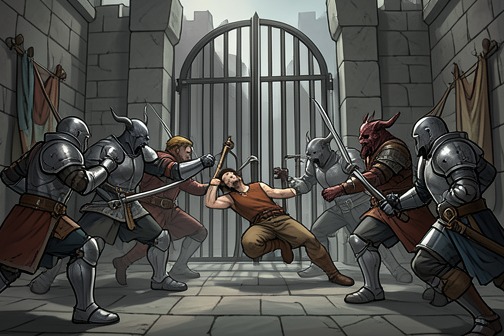
[The Hero's Party Assaults the Demon Fortress](entity:event-recall-event-7ff3416ea416) is the turning-point assault in which the [Hero](entity:concept-recall-concept-hero-c363661142b4)’s party penetrates the stronghold of the remaining [Demon Lords](entity:creature-recall-creature-demon-lords-faedb062c0d5) to rescue [Theo](entity:character-recall-character-theo-107bd6003b61) and confront the force that has taken him hostage. The attack transforms Theo from an isolated prisoner into the living stake of a public military crisis: [Tyraz](entity:character-recall-character-tyraz-d0813c0c4748) uses him as a sacrifice and a psychological weapon, while [Luc](entity:character-recall-character-luc-b00cd62cc765)’s determination to purge the demons is forced into direct conflict with his love for Theo. The fortress’s apparent security collapses under the assault, and the battle brings the competing claims of heroism, demonic succession, captivity, and chosen loyalty into the same courtyard.
## Causes and Strategic Background
The assault occurs against the larger political reality of [Algeya](entity:location-recall-location-algeya-1668b0a6fe56) after [Malthios](entity:character-recall-character-malthios-3bbf03e4fa99)’s defeat. The capital’s palace and training complex still treat the [Demon King](entity:state-recall-state-demon-king-d4ce23d2b4c1)’s remnants as an active threat, because the remaining Demon Lords continue to lead forces scattered across the land while the Hero’s party protects ordinary people. The old war has therefore not ended with the former Demon King’s defeat; it has become a succession crisis in which another Demon Lord can attempt to inherit the title and consolidate the surviving military order.
Tyraz’s strategy depends on Theo’s captivity. Theo is held in a dungeon, restrained badly enough that the pressure of the shadows causes bruising and makes his consciousness flicker. When a Demon Lord arrives with news that the first legion has engaged the invading force and that [Keplo](entity:character-recall-character-keplo-57c7f47905e7) was dueling the Hero, Tyraz does not treat the breach as an unexpected disaster. He explains that he had planned for such an attack and had taken the Hero’s lover precisely so the rescue would become a weapon against Luc. The fortress is thus defended not only by troops and magic, but by the assumption that Luc will be made powerless through fear for Theo.
The assault also follows a broader pattern of contested access and exclusion. The Hero’s party has already encountered communities whose fear makes them deny entrance, while the capital’s palace uses magic mirrors to bring rulers and councils together across Algeya without requiring physical travel. Against those controlled political spaces, the fortress represents a violently guarded territory in which entry is forbidden and prisoners are reduced to bargaining pieces. The invasion reverses that arrangement: the demons lose control of the boundary, and the supposedly secure interior becomes a battlefield.
## Course of the Assault
The attack reaches Theo through the sounds of a military crisis rather than through any orderly announcement. A newly arrived Demon Lord reports that the first legion has engaged the attackers and that Keplo was fighting the Hero when the messenger departed. The report establishes that the Hero’s party has already broken into the fortress’s defenses and that the demons cannot hold them back for long. Tyraz’s response is confident rather than alarmed, because the hostage plan allows him to convert the party’s advance into a confrontation on his chosen terms.
In the courtyard, the fortress has already become a killing ground. Many [Demonkin](entity:creature-recall-creature-demonkin-5aa641de4c0f) and Novices are dead, and their bodies are beginning to dissolve into shadows, while the survivors attempt to contain the Hero’s party. The contrast is stark: the defenders are numerous but disintegrating, whereas the invading party is described as an unstoppable force. The dead do not remain as ordinary corpses, reinforcing the unnatural character of the fortress and making the battlefield itself seem to absorb the forces sacrificed for its defense.
Luc is the most visibly transformed figure in the courtyard. His sword flashes like red lightning as he duels a demon whose massive build rivals [Khal](entity:character-recall-character-khal-3b2ff6449c13)’s and who carries a giant broadsword. Theo has never seen Luc fight with such complete abandonment of caution and humanity; every swing is directed toward killing. The sight shows both the power of the Hero and the danger of that power when it is driven by rage. Mal recognizes the resemblance between Luc’s present violence and [Eliza](entity:character-recall-character-eliza-6ec11b83dd18)’s earlier ferocity, warning that fighting in this state may allow Tyraz to win rather than save Theo.
Theo’s brief call to Luc interrupts the battle’s momentum. Luc hears him immediately, searches his body for injuries, and visibly experiences relief and anger at once. The exchange cannot become a reunion, because Tyraz orders the fighting to stop. Demon forces withdraw to the courtyard’s edges, leaving the Hero’s party at the center while Tyraz spreads his arms in a gesture of welcome. The apparent pause is therefore not peace but staging: Tyraz turns the invaded courtyard into a court of his own, with Theo displayed as the proof of his control.
## Tyraz’s Claim and the Hostage’s Role
Tyraz identifies himself as the new Demon King, and the other demons cheer his declaration. His claim is made at the exact moment when his military position is visibly weakening, giving the title an unstable, performative quality. He lacks the uncontested authority of the former Demon King, yet he attempts to create legitimacy through public announcement and the approval of the forces gathered around him. The assault consequently becomes both a rescue operation and a challenge to a new regime.
Luc answers Tyraz by naming himself Hero [Luca](entity:character-recall-character-luca-aa8721da92cd) of Algeya and stating that his duty is to purge all demons from the land. He offers to consider a quick end for Tyraz if Theo is released, but the offer does not soften the underlying conflict. Luc speaks as the institutional Hero, while Tyraz speaks as a ruler using the language of possession, sacrifice, and emotional humiliation. The two roles collide because Theo is simultaneously Luc’s companion and the person Tyraz has made central to his defense.
Tyraz deliberately reframes Theo’s relationship with Luc as a source of suffering. He calls Theo Luc’s lover and claims that Theo has endured enough merely because Luc loves him, adding that the captivity has brought Theo to tears. Whether or not Tyraz’s description is intended as truth, it is unmistakably calculated to provoke Luc and shame Theo. Before Theo can answer, the shadow around his throat closes over his mouth, preventing him from speaking. The physical silencing makes the political logic of the fortress literal: Tyraz controls the hostage’s body so that Luc must negotiate with an image of Theo rather than with Theo’s own voice.
Tyraz then approaches Theo and uses shadows to unlock the restraints while immediately binding him again. Blood rushes back into Theo’s hands and arms, but the relief is inseparable from renewed control; shadows secure his arms behind his back and coil loosely around his throat. Tyraz calls Theo a sacrifice and proposes showing Luc how powerless the Hero is within the fortress. The gesture exposes the assault’s central value shift. The Hero’s party has entered expecting rescue and combat, but Tyraz attempts to turn their advance into proof that love can be used to defeat heroic power.
## Immediate Consequences and Narrative Significance
The assault changes the fortress from a place of hidden imprisonment into a public arena where every major allegiance is visible. The demons’ bodies dissolve, the first legion is engaged, Keplo is occupied with the Hero, and Tyraz must personally reveal himself as the new Demon King. His claim emerges under pressure rather than after victory, suggesting that demonic authority is being asserted in the middle of collapse. The Hero’s party, meanwhile, is not merely fighting an enemy army; it is being forced to choose how to act when the enemy has made Theo the condition of the battle.
The event also clarifies the difference between Luc’s duty and Luc’s attachment. His declaration remains absolute in its language of purging demons, but his first practical demand is Theo’s release. Tyraz exploits the gap between those positions, presenting love as the source of Luc’s vulnerability. Luc’s feral fighting style confirms that Theo’s captivity has altered the Hero’s conduct before the formal confrontation even begins. The assault therefore does not simply test whether the party can defeat the fortress; it tests whether Luc can remain a Hero without allowing the role to erase the person he is trying to save.
Theo’s experience gives the invasion its emotional and bodily center. He survives the shadow pressure, hears Mal’s frantic warning, and remains conscious long enough to recognize the arriving forces and call to Luc. Yet the rescue has not secured his freedom. The fortress assault ends this phase with Theo still bound and Tyraz still able to parade him before the invading heroes. The attack wins entry and exposes the enemy, but its first visible result is an escalation: the battlefield is opened, the new Demon King is named, and Theo becomes the sacrifice around which the next confrontation must turn.
Event 36
Malthios's Return
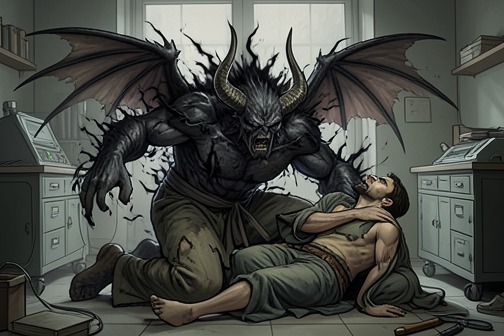
[Malthios's Return](entity:event-recall-event-malthios-12f7d3830281) is the turning point at which [Theo](entity:character-recall-character-theo-107bd6003b61)'s concealed connection to the former [Demon King](entity:state-recall-state-demon-king-d4ce23d2b4c1) becomes an undeniable public fact. Faced with [Luc](entity:character-recall-character-luc-b00cd62cc765)'s imminent death, Theo abandons secrecy and self-preservation: [Malthios](entity:character-recall-character-malthios-3bbf03e4fa99)'s power passes through him, wings and horns emerge, his fingers become black claws, and the returning Demon King bursts into the open. The transformation saves [Theo and Luc](entity:relation-recall-relation-theo-and-luc-6c31719ecbcf) from an immediate execution, but it also makes Theo answerable to the capital, the court, and the people who have feared Malthios's name.
## Causes and Background
Theo's return to the capital already carried the threat of exposure. He understood that entering through the portal would end his autonomy, reveal where he lived, and place him back within the [Hero](entity:concept-recall-concept-hero-c363661142b4)'s party, where [Camden](entity:character-recall-character-camden-901e9f21b9e7) could recognize him and the truth about his body might be discovered. He nevertheless went because Luc might die without his healing, and Theo considered Luc irreplaceable even though the institutions surrounding the Hero's party treated heroes as expendable. The journey therefore begins as an act of chosen loyalty under coercion: Theo knows that disclosure may destroy his life, yet refuses to let Luc be sacrificed to the system.
The danger of disclosure is not abstract. Theo knows that friendship would not save him if anyone learned what he was, while Cargo later confronts him directly about whether he will tell the others that he is demon spawn. The question freezes Theo in place and allows Malthios to press forward defensively from within him. His secret is thus both a personal burden and a political liability. Theo is not merely hiding a supernatural condition; he is concealing an identity that the dominant order has defined as grounds for death.
## The Return in Battle
The revelation occurs after [Tyraz](entity:character-recall-character-tyraz-d0813c0c4748)'s shadow copies overwhelm the battle. Two copies engage Luc while a third drives a sword into his side. Luc's blue coat darkens with blood, he drops the [Hero's sword](entity:object-recall-object-hero-s-sword-2996941205e7), and he collapses before Theo can reach him. Theo experiences Luc's pain through his own body, with the wound seeming to burn from his side into his chest. His magic is the only force capable of saving Luc, and desperation finally outweighs the fear that has governed his concealment.
Theo calls on Malthios and feels the demon's power flood through him while retaining control. He strikes the barrier holding him prisoner, sending magic down his arm like lightning and shattering the circle. With no weapon and no plan, he runs toward Luc. The action is not a calculated military maneuver but a rescue undertaken against overwhelming odds, driven by the conviction that Luc must not be allowed to die even if saving him costs Theo everything.
When Tyraz raises his sword over Luc, Theo throws himself between them. Malthios answers immediately. Power surges through Theo a second time; wings unfold from his shoulders, horns grow from his temples, and his fingertips curl into black claws. The force of the transformation blasts outward and sends Tyraz flying back. Luc can only look up at Theo with unfocused eyes, so the scene leaves uncertain whether he understands what he is seeing. The uncertainty does not lessen the revelation's scale: Malthios, identified as the King of all demons, has returned through Theo's body before Luc, Tyraz, the trapped Hero's party, and the wider courtyard.
## From Revelation to Trial
The transformation resolves the immediate threat but creates a larger one. Theo's identity can no longer remain a private secret between himself and Malthios, and the capital responds by treating the matter as a legal and political emergency. The court orders Theo taken to the dungeons, where he is confronted by the court mage and by [Julius](entity:character-recall-character-julius-2b9b6a5d3dd6), Luc's former lover. The trial is explicitly framed as the trial of the Demon King's host, showing that the authorities judge not only Malthios's acts but also Theo's status as the body through which Malthios survives.
The proceedings initially place Theo under the weight of collective accusation. The court agrees that Healer Theo is guilty of protecting Malthios, making his healing identity inseparable from the charge against him. Yet the trial is interrupted by a mirror spell opened from [Leafel](entity:location-recall-location-leafel-ce079facdeeb). [Micah](entity:character-recall-character-micah-b7a8af6bb3f9) stands at the front of the town with his staff raised, while [Imani](entity:character-recall-character-imani-3e59d6c7b288), [Dale](entity:character-recall-character-dale-fff2558efe87), [Dmitri](entity:character-recall-character-dmitri-f7165ee439b9) and his parents, [Nib](entity:character-recall-character-nib-c57b21ba9a3c), [Amaya](entity:character-recall-character-amaya-3164488322dd), and the people of Leafel gather behind him. [Hayden](entity:character-recall-character-hayden-3887fcc3a0d9) speaks for them and demands Theo's release. Their appearance changes the meaning of the disclosure: Theo is no longer presented only as a demonic threat, because the community he served publicly chooses to witness for him.
## Judgment and the New Balance of Power
Malthios's return also exposes the collapse of the old military order. When Luc asks whether Malthios destroyed the demons, Malthios confirms that he destroyed the fortress and everyone inside it, while acknowledging that lesser demons and demon-created monsters may still remain. He adds that there is no longer any need for a Hero. The statement presents the return as both victory and institutional crisis: the Demon King has ended the immediate fortress threat, but his power also makes the established Hero system appear obsolete.
Luc refuses to let that conclusion erase his own duty. After Malthios asks to be addressed by the name his friends gave him, Theo resumes control and returns to his ordinary appearance. Luc then declares that, as the Hero, it is his duty to kill the Demon King, but immediately asserts that he can choose when that duty will be carried out. This postponement is neither a denial of the law nor an immediate act of obedience. It creates a precarious compromise in which Luc preserves the formal obligation while refusing to surrender [Theo and Malthios](entity:relation-recall-relation-theo-and-malthios-24da48fb7937) to an automatic execution.
[King Alexis](entity:character-recall-character-king-alexis-965b76b67eae) ultimately announces the trial's sentence: Malthios is condemned to life in prison, while Healer [Theo Bladefoot](entity:character-recall-character-theo-bladefoot-4a02f215e1d3) is free of all charges. The decision separates the host from the being within him, even though the transformation has shown how inseparable their fates are in practice. The people of Leafel cheer through the mirror spell, and Luc turns so that Theo and the gathered community can acknowledge one another. The group expects to reach home before spring if the roads remain clear, giving the judgment a concrete aftermath: imprisonment replaces execution, communal acceptance replaces abandonment, and return to Leafel becomes possible.
## Narrative Significance
Malthios's Return reverses the meaning of Theo's hidden identity. Before the battle, concealment appears to be the condition of survival; at the decisive moment, concealment would instead permit Luc's death. Theo's choice to reveal the power inside him turns the secret from a source of shame and danger into the means of rescue. The return therefore joins sacrifice, recognition, and transformation in a single action: Theo saves the person he loves by becoming the figure the world has been taught to destroy.
The event also fractures the simple opposition between Hero and Demon King. Luc remains committed to the Hero's duty, but he delays its final violence; Malthios admits responsibility for destroying the [Demon Fortress](entity:location-recall-location-demon-fortress-e361fb201537), yet the court imposes life imprisonment rather than death; Leafel's people know what Theo contains and still demand his release. Justice consequently moves away from a single ritual of execution toward a constrained coexistence shaped by testimony, responsibility, and future choice. Malthios's Return is not merely the restoration of an old enemy. It is the moment when the story's inherited categories become inadequate, and when Theo's life as both healer and host must be recognized as a new political reality.
Event 37
Malthios Defeats Tyraz and Destroys the Demon Fortress
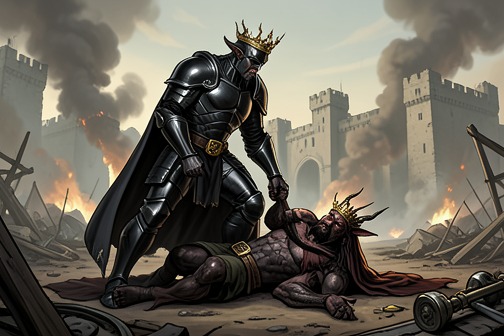
[Malthios Defeats Tyraz and Destroys the Demon Fortress](entity:event-recall-event-malthios-tyraz-951b48106d3f) is the climactic reversal of the conflict between [Malthios](entity:character-recall-character-malthios-3bbf03e4fa99) and [Tyraz](entity:character-recall-character-tyraz-d0813c0c4748). In the courtyard of the [Demon King’s Castle](entity:location-recall-location-demon-king-s-castle-06a0f428e0fe), Malthios reappears as the former ruler’s living counterpart and host-bonded self, defeats the Demon Lord in a public duel, takes back the crown, and immediately rejects the continuation of demon rule. The victory ends not merely with Tyraz’s death but with the destruction of the fortress and Malthios’s declaration that organized demonkind must end.
## Causes and Background
The confrontation grows out of a political vacuum created by Malthios’s earlier defeat. Although Malthios had been overthrown, remnants of his army remained scattered across [Algeya](entity:location-recall-location-algeya-1668b0a6fe56) under the command of surviving [Demon Lords](entity:creature-recall-creature-demon-lords-faedb062c0d5), while the [Hero](entity:concept-recall-concept-hero-c363661142b4)’s party continued protecting ordinary people from them. The Demon King’s Castle therefore represents both the surviving center of demonic power and the unfinished history of Malthios’s reign. Tyraz’s presence makes that history personal: he is not simply an enemy occupying a vacant throne, but the Demon Lord who has taken advantage of Malthios’s absence and now seeks to make the usurpation permanent.
Malthios’s return is also inseparable from [Theo](entity:character-recall-character-theo-107bd6003b61). The two souls share one body, and Theo’s will has become stronger than Malthios expected. Theo has reminded Malthios that good things still exist in the world, and Theo is now the Hero’s lover as well as Malthios’s host and friend. That bond changes the meaning of power before the duel begins. Malthios does not return only to recover a title; he returns because Tyraz threatens Theo and the people Theo loves. The old [Demon King](entity:state-recall-state-demon-king-d4ce23d2b4c1)’s authority is thus redirected through a relationship that the former ruler never imagined having.
## The Challenge and Duel
The courtyard falls silent when Malthios rises and addresses Tyraz directly. The surviving demons tremble at the recognition of their true king, while Tyraz reacts with disbelief and asks how Malthios can be alive. Malthios answers that fate has brought him back and states that he will not allow Tyraz to continue hurting Theo and those dear to him. The exchange converts a supposedly impossible resurrection into an immediate political confrontation.
Malthios then names the terms of the reversal. He insists that Theo is not a diminutive or a possession but a brave, selfless, and kind person, and he expresses gratitude for having Theo as a host and friend. With his sword appearing in his hand, he challenges Tyraz to fight for the kingship, claiming the identity he held before his coronation: Malthios, strongest of all demons and leader of the Pentagram. He also declares that Theo’s presence has made him stronger than he was before. The challenge turns the crown from an inherited symbol into something Tyraz must defend by personal combat.
Tyraz accepts and launches into the air, his wings opening as he attacks. Malthios meets him above the courtyard, and their swords clash over the castle and surrounding mountains. Blue fire crawls across the crossed blades and burns Tyraz when it touches him, while Tyraz answers with shadows that try to entangle Malthios. Malthios repeatedly summons fire to clear them, establishing the duel’s central contrast between Tyraz’s multiplying darkness and Malthios’s controlled, destructive flame.
The fight also makes Theo’s contribution visible without separating it from Malthios’s body. Each time Tyraz’s sword cuts Malthios, Theo’s magic rises and bathes the courtyard in green, helping sustain the combatant who carries him. Tyraz’s wounds accumulate while Malthios remains dominant. Their history stretches back centuries, and the narration presents Malthios as superior from the outset; he toys with Tyraz, exposing his incompetence before the watching demons. That humiliation drives Tyraz toward desperation rather than victory.
Tyraz’s desperation takes the form of imitation. Copies of the Demon Lord suddenly emerge from the shadows with shining blades, attempting to overwhelm Malthios through numbers and confusion. Malthios responds by letting blue flames run over his wings until the red feathers glow, then spins into a tornado of fire that burns through the copies. The maneuver recalls one of [Kamil](entity:character-recall-character-kamil-88c659fbf1a3)’s favorite techniques, transforming a remembered bond with a lost companion into an element of the present battle. Malthios follows the attack by concentrating mana around his blade and cutting through the air; the real Tyraz barely evades the strike, and the impact destroys a tower of the Demon King’s Castle.
The duel ends when Tyraz tries to reduce Malthios’s return to subservience, calling him a human’s pet and warning that mortals will hunt Theo once they learn he is the Demon King’s host. Malthios answers that he has promised to protect Theo and that his word is his bond. He then recalls the old condition attached to Tyraz’s ambition: if Tyraz attempted to take the crown, Malthios would end him. The promise becomes action when Malthios drives his sword into Tyraz’s torso, pulls it free, and lets the Demon Lord fall to the stone courtyard.
## Crown, Fortress, and Consequences
Before Tyraz’s body dissolves into shadows, Malthios removes the crown from his head. The watching demons cheer the return of their true king, but the image of the crown is already unstable. Its black points reflect broken pieces of Malthios’s face, and he observes that the crown always felt heavier when it rested on his own head. The moment resembles a restoration of monarchy while simultaneously exposing the burden and damage contained in that restoration. Malthios has won the throne, yet he no longer accepts the political order the throne represents.
His decisive statement comes immediately after Tyraz’s death. Asked what will happen next, Malthios declares that he will put an end to demonkind so that Algeya can finally know peace and no more children will lose themselves to become heroes. The goal changes from succession to abolition. Tyraz’s defeat therefore does not install a renewed Demon King’s regime; it removes the last rival, restores Malthios’s authority long enough for him to dismantle the system, and recasts the former enemy as the agent of its termination.
The consequences are visible at once. Tyraz’s death breaks the magic circle imprisoning the Hero’s party, freeing the group gathered around the wounded [Luc](entity:character-recall-character-luc-b00cd62cc765). Malthios uses shadows to transport them back to the forest, away from the castle. Soon afterward, an explosion tears through the night, and a column of blue flames rises from the [Demon Fortress](entity:location-recall-location-demon-fortress-e361fb201537). Malthios feels a weight lift from him and announces that the demons have ended. The destruction gives physical form to the decision he has just made: the fortress, once a seat of power and a monument to demonic continuity, becomes the site of that order’s erasure.
## Narrative Significance
The event’s strongest reversal is not simply that the defeated ruler returns and wins. It is that the expected cycle of conquest, coronation, and renewed war is interrupted by an act of self-dismantling. Tyraz treats kingship as an object to seize and uses Theo’s vulnerability as proof that Malthios’s bond has made him weak. Malthios turns both accusations around. Theo is the source of strength rather than humiliation, and the crown becomes something to remove rather than preserve.
The scene also joins public spectacle to private transformation. The duel takes place before demons who recognize Malthios, making his victory a visible transfer of legitimacy, while Theo’s magic and emotional presence remain inside the body carrying out that victory. Malthios’s old identity is therefore neither simply recovered nor discarded. It is reworked through shared embodiment, memory of the Pentagram, loyalty to Theo, and grief for the friends whose faces return to him after Tyraz’s death.
The destroyed fortress and the later scrutiny surrounding Theo give the event a lasting cost. Malthios’s decision promises peace, but it exposes Theo as the host of the reincarnated Demon King and places their shared future under mortal suspicion. The victory closes the age of demon rule while opening the trial of the person who made its ending possible. In that sense, Malthios Defeats Tyraz and Destroys the Demon Fortress is both an ending and a threshold: the old enemy is defeated, the battlefield is erased, and the question of whether Theo can survive the political consequences of Malthios’s return becomes the next crisis.
Event 38
Theo’s Demon King Host Identity Revealed
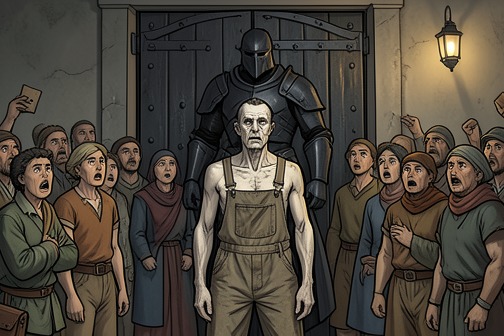
[Theo’s Demon King Host Identity Revealed](entity:event-recall-event-theo-af2b0578b503) turns a secret he has long feared exposing into a public crisis. When [Malthios](entity:character-recall-character-malthios-3bbf03e4fa99) retreats and [Theo](entity:character-recall-character-theo-107bd6003b61)’s familiar appearance returns, the people around him see what he is; the revelation leads from [Luc](entity:character-recall-character-luc-b00cd62cc765)’s rescue to Theo’s arrest and trial, where the choice between a prescribed heroic duty and a life chosen for love becomes explicit.
## Secrecy and the Cost of Disclosure
Theo’s fear is not abstract. He believes that friendship cannot save him if anyone discovers what he is, and he remains prepared to run again. When Cargo asks whether he will tell the others that he is demon spawn, Theo freezes so completely that he nearly drops his basket. Malthios immediately presses to take control and defend them. Even before the identity is exposed, the possibility of disclosure is enough to make Theo fear for both of them.
The risk becomes sharper when [Bryony](entity:character-recall-character-bryony-77c7475dde0d) brings news from the capital: Luc needs help. Theo understands that going there means surrendering his autonomy. The court will learn who he is and where he lives; [Camden](entity:character-recall-character-camden-901e9f21b9e7) might recognize him, and the authorities could force him back into the [Hero](entity:concept-recall-concept-hero-c363661142b4)’s party, where his secret could be discovered. He goes anyway because Luc might die. The decision makes the eventual revelation more than an accidental loss of privacy: Theo has accepted the danger of being recognized in order to save someone he loves.
That attachment has its own history of vulnerability. Luc has described relationships that could not survive the demands of being the Hero, including a squire who ended their relationship when Luc was called away. Later, Luc gives Theo his father’s sapphire ring, a keepsake from a man who died saving his adventuring party from a demon attack, and places it on Theo’s marriage finger. Their promise of a shared future gives Theo a reason to risk the capital, but also makes the threat of discovery more personal.
## Recognition and Immediate Consequences
The decisive disclosure comes after Malthios retreats. [Khal and Veiv](entity:relation-recall-relation-khal-and-veiv-c6f2c0a44936) relax as Theo’s appearance returns to normal, and [Wicker](entity:character-recall-character-wicker-4eaf8f5b7dfe) runs to embrace him. Cargo’s response reveals that he had already known: he says Theo was not dangerous. [Avery](entity:character-recall-character-avery-3f30ea9cdcd5) reacts with fury, naming the figure they have been confronting as the [Demon King](entity:state-recall-state-demon-king-d4ce23d2b4c1). The moment exposes not only Theo’s identity but also the difference between knowing a secret and treating its bearer as a threat.
Theo turns from the surrounding argument to Luc, who has suffered a fatal wound. Theo’s magic can heal it despite its placement and demonic magic, and he takes care to repair Luc completely before tending to his other injuries. Luc wakes and recognizes him. When he asks whether Theo is the Demon King’s host, Theo confirms it and apologizes. The revelation therefore arrives in the most intimate possible form: Luc learns the truth as Theo saves his life, and Theo has to face Luc’s reaction before he can know whether their bond will survive it.
Avery drops magic-dampening handcuffs into Theo’s lap and orders him to put them on. The handcuffs turn suspicion into custody. Avery uses a magic scroll to contact the court mage, while the party’s [Portal Orb](entity:object-recall-object-0dafc4da8ec2) provides a way to reach the capital by breaking it. Within ten minutes of Theo putting on the cuffs, the group steps through a portal into the capital courtyard, where knights and the court mage are waiting. The court mage orders Theo taken to the dungeons. Luc says nothing as Theo is led away, and Theo cannot bring himself to look at him.
## A Public Trial and a Second Revelation
The trial widens the consequences beyond [Theo and Luc](entity:relation-recall-relation-theo-and-luc-6c31719ecbcf). The court agrees that Theo is guilty of protecting Malthios, and the proceedings make plain that the disclosure has become a question of public judgment. Before the court can complete its decision, [Micah](entity:character-recall-character-micah-b7a8af6bb3f9) opens a large mirror spell from [Leafel](entity:location-recall-location-leafel-ce079facdeeb). Behind him stand [Imani](entity:character-recall-character-imani-3e59d6c7b288), [Dale](entity:character-recall-character-dale-fff2558efe87), [Dmitri](entity:character-recall-character-dmitri-f7165ee439b9) and his parents, [Nib](entity:character-recall-character-nib-c57b21ba9a3c), [Amaya](entity:character-recall-character-amaya-3164488322dd), and the gathered townspeople. [Hayden](entity:character-recall-character-hayden-3887fcc3a0d9) speaks for them: they demand Theo’s release.
Their appearance overturns Theo’s expectation that discovery will mean rejection. He had feared that no amount of friendship could protect him; now the people of Leafel make their loyalty visible before the court. Cargo’s earlier decision not to expose Theo and the villagers’ public demand for his release offer different forms of acceptance: one quiet and personal, the other collective and politically consequential.
Luc, meanwhile, asks whether Malthios destroyed the demons. Malthios answers that he destroyed the fortress and those inside it, though lesser demons and demon-created monsters may remain, and says there is no longer any need for a Hero. He asks Luc to use the name Mal, the name given by his friends and used by Theo. Luc takes control again and tells the court that his duty as the Hero is to kill the Demon King—but that he gets to choose when. He describes Theo as Malthios’s prison and himself as its humble guard, promising not to let Theo out of his sight.
## Judgment and the Future Chosen
[Eliza](entity:character-recall-character-eliza-6ec11b83dd18) challenges Luc over the choice he has made, asking whether he will end their bloodline and abandon the purpose for which he has trained. The conflict echoes an earlier explanation from [Julius](entity:character-recall-character-julius-2b9b6a5d3dd6): Eliza wanted Luc to continue the Hero’s bloodline and sire the next Hero, and had pressured Julius to leave him. Luc’s decision rejects not only an immediate execution but the future that Eliza’s expectations prescribe. He calls a quiet, peaceful life with the man he loves the only choice he has ever made for himself, and argues that those born with the Hero’s gift should be able to choose their fate rather than remain bound to duty.
[King Alexis](entity:character-recall-character-king-alexis-965b76b67eae) concludes the trial by sentencing Malthios to life in prison and declaring Theo free of all charges. The distinction matters: Theo is acquitted, while Malthios is not simply absolved. The people of Leafel cheer through the mirror spell, and Luc turns with Theo to wave to them. He hopes they will arrive home before spring if the roads are clear. The revelation that had seemed certain to cost Theo his safety and belonging instead leads to a public claim on his behalf, a judgment separating his fate from Malthios’s, and Luc’s declared commitment to a chosen life together.
Event 39
Trial of the Demon King's Host
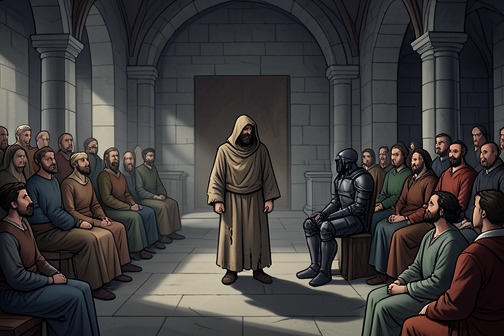
The [Trial of the Demon King's Host](entity:event-recall-event-malthios-f2ed83deaaa8) is the capital’s public judgment of [Theo Bladefoot](entity:character-recall-character-theo-bladefoot-4a02f215e1d3) after the revelation that he houses the reincarnated [Demon King](entity:state-recall-state-demon-king-d4ce23d2b4c1), [Malthios](entity:character-recall-character-malthios-3bbf03e4fa99). The trial transforms a private struggle over secrecy, bodily autonomy, and shared control into a question for the entire realm: whether [Theo](entity:character-recall-character-theo-107bd6003b61) should be treated as Malthios’s accomplice, as a dangerous vessel, or as a person whose choices have repeatedly protected others. Its verdict preserves the Heroic duty to destroy the Demon King while refusing to reduce Theo to that duty’s target, leaving [Luc](entity:character-recall-character-luc-b00cd62cc765) to determine when, if ever, the sentence will be carried out.
## Causes and Political Background
The trial follows the disclosure of a secret Theo has guarded since childhood. After the magic test revealed him to be a healer rather than exposing Malthios’s power, [Theo and Malthios](entity:relation-recall-relation-theo-and-malthios-24da48fb7937) made an agreement: Malthios would stop trying to seize Theo’s mind and body, while Theo would permit occasional control only when it did not violate his wishes. Theo later fled the capital rather than enter the [Hero](entity:concept-recall-concept-hero-c363661142b4)’s training system, traveling with Malthios for two years before settling in [Leafel](entity:location-recall-location-leafel-ce079facdeeb). His fear was not abstract. Theo knew that friendship might not save him if his nature became known, and when Cargo eventually asked whether he was demon spawn, Malthios immediately pressed forward to defend them.
The capital itself embodies the system judging him. Its palace joins royal government, councils, and public ceremony to the training of magic users and knights who may serve the crown or enter the Hero’s party. Although Malthios had been defeated, remnants of his army still remained under the [Demon Lords](entity:creature-recall-creature-demon-lords-faedb062c0d5), allowing the state to define demon extermination as a continuing public necessity. Theo had already experienced this machinery as a child: the court mage declared that a healer with his gift belonged in the Hero’s party, and on his sixteenth birthday [Camden](entity:character-recall-character-camden-901e9f21b9e7) told him that guards would take him back to the capital to train with a new Hero. Theo’s flight was therefore not merely personal evasion; it was resistance to a political order that claimed his abilities, his labor, and eventually his body.
The immediate crisis begins when the Hero’s party seeks Theo’s help for the gravely injured Luc. Entering the capital through a portal, Theo understands that his autonomy is ending: the authorities will know who he is and where he lives, and he may be forced into the Hero’s party where his secret can be exposed. He nevertheless goes because Luc might die, and Theo refuses to treat him as expendable in the way the authorities have treated successive young Heroes. That choice brings him into the very institution he had spent years avoiding.
## Arrest and Public Proceedings
[Avery](entity:character-recall-character-avery-3f30ea9cdcd5)’s message scroll, the court mage’s matching scroll, and the party’s portal orb enable Theo’s rapid return to the capital. Within ten minutes of putting on the magic-dampening handcuffs, he is transported to the courtyard and met by a dozen knights and the court mage. She orders him taken to the dungeons. Luc has remained silent since Theo confirmed the truth, and Theo cannot look at him as he is led away; [Julius](entity:character-recall-character-julius-2b9b6a5d3dd6), Luc’s former lover, is among the guards and tells him that he will pay for hurting Luc.
The formal proceeding is staged as a spectacle of state power. Theo enters a crowded throne room with members of the court lining both sides, mirror spells displaying other meeting rooms, and the Hero’s party positioned opposite the throne. [Syvia](entity:character-recall-character-syvia-1e34b1c5407f), the court mage, stands beside the haunting form of [Eliza](entity:character-recall-character-eliza-6ec11b83dd18), while [Veiv](entity:character-recall-character-veiv-2ba6a25fcbd2), [Khal](entity:character-recall-character-khal-3b2ff6449c13), [Wicker](entity:character-recall-character-wicker-4eaf8f5b7dfe), and Cargo watch Theo, Avery and [Emi](entity:character-recall-character-emi-6cd72baa2831) glare at him, and [Bryony](entity:character-recall-character-bryony-77c7475dde0d) looks down at her feet. A round mirror above the throne broadcasts the scene to every town, village, and city in [Algeya](entity:location-recall-location-algeya-1668b0a6fe56), making Theo’s humiliation and the court’s decision visible even in Leafel, the home he built around his work as a village healer.
Syvia announces the case as the trial of Healer Theo Bladefoot, revealed to be the host of the reincarnated Demon King, Malthios. The announcement provokes demands for immediate execution before [King Alexis](entity:character-recall-character-king-alexis-965b76b67eae) silences the room and insists that witnesses be heard. The proceeding thus presents itself as a trial, but its opening atmosphere reveals how little space the public initially grants to uncertainty: many spectators regard the identity of the host as proof of guilt before any evidence is considered.
The testimony divides the Hero’s party. Wicker, Veiv, and Khal emphasize that Theo helped them without hesitation, that Malthios harmed none of them when released, and that Theo saved Luc’s life twice. Avery stresses that Theo had seemed suspicious from the beginning, while Emi claims that he deliberately slowed the quest and allowed [Tyraz](entity:character-recall-character-tyraz-d0813c0c4748) to capture him too easily. Bryony says little, and Cargo is not called to testify. Luc’s evidence is brief because he was unconscious during much of the final battle, but his voice cracks while describing how Theo threw himself over him to block Tyraz’s blade before transforming. The testimonies make the central dispute concrete: Theo’s hidden identity is real, but so are the repeated acts by which he has chosen to protect the people now judging him.
## Theo’s Defense and the Question of Two Souls
King Alexis asks whether Theo denies the party’s accusations or is Malthios. Theo answers that he denies neither the revealed facts nor his own identity as a host, but refuses the court’s attempt to collapse the two beings into one. He states that he and Malthios are two separate souls sharing one body, with one in control at a time. When the King asks why Theo did not surrender once he understood what he was, Theo points out that he was three years old when the truth became apparent and that Malthios was not then a danger to anyone.
Syvia proposes extracting Malthios from Theo and freeing him. Theo rejects the offer because he does not trust the court to avoid killing him, and because Malthios has told him that the two cannot be separated. Eliza challenges Theo for believing Malthios, exposing the deeper issue beneath the legal language: the court cannot accept a relationship in which Theo names, consults, and trusts the being it defines as an enemy. To the officials, calling Malthios by the familiar name Mal suggests dangerous sympathy; to Theo, that name records years of negotiated coexistence and the limits Malthios has accepted.
The trial also makes visible the asymmetry between Theo’s responsibilities and the authorities’ expectations. Theo is accused of protecting Malthios even though he has spent years restraining him, hiding him, and preventing his power from harming others. The court treats knowledge of the Demon King as sufficient grounds for suspicion, while Theo’s life in Leafel demonstrates a different standard of conduct: healing, community service, and chosen loyalty. His defense is therefore not an attempt to claim that Malthios never existed or never caused harm. It is an insistence that host, soul, intention, and action cannot be made interchangeable merely because the state requires a simple enemy.
## Leafel’s Intervention and Luc’s Decision
The proceedings turn when the court moves toward a guilty verdict. Theo’s anger gives way to fear that punishment will extend to Leafel; if the authorities attack the village, he believes its suffering will be his fault. Before Syvia can complete the judgment, light erupts beside her and a larger mirror spell opens. Through it, Theo sees Leafel’s town square filled with people: [Micah](entity:character-recall-character-micah-b7a8af6bb3f9) stands at the front with his staff raised, joined by [Imani](entity:character-recall-character-imani-3e59d6c7b288), [Dale](entity:character-recall-character-dale-fff2558efe87), [Dmitri](entity:character-recall-character-dmitri-f7165ee439b9) and his parents, [Nib](entity:character-recall-character-nib-c57b21ba9a3c), [Amaya](entity:character-recall-character-amaya-3164488322dd), and the rest of the village. [Hayden](entity:character-recall-character-hayden-3887fcc3a0d9) steps forward, bows to the King and council, and declares that the people of Leafel demand Theo’s release.
The intervention overturns Theo’s expectation that discovery must end in abandonment. The village does not deny that he is Malthios’s host, nor does it attempt to erase the danger surrounding him. Instead, its people testify through presence. They place their knowledge of Theo’s daily conduct, healing, and belonging against the capital’s abstract image of a demonic threat. For Theo, their appearance is emotionally decisive: the people he feared he had endangered have come to defend him, proving that his chosen home is more than a refuge he built in secret.
King Alexis then clarifies the constitutional limit of the court’s authority. The fate of Healer Theo belongs solely to Hero [Luca](entity:character-recall-character-luca-aa8721da92cd). Accusations that Luc is biased because he and Theo were lovers are answered by Eliza’s insistence that the Hero must place the world before personal feeling. Luc approaches Theo and asks to speak to Malthios directly. Malthios takes control, declares that he destroyed the [Demon Fortress](entity:location-recall-location-demon-fortress-e361fb201537) and all within it, and explains that only a few lesser demons and demon-created monsters may remain. Because the organized demonic threat has been broken, he says there is no longer any need for a Hero.
Luc nevertheless states the principle that governs his decision: as the Hero, it is his duty to kill the Demon King. The statement appears to confirm the death sentence, but Luc immediately adds that he also has the right to choose when that death will occur. The distinction between obligation and timing creates a narrow but vital form of mercy. Malthios remains condemned in principle, yet the execution is deferred indefinitely rather than performed at once. His appeal to Luc, made under the name Mal, recognizes both the legal authority of the Hero and the personal bond formed with Theo and his friends.
## Verdict and Consequences
King Alexis announces the final judgment: Malthios is sentenced to life in prison, while Healer Theo Bladefoot is free of all charges. The decision preserves a distinction that the opening of the trial tried to erase. Theo is not legally punished for being the host, for sheltering Malthios under the conditions of their pact, or for refusing to surrender himself to authorities he believed might kill him. Malthios, meanwhile, is neither declared harmless nor executed; his existence remains subject to restraint and to Luc’s eventual judgment.
The verdict’s practical meaning is therefore more complicated than either acquittal or condemnation. Theo’s freedom recognizes the moral weight of his actions and the testimony of those he has saved. Malthios’s life imprisonment acknowledges the continuing danger associated with the former Demon King without requiring the state to sacrifice Theo’s life as a substitute punishment. Luc’s authority converts an immediate execution into a postponed sentence, making coexistence possible while leaving the unresolved question of whether a future threat will justify death.
The trial also changes the spatial and social balance between the capital and Leafel. The capital begins as a place that claimed Theo through testing, training, conscription, imprisonment, and public judgment. Leafel answers that claim through a magical projection of collective solidarity, turning the village itself into a political witness. When the proceedings end, Luc waves toward the people of Leafel through the mirror and says that, if the roads are clear, the party should arrive home before spring. The language of return is significant: Theo is not merely released from the court; he is publicly reattached to a home that has chosen him after learning the truth.
## Narrative Significance
The Trial of the Demon King's Host is the story’s clearest collision between institutional identity and lived identity. The capital sees a category, the host of a reincarnated Demon King; Theo sees a negotiated shared body, a friendship formed through restraint, and a life defined by healing. The court’s questions focus on what Theo is, while the witnesses answer with what he has done. That contrast makes the trial less a search for hidden facts than a struggle over which facts are allowed to determine a person’s fate.
The event also reverses the expected logic of the Hero’s story. [The Hero’s duty](entity:concept-recall-concept-the-hero-s-duty-5a33a6ab6382) has been built around purging demons and protecting the common folk, yet Luc protects the common folk partly by refusing to kill Theo immediately. Theo, meanwhile, fulfills the protective role without belonging to the official Hero’s party and without surrendering his identity as a village healer. The judgment does not abolish the heroic system, but it exposes its limits: a law designed for an external enemy cannot easily account for two souls, one body, and a community that recognizes the host as more than the power within him.
Most importantly, the trial turns secrecy into public knowledge without allowing disclosure to dictate the final meaning of Theo’s life. He had expected that friendship would fail once the truth emerged, and the capital initially appears to confirm that fear. Yet the party’s testimony, Leafel’s intervention, and Luc’s postponed sentence establish a different possibility. Theo remains bound to Malthios, and Malthios remains condemned, but Theo is no longer alone in carrying the danger. The public ending makes chosen allegiance—not blood, origin, or official designation—the force that determines whether the host can return home.
Event 40
Luc Delays Theo's Execution
[Luc Delays Theo's Execution](entity:event-recall-event-luc-theo-87b4308815f6) is the turning point of the trial of the [Demon King](entity:state-recall-state-demon-king-d4ce23d2b4c1)'s Host. Faced with the requirement that the [Hero](entity:concept-recall-concept-hero-c363661142b4) kill [Malthios](entity:character-recall-character-malthios-3bbf03e4fa99), [Luc](entity:character-recall-character-luc-b00cd62cc765) does not deny the danger represented by the Demon King, but refuses to let the court decide that [Theo](entity:character-recall-character-theo-107bd6003b61) must die immediately. By choosing to live with Theo, supervise the Demon King, and leave execution for an undefined future after they have grown old together, Luc converts an apparently final sentence into a conditional postponement and makes a shared life the center of his understanding of justice, duty, and the future.
## Causes and Background
The decision emerges from a conflict that has been building around Theo's concealed identity. Theo understands that friendship alone cannot save him if people discover what he is, and Cargo eventually asks whether he will tell the others that he is demon spawn. The question exposes the danger beneath Theo's ordinary life in [Leafel](entity:location-recall-location-leafel-ce079facdeeb): disclosure can turn a healer and neighbor into a condemned threat. When [Bryony](entity:character-recall-character-bryony-77c7475dde0d) brings a portal from the capital to summon him to Luc's aid, Theo recognizes that entering the capital will end his autonomy. The court will learn who he is and where he lives, and [Camden](entity:character-recall-character-camden-901e9f21b9e7) may identify him; the authorities could force him back into the Hero's party, where his secret might be exposed. He nevertheless goes because Luc may die, and Theo cannot accept a system that treats Luc as expendable and simply raises another child to replace him.
The trial therefore concerns more than whether Theo has committed a punishable act. The court has already placed his body under institutional control: a portal orb brings the party to the capital, magic-dampening handcuffs are fastened around his wrists, and he is taken to the dungeons. The court mage orders his imprisonment while Luc remains silent, and Theo cannot look at him as he is led away. The presence of [Julius](entity:character-recall-character-julius-2b9b6a5d3dd6), Luc's former lover, among those involved in the proceedings intensifies the personal cost of the judgment. Theo's private relationship with Luc is being examined through a political system that has long treated the Hero as a function rather than as a person.
Luc's earlier history makes the court's expectations explicit. He describes previous lovers whose relationships could not survive the demands of the Hero's life: a maid in training from his youth, a squire who ended their relationship when Luc was announced as a departing Hero, and several later attachments that could not last when the party remained in towns for only a few months. Julius later tells Theo that Hero [Eliza](entity:character-recall-character-eliza-6ec11b83dd18) ordered him to reject Luc, threatening to take everything from him, because she wanted Luc to continue the Hero bloodline and sire the next Hero. The trial thus stands at the intersection of execution, compulsory service, heterosexual succession, and the inherited claim of the Hero institution over Luc's future.
## The Trial and Malthios's Testimony
At the crucial moment, Luc asks Theo to let him speak to Malthios. Theo understands the danger of surrendering control and feels his fear sharpen, but Malthios tells him to trust him. Theo takes a breath and releases the Demon King. This act allows the court to hear directly from the being whose existence has been used to justify Theo's imprisonment and prospective execution.
Luc asks whether Malthios destroyed the demons. Malthios admits that he destroyed the [Demon Fortress](entity:location-recall-location-demon-fortress-e361fb201537) and everyone there, while acknowledging that a few lesser demons and demon-created monsters may still be loose. He nevertheless insists that nothing remains that competent adventurers could not handle and concludes that there is no longer any need for a Hero. The statement changes the practical stakes of the hearing: Malthios presents the destruction of the fortress as an act that has removed the immediate need for the heroic system, not as a plea that the court simply overlook his power.
Malthios also explains why he made that choice. He says that he never truly wanted to be the Demon King, though years of playing the role and witnessing his only real friends slaughtered by a Hero caused him to lose himself in it. His first motives were a return to power and revenge, but Theo reminded him what living meant and brought him back toward the person he had been before the crown was placed on his head. Theo gave him peaceful life, good food, and genuine friendship. Malthios therefore accepts responsibility for protecting Theo and Theo's world, even at the cost of his own life.
The testimony makes the host relationship morally legible without erasing the danger. Malthios is still the Demon King, and the court still has a reason to fear him, but his account establishes that the bond with Theo has altered his objectives. It also makes Theo more than a vessel to be destroyed. Theo is the person whose care and companionship have changed Malthios, while Malthios is a conscious participant in the decision to protect the world connected to Theo. Luc's later choice depends on recognizing both facts at once: the threat is real, but an immediate execution would also destroy a relationship that has produced the strongest available protection for Theo's world.
## Luc's Conditional Sentence
After Malthios returns control to Theo, Luc asks for Theo back. He then announces that he has made his decision: as the Hero, it is his duty to kill the Demon King. The declaration appears to confirm the court's expected outcome, and Theo's heart freezes as Malthios's anger makes their fingers twitch. [Khal](entity:character-recall-character-khal-3b2ff6449c13), [Veiv](entity:character-recall-character-veiv-2ba6a25fcbd2), and [Wicker](entity:character-recall-character-wicker-4eaf8f5b7dfe) begin to move, expecting violence or an immediate attempt to defend Theo.
Luc interrupts that expectation by adding that he also chooses when the killing will occur. The distinction is the foundation of the event. Luc does not claim that the Hero's duty has disappeared, nor does he pretend that Malthios is harmless. Instead, he takes the timing of the sentence away from the court. He crosses the room, pulls Theo to his feet, and grips Theo's cold hands, turning a rule of execution into a decision governed by a future that the two of them will share.
Luc states that he will execute the Demon King only after they have had their years, their hair has gone grey, and they have lived their happily ever after. Until then, he will keep a close eye on the Demon King and his host. He proposes that he reside with them in a small northern village, away from the general population, where the arrangement will not alarm ordinary people. The plan is simultaneously intimate and political: Luc will remain a safeguard against Malthios, but that safeguard will take the form of cohabitation rather than separation, surveillance rather than immediate destruction, and an ordinary domestic future rather than endless heroic travel.
Luc then breaks the handcuffs with Hero strength. When the court mage protests that he cannot simply release the Demon King, Luc answers that Malthios is not being released in the ordinary sense. Theo is Malthios's prison, and Luc will be his humble guard; Luc also promises that Theo will never again be out of his sight. The image preserves the court's language of containment while radically changing its meaning. Theo is no longer an isolated prisoner in a dungeon, and Luc is no longer merely the executioner appointed by doctrine. Their relationship becomes the structure through which the danger is contained.
## Leafel's Intervention and the Judgment
Luc's decision is made possible not only by personal love but also by collective witness. During the trial, [Micah](entity:character-recall-character-micah-b7a8af6bb3f9) opens a large mirror spell from Leafel. Behind him stand [Imani](entity:character-recall-character-imani-3e59d6c7b288), [Dale](entity:character-recall-character-dale-fff2558efe87), [Dmitri](entity:character-recall-character-dmitri-f7165ee439b9) and his parents, [Nib](entity:character-recall-character-nib-c57b21ba9a3c), [Amaya](entity:character-recall-character-amaya-3164488322dd), [Hayden](entity:character-recall-character-hayden-3887fcc3a0d9), and the people of Leafel. Hayden bows to the king and council and demands Theo's release on behalf of the town. Their appearance confirms that Theo's identity has not erased the bonds he formed as Healer Theo. The community does not abandon him when the capital calls him a demon king's host; it travels into the court's proceedings as a public body insisting that its healer be returned.
The contrast exposes the limits of the capital's justice. The court is prepared to classify Theo through his supernatural association and to resolve the problem through confinement and death, while Leafel judges him through years of care, friendship, and shared life. The town's intervention does not deny Malthios's existence or erase the need for vigilance. It demonstrates instead that Theo's social identity cannot be reduced to the legal category imposed upon him. Luc's choice gains ethical force because it is answered by a community willing to stand publicly beside Theo rather than leaving him to negotiate the court alone.
Eliza objects that the Hero's duty is to place the fate of the world above everything else and trusts Luc to honor that obligation. Luc's answer rejects her authority without denying the seriousness of the role. He tells her that choosing a quiet and peaceful life with the man he loves is the only choice he has ever made for himself. He also imagines a world in which those born with the Hero's gift can choose their fate instead of being bound to duty. The conflict therefore expands from Theo's sentence to the legitimacy of the Hero system itself: Luc refuses a structure that treats bloodline, service, and inherited command as more authoritative than personal consent.
[King Alexis](entity:character-recall-character-king-alexis-965b76b67eae) ultimately records the outcome as a formal judgment. The trial of Demon King Malthios ends with a sentence of life in prison, while Healer [Theo Bladefoot](entity:character-recall-character-theo-bladefoot-4a02f215e1d3) is freed of all charges. The result is neither an uncomplicated acquittal of Malthios nor a conventional execution. Malthios remains subject to a punitive designation, but the sentence is rendered compatible with [Theo and Luc](entity:relation-recall-relation-theo-and-luc-6c31719ecbcf)'s supervised life together; Theo, meanwhile, is cleared rather than condemned for protecting him. The cheers from Leafel through the mirror spell turn the legal conclusion into a communal reclamation, and Luc tells the townspeople that, if the roads are clear, they should arrive home before spring.
## Significance and Aftermath
The event completes Luc's movement from a Hero defined by service into a person capable of choosing his own future. Earlier, his relationships were repeatedly shortened by departure, and the institution expected him to provide the next Hero through a prescribed bloodline. At the trial, he refuses both forms of dispossession. He will not surrender Theo to an abstract duty, and he will not allow Eliza to define his future through succession. His delay is therefore not passivity. It is an active reordering of priorities in which continued life, love, and consent become conditions for understanding what heroic responsibility should mean.
The decision also changes the meaning of Theo's secrecy and disclosure. Theo had expected discovery to end in coercion, imprisonment, and death, and the capital initially confirms those fears. Yet the disclosure brings three different responses into view: the court seeks control, Leafel offers public solidarity, and Luc chooses continued proximity instead of execution. The event does not make Theo's danger disappear; Malthios remains a condemned power within him, and Luc's promise of constant watchfulness acknowledges the continuing threat. What changes is the social and moral interpretation of the host bond. It becomes a relationship that must be managed, not a reason to erase the host.
The postponement also turns time into a form of resistance. The court imagines justice as immediate removal of danger, while Luc imagines a long interval in which he and Theo can live, grow old, and establish a peaceful home. The promised grey hair matters because it rejects the Hero system's compressed timeline of training, departure, service, reproduction, and replacement. Luc chooses a future that has no guarantee of being permanent, but that is still worth protecting. Execution is not denied forever; it is displaced beyond the life they intend to build, making the lived years rather than the sentence's final completion the decisive measure of their future.
Finally, Luc's choice gives the trial its lasting political significance. He remains willing to bear responsibility for Malthios, yet he refuses to reproduce the violence that made Malthios lose himself: the crown, the imposed role, and the killing carried out in the name of a larger order. By calling himself Theo's guard rather than Theo's executioner, Luc creates a provisional alternative to both unchecked demonic power and unquestioned heroic authority. The trial ends with Theo free, Malthios confined within a supervised shared life, Leafel publicly reunited with its healer, and Luc committed to a future in which the Hero's gift no longer automatically dictates the shape or ending of the person who bears it.
Event 41
Theo Duels Eliza
[Theo Duels Eliza](entity:event-recall-event-theo-eliza-7f21cc375498) is the decisive confrontation between [Theo](entity:character-recall-character-theo-107bd6003b61) and [Hero](entity:concept-recall-concept-hero-c363661142b4) [Eliza](entity:character-recall-character-eliza-6ec11b83dd18) in which the private choice of [Theo and Luc](entity:relation-recall-relation-theo-and-luc-6c31719ecbcf) becomes a public test of freedom, identity, and moral control. Eliza challenges Theo to defeat her without transforming into [Malthios](entity:character-recall-character-malthios-3bbf03e4fa99), making the duel’s true stake larger than survival: Theo must prove that the presence of the former [Demon King](entity:state-recall-state-demon-king-d4ce23d2b4c1) does not determine his nature, while [Luc](entity:character-recall-character-luc-b00cd62cc765)’s right to choose a peaceful life with the man he loves is placed under the authority of the Heroic duty system.
## Causes and Background
The duel grows directly out of the conflict over Luc’s future. Eliza believes that Luc must continue the Hero bloodline and sire the next Hero, a future she considers more important than his personal wishes. [Julius](entity:character-recall-character-julius-2b9b6a5d3dd6) reveals that Eliza had previously threatened to take everything from him if he stayed with Luc or joined the Hero’s party, because she wanted Luc free of distractions and directed toward producing an heir. Her demand therefore treats Luc not as a person entitled to choose his relationships, but as a vessel for hereditary duty.
Luc rejects that arrangement openly. When Eliza asks whether he is willing to end their bloodline and discard everything he has trained his whole life for, he answers that choosing a quiet and peaceful life with Theo is the only choice he has ever made for himself. He extends that personal decision into a wider principle, imagining a world in which those born with the Hero’s gift can choose their own fate rather than remain bound to duty. Theo’s defense of Luc intensifies the confrontation: he calls Luc a better Hero than Eliza, provoking her into abandoning restraint.
The challenge is also shaped by Eliza’s earlier history with Malthios. She insists that no one can change a demon’s nature, especially not in the short time Theo has shared his body with Malthios. Her accusation reduces Theo to the threat inside him and assumes that the former Demon King’s violence will eventually break through. Theo’s answer is not an argument about abstract innocence. He accepts the duel and the danger it carries, because losing would mean death for both him and Malthios and would leave Luc’s choice defeated by the same system Theo is resisting.
## Terms and Participants
Eliza establishes the condition herself: Theo may win only if he avoids transforming at any point. If Malthios takes control, she declares that she will kill Theo where he stands. The rule makes transformation both a tactical advantage and a moral failure. Theo possesses access to Malthios’s memories and power, but victory requires him to remain responsible for his own body and actions rather than surrendering the fight to the identity feared by everyone watching.
The confrontation takes place before the court, with [King Alexis](entity:character-recall-character-king-alexis-965b76b67eae) present and mirror magic carrying the scene to [Leafel](entity:location-recall-location-leafel-ce079facdeeb). Luc stands close to Theo and shields him when Eliza lunges, while [Khal](entity:character-recall-character-khal-3b2ff6449c13), [Veiv](entity:character-recall-character-veiv-2ba6a25fcbd2), and [Wicker](entity:character-recall-character-wicker-4eaf8f5b7dfe) later witness the result through the mirror spell. The political audience matters because Eliza is not merely attacking a private rival. She is attempting to enforce the Hero’s inherited order in front of the people whose judgment will determine whether Luc’s sentence and Theo’s place in the world can stand.
Eliza enters the duel with the Hero’s sword, whose red blade catches the light. Theo fights with the kris. Their weapons embody opposing forms of authority: Eliza’s sword is the established instrument of the Hero, while Theo’s smaller blade accompanies a healer who is being forced to prove that compassion does not make him powerless. The terms also protect Luc from being forced back into the life Eliza has prescribed. If Theo defeats her without transforming, the sentence against him can remain in effect rather than being replaced by execution.
## Course of the Duel
Eliza begins with overwhelming speed. The brightening of her magic gives Theo only a moment’s warning before she disappears from his sight and strikes. He dodges the first attack, leaving a crater in the floor, then leans back and uses the kris to block the Hero’s sword. Eliza presses him without allowing any breathing room, her body glowing almost as brightly as Luc’s. When the blade cuts Theo’s arm, the wound burns with the same force he experienced when he previously handled the Hero’s sword during the bandit conflict.
Theo answers the injury with healing magic. Green power rises through him and closes the wound, giving him temporary relief while Eliza attacks again. The exchange establishes the duel’s central rhythm: Eliza converts Hero magic into relentless offense, while Theo survives by combining speed, agility, and healing. His magic can repair damage, but it cannot erase exhaustion. His body is already depleted from earlier fights and from the abuse and confinement endured in [Tyraz](entity:character-recall-character-tyraz-d0813c0c4748)’s dungeon, and every evasive movement costs him strength.
Malthios’s memories of fighting Eliza help Theo understand the scale of the danger but do not make the battle easy. The former Demon King’s recollection carries an apparently final judgment that they will never win. Theo nonetheless keeps fighting because the condition leaves no alternative. He must remain himself, withstand Eliza’s attacks, and preserve both his own life and Malthios’s without transforming. The shared-body bond turns the duel into a crisis experienced by two consciousnesses at once: Malthios’s fear is not distant commentary but a panic that echoes Theo’s own.
A change appears in Eliza’s performance. While Theo relies increasingly on dodging and puts distance between them, he notices that her light flickers for an instant. He recognizes that she is no longer the Hero who fought Malthios in the past. She is older and weaker, and her mana is tied more closely to her life force. Theo’s position is also different from Malthios’s former one: unlike the Demon King, he is fighting for something immediate and personal. His connection to Luc gives him a reason to endure that Eliza, pursuing duty for its own sake, no longer possesses in the same form.
The duel becomes a contest between two kinds of depletion. Theo’s magic continues to heal superficial wounds, but his muscles ache, his lungs burn, and sweat gathers at the back of his neck. Eliza’s power can produce devastating attacks, yet each use draws more heavily on the life that sustains it. Theo taunts her by suggesting that she is angry because she has failed, striking at the shame beneath her certainty. Eliza responds by treating the fight as an obligation rather than a choice, saying that it is her duty as a Hero and warning that healing has limits.
Eliza then escalates. Her mana spikes as she launches another strike, and Theo initially raises the kris to block. Malthios recognizes the danger and urgently warns Theo to dodge. Theo leaps aside at the last moment and throws the kris with all his strength. Eliza’s sword cuts through the space where he had stood, but the kris reaches her heart. She staggers, drops the Hero’s sword, and collapses onto the grey stone floor as dark blood spreads beneath her.
## Mercy, Proof, and Immediate Consequences
Theo does not treat Eliza’s fall as permission to abandon his healer’s duty. He kicks the Hero’s sword out of reach, kneels beside her, and places both hands over the fatal wound. Eliza tries to refuse him, saying that she will not live in shame, but Theo rejects her attempt to decide the outcome of her own injury. For him, healing is an obligation independent of allegiance, judgment, or personal history. He pulls the kris from her heart while keeping his other hand over the wound, then concentrates on repairing the damage.
The healing takes several minutes because the wound has pierced Eliza’s heart. Her resistance gives way to confusion when Theo’s magic succeeds, and her skin closes as the light fades. The reversal is decisive: the woman who declared that she would kill Theo if Malthios emerged is defeated by the very healer she dismissed, yet remains alive because that healer refuses to let victory become execution. Theo’s final instruction is practical rather than triumphant: he tells Eliza to have a blood-replenishing potion administered.
The court’s response confirms the public consequence of the duel. The throne room remains silent immediately after Eliza is healed, but cheers then erupt from the mirror spell connecting the court to Leafel and from Khal, Veiv, and Wicker. Some members of the court and leaders of [Algeya](entity:location-recall-location-algeya-1668b0a6fe56) nod in approval, while others stand in shock or awe. Theo’s victory therefore changes more than the immediate sentence. It supplies visible evidence that he can confront Eliza without transforming, survive the former Hero’s assault, and still act as a healer toward the person who sought his death.
## Reversal of Heroic Authority
The duel turns Eliza’s own standard against her. She presents herself as the guardian of hereditary Heroic duty, defending the bloodline and claiming that Theo’s demon nature cannot be changed. Yet her attack is driven by a prescribed future for Luc, while Theo’s conduct makes room for choice, care, and continued life. Eliza enters the confrontation believing that authority gives her the right to define Luc’s purpose and Theo’s identity; she leaves defeated, wounded, and dependent on the mercy of the person she had reduced to a threat.
Theo’s refusal to transform is the crucial moral and political proof. Malthios remains present throughout the fight, sharing Theo’s danger and panic, but Theo does not allow the former Demon King to take control. The result distinguishes possession from destiny: Malthios’s existence inside Theo creates an extraordinary risk, but it does not dictate Theo’s action. By winning through his own speed, kris, and healing magic, Theo demonstrates that identity can be maintained through choices made under pressure rather than settled by ancestry, reputation, or the nature attributed to an inner companion.
Luc’s position is transformed alongside Theo’s. He had been treated as the next link in a bloodline, with intimacy and partnership characterized as distractions. During the confrontation, however, Luc stands beside Theo and physically shields him when Eliza attacks. Theo’s success protects the possibility Luc had claimed: a quiet life with the man he loves instead of a future imposed by the Heroic system. The cheers from Leafel make that private choice collective, allowing the community to witness a different model of Heroic conduct.
## The Duel’s Narrative Significance
Theo Duels Eliza combines rivalry, forbidden love, sacrifice, and recognition in a single public ordeal. Its outer action is a sword fight, but its deeper conflict concerns who may determine a person’s future. Eliza fights for an inherited institution and for the continuation of a Heroic bloodline; Theo fights for survival, for Malthios’s continued coexistence within him, and for Luc’s right to choose a life outside that institution. The duel’s value shift moves from imposed duty toward self-determined responsibility, while death is brought close enough to make mercy an active decision rather than a sentimental reward.
The confrontation also revises the meaning of strength. Eliza’s Hero magic is spectacular but costly, increasingly bound to her aging body and life force. Theo’s power is less absolute: he is exhausted, wounded, and forced to rely on movement rather than domination. His advantage finally lies not in overwhelming Eliza but in endurance, judgment, and the capacity to heal even after striking a fatal blow. The scene’s climax therefore refuses the simple equation of victory with destruction. Theo defeats the former Hero precisely when he chooses not to become an executioner.
The aftermath leaves Eliza alive but ideologically defeated. Her claim that Theo cannot change a demon’s nature is answered by a concrete sequence of actions: Theo resists transformation, overcomes her attack, and restores the life he could have allowed to end. Luc’s sentence can stand under the condition Eliza herself imposed, yet the meaning of that condition has changed. What begins as a threat designed to expose Theo as Malthios ends as public testimony that Theo is neither merely a demon’s vessel nor merely a healer obeying orders. He is a person capable of choosing, fighting, and extending mercy on his own terms.
Event 42
The Hero's Party Disbands and Escorts Theo Home
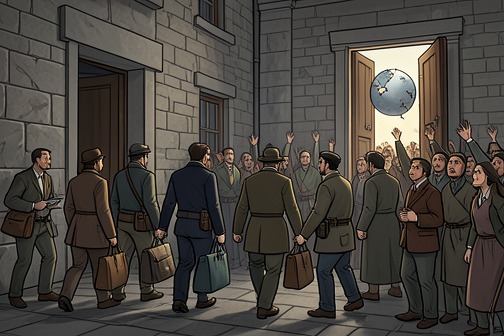
[The Hero's Party Disbands and Escorts Theo Home](entity:event-recall-event-b11e1fddad1d) marks the transition from a quest organized around the destruction of the [Demon King](entity:state-recall-state-demon-king-d4ce23d2b4c1) to a future organized around chosen family, accountability, and ordinary life. Its decisive significance lies in the party's refusal to remain bound together by the old heroic mission: [Luca](entity:character-recall-character-luca-aa8721da92cd) keeps his duty but claims the right to decide when and how it will be fulfilled, while [Theo](entity:character-recall-character-theo-107bd6003b61) leaves the court not as a condemned host but as a healer cleared of every charge. The return to [Leafel](entity:location-recall-location-leafel-ce079facdeeb) is therefore both a physical homecoming and a rejection of the institutions that defined them.
## The Trial’s Resolution
The disbanding follows the trial of the Demon King's host, which is conducted in the capital after [Avery](entity:character-recall-character-avery-3f30ea9cdcd5) uses a message scroll and the party breaks a [Portal Orb](entity:object-recall-object-0dafc4da8ec2) to reach the court. Theo is taken to the dungeons in [Magic-Dampening Handcuffs](entity:object-recall-object-b7061ed073db), and the proceedings initially place him in the position of a criminal because he protected [Malthios](entity:character-recall-character-malthios-3bbf03e4fa99). The judgment changes when [Micah](entity:character-recall-character-micah-b7a8af6bb3f9) opens a mirror spell from Leafel and shows the town gathered behind him: [Imani](entity:character-recall-character-imani-3e59d6c7b288), [Dale](entity:character-recall-character-dale-fff2558efe87), [Dmitri](entity:character-recall-character-dmitri-f7165ee439b9) and his parents, [Nib](entity:character-recall-character-nib-c57b21ba9a3c), [Amaya](entity:character-recall-character-amaya-3164488322dd), [Hayden](entity:character-recall-character-hayden-3887fcc3a0d9), and the wider community demand Theo's release. Their intervention makes visible the local bonds that the court's accusation had ignored. Theo understands that Leafel has not abandoned him, and that the people there regard him as one of their own.
The court also receives a direct account of Malthios's actions. Malthios admits that he destroyed the [Demon Fortress](entity:location-recall-location-demon-fortress-e361fb201537) and everyone inside it, while warning that a few lesser demons and demon-created monsters may remain. He concludes that there is no longer any need for a [Hero](entity:concept-recall-concept-hero-c363661142b4), but Luca does not accept that conclusion as permission to erase his own role. He declares that, as the Hero, it is his duty to kill the Demon King; he immediately qualifies that statement by insisting that he can choose when the killing occurs. This distinction allows the verdict to recognize danger without reducing every question of justice to immediate execution.
[King Alexis](entity:character-recall-character-king-alexis-965b76b67eae) finally announces the sentence: Malthios is condemned to life in prison, while [Theo Bladefoot](entity:character-recall-character-theo-bladefoot-4a02f215e1d3) is free of all charges. The result is neither simple acquittal nor uncomplicated forgiveness. Malthios remains answerable for the destruction he caused, but Theo is not treated as identical with the will housed within him. The court's decision separates host from Demon King and makes room for a controlled, continuing existence rather than an automatic death sentence.
## Luca’s Choice and the Party’s Fracture
The verdict exposes the conflict between Luca's private future and the hereditary demands placed upon him. Earlier, Luca had explained that the fate of the Hero made lasting relationships difficult: partners were left behind when the party moved on, and even a squire who had trained with him ended their relationship when Luca was announced to be departing. His relationship with Theo breaks that pattern through an explicit promise to wait, symbolized by Theo's [Arriss Pendant](entity:object-recall-object-arriss-pendant-f3335bf1f7f9) and by the silver, scale-textured ring set with a dark sapphire that belonged to Luca's father. Luca places the ring on Theo's marriage finger, joining personal inheritance to a future that is not controlled by the Heroic duty system.
That future directly opposes Hero [Eliza](entity:character-recall-character-eliza-6ec11b83dd18)'s expectation that Luca should continue the bloodline and sire the next Hero. [Julius](entity:character-recall-character-julius-2b9b6a5d3dd6) reveals that Eliza had threatened to take everything from him unless he abandoned Luca, believing that Luca required no distraction from his assigned purpose. At the trial, Eliza frames Luca's decision as the destruction of their bloodline and the waste of everything for which he trained. Luca answers that choosing a quiet and peaceful life with the man he loves is the only choice he has ever made for himself. He further imagines a world in which people born with the Hero's gift can choose their fate rather than remain bound to duty. The escort home thus begins as an act of political and emotional refusal: Luca declines the reproductive future prescribed by Hero Eliza and chooses a non-hereditary household with Theo.
The party does not dissolve because its members cease to matter to one another. It separates because each member must respond to the consequences of the journey. [Emi](entity:character-recall-character-emi-6cd72baa2831) leaves after Eliza, without waiting for Luca's request, signaling a loyalty that remains with the older Hero. [Bryony](entity:character-recall-character-bryony-77c7475dde0d) turns her back and refuses to escort Theo, a rejection shaped by her gravely injured brother and by her inability to accept that the person responsible can walk free. Her refusal hurts Luca, but he recognizes why she cannot offer solidarity on those terms. Avery also declines, though for a different reason: he must return to the academy for the spring semester if he is to continue his studies and become a magic researcher. His departure is not a denunciation. Luca embraces him, tells him he is proud, and asks him to write, transforming separation into an acknowledgment of an independent future.
## The Escort Home
Luca does not assume that the remaining companions will continue with him. He admits that he has no right to ask, then appeals to the party's shared beginning and says that he would like to finish together by having them escort him and Theo home. [Khal](entity:character-recall-character-khal-3b2ff6449c13) accepts, calling it an honor; [Veiv](entity:character-recall-character-veiv-2ba6a25fcbd2) beams, and [Wicker](entity:character-recall-character-wicker-4eaf8f5b7dfe) claps their gloved hands. Their response restores a form of fellowship after the court has divided the group, but it is fellowship chosen freely rather than imposed by a mission decree.
The group that leaves is deliberately smaller and more intimate: Theo and Luca, Khal, Veiv, Wicker, and Cargo. As they reach the door, Luca picks up the [Hero's sword](entity:object-recall-object-hero-s-sword-2996941205e7) while keeping hold of Theo's hand. The gesture preserves the visible symbol of the Hero without allowing it to dictate the couple's direction. The sword travels with them, but the institution and the inherited expectations surrounding it no longer command the scene. Luca and Theo leave together, accompanied by those who consent to the journey, while the other members take separate paths.
Their destination is Leafel, where the mirror spell has already shown a community prepared to defend Theo. Luca tells the people that, if the roads are clear, they should arrive home before spring. The seasonal promise gives the return a practical horizon, but it also contrasts with the endless itinerancy that defined the Hero's life. This is not another departure toward an unspecified battle. It is a journey toward a town, a household, and a community that has publicly claimed them.
## Consequences and Narrative Significance
The event resolves several competing meanings of heroism. Luca remains willing to acknowledge the duty to kill Malthios, but he refuses to let that duty determine every moment of his life or require Theo's immediate death. His statement that Theo is Malthios's prison and that he will not let Theo out of his sight reframes protection as an ongoing responsibility. The Demon King is constrained, Theo is released, and Luca accepts the burden of guarding the arrangement rather than pretending that the danger has vanished.
The ending also distinguishes personal attachment from public repair. Leafel's intervention supplies communal recognition, King Alexis supplies a legal judgment, and Luca supplies a personal decision about the future. None of these replaces the others. Malthios's life sentence acknowledges punishment; Theo's release acknowledges the limits of host culpability; the escort acknowledges the relationships formed through shared danger; and Luca's rejection of compulsory succession challenges the system that made heroic violence appear inevitable.
At the threshold of departure, Theo tells the leaders of [Algeya](entity:location-recall-location-algeya-1668b0a6fe56) that Malthios may be reformed, but that he will still retaliate if anyone threatens them or their people. No one answers. Luca simply slips his hand into Theo's, and together they leave. The silence closes the court's authority over them. The Hero's Party has not ended in a single ceremonial farewell but in a series of distinct choices: Emi follows Eliza, Bryony refuses, Avery returns to study, and Khal, Veiv, Wicker, and Cargo accompany Theo and Luca home. What survives is not the old party as an instrument of duty, but a chosen network capable of carrying the characters beyond the war.
Event 43
Theo and Luc Return to Leafel
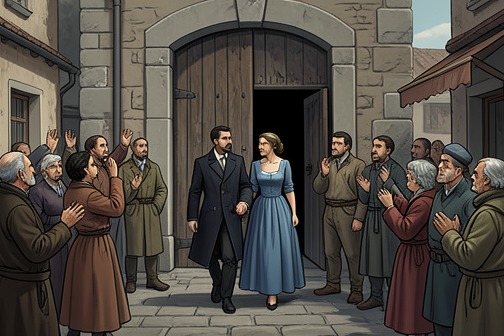
[Theo and Luc Return to Leafel](entity:event-recall-event-theo-luc-leafel-eb9eb0c7dc71) is the decisive homecoming of the story: [Theo](entity:character-recall-character-theo-107bd6003b61) returns not as a concealed threat awaiting discovery, but as Theo, accompanied by Mal, the former King of [Demons](entity:creature-recall-creature-demons-6600dcc7335a), and openly claimed by [Luc](entity:character-recall-character-luc-b00cd62cc765) as the man he loves. The journey closes the immediate crisis of the capital while transforming [Leafel](entity:location-recall-location-leafel-ce079facdeeb) from a refuge Theo might lose into a chosen family and a future he can inhabit without hiding.
## Causes and Background
The return follows the exposure of Theo’s identity and the political danger created by his bond with Mal. Theo had long understood that friendship could not guarantee his safety if anyone discovered what he was. Cargo eventually named the secret directly by asking whether Theo would tell the others that he was demon spawn, and Theo’s fear became concrete when the court summoned him to the capital. He knew that entering the portal would surrender his autonomy: the authorities would learn who he was and where he lived, and the [Hero](entity:concept-recall-concept-hero-c363661142b4)’s party could force him back into service while the truth about him remained punishable.
Theo nevertheless went because Luc’s life was at stake. The court treated Luc as expendable, someone who could die and be replaced by another child trained to become the next Hero. Theo could not accept that calculation. In the capital, his worst fears were realized during the Trial of the [Demon King’s Host](entity:state-recall-state-demon-king-s-host-76fd1b21021f): the court mage ordered him taken to the dungeons, Luc fell silent after Theo confirmed the truth, and the court agreed that Healer Theo was guilty of protecting Mal. The judgment was challenged when [Micah](entity:character-recall-character-micah-b7a8af6bb3f9) opened a mirror spell from Leafel, with [Imani](entity:character-recall-character-imani-3e59d6c7b288), [Dale](entity:character-recall-character-dale-fff2558efe87), [Dmitri](entity:character-recall-character-dmitri-f7165ee439b9) and his parents, [Nib](entity:character-recall-character-nib-c57b21ba9a3c), [Amaya](entity:character-recall-character-amaya-3164488322dd), [Hayden](entity:character-recall-character-hayden-3887fcc3a0d9), and the townspeople demanding Theo’s release.
Luc’s decision altered the political meaning of Theo’s return. When Hero [Eliza](entity:character-recall-character-eliza-6ec11b83dd18) accused him of abandoning his training and ending the heroic bloodline, Luc answered that choosing a quiet and peaceful life with the man he loved was the only choice he had ever made for himself. He rejected the expectation that he would sire the next Hero and argued for a world in which those born with the Hero’s gift could choose their own fate rather than remain bound to duty. [Theo and Luc](entity:relation-recall-relation-theo-and-luc-6c31719ecbcf) therefore leave the capital not merely after a trial, but after refusing the institutions that defined their identities for them.
## The Homecoming
[Winter](entity:time-recall-time-winter-d51e63751f76) was beginning to melt into spring when five people, three on horses and two on ponies, together with a large black pig, reached a familiar stretch of road near Leafel. The seasonal transition gives the event a precise emotional shape: the cold period of confinement, judgment, and threatened separation is giving way to a season associated with return and renewed life. Theo’s heart beat frantically as the town came into view, and Luc reached over to squeeze his hand, answering bodily fear with immediate reassurance.
A crowd had gathered by the [Leafel Watchtower](entity:location-recall-location-leafel-watchtower-445b76b722ca), apparently alerted to their arrival. Theo still feared that the townspeople would look past him and see only the monster beneath his skin. That fear repeats the central tension of his life: he has been loved as a healer and companion, yet expects acceptance to disappear once his hidden identity becomes visible. The first response from Leafel is not accusation. Micah breaks from the crowd and runs into Theo, sobbing that he had thought the authorities would take Theo away and that he had been terrified.
Imani and Dale then enclose Theo in a tight embrace. Imani calls him their dear Theo and says that they are proud of him, while Dale welcomes him home as a son. The words matter because they answer the accusation that Theo is only a dangerous vessel. Micah, Imani, and Dale recognize continuity between the healer who left Leafel and the person who returns with Mal exposed beside him. Theo’s restrained years finally give way to tears as he sags into their embrace, with Micah still clinging to him and Nib offering a handkerchief.
## Public Disclosure and Acceptance
The return becomes a second, voluntary disclosure. Theo asks whether Leafel wants to meet Mal, then shrugs off his jacket and introduces him to everyone. As Mal takes control, their wings unfold from Theo’s shoulders, forcing the townspeople to confront the physical reality of the former King of Demons rather than an abstract rumor about demon blood. Mal raises a hand and introduces himself as the former King of Demons. Micah responds with fascinated excitement, noticing Mal’s tail, while Dmitri stands nearby with wide eyes.
The scene does not erase fear or difference; it places those differences in a communal setting where they can be met with curiosity rather than immediate violence. Mal’s presence is especially significant because Theo had once assumed that disclosure would make him impossible to love and that no amount of friendship could protect him. Here the secret is not discovered by an enemy or extracted by a court. Theo presents it himself, with Luc and the people of Leafel present, turning exposure into an act of trust.
The gathering also preserves ordinary familiarity. Hayden predictably proposes a spar, and Mal jokes that he would not be able to show proper restraint. The humor lets the former King of Demons enter Leafel through the same social texture that binds its people together: teasing, rivalry, food, stories, and shared history. The monstrous identity is neither denied nor allowed to become the sole definition of the returning party.
## Luc’s Commitment and the New Household
After Mal finishes speaking, Theo resumes control, and Luc immediately comes to his side, placing an arm around his waist and pulling him close. Luc then addresses the people of Leafel. He hopes that his decision to live there will not change their welcome and says that he looks forward to working and living alongside them. His speech makes the return permanent rather than provisional: Leafel is not simply a destination after exile, but the place where he intends to build daily life.
Luc also publicly asks the townspeople to accept his claim on Theo. He says that he loves the healer with everything he has and promises to care for him for the rest of their lives. The declaration completes a pattern established earlier when Luc gave Theo his father’s ring, the last object he possessed from a father who had died saving an adventuring party from a demon attack. That ring, fitted onto Theo’s marriage finger, joins inherited memory to a future Luc chooses rather than one imposed by Hero Eliza and the heroic bloodline.
The crowd cheers, while Imani and Dale beam like the proud parents they have become to Theo, and Hayden reacts with defeated shoulders. Theo’s embarrassment and affection coexist: he elbows Luc as his cheeks heat, but he does not reject the public commitment. The return therefore establishes a household made through love and recognition rather than bloodline, heroic succession, or the court’s command.
## Consequences and Significance
The event resolves the question of whether Theo can return home after being named the [Demon King](entity:state-recall-state-demon-king-d4ce23d2b4c1)’s host. Leafel’s answer is enacted through embraces, pride, curiosity, joking, and celebration. The town does not require Theo to separate himself from Mal before accepting him, nor does Luc ask Theo to conceal the danger attached to their shared body. Instead, the community receives the truth together with the person it already knows.
The homecoming also completes Luc’s break with the Hero’s imposed future. Eliza had wanted him to continue the bloodline and sire the next Hero, while Luc chooses a peaceful life with Theo and openly challenges the idea that heroic power must dictate its bearer’s fate. His return to Leafel turns that refusal into practice: he will work, live, and age alongside Theo rather than continue as an instrument of succession.
Finally, the event restores narrative voice and collective memory. At the [Broken Blade](entity:location-recall-location-broken-blade-7199f39a563c), Dale offers to host a gathering where everyone can hear about Theo’s adventures. Theo looks around at the people before him, smiles genuinely, and leans against Luc as he agrees to tell them. The story that began in secrecy can now be recounted in public. Theo’s return is thus not only a physical arrival but an integration of hidden history into communal history, ending with the promise that his life will be remembered as part of Leafel’s story rather than judged solely by the monster beneath his skin.
Event 44
Khal and Veiv Leave Leafel
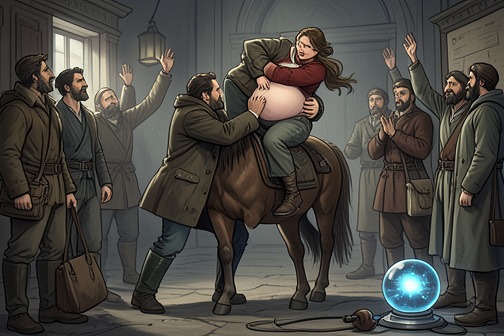
[Khal and Veiv Leave Leafel](entity:event-recall-event-khal-veiv-leafel-c13905a67fa5) marks the practical and emotional dissolution of the [Hero](entity:concept-recall-concept-hero-c363661142b4)’s party as a traveling unit. [Veiv](entity:character-recall-character-veiv-2ba6a25fcbd2)’s pregnancy has advanced so far that she has trouble walking and her stomach is nearly at bursting point, making departure both a necessary journey home and a sign that the group’s years of shared quests have entered a different phase. [Khal](entity:character-recall-character-khal-3b2ff6449c13), Veiv, and Cargo leave [Leafel](entity:location-recall-location-leafel-ce079facdeeb) together, while [Theo](entity:character-recall-character-theo-107bd6003b61), [Luc](entity:character-recall-character-luc-b00cd62cc765), [Wicker](entity:character-recall-character-wicker-4eaf8f5b7dfe), and [Micah](entity:character-recall-character-micah-b7a8af6bb3f9) remain behind to send them on their way.
## The Departure from Leafel
Khal’s departure takes place a few days after [Theo and Luc](entity:relation-recall-relation-theo-and-luc-6c31719ecbcf)’s confrontation with the court and their decision to build a life outside the Heroic duty system. Veiv cannot easily travel on foot, so Khal gently lifts her onto her pony. Theo, Wicker, and Micah open a portal to carry the travelers home, an act that would normally be nearly impossible for only three magic users. The portal becomes feasible because [Malthios](entity:character-recall-character-malthios-3bbf03e4fa99), the former [Demon King](entity:state-recall-state-demon-king-d4ce23d2b4c1), lends them both his mana and his technique. His power, once associated with war and domination, is therefore redirected toward an intimate act of communal care: helping a pregnant couple reach home safely.
The scene is not framed as a triumphant expedition. There is no new quest waiting beyond the portal and no promise that the old party will reform. Theo asks [Khal and Veiv](entity:relation-recall-relation-khal-and-veiv-c6f2c0a44936) to visit when their babies are older, and Veiv promises that they will. Her promise also confirms a new bond: Theo and Luc will be the children’s godparents. The announcement surprises both of them, and Theo feels some dread because he remains unenthusiastic about children, while Luc is moved almost to tears when Khal embraces him.
## Family, Memory, and the Children to Come
The couple’s future is made concrete through the names of the unborn twins. Khal says that one child will be named Denzel, after his father. The other will be called Acul, a name that is [Luca](entity:character-recall-character-luca-aa8721da92cd) backward. Veiv confirms the joke, and Luc begins crying in earnest as Khal pats his shoulder. The naming combines ancestry, romance, and friendship: one child carries Khal’s family memory, while the other carries a playful mark of Luc’s place in the couple’s chosen family.
This family future also contrasts with the pressure placed on Luc by Hero [Eliza](entity:character-recall-character-eliza-6ec11b83dd18). [Julius](entity:character-recall-character-julius-2b9b6a5d3dd6) previously warned Theo that Eliza wanted Luc to continue the Hero bloodline and sire the next Hero, a future that could not be achieved through either of Luc’s former male relationships. Luc instead chose a peaceful life with Theo and argued that people born with the Hero’s gift should be able to choose their own fate rather than remain bound to duty. Khal and Veiv’s departure does not resolve that institutional conflict through debate; it answers it by displaying another form of inheritance, one created through friendship, guardianship, chosen names, and mutual care rather than compulsory succession.
## The Farewell Scene
The farewell gathers the remaining friends around the portal. Theo, Luc, Wicker, and Micah stand and wave as Khal leads his horse and Veiv’s pony through the opening, with Cargo bringing up the rear. The magical light fades after the portal closes. Wicker leans against Theo, while Luc puts an arm around Theo’s shoulders, turning the group’s physical arrangement into a quiet image of support after separation.
Cargo’s last exchange with Theo preserves the party’s familiar humor. He nudges Theo’s leg and tells him not to do anything stupid, immediately qualifying the warning as anything else stupid. Theo responds fondly and pats the hog’s head, acknowledging that he will miss him. The banter prevents the farewell from becoming solemn pageantry, but it does not erase the grief beneath it. Affection survives here through teasing, touch, promises, and the knowledge that ordinary companionship will no longer be continuously available.
## The Hero’s Party Scattered
Theo recognizes a strange grief in the moment because the party that had been together for years is now dispersed across the land. Khal and Veiv are beginning a family. [Avery](entity:character-recall-character-avery-3f30ea9cdcd5) is studying and is expected to divide his time between a laboratory and a library. [Bryony](entity:character-recall-character-bryony-77c7475dde0d) is at home caring for her brother as he slowly fades. [Emi](entity:character-recall-character-emi-6cd72baa2831)’s future remains uncertain to Theo. Wicker has become the head of the Leafel adventurer guild post and now has Micah to teach. The departure therefore belongs to a larger pattern: each member’s next life is defined by a different responsibility rather than by a shared road.
Theo and Luc remain in Leafel, but their future is no longer organized around demon hunting or the construction of additions to their home. Theo will continue as the village healer, identifying that work as his duty and purpose. He does not know how Luc will spend his time now that the immediate demands of heroic combat have ended, yet he looks forward to discovering that future with him. The uncertainty is important: the event closes the era of compulsory adventure without pretending that a complete replacement life has already been mapped.
## Narrative Significance
Khal and Veiv Leave Leafel transforms separation into evidence of survival. The Hero’s party does not remain intact as a symbolic unit, and its dispersal carries genuine grief, but the members do not vanish into failure. They study, care for family, teach, heal, and prepare for children. Even Cargo’s departure is accompanied by affection rather than rupture.
The event also completes the movement from imposed roles toward chosen relationships. Luc was once defined by the fate of the Hero, while Theo feared that disclosure of his nature would cost him every friendship and place of safety. By the time Khal and Veiv leave, the group’s future is no longer governed solely by bloodlines, conquest, or institutional duty. A former Demon King contributes magic to a family’s journey; two former adventurers become godparents; and the former Hero begins an undefined life beside the man he loves. The portal closes on the party’s shared past, but it opens the possibility of a broader, less compulsory understanding of home.
Event 45
Theo Seduces the Hero and Defies His Fate
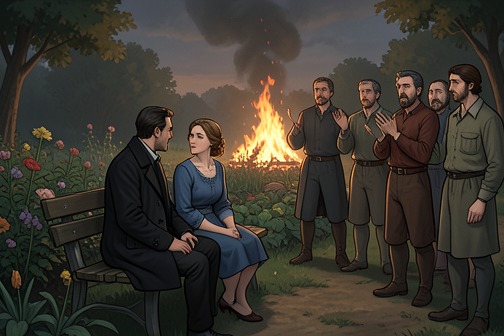
[Theo Seduces the Hero and Defies His Fate](entity:event-recall-event-81deb459d1ac) is the intimate culmination of [Theo and Luc](entity:relation-recall-relation-theo-and-luc-6c31719ecbcf)’s relationship and the point at which [Luc](entity:character-recall-character-luc-b00cd62cc765) refuses to let the [Hero](entity:concept-recall-concept-hero-c363661142b4)’s role determine their future. The encounter closes not with a return to heroic duty, but with the lovers imagining an ordinary life together in [Leafel](entity:location-recall-location-leafel-ce079facdeeb): tending a garden, collecting eggs, reading by the fire, and serving their village. In that reversal, the Hero’s sword loses its power over [Theo](entity:character-recall-character-theo-107bd6003b61)’s imagination, while the future once dictated by bloodline and obligation gives way to a life they choose for themselves.
## Causes and Background
Luc’s attraction to Theo develops against the instability of a life organized around the Hero’s travels. When they speak about former lovers, Luc explains that his earliest relationships began in the capital, but neither could become a lasting partnership: one was a childhood connection, and a squire ended their relationship when Luc was called away, despite Luc asking him to come along. Later relationships formed during brief stays in towns, but could not last. Luc presents this as the recurring cost of being the Hero, a role that makes continuity difficult even when affection is present.
Theo has reason to doubt that their relationship can escape the same pattern. The possibility of a romance does not erase the demands surrounding Luc’s position, and Theo asks what could make this attempt different from Luc’s earlier relationships. Their intimacy therefore grows alongside a question of whether love can survive the Hero’s prescribed life, rather than in a world free of such constraints.
That conflict becomes explicit through [Julius](entity:character-recall-character-julius-2b9b6a5d3dd6), Luc’s former lover. Julius tells Theo that he did not want to leave Luc, but Hero [Eliza](entity:character-recall-character-eliza-6ec11b83dd18) ordered him to refuse Luc’s invitation to join the party and threatened to take everything from him if he did not let Luc go. Julius believes Eliza wants Luc to continue their bloodline and sire the next Hero, something that neither Julius nor Theo could provide. Theo rejects the warning as a reason to withdraw. The obstacle is not simply the lovers’ separation by travel: Luc’s family and heroic function are being treated as matters to be controlled by others.
## A Promise and a Chosen Future
Theo and Luc’s commitment has already taken material form before the final encounter. Theo touches the pendant and recalls promising to wait for Luc, whatever the length of the separation. Luc responds by presenting a silver ring that belonged to his father, the only keepsake he has from him. His father died after saving his adventuring party from a demon attack. Luc places the ring on Theo’s marriage finger; the band contracts to fit. The gesture joins Luc’s family history, marked by loss in the service of others, to a promise directed toward a future with Theo.
The relationship is consequently set against two inherited demands: the Hero’s duty to continue a line and a past in which Luc’s father died saving companions from demons. The book does not resolve that tension by making Luc’s love a substitute heroic assignment. Instead, Luc later names his own choice as a quiet and peaceful life with the man he loves, and argues for a world in which people born with the Hero’s gift can choose their fate rather than remain bound to duty. Theo’s promise to wait and Luc’s gift of the ring make that chosen future personal before the final scene makes it imaginable in daily detail.
## The Encounter and Its Reversal
In the ending scene, Theo takes the lead in their sexual encounter, telling Luc not to move until told and that he must accept what Theo gives him. Luc follows his direction, remaining still as Theo sets the pace. The balance shifts later: Luc takes hold of Theo’s hips and drives the encounter toward its climax. The sequence passes between control and surrender rather than fixing either lover in a single role, making their intimacy an exchange between partners who know one another closely.
The scene culminates in both lovers reaching release. Afterwards, Luc rests against Theo, their bodies still close as they recover. Theo anticipates bruises on his hips and thighs and an aching back, and chooses not to heal them with magic. He understands the marks as reminders of belonging that is mutual: he belongs to Luc, and Luc to him. The detail gives their private physical relationship a lasting significance without turning it into a public declaration; the chosen reminder will remain on Theo’s body after the encounter itself has ended.
## Consequences and Significance
The scene opens into a concrete, domestic future rather than a heroic next step. Theo imagines years of gathering eggs for breakfast, caring for their garden, reading by the fire, spending time with friends, sparring, and serving their village together. The future is not presented as escape from responsibility altogether: Theo and Luc will continue serving Leafel. What changes is where that responsibility is rooted and who has chosen it. The village, shared home, and daily routines become alternatives to the demands that would make Luc’s life chiefly an instrument for producing another Hero.
The Hero’s sword, partly hidden beneath the cloaks and coats and caught in a cobweb, supplies the final visual contrast. Theo recognizes that everything has changed since he first saw it. Neither he nor [Malthios](entity:character-recall-character-malthios-3bbf03e4fa99) feels the old cold fear at its sight; without someone to wield it, the weapon is only metal and jewels. Its diminished force reflects the larger reversal: the symbol of a predetermined heroic struggle no longer commands Theo’s sense of what must happen next.
Theo concludes that he escaped his fate by seducing the Hero, a thought that nearly makes him laugh because neither mortal, god, nor demon could have predicted this outcome. The conclusion is deliberately ironic. The mechanism of change is not a victory over Luc or the destruction of his heroic identity, but the intimacy through which Luc becomes a partner able to choose a future beyond that identity’s demands. The book ends with that future still ahead of them, expressed not as a new prophecy but as years of shared work, pleasure, and ordinary life.
Event 46
Luc and Theo’s First Meeting
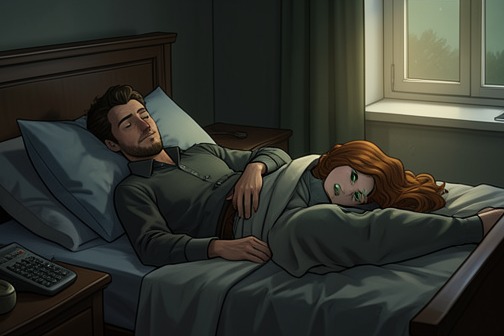
[Luc and Theo’s First Meeting](entity:event-recall-event-89e3cc0651c9) brings the [Hero](entity:concept-recall-concept-hero-c363661142b4) and the village healer together in [Leafel](entity:location-recall-location-leafel-ce079facdeeb) and starts a relationship that will ultimately contest the duties imposed on [Luc](entity:character-recall-character-luc-b00cd62cc765). Its significance lies not only in their immediate attraction, but in what grows from it: Luc’s attachment to [Theo](entity:character-recall-character-theo-107bd6003b61) becomes a reason to refuse a future organized around the Hero’s role and bloodline, while Theo’s willingness to risk himself for Luc turns an unexpected connection into a lasting commitment.
## The Encounter and Its Immediate Aftermath
The meeting is first marked by a change in Luc that he cannot explain away as ordinary attraction. After waking beside Theo, he finds himself unusually relaxed and safe, a feeling he associates with no time since his mother died. Theo comes to mind with striking clarity: auburn hair, green-crystal eyes, and a stubborn mouth. Luc reflects that he has had several romantic connections, including a long relationship with [Julius](entity:character-recall-character-julius-2b9b6a5d3dd6), but none has made him feel so at ease. His regret about having made a poor first impression is already joined to a hope that Theo might see him differently.
That attraction becomes concrete when Luc hurries downstairs, concerned that Theo has left the bed in haste. He finds the healer at the cottage door, wearing Luc’s shirt, and experiences a sudden, possessive satisfaction. When a blond man grabs Theo’s arm, Luc acts before thinking, forces the man’s wrist away, and orders him to let Theo go because Theo dislikes being touched. The speed of the intervention gives the encounter an immediate physical consequence: Luc’s impulse to protect Theo precedes any settled account of what their relationship is.
The interruption also makes Luc’s identity part of the scene. Asked who he is and what he is doing there, Luc identifies himself as the Hero and Demon Slayer, explains that Theo has kindly given him shelter while he watches over an injured friend, and says the rest of his party is staying at the town tavern. The blond man reacts to the fact that Luc and Theo shared a bed, but Theo objects to being treated as though he were not present. The exchange establishes both Luc’s public status and Theo’s insistence on speaking for himself.
## Attraction Against the Hero’s Life
Luc’s own account of his past helps explain why the new connection feels precarious. His first two relationships lasted longest because those partners lived in the capital where he grew up. One was a maid in training, in a romance he regarded as only partly counting because they were both so young; the next was a squire who trained with him. That relationship ended when Luc was announced as leaving, although he had asked the squire to come with him. Later connections formed during stays in towns, but could not last. Luc presents this pattern as the fate of the Hero: departure and obligation repeatedly cut short the possibility of a shared life.
Theo does not simply accept that history as proof that their relationship will be different. He asks what makes Luc think what he is trying to begin will turn out otherwise. The question gives the attraction its first test: Luc’s feelings may be intense, but they do not erase the practical pattern that has ended his previous relationships. His later offer to help Theo while [Khal](entity:character-recall-character-khal-3b2ff6449c13) recovers is both an acknowledgment of debt for Theo’s care and, as Luc recognizes, an excuse to spend more time with him. Affection begins to take shape through ordinary assistance as well as moments of protective urgency.
## Secrecy, Danger, and Mutual Commitment
Theo’s attachment develops under a different pressure. He knows that friendship will not necessarily save him if anyone discovers what he is: the [Demon King](entity:state-recall-state-demon-king-d4ce23d2b4c1)’s host. [Malthios](entity:character-recall-character-malthios-3bbf03e4fa99) can perceive Theo’s thoughts and feelings, while Theo’s disobedience has provoked fits and incapacitating headaches. Their shared existence is a bond neither can simply leave; Malthios explains that transferring himself to another host would take years, and that Theo’s death would also mean his own. This concealed danger shadows Theo’s relationships, making trust and disclosure matters of survival as well as intimacy.
Luc’s presence does not remove that danger, but Theo repeatedly chooses him despite it. When Luc is in mortal danger, Theo breaks the barrier imprisoning him by drawing on Malthios’s power while retaining control, then throws himself between Luc and [Tyraz](entity:character-recall-character-tyraz-d0813c0c4748)’s raised sword. Theo’s action gives physical form to the commitment first suggested by the attraction: he risks his life to save the man he loves. Malthios answers Theo’s call, and the two act together in the crisis, even though their relationship remains strained by the host bond and its history of coercion.
The objects exchanged between Luc and Theo later make their promises tangible. Theo touches his pendant and tells Luc he had marked him first, promising to wait however long it takes. Luc offers a silver ring that belonged to his father, the only thing he has of him. His father died after saving his adventuring party from a demon attack. Luc places the ring on Theo’s marriage finger; the band fits snugly despite Theo’s expectation that it would not. The ring carries both personal inheritance and a future promise, linking Luc’s family history to the life he wants to build with Theo.
## Refusal of Inherited Duty
That future conflicts with the demands placed on Luc by Hero [Eliza](entity:character-recall-character-eliza-6ec11b83dd18). Julius tells Theo that he had wanted to join Luc’s party, but Eliza threatened to take everything from him if he did not refuse. He believes she wants Luc to continue their bloodline and sire the next Hero, something neither Julius nor Theo could do. The disclosure clarifies that Luc’s romantic life is not constrained only by travel or circumstance: his aunt’s expectations make his intimate choices part of a political and hereditary project.
Luc eventually names his decision as the only choice he has ever made for himself. He chooses a quiet, peaceful life with the man he loves instead of the bloodline and training Eliza expects him to preserve. He also expresses a broader hope that people born with the Hero’s gift should be able to choose their fate rather than remain bound to duty. Theo’s relationship with Luc thus becomes the setting for a direct rejection of the idea that inherited power determines a person’s whole future. The first meeting matters because the connection it begins does not merely survive the Hero’s obligations: it helps Luc imagine and claim a life beyond them.
Event 47
Basilisk Attack and Khal’s Poisoning
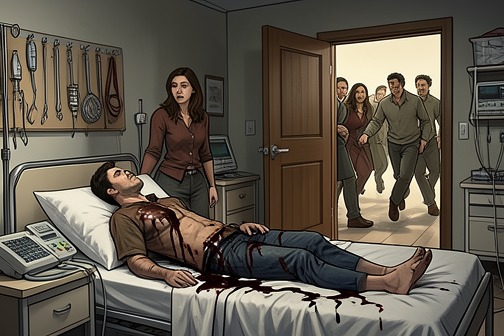
The [Basilisk Attack and Khal’s Poisoning](entity:event-recall-event-b64492c171b0) is the crisis that brings [Khal](entity:character-recall-character-khal-3b2ff6449c13), already beyond the party’s ability to heal, to [Theo](entity:character-recall-character-theo-107bd6003b61) for treatment. The attack’s immediate consequences are clear even though its details are not shown: poison resists the party’s efforts, the group must hurry to find help, and Theo’s intervention becomes essential to Khal’s recovery.
## Causes and Background
Khal was bitten by a basilisk and poisoned. By the time his companions sought Theo, a day had passed and their healing efforts had failed. They had no healer in their party; as Theo recognized, he was supposed to fill that role. Their appeal rested on the townsfolk’s belief that he could work miracles.
[Luc](entity:character-recall-character-luc-b00cd62cc765) later recounts the emergency from Khal’s perspective: Khal had saved Luc from the basilisk, then been poisoned himself. [Avery](entity:character-recall-character-avery-3f30ea9cdcd5) and [Veiv](entity:character-recall-character-veiv-2ba6a25fcbd2) could only slow the poison, so the group made for the nearest town. The account establishes both the urgency of the journey and the limits of the party’s available treatment; it does not describe the attack’s exact course or how Khal was bitten.
## Treatment and Recovery
When Khal wakes, he immediately asks whether Veiv is safe. Luc reassures him that she is unharmed and explains that Theo, the town’s healer, got the poison out. Theo says that Khal’s wounds still need attention and that he had to infuse an antidote to deal with any poison that remained. The rescue therefore involves both removing the immediate danger and continuing treatment for its residual effects and physical injuries.
Khal thanks Theo as the healer and reaches out to brush his hand. He hopes to repay the help one day. The gesture closes the medical emergency with an offer of gratitude and future reciprocity, rather than treating survival as an impersonal outcome.
## Consequences and Significance
The poisoning makes Theo’s healing role concrete: the party’s own efforts could slow the venom, but they could not finish the treatment, while Theo could remove the poison and address what remained. The earlier request also clarifies that the party had expected Theo to be its healer, making his absence from that role part of the crisis’s background.
Khal’s first concern on waking is Veiv’s safety, while his thanks to Theo recognizes the care that saved him. The event thus joins the practical stakes of healing to the ties among the companions, without suggesting that the danger is resolved by a single antidote: Theo still has to treat Khal’s wounds.
Event 48
Malthios regains freedom and begins life in Leafel
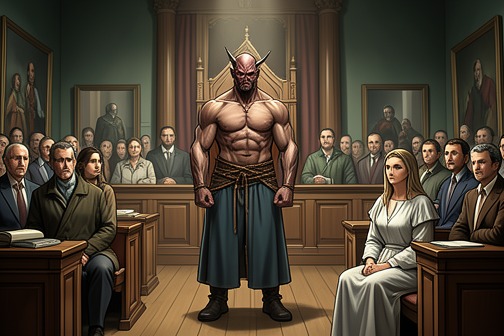
[Malthios regains freedom and begins life in Leafel](entity:event-recall-event-e29a16af6bba) is the event in which the former [Demon King](entity:state-recall-state-demon-king-d4ce23d2b4c1) moves from judgment and confinement into an uncertain, shared future with [Theo](entity:character-recall-character-theo-107bd6003b61) in [Leafel](entity:location-recall-location-leafel-ce079facdeeb). Its decisive significance lies in the contrast between [Malthios](entity:character-recall-character-malthios-3bbf03e4fa99)'s past as the enemy around whom kingdoms organized their defenses and his first tentative attempt to become a neighbor: he leaves the healer's cottage, flies without restriction, lands in town with his demonic body visible, and is invited inside rather than driven away.
## Causes and Background
Malthios's freedom follows the trial of the Demon King's host, a public proceeding that exposes Theo as the host of the reincarnated Malthios. The case is conducted through the political machinery of [Algeya](entity:location-recall-location-algeya-1668b0a6fe56): the capital's throne room is surrounded by court members and mirror spells that allow rulers and communities across the country to witness the hearing. Theo is brought before the throne in restraints and initially faces the judgment of a court that declares him guilty for protecting Malthios. The arrangement places both souls under the authority of institutions that treat Malthios's existence as a continuing danger rather than as a person capable of change.
The trial's meaning shifts when Leafel refuses to let the capital define Theo alone. Through a newly opened mirror spell, [Micah](entity:character-recall-character-micah-b7a8af6bb3f9) presents the people of Leafel, including [Imani](entity:character-recall-character-imani-3e59d6c7b288), [Dale](entity:character-recall-character-dale-fff2558efe87), [Dmitri](entity:character-recall-character-dmitri-f7165ee439b9) and his parents, [Nib](entity:character-recall-character-nib-c57b21ba9a3c), [Amaya](entity:character-recall-character-amaya-3164488322dd), and [Hayden](entity:character-recall-character-hayden-3887fcc3a0d9), who demands the healer's release. Their intervention establishes that Theo's community knows the truth and does not respond with abandonment. It also supplies the social foundation for Malthios's later life in Leafel: freedom is not merely granted by the court but made livable by people willing to recognize the shared body as part of their community.
The legal resolution preserves both responsibility and possibility. Malthios admits that he destroyed the [Demon Fortress](entity:location-recall-location-demon-fortress-e361fb201537) and everyone within it, while noting that a few lesser demons and demon-created monsters may remain. [Luc](entity:character-recall-character-luc-b00cd62cc765) states that the [Hero](entity:concept-recall-concept-hero-c363661142b4)'s duty is to kill the Demon King, but immediately qualifies that duty by insisting that he can choose when it will happen. [King Alexis](entity:character-recall-character-king-alexis-965b76b67eae) ultimately announces that Malthios is sentenced to life in prison while [Theo Bladefoot](entity:character-recall-character-theo-bladefoot-4a02f215e1d3) is free of all charges. The result is neither a simple declaration that Malthios's past has vanished nor an immediate execution: it is a constrained second chance in which his continued existence remains acknowledged and morally serious.
## Release and First Flight
At the beginning of the event, Malthios stands in the doorway of the healer's cottage and looks toward the road leading to Leafel. The threshold becomes a fitting image for his condition. For the first time in thirty years, or perhaps longer, he has the freedom to do whatever he wants, yet the absence of commands leaves him frozen. The former ruler who once embodied destruction has no prepared role for a life without a throne, an army, or an enemy to conquer.
Theo's voice offers the first practical form of support: he tells Malthios that he is still there and advises him to start small. Their shared-body bond therefore becomes more than a magical imprisonment. Theo's presence gives Malthios a companion with whom freedom can be practiced gradually, while Malthios must learn to make choices without converting every choice into domination. The event begins not with triumphal movement but with hesitation, followed by a modest instruction that makes movement possible.
Malthios's first choice is flight. His wings flutter, and he looks up at the sky before taking off into the spring air. He has not flown without restrictions for almost a century, making the act a release from a confinement older than his current legal sentence. The flight is shared: Theo's joy mixes with Malthios's own, and their common face breaks into a grin so broad that their cheeks hurt. Below them, Leafel, its farmland, and its surrounding forest form a green and brown quilt. The image reverses the scale of Malthios's former identity. Once associated with castles, armies, and the destruction of whole strongholds, he now experiences the world from above a small village that has become home to the healer who houses him.
The flight also carries grief. Malthios remembers [Kamil](entity:character-recall-character-kamil-88c659fbf1a3), who used to drag him flying, and the memory produces a hollow ache. Theo's presence soothes it, functioning as a healing influence that Malthios recognizes even though Theo does not fully understand how deeply he affects others. Hunger then interrupts the expansive moment. Theo notes that humans need to eat more regularly than demons, and Malthios dives toward the village, choosing the next destination and the meal they will share. Freedom is thus grounded in bodily routine rather than reserved for grand gestures.
## Entering Leafel Openly
Landing in the middle of Leafel feels strange to Malthios because his horns, wings, and tail are fully visible. The body that once signaled catastrophe is now displayed in the ordinary center of town. Passing townsfolk either wave or stare in awe, and Malthios awkwardly waves back. The gesture is small but consequential: he does not conceal himself, retreat, or demand recognition. He simply attempts to answer the attention of people who are learning how to see him.
He chooses [Fox Tales](entity:location-recall-location-fox-tales-551227903e88) for a snack and enters with anxiety. When Amaya turns at the sound of the bell, Malthios briefly expects to be thrown out. He tries to hide his claws in closed fists while his tail swishes nervously behind him, revealing how little his former power protects him from the vulnerability of being a newcomer. He introduces his visit as temporary, saying that he only came for a snack and would be on his way, as though minimizing his presence might prevent rejection.
Amaya answers that fear with hospitality, beaming and inviting him to sit wherever he is comfortable. Malthios chooses a corner table so his wings will not bump anyone. The welcome does not erase the awkwardness of his body or the history attached to it; instead, it gives him a safe setting in which awkwardness can remain visible without becoming grounds for expulsion. Amaya recognizes him as Mal and expresses happiness that Theo is letting him out to visit, explicitly acknowledging the challenge of two people sharing one body. Her response treats the arrangement as difficult but intelligible, not as an automatic reason for violence.
## Consequences and New Life
The event changes the practical meaning of the trial's sentence. Malthios is not shown returning to a fortress or assuming a restored hierarchy. He begins with a doorway, a flight, hunger, a descent into town, and a seat in the corner of a café. These details establish a life structured by access to shared domestic and communal spaces: the healer's cottage provides the point of departure, the sky provides newly recovered mobility, and Fox Tales provides a public place where he can be welcomed as Mal.
Theo remains essential to every stage of the transition. His voice steadies Malthios when freedom produces uncertainty; his joy joins the joy of flight; his human needs redirect the excursion toward food; and his reputation as Leafel's healer helps make the village's acceptance possible. At the same time, Malthios's experience cannot be reduced to Theo's. The exhilaration of flight, the ache of remembering Kamil, the anxiety over his claws and tail, and the awkward wave to the townsfolk belong to Malthios as he begins to inhabit a life that is no longer defined solely by his former title.
The event therefore inaugurates a second chance rather than completing a redemption. The court's decision does not declare the destruction of the Demon Fortress irrelevant, and Malthios's life remains tied to the condition of sharing Theo's body. Yet Leafel offers a social alternative to the capital's carceral logic. The capital contains dungeons, courts, royal authority, and magical surveillance; Leafel answers with familiar roads, a healer's cottage, townspeople, and a café table. Malthios's first day of freedom shows that a changed life begins when the former Demon King can enter an ordinary room, be recognized, and remain there.
Event 49
Malthios Finds Acceptance at Fox Tales
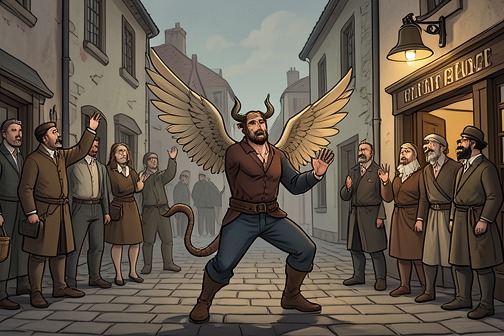
[Malthios Finds Acceptance at Fox Tales](entity:event-recall-event-320ea9bd3c08) marks a quiet turning point: in a village that has already made room for people seeking refuge, [Malthios](entity:character-recall-character-malthios-3bbf03e4fa99) is offered welcome without being asked to deny the harm in his past. [Amaya](entity:character-recall-character-amaya-3164488322dd)’s kindness does not erase his grief or excuse what he has done; it gives him a place from which he can begin to imagine a purpose beyond it.
## Context and Arrival
The encounter follows Malthios’s return to [Leafel](entity:location-recall-location-leafel-ce079facdeeb) in his own visible demonic form. He dives toward the village and lands casually in its middle, horns, wings, and tail on display. The ordinary response around him is strikingly different from the fear he anticipates: some townsfolk wave, while others stare in awe. He awkwardly waves back and makes his way to [Fox Tales](entity:location-recall-location-fox-tales-551227903e88), unsure how to handle the attention.
The public appearance does not make him feel at ease. When the bell above the café door announces his entrance, Amaya begins to welcome the visitor, then recognizes him. Malthios has a brief, fearful expectation that she will throw him out. He tries to hide his claws by closing his fists, while his tail swishes anxiously behind him. He presents his visit as a small, temporary request for a snack before he leaves. Amaya answers that he should sit wherever he feels comfortable. The welcome is immediate and practical: she neither makes his body a spectacle nor treats his presence as a threat.
## Amaya’s Welcome
Malthios chooses a corner table so his wings will not bump anyone. Amaya comes over smiling and addresses him as Mal, showing that she recognizes the name [Theo](entity:character-recall-character-theo-107bd6003b61) uses for him. She also acknowledges the unusual circumstances directly: Theo is letting Malthios out to visit, and sharing one body must be challenging. Malthios pauses before agreeing that it is difficult at times. He adds that he has found ways to give Theo and Theo’s lover privacy when needed, prompting Theo’s embarrassed anger and Amaya’s laughter.
That exchange makes the welcome more than polite service. Amaya recognizes Malthios as someone distinct from Theo while also understanding that their lives remain physically entangled. She speaks to him as a guest and a person with relationships of his own, without pretending that sharing a body is simple. Malthios, who entered expecting rejection, can answer honestly and participate in the lightness of the conversation.
## Grief, Guilt, and Leafel
As they talk, Amaya describes her own contentment in the village: Leafel has become her family, and she values being able to give back after its people welcomed her. Malthios looks down at the tea he has poured and admits that he hopes to do the same, but does not believe he deserves the welcome after everything he has done. Amaya reaches across the table and closes her hand over his clawed one. She tells him that the villagers do not hold him to the mistakes of his past, then asks him to consider whether he is the only person in the village escaping something.
She makes that idea concrete by naming people whose histories include difficult departures and painful circumstances. [Imani](entity:character-recall-character-imani-3e59d6c7b288) escaped an arranged marriage; [Hayden](entity:character-recall-character-hayden-3887fcc3a0d9) killed an abusive mentor; and Liffey’s parents were banished in shame. Amaya describes Leafel as a place that takes in people with nowhere else to go and helps them heal. She points to Theo’s experience as something Malthios has already seen firsthand, then urges him to let the village offer that same chance to him. Her welcome is therefore neither a declaration that his actions do not matter nor a demand that the villagers forget them. It is an invitation to enter a community whose members know that refuge and recovery can matter even when a person carries a troubled past.
Malthios catches Amaya’s hand when she starts to let go, holding on as though her touch and Theo’s presence are what keep him grounded. When he begins to describe the people he lost, memories of [Kamil](entity:character-recall-character-kamil-88c659fbf1a3), [Torq](entity:character-recall-character-torq-7e92679e994e), and [Foras](entity:character-recall-character-foras-2260f2d99951) join the grief he has kept pressed down. His grip becomes so tight that his claws cut Amaya’s skin. He releases her at once and apologizes, expecting repercussions; Amaya instead licks the cuts and smiles sadly. She tells him that grief takes time to heal, especially after it has been suppressed for so long. Her response meets the harm in the moment with tenderness without pretending it has not happened.
## Consequence and Significance
Malthios explains that his losses were why he became as he did and became the [Demon King](entity:state-recall-state-demon-king-d4ce23d2b4c1). The disclosure links the identity he has carried with the grief behind it, but the scene does not use that grief to absolve him. Instead, Amaya listens, holds his hand, and gives him language for the slow work of healing. Malthios leaves Fox Tales many minutes later, finishing his muffin with the taste of floral tea still on his tongue. He departs with a new burning desire in his chest: he has found a purpose again.
The encounter is small beside the trials and battles surrounding Malthios’s story, but its stakes are personal and consequential. The café offers an alternative to the secrecy and anticipated rejection that have shadowed his life: a welcome in which his demonic appearance, shared existence with Theo, and painful past can be acknowledged without becoming the only things that define him. Amaya’s gesture does not settle what Malthios owes others. It gives him a reason to try to contribute to the community that has made room for him.
Event 50
Elven Avenger Attack on the Demon King
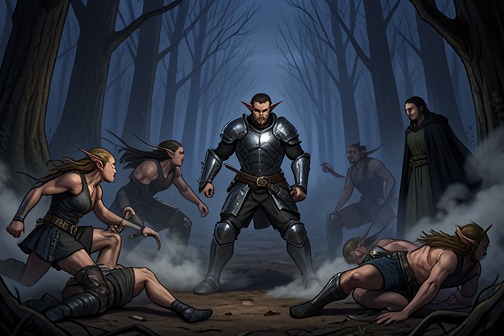
The [Elven Avenger Attack on the Demon King](entity:event-recall-event-20cb2db53fe2) turns a routine effort to defend [Leafel](entity:location-recall-location-leafel-ce079facdeeb) into a test of whether [Malthios](entity:character-recall-character-malthios-3bbf03e4fa99) can meet violence without answering it with slaughter. When Elven attackers ambush him and [Hayden](entity:character-recall-character-hayden-3887fcc3a0d9) in the woods, Malthios has the strength to overwhelm them; the harder task is to do so without setting the forest alight or killing his enemies. [Theo](entity:character-recall-character-theo-107bd6003b61)’s presence within him makes that restraint an active negotiation rather than a given.
## Causes and Background
The encounter begins during a return to Leafel’s borders. Hayden asks why they must walk the boundary again, and Malthios explains that he is setting up alerts. The sigil he carves into a tree with one of Theo’s knives also wards against demon creatures, joining practical warning with magical protection. Malthios would rather have had another adventurer show him the defenses, but Hayden is the party’s leader and knows Leafel and its safeguards best. The patrol therefore places the former [Demon King](entity:state-recall-state-demon-king-d4ce23d2b4c1) beside the person most familiar with the town’s defenses, in work intended to protect the community that has accepted him.
That acceptance exists alongside a recent public judgment. At the trial, [King Alexis](entity:character-recall-character-king-alexis-965b76b67eae) sentences Malthios to life in prison while declaring Theo free of all charges; the people of Leafel have appeared through a mirror spell to demand Theo’s release. Later, Malthios is again in Leafel, helping protect its borders. The attack exposes the limit of that local welcome: to the Elven assailants, he is not a neighbor or a former ruler but the Demon King, a threat they claim must be purged from [Algeya](entity:location-recall-location-algeya-1668b0a6fe56).
## The Ambush
Malthios senses danger before the attack fully unfolds, his magic sparking blue around his hands. An arrow flies from the trees and clips the feathers at the edge of his wing. Roughly twenty dark-clad figures appear, their faces covered and their weapons divided among bows, short thin blades, and mage staffs. Hayden draws his sword and challenges them, asking why they have brought violence to peaceful lands. A male voice answers by condemning the person beside him as the King of the demons and declaring the attackers’ intention to rid Algeya of its perceived filth.
Hayden moves between Malthios and the crescent of enemies and urges him to flee, get Theo to safety, and summon help. Malthios refuses to abandon him. Instead, he pushes Hayden into the shadow of a tree and magically transports him to the [Leafel Watchtower](entity:location-recall-location-leafel-watchtower-445b76b722ca). The intervention removes Hayden from the immediate fight, but it also leaves Malthios facing the attackers alone. His choice reveals a priority distinct from simple self-preservation: he will protect his companion, even while refusing to retreat himself.
## Fighting Without Killing
The attackers’ speed and agility identify them as [Elves](entity:creature-recall-creature-elves-75820362b438), and Malthios recognizes that their opponents are badly outmatched: only a [Hero](entity:concept-recall-concept-hero-c363661142b4) would ordinarily have a chance against a Demon King. Yet overwhelming force is not a clean solution. Malthios avoids using fire because it could harm the attackers or burn down the forest. Instead, he channels magic associated with [Aym](entity:character-recall-character-aym-bc4f15f5be03), shaping it into blue vines that tangle his enemies and disarm them. He concentrates first on the archers while keeping a shield ready against magical attacks.
One spell strikes with the force of lightning and sends Malthios spiraling before his wings catch him; the air around him smokes. In the distraction, an attacker reaches him with a blade. He turns aside so that it enters his thigh rather than his chest, kicks the attacker away, and Theo’s magic rises to heal the wound. Theo warns internally that the fight cannot continue this way. Malthios snaps back that he is already more handicapped than Theo is during a fight, a sharp exchange that makes their shared body a site of competing judgments as well as shared danger.
## Restraint and Aftermath
Rather than continue trading blows, Malthios builds up enough mana to knock the attackers unconscious instead of killing them. He releases a pulse of magic, and the Elves collapse across the forest floor, some more slowly than others. Theo observes that Malthios could have done that from the beginning; Malthios explains that he needed to accumulate the mana to make incapacitation possible. His restraint is therefore neither effortless nor merely symbolic: he chooses a method that requires enduring the fight and taking a wound before he can end it without deaths.
With the attackers unconscious, Malthios spreads shadows over them and transports them away, as he had transported Hayden. The woods are left empty of combatants, with only wildlife audible. Malthios and Theo then turn their attention back toward town, anticipating Hayden’s alarm. The attackers’ defeat ends the immediate danger, though Malthios hopes that being overcome so easily will discourage them from returning; the text does not confirm whether that hope is fulfilled.
## Significance
The ambush puts Malthios’s contested identity into physical form. The Elves define him entirely by his past power and the title of Demon King, while his actions in the woods show a different use of that power: he protects Hayden, avoids fire, accepts injury, and deliberately incapacitates rather than kills. His conduct does not erase the danger he represents, but it distinguishes capacity from choice.
The scene also gives Theo’s influence concrete force. Theo asks Malthios not to kill the attackers, and Malthios follows that constraint even as he objects to Theo’s commentary during the fight. Their coexistence is not presented as frictionless agreement; it is a shared-body relationship in which one can set a moral limit and the other must find a workable way to honor it. The attack thus extends the novel’s question of whether a former enemy can belong in a community: acceptance does not prevent hostility, but Malthios’s response offers evidence that power once associated with terror can be turned toward defense and restraint.
Event 51
Luc and Malthios Reconcile
[Luc and Malthios Reconcile](entity:event-recall-event-5035f12426a7) turns a dispute over [Theo](entity:character-recall-character-theo-107bd6003b61)’s safety into the beginning of a difficult, chosen trust. After [Malthios](entity:character-recall-character-malthios-3bbf03e4fa99) returns with Theo, [Luc](entity:character-recall-character-luc-b00cd62cc765)’s anger makes plain that love for Theo has not yet become confidence in the [Demon King](entity:state-recall-state-demon-king-d4ce23d2b4c1) sharing his body. Theo refuses to take control until the two men address that conflict; the forced conversation at home brings their separate fears into view and ends with a promise of trust, a kiss between Luc and Theo, and Malthios’s first sense that connection might give his life a purpose beyond bloodshed.
## Causes and Background
Theo’s shared body with Malthios is not a simple partnership between equals. Earlier, Theo refused to follow Malthios’s suggestions because he resented being told what to do, not because he claimed a higher moral standing. Malthios responded with threats and belittlement, and his fits left Theo bedridden with severe headaches. Their dependence ran both ways: Malthios was a prisoner in Theo’s mind and body, while Theo could not keep his thoughts or feelings from him. This history makes the question of trust more complicated than whether Malthios can be kind. It concerns autonomy, coercion, and the fact that neither can simply leave the other behind.
Theo also had reason to expect that intimacy could be taken from him. He knew friendship might not save him if others discovered that he was the Demon King’s host, and his first response to that danger was to prepare to run. Luc’s commitment offered another kind of security: Theo had promised to wait for him, and Luc placed his father’s ring on Theo’s marriage finger. But their bond existed alongside external pressure. Luc’s former lover [Julius](entity:character-recall-character-julius-2b9b6a5d3dd6) told Theo that [Hero](entity:concept-recall-concept-hero-c363661142b4) [Eliza](entity:character-recall-character-eliza-6ec11b83dd18) had ordered him to refuse Luc’s invitation to join the party, threatening to take everything from him if he did not. Julius believed Eliza wanted Luc to continue the bloodline and sire the next Hero, a future incompatible with either Julius or Theo. The couple’s chosen life therefore stood against both the Hero’s inherited duty and the expectation that Luc’s future should serve a lineage.
That tension became public when Theo’s identity was exposed at his trial. The court agreed that Healer Theo was guilty of protecting Malthios, and Theo was taken to the dungeon. In response, the people of [Leafel](entity:location-recall-location-leafel-ce079facdeeb) appeared through a mirror spell and demanded his release. Their action countered Theo’s fear that discovery would leave him alone, but it did not automatically settle the more intimate problem between Luc and Malthios: how Luc could love Theo while sharing his life with the Demon King.
## The Dispute at the Watchtower
The reconciliation begins at the [Leafel Adventurers’ Guild Watchtower](entity:location-recall-location-leafel-736bfb64836d), where the Leafel adventuring party, Luc, [Khal](entity:character-recall-character-khal-3b2ff6449c13), and [Veiv](entity:character-recall-character-veiv-2ba6a25fcbd2) are preparing for an assault. Malthios lands there with Theo, and Luc confronts him before their boots have touched the ground. His anger is directed at the danger Malthios has put Theo in. Malthios answers that Luc is speaking as though Theo could not take control whenever he chose; according to Malthios, Theo thought letting them handle the situation was best.
Luc restrains himself from continuing the argument and runs his fingers through his messy dark hair. His request is not for Malthios to defend himself or explain the wider situation, but to give Theo back to them. The wording exposes the immediate emotional divide: Luc experiences the shared body as a possible loss of the person he loves, while Malthios understands Theo’s choice as evidence that Theo still retains agency. Neither interpretation is wholly dismissed by the scene. Malthios can speak for Theo’s ability to take control, but Luc’s fear shows that knowing this does not yet make him feel safe.
When Luc asks where Theo is, Malthios says that his lover is being stubborn. Theo then sets a condition from within: he will not take control again until Luc and Malthios work something out. Malthios tells Luc that Theo intends to keep them together until they talk. Theo’s refusal makes the conflict impossible to evade. Rather than resolve it by taking over, he uses his control to require a conversation between the two people whose relationship has become part of his daily life.
## A Difficult Evening at Home
Luc agrees to go home, and the setting shifts from the confrontation at the Watchtower to the potion-room kitchen of the healer’s cottage. The domestic scene does not soften the disagreement at once. Malthios sits backwards on a chair while Luc angrily makes dinner; neither speaks. Theo’s impatience is perceptible to Malthios, but Theo still makes no attempt to resume control. Malthios considers provoking him into doing so, then stops short because he does not want to worsen Theo’s anger.
The meal gives their silence a concrete shape. Luc serves steak with roasted potatoes, carrots, and beets. Malthios answers with a growled thanks; they eat without conversation, accompanied only by cutlery and the crackle of the fire. Afterward, Malthios does the washing-up that Theo usually handles because Luc has cooked. Luc allows this small exchange of care without comment, then goes to clean up. Their cooperation is not yet reconciliation, but it disrupts the assumption that every interaction must become another contest.
The strain follows them upstairs to the loft bedroom and its single large bed. Malthios’s wings make their arrangement awkward, forcing him to lie on his side facing Luc so they will not touch. Luc stares at the ceiling before admitting the heart of his fear: he does not distrust Luc’s love, but he does not trust Theo to anyone. Malthios asks whether that includes Theo himself. He explains that Theo still makes the choices and can take control whenever he wishes; Theo would not permit Malthios to do anything he did not want. Luc then identifies his actual suspicion: he does not trust Malthios.
## Tentative Trust and a Shared Future
The turning point comes when Luc reaches toward Malthios’s wings. Their sensitivity makes the gesture intimate, and Malthios hesitates because the last person to touch them was [Aym](entity:character-recall-character-aym-bc4f15f5be03), with whom he had once shared the mutual grooming of feathers after sex. Malthios says the wings are all he has left that is his, and Luc withdraws his hand. The exchange briefly exposes a past and a vulnerability that are Malthios’s, not Theo’s. Luc recognizes that Theo is not the only one trapped. Malthios agrees, while distinguishing their circumstances: Theo did not choose this shared body.
That recognition allows each man to acknowledge the other without pretending their positions are identical. Luc says he will try to trust Malthios for Theo’s sake. Malthios, in turn, says he will try to remember that they are no longer alone. The promises are deliberately limited: neither claims that suspicion has vanished, only that each will attempt a different response to it. Theo then takes control again, and Luc’s face lights up before he pulls Theo into an intense kiss. Malthios does not complain about the change. Instead, he is grateful to rest after the day and the awkward evening.
The scene closes by widening the meaning of reconciliation beyond a private truce. Malthios recalls that he had never been sociable and that his friends once had to force their way into his life; now the people of Leafel and Luc have done something similar for Theo. He recognizes that connection has returned to his life and that its purpose need not be stained with blood. The final possibility—that even the Demon King might receive a happily ever after—does not erase the danger or the history between them. It makes happiness imaginable through shared boundaries, Theo’s continuing agency, and the imperfect willingness of Luc and Malthios to trust one another.