Ashenhave Nightfall Lockdown
The Reincarnated Demon King's Host Just Wants to Live in Peace, But the Hero Won't Leave Him AloneAshenhave Nightfall Lockdown is the temporary after-dark prohibition on entering or leaving the haunted town of Ashenhave. Introduced through barricades, darkness, armed watchers, and a demand that strangers prove themselves before dawn, the lockdown is not merely a local inconvenience. It is the town’s principal defense against Ghosts and ghost-touch, while also exposing how fear reshapes access, authority, and the obligations of the Hero’s party. Its most consequential exception is granted to Theo, whose identity as a healer transforms him from a suspected outsider into the one person the town urgently admits.
Definition and Setting
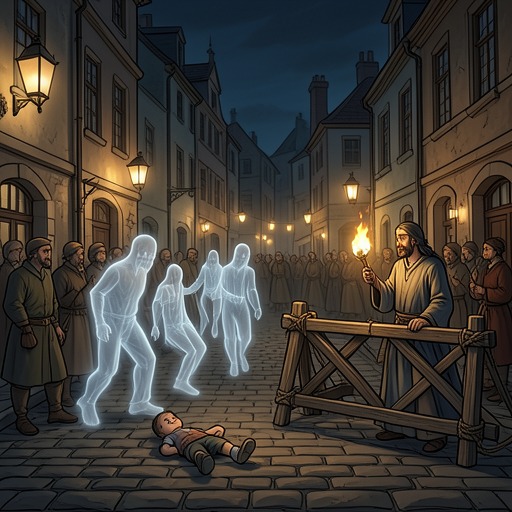
Dusk is already falling when Theo and the Hero’s party see Ashenhave ahead. Temporary fencing surrounds the main section of town, while the farms they have passed and the town’s windows remain dark. The visual impression is one of deliberate withdrawal: Ashenhave has not simply become quiet, but has closed itself against the night. Wicker senses many Ghosts nearby, and Veiv explains that the season makes their presence more likely, giving the barriers a practical supernatural cause rather than making them an ordinary civic curfew.
The road party approaches a makeshift fence watched by roughly half a dozen armed figures. They carry neither lanterns nor sun crystal, and the surrounding darkness makes their authority feel inseparable from the danger outside the walls. The first order is absolute: the travelers must halt because entry is forbidden. When Luc identifies the group as the Hero’s party and requests supplies and rest, the guards do not accept the claim at face value. They ask how the watchers can know the travelers are who they say they are, making identity verification part of the lockdown’s operation.
Operation and Enforcement
The rule prohibits everyone from entering or leaving Ashenhave after nightfall. It therefore controls movement in both directions: residents cannot escape the sealed town, and travelers cannot enter it simply because they possess a prestigious name or an official mission. Avery regards the refusal as outrageous, but Wicker interprets it as fear. In that reading, the guards are not exercising power for its own sake; they are trying to hold a fragile boundary against an enemy capable of terrifying people or returning against them when wronged.
The lockdown also demands proof through endurance. After Wicker identifies the ghost problem and Veiv offers to establish ghost wards on every home, the guards still refuse immediate admission. They declare that, if the travelers truly are the Hero’s party, they should survive the night outside in the open and discuss the matter in the morning. This condition makes the night itself an examination. The party’s reputation is not enough; the town requires visible evidence that the supposed rescuers can withstand the threat that has made the curfew necessary.
The rule is then modified by professional necessity. When a guard learns that Theo is a healer, the tone changes urgently, and Theo confirms the role. He is allowed to enter, but only he is initially permitted across the boundary. Luc objects to sending him in alone, revealing the conflict between the lockdown’s demand for controlled access and the party’s insistence that Theo not be isolated. The exception demonstrates that Ashenhave’s security policy is selective rather than uniform: the town will suspend its general exclusion when a person’s healing ability is judged indispensable.
Medical Crisis and Collective Response
Theo’s admission reveals the severity of the emergency. Inside the inn, the main room has been emptied and converted into rows of bedrolls, at least a dozen in all. The victims’ exposed skin is grey and blue, with lips, eyelids, and nostrils appearing almost frostbitten. Theo can smell ghost-touch in the air as he enters, and the curfew’s abstract purpose becomes bodily and immediate: Ashenhave is containing a spreading supernatural affliction whose effects are visible on the faces and skin of its people.
The lockdown does not solve the crisis by itself. It buys the town a defended night and creates the conditions under which specialists can work. Theo spends the night healing victims of ghost-touch and is exhausted afterward, while Garris acknowledges that the town owes him greatly and asks whether the Ghosts can be stopped. Wicker has studied several of the spirits and needs further information about recent events before acting with confidence. Veiv and Avery undertake a parallel protective effort, setting up ghost wards around houses, farms, and shops. Avery’s wards are less effective than Veiv’s, but they are still expected to provide meaningful protection.
This division of labor clarifies the lockdown’s emergency logic. The guards control the boundary; Theo treats those already affected; Wicker investigates the Ghosts; and Veiv and Avery reinforce the entire settlement. The policy is therefore both exclusionary and infrastructural. It restricts movement because the town lacks safety, but it also creates a protected interval in which healing, investigation, and warding can be coordinated.
Authority, Identity, and Moral Stakes
Ashenhave’s curfew places ordinary hospitality beneath survival. The Hero’s party cannot rely on its public status, and even Luc’s courteous introduction does not open the gate. The guards’ suspicion is reinforced by the fact that the town is dark, fenced, and already under supernatural pressure. Their questions insist that authority must be demonstrated at the threshold rather than merely asserted from the road.
At the same time, the rule exposes the costs of treating people according to a single function. Theo is admitted because he is a healer, while the rest of the party remains excluded. His skill gives him access but also makes him vulnerable to being separated from those who protect him. The episode echoes the wider political structure of Algeya, where children with rare abilities can be assigned to the Hero’s party and where institutions decide how bodies will serve public safety. Theo was once identified by the court mage as someone who belonged in the Hero’s party because of his powerful healing gift, and at sixteen he was expected to return to the capital and train for the duty of purging Demons. In Ashenhave, the same identity that once threatened to conscript him instead becomes the reason a frightened community opens its gate.
That contrast gives the lockdown its sharpest significance. Theo refuses to be reduced to a state-designated role, insisting later that he will always be a village healer first, yet his healing remains an ethical practice rather than merely an institutional label. At Ashenhave, he crosses the boundary because suffering calls for care. The town’s rule initially treats him as an unknown risk, then recognizes him as a necessary responder; the change in status occurs not through rank, but through demonstrated capacity to preserve life.
Narrative Significance
The lockdown converts a routine travel obstacle into a compact study of communal defense under supernatural threat. The party has been traveling for almost two weeks after a storm-forced detour and mountain crossing, but the journey’s physical hardship does not prepare it for a town where nightfall itself has legal force. The fence creates a clear spatial division between those seeking entry and those trying to keep danger out, while the demand to remain outside until morning makes the boundary a test of trust.
Its final effect is a controlled opening rather than a simple triumph over fear. The town does not abandon the curfew; it makes a narrow exception for Theo and, through him, allows the party’s wider protective abilities to become useful. The rule thus preserves the residents’ caution while permitting a response to the crisis that ordinary isolation could not provide. Ashenhave Nightfall Lockdown embodies the book’s recurring tension between imposed duty and chosen care: a frightened community guards its threshold, but healing, investigation, and solidarity eventually persuade that guarded space to admit help.