Dale
The Reincarnated Demon King's Host Just Wants to Live in Peace, But the Hero Won't Leave Him AloneDale is the dwarf innkeeper and cook of the Broken Blade, and one of the central figures in Theo’s chosen family. His importance lies not only in feeding travelers or maintaining a village tavern, but in recognizing Theo’s need for care before Theo can recognize it himself. Alongside Imani, Dale transforms an ordinary place of lodging into Theo’s first genuine home and later becomes one of the people who publicly defends Theo when the capital treats him as a criminal because of the power within him.
Identity and Place in the Broken Blade
Dale runs the Broken Blade with Imani, his wife. He acts as the tavern’s cook, wears a stained apron while carrying meals through the building, and has a dark brown beard trimmed shorter than those of most dwarves; his matching hair is twisted into a bun at the back of his head. The physical details place him firmly in the practical, domestic world of the inn: Dale’s authority is expressed through food, work, and immediate hands-on assistance rather than ceremony or formal power.
When Theo first came to Leafel, he stayed at the Broken Blade for several weeks before purchasing his shop. Dale and Imani had already chosen to make room for him, keeping a table in the corner by the kitchen door where he could hide from the tavern crowd. Their arrangement was more than hospitality. They treated Theo as a child almost immediately, offering him more love and affection in a few weeks than his actual parents had given him throughout his life. Dale taught him how to cook better, while Imani asked about his day and listened even when his answers were short and quiet.
Care Through Food and Daily Attention
Dale’s care is repeatedly material, specific, and embodied. When Theo returns to the Broken Blade with members of the Hero’s party, Dale and Imani are delighted despite having received little more than greetings from him for months or even years. They serve his favorite meal without waiting for him to ask: steak pounded thin, breaded and fried in a pan of oil, with buttered baby potatoes seasoned with rosemary. Theo feels guilty for having pushed them away, but he still devours the food, revealing how deeply their care remains connected to his sense of safety.
Dale also responds to Theo’s emotional withdrawal without turning his concern into condemnation. After Imani tells Theo that he should allow other people to care for him, Dale arrives carrying a tray with a steaming bowl and a mug. He tells Theo that there is no need for an apology and props him against pillows before serving him. His explanation of their attachment is especially important: he and Imani cannot have children, though they had dearly wished for them, and when Theo came to the tavern, they felt instinctively that he needed them.
The care Dale describes is confirmed by remembered acts. Imani gave Theo the first hug he had ever received, and Dale made a cake specially for Theo’s eighteenth birthday, the first birthday Theo had ever celebrated. Dale’s parental role therefore develops through repeated domestic gestures rather than a formal adoption. Food, instruction, physical support, and celebration become the means by which Theo learns that parental love is not supposed to be cold or distant.
Dale continues that pattern after Theo’s relationship with Luc begins to take shape. He brings dinner for Theo and Luc and serves Theo’s favorite breaded fried steak with herby baby potatoes. The meal is eaten on the floor of Theo’s potion-room kitchen by the fire, echoing the first night Luc arrived at Theo’s doorstep and linking Dale’s care to the couple’s emerging household. Later, Dale teaches Luc to cook, and Luc becomes responsible for luncheon and supper while Theo remains the first to rise and prepares breakfast. Dale’s influence thus extends beyond feeding Theo: he helps establish the practical habits of the home Theo and Luc build together.
Relationship with Theo and Leafel
Theo initially avoids the Broken Blade precisely because Dale and Imani matter so much. He claims that the crowd is the reason for his absence, but the deeper reason is that their affection exposes the pain of what he lacked before coming to Leafel. Theo knows that if people discovered what he was, friendship might not save him, and he fears that affection could become another source of loss if those who cared for him turned against him. Dale’s response to this guardedness is persistence rather than pressure.
After the Hero’s party leaves Leafel, Theo keeps his promise to dine at the Broken Blade once a week. Dale and Imani greet him happily, serve his favorite dish, ask about his day, and share news of their own lives. Theo recognizes the connection as real and gradually stops comparing them with his birth parents, concluding that this is how real parents act. The weekly meal gives his settled life a recurring rhythm: belonging is not a single declaration but something maintained through return, conversation, and familiar attention.
Dale’s relationship with Theo also reinforces Theo’s decision to remain in Leafel. When Raf worries that a healer of Theo’s ability does not belong in a remote village and that he may leave at any moment, Theo describes the life he wants: settling in a small village where everyone knows one another, growing and making his own food, and spending his days with the person he loves. He then states that Leafel is his home and that he is not going anywhere. Dale and Imani’s tavern is one of the clearest places where that home has been made tangible.
The Capital Crisis and Public Defense
Dale’s private care becomes public courage when Theo is summoned to the capital. Theo understands that entering the portal will end his autonomy: the authorities will know who he is and where he lives, and his identity as the Demon King’s host may be exposed. Even so, he goes because Luc may die. Before departing, Theo receives farewell gestures from the people of Leafel. Imani pulls him into a hug without hesitation, and Dale pats his back. Their physical reassurance is part of a broader communal promise that they will await his safe return.
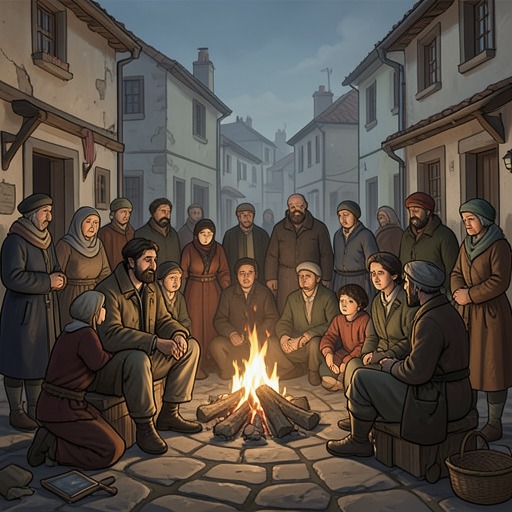
During the trial of the Demon King’s host, the court treats Theo’s protection of Malthios as guilt. A portal opens onto Leafel’s town square, where Micah stands before Imani, Dale, Nib, Amaya, Dmitri and his parents, Hayden, and the gathered townspeople. They demand Theo’s release. When the court mage declares that the villagers are guilty of treason as well, Dale rejects the accusation as absurd and insists that the court is asking about Theo’s character while the people of Leafel know him better than anyone in the room.
Dale’s testimony carries particular weight because it is grounded in Theo’s ordinary life. He is not defending an abstract magical being or denying the danger associated with Malthios. He is defending the young man who came to the village lost and isolated, accepted care reluctantly, and repaid it through healing and devotion. Imani explains that Theo repaid their welcome with love and care in his own way, while Nib states that some villagers can live their present lives only because Theo healed them and asked for little in return. Dale’s testimony therefore joins domestic knowledge to moral judgment: Theo’s identity is measured by what he repeatedly chooses to do.
Camden also supports Theo before the court, saying that he raised Theo himself and that Theo is stronger and kinder than those judging him. The defense from Camden, Dale, Imani, and the people of Leafel contrasts sharply with the capital’s institutional demand that Theo be reduced to his dangerous status. Dale is one of the voices that prevents the court from defining Theo solely through inheritance, magical contamination, or alleged treason.
Return, Household, and Narrative Significance
After the crisis, Dale remains part of the communal home to which Theo and Luc return. The whole village fits into the Broken Blade’s common room for a celebration filled with food and laughter, with Theo and Luc at its center. Dale’s familiar cooking acts as a balm, and the tavern gathers the people Theo loves into one shared space. The setting completes Dale’s arc: the corner table where Theo once hid has become a room large enough, emotionally and socially, to hold his story in public.
Dale represents chosen parenthood as an active practice rather than a biological fact. He and Imani cannot have children, yet they become parents to Theo through recognition, patience, meals, instruction, physical comfort, and loyalty under political threat. Their care also helps create the domestic future that the capital’s heroic system tries to deny. Luc’s cooking lessons from Dale, the couple’s shared meals, and the return to the Broken Blade all show family being assembled through daily acts instead of bloodline or compulsory succession.
Dale’s significance is consequently clearest in contrast. The capital asks what Theo is and whether his supernatural connection makes him guilty; Dale remembers who Theo was when he arrived, what he needed, how he behaved, and how he cared for others. His defense does not erase danger or simplify Theo’s secret. It insists that danger is not the whole person. Through Dale, the novel presents belonging as something that can survive revelation because it has been built from knowledge, repeated care, and chosen loyalty rather than from an inherited name.