Demon King Soul-Transfer Spell
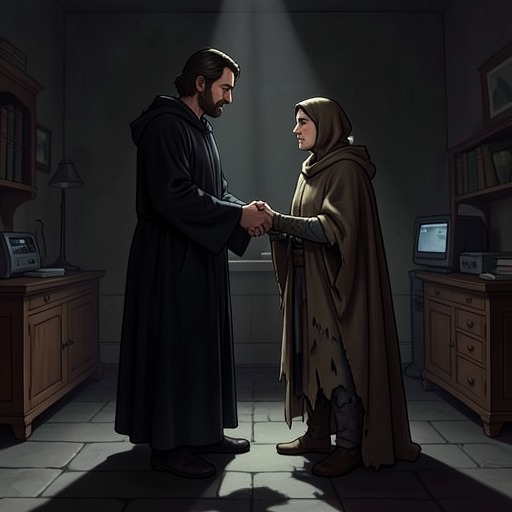
The Reincarnated Demon King's Host Just Wants to Live in Peace, But the Hero Won't Leave Him AloneThe Demon King Soul-Transfer Spell is Malthios’s posthumous escape from defeat and the mechanism that binds him to Theo. Cast before Malthios was killed by Hero Eliza and her companions, it preserves the Demon King’s soul inside another body so that he can survive and eventually resume his rule. Theo becomes that unwilling host, and the spell transforms a supposedly concluded war into a continuing conflict contained within one person.
Origin and Intended Purpose
Malthios had been the sworn enemy of the people of Algeya for centuries. Eliza’s birth and the victory of her party ended his campaign to conquer the land, but rumor held that he had prepared a spell before his death to transport his soul into another body. The spell therefore functions as a contingency against military defeat: the destruction of the Demon King’s body does not necessarily destroy the Demon King himself.
The transfer was not an improvised act of ordinary magic. When Theo asked why Malthios could not simply kill him and move to another host, Malthios explained that preparing and casting the spell had taken more than a human lifetime. A new transfer would require years, and Malthios stated that Theo’s death would also kill him. This establishes both the spell’s extraordinary cost and its decisive limitation: the host is not disposable, and Malthios’s continued existence depends on Theo’s survival.
Theo as the Host
Theo’s first memory comes from two days after his birth, when a raspy masculine voice addressed him as a host. He did not understand the voice’s identity until he was three, when he learned that it belonged to Malthios. The spell thus begins Theo’s life with an invisible second presence already occupying his mind, before he possesses the knowledge or power to consent to that condition.
Malthios intended the possession to become a route back to his throne. He tried to set Theo on an evil path at the age of two, when Theo could walk, speak fully, and was beginning to read and write. The plan encountered an unexpected barrier: Theo’s will was stronger than Malthios’s. Malthios could not take control of Theo’s body or use magic without Theo’s consent, except when Theo suffered a lapse of control caused by an intense sudden emotion such as anger or fear.
Those lapses briefly exposed the physical consequences of the spell’s shared embodiment. Horns could grow from Theo’s head, wings from his shoulders, and a tail from his spine, while his eyes bled black and their pupils became glowing red slits. The transformations occurred only once or twice during his childhood, usually when village children bullied him, and Theo learned to escape before the change could be witnessed. His efforts to suppress Malthios were therefore also efforts to conceal the evidence of the spell.
Limits and Shared Confinement
The spell creates reciprocal confinement rather than simple possession. Malthios is trapped in Theo’s mind and body, while Theo cannot have a thought or feeling without Malthios knowing it. When Malthios discovered that his intended host could resist him, he responded with fits, threats, and belittling attacks. His outbursts caused headaches so severe that Theo became bedridden, yet they did not break Theo’s control.
The arrangement also imposes a direct life bond. Malthios cannot casually abandon Theo because the spell cannot be repeated quickly, and the Demon King explicitly acknowledges that when Theo dies, Malthios dies as well. The spell’s power is consequently defined less by limitless supernatural control than by dependence, delay, and mutual vulnerability. Its most important rule is not that Malthios can enter a body, but that entry does not guarantee mastery of it.
Theo and Malthios eventually form an agreement after Theo’s magic test. Malthios stops trying to take over Theo’s mind and body, while Theo permits him occasional control provided that Malthios does nothing against Theo’s wishes. Even this concession is conditional: it is to occur only after Theo completes his training and the pair have gone far from the capital and from Heroes, past and present. Their arrangement turns the spell from an attempted possession into a negotiated shared-body existence, though the danger of involuntary transformation remains whenever Theo loses control.
Secrecy, Exposure, and Political Consequences
Because the spell makes Theo the Demon King’s host, concealment becomes necessary for survival. Theo believes that no amount of friendship could save him if anyone discovered what he was. He keeps emergency provisions ready in case he has to run again, treating every peaceful home as provisional. His secrecy is not merely personal caution: the surrounding political order defines the host as a threat whose body may be claimed, restrained, or destroyed.
The danger becomes explicit when Cargo asks whether Theo will tell the others that he is a demon spawn. Theo freezes, and Malthios immediately presses forward, attempting to seize control in defense of them both. Later, when Bryony brings Theo through a portal to help the gravely endangered Luc, Theo understands that entering the capital will end his autonomy. The authorities would learn who he was and where he lived, and they could force him into the Hero’s party, where the truth might be discovered at any moment. He nevertheless goes because Luc might die, choosing the risk created by the spell over the political system’s readiness to replace an expendable person.
The institutional response confirms Theo’s fear. After his identity is established, the court mage and Hero Eliza order him restrained with magic-dampening handcuffs and brought before the capital’s court. The trial is explicitly framed as the trial of the Demon King’s host, showing how the spell converts Theo’s private condition into a public legal category. The authorities treat the host bond as grounds for confinement even though Theo has spent his life resisting Malthios and controlling the body they share.
Recognition and the Question of Responsibility
Theo’s disclosure forces the court to distinguish, or refuse to distinguish, between Malthios’s actions and Theo’s choices. Eliza condemns him for fleeing his duty, while Theo answers that it was Eliza’s system of turning children into weapons that shaped Luc’s suffering. The exchange reveals the spell’s political significance: Theo is not only feared as a vessel for an enemy ruler but also judged against the duties imposed by the Heroic order.
Leafel’s response provides the strongest counterclaim to the court’s definition of the host. During the trial, Micah opens a mirror spell from Leafel, with Imani, Dale, Dmitri and his parents, Nib, Amaya, Hayden, and the townspeople gathered behind him. Hayden demands Theo’s release in the name of the people of Leafel. Their intervention shows that the host bond has not erased Theo’s identity for those who know him; the community recognizes the healer and companion within the politically stigmatized category.
King Alexis then reminds the court that the decision belongs solely to Hero Luca. The point does not make the spell less dangerous, but it changes the immediate question from an automatic execution to a personal judgment by someone who knows Theo intimately. Luc confirms that the demons and the Demon Fortress have been destroyed and that there is no longer any need for a Hero, yet he still identifies the duty to kill the Demon King as his own. He also claims the authority to choose when that duty will be fulfilled, leaving the spell’s apparent death sentence suspended rather than immediately carried out.