Garris
The Reincarnated Demon King's Host Just Wants to Live in Peace, But the Hero Won't Leave Him AloneGarris, the chief of Ashenhave, represents a community under pressure from a supernatural emergency. He first appears as a cautious local authority who refuses to admit the Hero’s party until its members prove themselves, but his suspicion gives way to practical cooperation once Theo, Wicker, and the others demonstrate that they can protect the town. Through that reversal, Garris becomes an important measure of the party’s credibility: the villagers’ trust is not granted automatically, but it is earned through healing, investigation, and shared danger.
Identity and Introduction
Garris is a large, middle-aged man with flecks of grey in his reddish hair, beard, and sideburns, and an eyepatch over his right eye. His clothing combines leather armor and a kilt similar to Khal’s with an officer’s jacket, marking him as both a fighting man and a local commander. He is accompanied by a younger guard with close-cut blond hair and formal guard livery, while Garris himself speaks in a rough voice and gives instructions without wasting words. His first introduction is therefore visual as well as institutional: he is a hardened guardian whose authority is expressed through military bearing rather than ceremony.
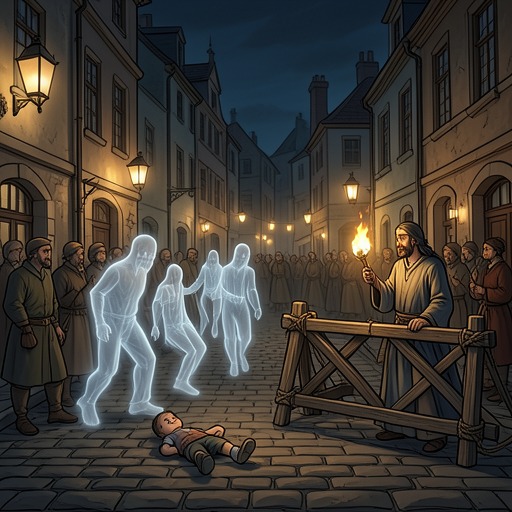
That guarded manner reflects Ashenhave’s recent experience. When the Hero’s party reaches the settlement, the townspeople are sufficiently frightened to demand that the visitors spend the night outside in the open before entrance will be considered. The challenge is framed as a test of identity and endurance: if the travelers are truly who they claim to be, they should survive the night and return in the morning. Avery objects to being denied entry, while Wicker explains that the residents are afraid because ghosts can be terrifying, especially when they have been wronged. Garris’s position thus belongs to a larger defensive response rather than to personal hostility alone.
Authority During the Ghost Crisis
Garris’s leadership is defined by the need to protect ordinary residents from ghost-touch while operating with incomplete knowledge. After Theo spends the night healing victims, Garris bows and offers eternal gratitude on behalf of Ashenhave. He asks whether Theo truly believes the ghosts can be stopped, acknowledging both the healer’s achievement and the scale of the remaining threat. The question also establishes Garris as a practical interlocutor: he does not treat the Hero’s party as infallible, but seeks a workable assessment before committing the town to a course of action.
Wicker answers that the ghosts should be manageable after studying several of them and that he only needs to confirm details about the recent events in Ashenhave. Veiv and Avery then undertake to establish ghost wards on every house, farm, and shop, with Veiv noting that Avery’s wards are not yet as strong as hers but will still be far better than having none. Garris’s role is to receive this expertise and convert it into communal protection. His authority does not replace the party’s specialized abilities; it creates the conditions in which those abilities can be applied across the settlement.
When the party prepares to leave at sunset for the next stage of the plan, Garris is waiting with Everett, Gail, and several guards. The chief has been informed of the proposed operation and, surprisingly to Theo, has consented to it. This decision places Ashenhave’s official authority behind a dangerous division of labor: Luc, Avery, Khal, and Veiv will draw the ghosts away from the town and farms, while Theo and Wicker pursue the means of stopping the threat. Garris’s consent turns the party’s plan from an improvised intervention into an operation recognized by the settlement’s leadership.
Relationship with the Hero’s Party
Garris’s relationship with the Hero’s party develops through demonstrated service. At first, the settlement’s gates function as a threshold guarded by fear. By the following morning, Theo has healed the last two victims in the inn and is swaying against the wall from exhaustion. Garris bows before him and explicitly asks him to rest, while the goblin Geg grumbles that the healer may end up taking his bed. Garris’s gratitude is therefore not merely ceremonial: it is paired with concern for the physical cost of Theo’s work.
Theo nevertheless insists on checking on the party, remarking that he is surprised the Hero has not already broken through the fence. The line captures the tension between Ashenhave’s defensive isolation and the party’s urgent movement. Garris does not answer with resentment. Instead, his subsequent actions show that he recognizes the party as an ally whose presence is necessary even when the town’s first response has been exclusion.
Garris also observes the public trust placed in the visitors. Theo is baffled by the common folk’s blind confidence in the Hero’s party, but Garris’s consent demonstrates how that confidence is organized locally: the chief hears the plan, weighs the danger, and allows the heroes to act. The party is not simply passing through a frightened settlement; it is temporarily incorporated into Ashenhave’s emergency structure, with Garris serving as the official bridge between outsiders and residents.
Change and Ending
By the time the party gathers again after Theo’s fitful rest, Garris’s attitude has softened noticeably. He waits outside with his guards, including Everett, who still scowls, while Garris gives the group a short bow. His rough voice is gentler when he tells them that Ashenhave is indebted to them and that he cannot imagine what would have happened if they had not arrived. The change is measured rather than sentimental. Garris does not abandon his sternness or become an intimate member of the party; he expresses recognition in the restrained language of a commander whose town has survived because others accepted responsibility for it.
Luc responds that the party is honored to help and hopes they can remain long enough to see Ashenhave’s pumpkin festival. The exchange places Garris’s crisis within the possibility of ordinary communal life returning. His importance lies in that transition: he begins as the authority of a locked settlement and ends as the representative of a town able to imagine a festival after the ghosts have been confronted. Garris’s arc is consequently one of earned trust, from threshold guardian to grateful collaborator, without requiring him to surrender caution.
Narrative Significance
Garris gives the Ashenhave episode a local human scale. The capital contains kings, councils, magic mirrors, and institutions that can display or judge people across Algeya, whereas Garris governs a threatened town through immediate decisions: whether to open the fence, whether to authorize the night operation, and how to acknowledge those who have saved the afflicted. His eyepatch, officer’s jacket, guards, and terse commands make him a figure of defensive order, but his willingness to listen prevents that order from becoming mere obstruction.
His role also clarifies the Hero’s party’s function beyond combat. Theo heals the victims, Wicker studies the ghosts, and Veiv and Avery establish wards; Garris supplies civic recognition and coordination. The episode therefore presents protection as collective labor rather than as the isolated triumph of a single hero. Garris’s final gratitude confirms that the party’s value is measured not only by defeating supernatural enemies, but by preserving the ordinary homes, farms, shops, meals, and festivals that make a community worth defending.