Genevieve
The Reincarnated Demon King's Host Just Wants to Live in Peace, But the Hero Won't Leave Him AloneGenevieve, also called Veiv or Viev, is a dwarf mage and member of Luca’s Hero’s Party. She is introduced as one of the companions who arrive at Theo’s cottage soaked and bloody after a fight, and her presence establishes the party as a mixed group of humans, elves, dwarves, faery- or nymph-blooded people, a half-orc, and even a talking pig. Although the evidence does not assign her a major independent subplot, Genevieve’s repeated presence in moments of danger, recovery, travel, and reunion makes her part of the party’s dependable communal identity.
Identity and Introduction
Genevieve first appears among the seven exhausted adventurers on Theo’s porch. She is described as a female dwarf with dark hair and matching sideburns along her cheeks, arranged in rows of braids, and skin the color of polished oak. A staff hangs at her side, marking her as a user of magic. Cargo, the party’s unusually intelligent black pig, stands beside her, while the wounded Khal is supported by several companions. The visual detail gives Genevieve a distinct place in an ensemble whose members are recognizable through race, clothing, equipment, and bodily bearing even before their personalities are fully explained.
When Luca introduces the group to Theo, he names Genevieve alongside Khal, Avery, Emi, Bryony, and Wicker. The formal introduction places her within Luca’s authority as the Hero but also confirms her as a recognized companion rather than a peripheral traveler. Theo notices that Genevieve responds to the awkward meeting with a nod, as do Emi and Viev, while other members react according to their own temperaments. The use of both Genevieve’s full name and the shorter form Viev reflects the party’s informal familiarity with her.
Role in the Party
Genevieve’s clearest demonstrated function is magical and supportive. After Khal is injured, the party returns to Theo’s door with a rented horse and cart so the half-orc can be transported to the Broken Blade. Emi removes her silk bands, allowing Theo to examine Khal’s wound, while Genevieve remains part of the group coordinating his recovery. Theo’s healing closes the wounds and confirms that Khal has no poison, but the scene’s practical organization depends on the party acting collectively around its injured member. Genevieve is therefore situated within the party’s care network, even though the passage does not specify a separate spell or treatment performed by her.
Her staff also connects her to the broader magical hierarchy of the setting. Magic is not restricted to one species: Theo is a healer, Emi is a priestess mage, and Genevieve is a dwarf who carries a staff as a common tool of magic users. Her equipment quietly counters any assumption that dwarves occupy only martial or artisanal roles. Within Luca’s party, different forms of expertise coexist, and Genevieve’s presence contributes to that distribution of skills.
The party itself is contrasted with the isolated life Theo has built in Leafel. Theo is a skilled healer whose townspeople praise him, while Leafel’s local adventurer group protects the town from ordinary and monstrous beasts. Luca’s party arrives from the wider world carrying the visible consequences of adventure: blood, exhaustion, wounds, and obligations. Genevieve belongs to that mobile heroic world, but her repeated appearances also show how such a group depends on routine acts of accompaniment and care rather than combat alone.
Companionship and Group Dynamics
Genevieve remains part of the party’s ordinary social rhythm after the crisis at Theo’s cottage. When Theo and Luca go to the Broken Blade the following morning, the other companions are already eating breakfast in the common room. Wicker and Bryony wave, Veiv offers a friendly smile, and Cargo sits at her side, while Khal, restored to health, eats an enormous breakfast of bacon and eggs. Genevieve’s friendly gesture is small but meaningful: it places her among the people who welcome Theo into contact with the group rather than treating him solely as a healer or a convenient refuge.
Her association with Cargo gives her an especially distinctive place in the ensemble. Cargo complains that the others always forget to introduce him, and the talking pig’s comic interruption breaks the tension of the party’s first meeting with Theo. Genevieve is the figure beside whom Cargo is visually positioned when the group arrives, and later Veiv is again described with Cargo at her side. The pairing links her to one of the book’s most unusual companion relationships and reinforces the party’s rejection of rigid boundaries between people, animals, and magical beings.
Genevieve is also present during conversations about intimacy and the burdens of the Hero’s role. Luca explains that his life as the Hero has made lasting relationships difficult: his earliest lovers lived in the capital, another ended their relationship when Luca was called away, and later romances could not survive the party’s prolonged travels. Genevieve is not made the subject of this confession, but her inclusion in the surrounding party scenes matters. She belongs to the community that witnesses the personal cost of Luca’s duty and the possibility that his relationship with Theo might become different from the temporary attachments his role has previously allowed.
Conflict, Loyalty, and Return
The larger conflict around Luca concerns more than romance. Hero Eliza pressures him to preserve the Heroic bloodline, and Julius later explains that Eliza wanted Luca to sire the next Hero, something that could not be achieved through either Julius or Theo. Luca rejects that demand and chooses a quiet life with Theo, declaring that those born with the Hero’s gift should be able to choose their own fate rather than remain bound to duty. Genevieve’s importance in this conflict is collective rather than argumentative: she is one of the companions whose shared history belongs to the life Luca refuses to sacrifice to an inherited reproductive mandate.
The party’s campaigns expose its members to severe physical danger. During the fight with the dire wolves, Luc is pinned beneath the leader’s paw while another figure holds Theo by the hood. The struggle ends when Luc breaks the wolf leader’s jaws with his bare hands and kills it, after which the surviving wolves flee. Genevieve is not assigned a separate action in this encounter, but the scene belongs to the party’s shared chain of ordeals, alongside the bandit ambush, ghost encounters, and battles with demons later recalled by the group. Her survival and continued presence place her among the companions who carry the consequences of those dangers forward.
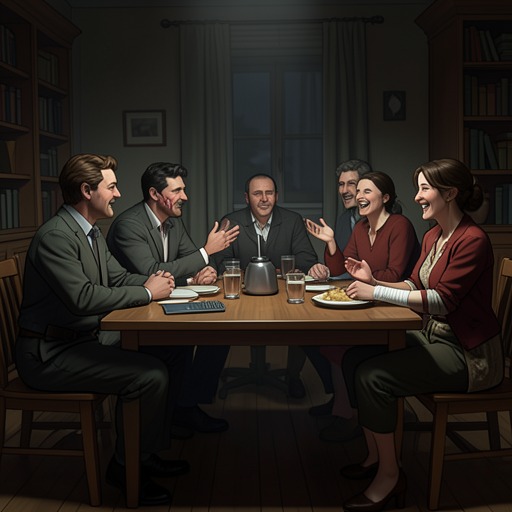
When the party returns to Leafel, Genevieve is part of the village gathering that fills the tavern common room with food, laughter, and stories. Wicker recounts the group’s last adventure against the Demon Lords, with the others contributing details about the bandit ambush, the dire wolves, the ghosts, and the final battle with the demons. Genevieve’s role in this retelling is not individually quoted, but the collective narration makes her one of the witnesses and survivors who help transform dangerous events into communal memory.
Narrative Significance
Genevieve functions as an ensemble character whose significance lies in continuity, plurality, and mutual support. Her braided hair, dwarf identity, staff, and recurring place beside Cargo establish her as a memorable presence without reducing her to a single occupational trait. She helps embody the party’s mixed composition, in which racial difference, magical specialization, animal intelligence, romantic history, and heroic duty coexist within one traveling household.
Her quietness also contrasts with the most explicit ideological conflict of the story. Theo must resist Malthios’s commands because the Demon King is trapped within his body, while Luca must resist Eliza’s demand that his life serve the continuation of a bloodline. Against both forms of imposed destiny, the party’s recurring gestures of arrival, breakfast, recovery, storytelling, and return offer another model of belonging. Genevieve does not need a grand declaration to participate in that model. Her repeated place among the companions shows that the Hero’s Party is sustained not only by heroic power, but by the ordinary presence of people who remain together after the battle is over.