Glefald
The Reincarnated Demon King's Host Just Wants to Live in Peace, But the Hero Won't Leave Him AloneGlefald is the retired elf adventurer who maintains Leafel’s Adventurer’s Guild from a converted watchtower. More than a guild keeper, he is one of the village’s practical guardians and a steady point of connection between Leafel’s local adventurers, its younger residents, and Theo’s growing life there. His prolonged illness and carefully witnessed death give the village’s protective institutions a deeply personal cost, while his final gift to Theo confirms that Theo has been accepted into a community he once believed could never safely know him.
Identity and Place in Leafel
Glefald is the only employee of Leafel’s Adventurer’s Guild, a modest institution housed in an old watchtower just outside the village on the main road. He maintains the rooms and organizes the few quests available in the far north, where new adventurers rarely pass through. Because the local party also acts as Leafel’s guardian, the guild is not merely an administrative stop for travelers; it is part of the village’s defensive structure and its everyday safety.
The Watchtower also serves as the home of Hayden’s adventuring party. Its surrounding shield makes it an unusually suitable training ground for the Hero’s party because magical attacks can be contained without spreading destruction through the village. When Theo and the Hero’s party arrive, Glefald is watching the local adventurers train from a rocking chair on the porch, knitting with needles clicking in his hands and a fat black-and-white cat at his feet. The image places him between martial vigilance and domestic patience: the tower is a post of protection, but Glefald inhabits it through routine, craft, and observation rather than spectacle.
Illness and Theo’s Care
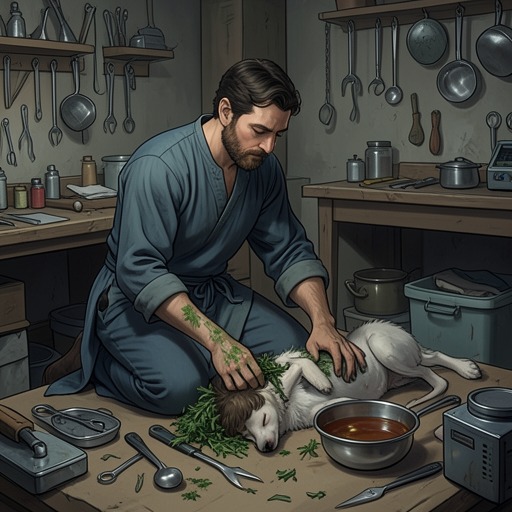
Glefald has struggled for years with an unknown disease that causes difficulty breathing and occasional coughing of blood. Malthios identifies it as a demon-made disease that causes rot in the lungs. The illness is incurable, but Theo manages to heal its worst effects and develops an infusion that can be added to boiling water, producing a healing steam that slows the rot’s return. This treatment does not restore Glefald to health; it buys time, making the healer’s work an act of resistance against an ending that cannot ultimately be reversed.
Theo’s connection to Glefald is therefore shaped by both professional responsibility and guilt. Theo feels responsible whenever he sees the elf, even though neither the disease nor its demonic origin is his fault. The guilt becomes especially acute when Theo avoids visiting the Watchtower because of Hayden’s hostility. During one visit, Theo discovers Glefald skeletal beneath a quilt, pale against the pillow, with a burner and boiling pot sending steam through the room. Micah has been caring for him, but the severity of the relapse is unmistakable.
Theo reacts with anger because Glefald has concealed how close he is to death. He tells the elf that the lung rot could not have become so severe overnight and accuses him of keeping silent. Beneath the anger is self-condemnation: Theo believes he should have noticed the deterioration sooner and connects Glefald’s suffering to the fact that he is sheltering Malthios, the being responsible for the disease’s existence. His healer’s burden becomes inseparable from his secret identity as the Demon King’s host. Caring for Glefald does not erase that contradiction, but it gives Theo a concrete way to oppose the harm associated with Malthios.
Final Illness and Death
After the Hero’s party leaves, Theo checks on Glefald every other day. The elf’s condition improves slowly under Theo’s magic, yet he remains bedridden. The treatment extends the period Theo originally estimated as one month to almost twice that length, but Glefald’s decline eventually becomes unmistakable. He tells Theo that he will soon choose a day to die if the lung rot does not take him first. Isabelle plans to tell Leafel’s people when the end is near so that they can say goodbye, while Glefald resists having the Watchtower overwhelmed by well-meaning visitors every day.
Micah regards Glefald as a father. The young cat mage explains that Glefald has only a few days left, that Micah used to help him with chores while not on patrol, and that the loss of his ability to leave bed has forced Micah to manage those tasks alone. Glefald’s illness therefore reaches beyond the patient himself: it alters the daily life of the youngest member of the local adventuring party and exposes the emotional family formed inside the Watchtower.
Glefald dies three days later. Theo spends almost twenty-four hours at the Watchtower, easing the elf’s suffering and watching him gradually fade. Muffins the cat remains at his side, while Isabelle, Micah, and Cade come and go with food and other necessities. Hayden stays in a chair beside the door as if standing guard, his expression more solemn than Theo has ever seen. At dawn, Theo notices that Glefald’s chest has stopped moving and tells Hayden that he is gone. Hayden thanks him for his work as Healer Theo and undertakes to inform the others. The death is quiet, prolonged, and communal rather than violent, and its duration makes visible the care required when healing can delay death but cannot defeat it.
Funeral, Memory, and Legacy
The funeral takes place the following day. Whereas most burials in Algeya are bonfires intended to free the departed soul through smoke and sparks, Glefald requests burial in the earth with a tree planted over his body so that his remains will nourish new life. The people of Leafel honor this traditional elven wish. His grave is placed across the road from the Watchtower, allowing the future tree to become a second guardian of Leafel’s entrance.
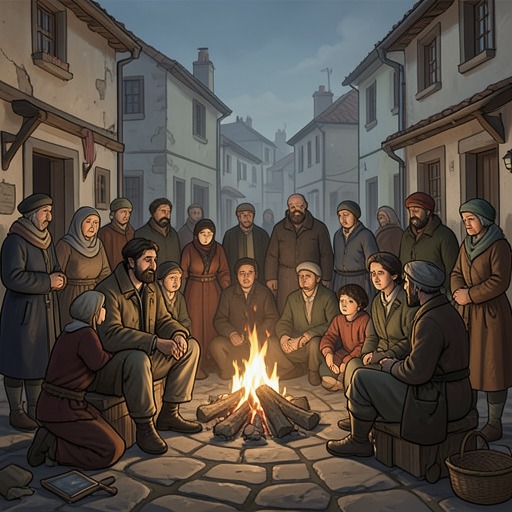
The funeral gathers the village and the entire adventuring party around the Watchtower’s threshold. The party lowers Glefald into the ground, with Micah standing beside the grave because the cat mage is too slight to help with the descent. Everyone takes a turn adding earth, including Theo when Cade silently offers him the shovel. Liffey, Raf’s wife and the village’s only other elf, sings in her own language after the sapling is planted. Theo cannot understand the words, but he understands the emotion, and he touches the Arriss Pendant at his neck while hoping that Glefald has found peace after so much suffering.
The location of the grave transforms Glefald’s guardianship rather than ending it. The Watchtower remains a place of defense, but the tree will eventually stand beside it as a living memorial, extending Glefald’s role into the village’s future. The choice also contrasts with the destructive associations surrounding Malthios and demon-made disease: Glefald’s death is returned to earth and made into the beginning of another life.
Relationship with Theo and Narrative Significance
Glefald’s relationship with Theo develops through repeated care rather than dramatic declarations. Theo first encounters him as a guild official and local observer, then becomes the healer responsible for slowing an incurable disease. Glefald’s willingness to accept treatment, his decision to disclose the nearness of his death, and the trust shown by allowing Theo to remain at his bedside make the Watchtower one of the places where Theo is treated as a responsible member of Leafel rather than as a dangerous secret.
After the funeral, the adventuring party lays out the knitwear Glefald made over the years so that villagers can choose mementos. Isabelle gives Theo a scarf Glefald had made especially for him and intended as a solstice gift. The wool is dyed the same grey-green as Theo’s eyes and is notably soft when he takes it. The scarf is more than a keepsake: it is evidence that Glefald had imagined Theo’s continued presence in the village and had included him in the ordinary cycle of gifts, seasons, and belonging.
Glefald’s death also sharpens the novel’s contrast between chosen community and imposed identity. Theo believes that no amount of friendship can save him if people discover that he is Malthios’s host, and Cargo later directly asks whether he will tell the others that he is demon spawn. Yet Glefald’s final gift comes from a relationship formed before the village knows the whole truth. His life shows Theo the obligations of care; his death shows the limits of healing; and the scarf preserves the possibility that affection can survive fear, secrecy, and loss. In a story where the capital, the court, and the Hero’s duty treat people as replaceable instruments, Glefald’s Watchtower offers another model of protection: patient, local, handmade, and carried forward by those who remain.