Glefald’s Terminal Relapse
The Reincarnated Demon King's Host Just Wants to Live in Peace, But the Hero Won't Leave Him AloneGlefald’s Terminal Relapse is the deathbed diagnosis that turns an apparently routine visit into a reckoning with irreversible illness. When Theo reaches the Watchtower, he finds Glefald skeletal beneath a quilt, coughing through the night and surrounded by steam from a boiling pot. Theo’s healing knowledge identifies what Glefald has concealed: the rot in his lung has returned so severely that death is near. The event binds medical failure, personal guilt, and farewell preparation together, while showing that Theo’s role as a healer includes witnessing suffering that magic cannot ultimately remove.
Causes and Background
Theo’s visit begins as an ordinary errand. He has brought a bottle of oil for Glefald and carries a basket of food for a picnic, with some of the load slung over Cargo’s flank. He has delayed visiting because Hayden’s presence makes the Watchtower emotionally difficult for him, and that avoidance has consequences when Micah answers the door and reports that Glefald has been coughing all night. The relapse is therefore discovered not through a summons but through Theo’s belated return.
The Watchtower’s treatment is already under way when Theo arrives. A small burner warms a pot, and steam drifts through Glefald’s room while the elf lies pale and skeletal against his pillow. Glefald admits that this is not his first turn of illness, but the severity of his condition makes clear that the current episode is not a minor recurrence. Theo’s healer’s instincts take control immediately: he leaves his basket outside with Cargo, follows Micah upstairs, and begins examining Glefald with magic.
Diagnosis and Immediate Care
Theo asks whether Glefald intended to send for him while moving his hand slowly above the elf’s chest and lighting the room with magic. He orders Micah to prepare throat-cure tea with plenty of honey and a splash of whiskey, then confronts Glefald with the conclusion he can no longer soften: Glefald is dying, and the lung rot did not simply grow back overnight. The accusation carries anger because Glefald knew the danger and said nothing, but it also exposes Theo’s self-reproach. He believes he should have noticed the deterioration sooner and blames himself for staying away.
Glefald asks how long he has. Theo answers with a brutally short estimate: a month, if that. The precision is not comforting, but it gives the dying elf a limited period in which to make practical decisions. Theo offers to inform Hayden and the others, yet Glefald refuses that immediate intervention, choosing to tell them himself that night and to send a message to the Adventurer’s Guild requesting a replacement for his post.
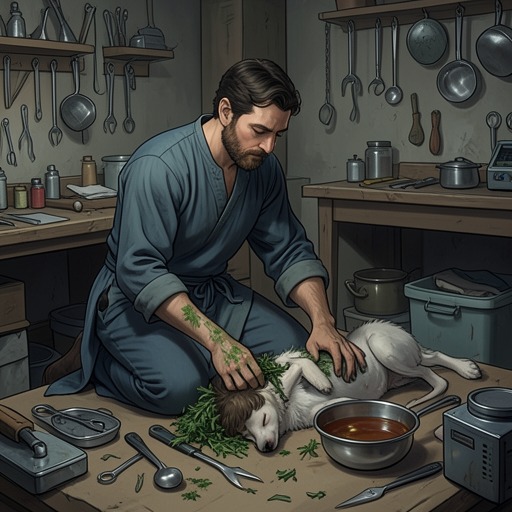
Theo cannot reverse the illness, but he can reduce its pain. He advises Glefald to keep adding the oil to the steam, explaining that it will ease the cough and make breathing less painful, and tells him to send for help if the pain becomes too severe. The treatment is modest beside the prognosis, but its modesty is the point: Theo’s magic and medical skill remain meaningful without becoming a cure for death. Glefald’s room contains both care and defeat, with the steam offering temporary relief while the disease continues toward its known end.
Glefald’s Farewell Preparation
The diagnosis immediately changes Glefald’s relationship to the Watchtower. He does not merely receive treatment; he begins arranging what will happen after his death. His message to the Adventurer’s Guild will request a replacement, while his personal promise to tell Hayden and the others that evening gives him control over how his condition is disclosed. The event thus preserves Glefald’s agency even as his body loses strength.
A black-and-white cat named Muffins enters the scene as another part of the life Glefald is preparing to leave behind. Muffins has lived in the Watchtower since she was a kitten, and Glefald jokes that he hopes his replacement will like cats. Theo reassures him that the others will not let anything happen to her. The detail makes the impending vacancy concrete: Glefald is not only leaving a duty, but also a familiar room, a dependent animal, and a small community whose care must continue without him.
Glefald’s gratitude gives the scene its emotional counterweight. After Theo promises continued help, Glefald tells him that he is lucky to have met him. Theo is unable to remember leaving the Watchtower, collecting his basket, or walking back to his shop. The diagnosis has therefore produced a second shock beyond the medical fact itself: it strips ordinary movement of meaning and leaves Theo suspended between professional composure and grief.
Theo’s Guilt and the Limits of Healing
Theo responds to Glefald’s relapse with disproportionate self-condemnation. He sees his absence as a failure of duty and believes he should have caught the deterioration at its beginning. The guilt becomes still more severe because he is sheltering the being responsible for the elf’s suffering: Malthios, the Demon King, lives within Theo as his host. Theo’s private logic turns the relapse into an indictment of his entire existence, extending from one missed visit to the belief that he deserves to die for protecting the source of Glefald’s illness.
Malthios interrupts that descent, growling at Theo so loudly that he flinches. Their shared body makes the crisis structurally intimate: Theo cannot regard the responsible power as a distant enemy, because Malthios is present inside him and can answer his self-hatred. Yet the event does not erase responsibility or cure the disease. It instead establishes the contradiction that defines Theo’s healing burden. He can diagnose, soothe, and accompany; he cannot restore a ruined lung to health or make mortality obey compassion.
The relapse also exposes how Theo’s protective walls are failing. Before reaching the Watchtower, he has been trying to remain emotionally detached, but the villagers’ affection and physical embraces have already begun to unsettle that isolation. Glefald’s frailty and final thanks make detachment impossible. Theo’s professional response becomes an expression of attachment, and his failure to save Glefald becomes painful precisely because Glefald is no longer merely a patient.
Consequences and Narrative Significance
Glefald’s Terminal Relapse establishes a clear countdown of approximately one month and initiates the process by which the Watchtower will require a replacement. It also places Hayden and the other members of the local community before an impending loss that Glefald intends to announce himself. The consequences are administrative, domestic, and emotional at once: a post must be filled, Muffins must be protected, and the people connected to Glefald must prepare for his absence.
As a turning point, the event contrasts with the later political crisis surrounding Theo’s identity. Theo fears that no amount of friendship will save him if anyone discovers what he is, while Glefald’s bedside scene shows friendship operating in the face of a different kind of inevitability: it cannot prevent death, but it can make suffering less lonely and preserve a person’s choices. This distinction becomes central to Theo’s developing understanding of care.
The event also anticipates the novel’s broader challenge to heroic and dynastic expectations. Luc later rejects the demand that he continue the Hero’s bloodline and chooses a peaceful life with Theo, declaring that people born with the Hero’s gift should be able to choose their fate. Glefald’s diagnosis supplies an earlier, quieter version of the same conflict with imposed roles and limited time. Against institutions that treat people as replaceable—the Watchtower can receive a replacement, and the Hero’s system can raise another child—Theo and Glefald insist on the irreducible value of one particular life, even when that life cannot be prolonged.