Khal
The Reincarnated Demon King's Host Just Wants to Live in Peace, But the Hero Won't Leave Him AloneKhal is the half-orc warrior of Luca’s Hero’s Party, recognized by his tusklike lower fangs, reddish skin, unusual strength, and exceptional resistance to poison. He first appears as the party’s gravely poisoned companion, carried into Theo’s cramped potion-room kitchen and laid across a massive oaken table. His recovery establishes him as more than a powerful fighter: Khal is a dependable member of the group whose endurance, practical care for others, and hope for a more integrated society give the party a durable moral center.
Identity and Introduction
Khal is introduced among Luca’s companions when Luca presents the party to Theo as Khal, Avery, Emi, Genevieve, Bryony, and Wicker. Cargo, the party’s giant hog, immediately adds himself to the introduction after complaining that the others always forget him, placing Khal within an unusually broad traveling fellowship that includes both humanoid adventurers and a speaking animal companion.
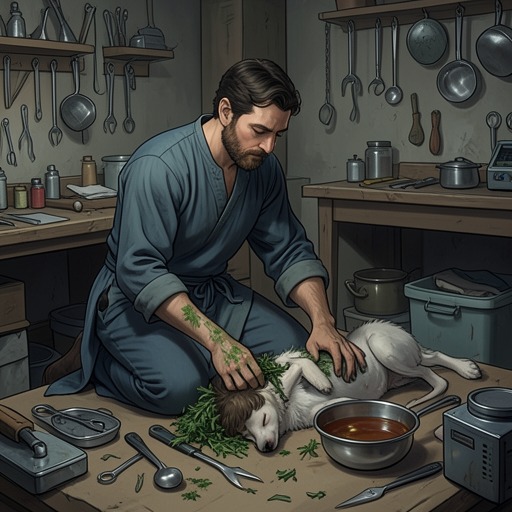
Khal’s first major scene is defined by bodily danger. The party brings him to Theo after a basilisk attack has left him poisoned, and the healer’s kitchen is too small for the crowd and the enormous hog. The group sweeps Theo’s cooling dinner onto the floor to place Khal on the table, whose oak slab groans beneath his weight. Theo notices Khal’s tusklike fangs and reddish skin and identifies him as partly orc, reasoning that the hardy race does not succumb to poison quickly. Khal’s mixed heritage is therefore linked from the beginning to survival rather than monstrosity: the trait that marks him as different is also what gives him time to be saved.
Role in the Hero’s Party
Khal’s recovery is one of the party’s immediate practical priorities. The poison cannot simply be slowed by Avery and Veiv, so the group travels to the nearest town in search of a healer. Theo removes the poison, later explaining that Khal still requires an antidote infused into his treatment to address what remains in his body. Khal responds with direct gratitude, lightly brushing Theo’s hand and promising that he hopes to repay the healer one day. The gesture turns medical rescue into a lasting bond of obligation and appreciation.
By the following morning, Khal is well enough to sit at the Broken Blade and consume a meal described as a hog’s weight in bacon and eggs. The comic abundance of that breakfast does not erase the seriousness of his earlier poisoning; instead, it gives visible form to his return to strength. The party’s readiness to resume its journey depends partly on this restoration, and Khal’s appetite becomes a concrete sign that the poison no longer controls him.
Khal also functions as a disciplined protector during travel. When the party runs from pursuing danger, he should be able to outpace much of the group, yet he shortens his stride to remain beside Veiv, just as Luc restrains his own pace to stay with Theo. The choice reveals a recurring principle in Khal’s conduct: physical superiority is not treated as permission to abandon slower companions. His strength is valuable precisely because he uses it within the formation of a group.
During the party’s escape, Khal catches Wicker when the halfling falls, leaving Wicker perched on his shoulder like a crow. The image combines strength with improvisational tenderness. Khal is not merely the person who holds a defensive line; he is also the companion trusted to catch another member in motion and carry him when necessary. Later, when the party reflects on the painful circumstances that brought Theo to them, Khal says that everyone is happy Theo is there. His response frames suffering as the cost of arrival rather than a reason to reject the newcomer.
Combat and Community Vision
In battle against weak Demonkin, Khal occupies one of the party’s defensive positions. The group uses a practiced formation: Avery, Emi, Veiv, and Cargo remain in the center to support the magical attacks; Khal, Luc, and Wicker each defend a side; Bryony supports the mages with her bow; and Theo takes a shield position beside Luc and the other defenders. Khal’s placement shows that his role is tactical as well as physical. He protects the formation’s vulnerable edges while allowing the spellcasters and ranged fighter to work from relative security.
His importance is consequently not reducible to half-orc strength. The party’s survival depends on coordination among different bodies, abilities, and species, and Khal embodies the defensive labor that makes that coordination possible. The same mixed structure that includes a half-orc, a dwarf, a halfling, an elf, human members, a cat mage, and Cargo also allows each member’s distinct capacity to become part of a collective method.
Khal’s political hopes extend this principle beyond the party. He wants to build a mixed community where people from his mother’s side can live alongside other races. He explains that orcs are reclusive and therefore often receive a bad reputation, although they are in fact deeply community-driven. His proposed settlement would give orcs a place to build alongside other peoples, improve their public image, and perhaps even secure orc representation on the council. The plan makes Khal an advocate for structural inclusion rather than a character seeking only personal acceptance. He imagines architecture, shared residence, public reputation, and political participation as connected forms of belonging.
Relationships and Loyalty
Khal’s closest demonstrated relationship is with Veiv. While running, he deliberately matches her pace, refusing to let his greater speed separate them. Their partnership is also visible in the later departure from Leafel, when Veiv is heavily pregnant with twins and has difficulty walking. Khal gently lifts her onto her pony before she is sent home through a portal opened by Micah, Wicker, and Theo, with Malthios lending mana and technique to make the difficult transportation possible. His care is physical, attentive, and unshowy: he adjusts the journey to Veiv’s condition and handles the immediate burden himself.
Khal’s relationship with Theo begins through rescue but develops through reciprocal regard. Theo keeps treating the remaining effects of the basilisk poison rather than assuming the initial antidote has solved everything, while Khal answers the care with thanks and an expressed wish to repay it. When Theo returns with the rest of the party, Emi and Veiv help with Khal’s recovery and the group assists him to the waiting cart and horse. Khal is thus not restored in isolation; his healing is folded into the party’s shared labor.
His connection to the wider group is similarly practical. He eats with them, runs beside them, fights within their formation, catches Wicker, and accepts the difficult circumstances that accompany Theo’s arrival. These actions establish loyalty through repeated participation rather than through grand declarations. Khal’s place in the party is made visible whenever the group must move, defend itself, treat an injury, or carry someone who cannot continue alone.
Change, Departure, and Narrative Significance
The evidence surrounding Khal emphasizes continuity more than a dramatic transformation. He moves from near death under basilisk poison to renewed appetite, travel, combat readiness, and responsibility for others. His recovery is not simply a private medical success; it allows the Hero’s Party to resume its mission and confirms Theo’s reputation as a healer whose work changes the party’s immediate future.
Khal’s later departure from Leafel creates a quieter reversal. The warrior who has repeatedly supported the party must now accompany Veiv through a physically demanding pregnancy and return home with her and Cargo. The portal journey is made possible by cooperation among three magic users and the additional mana of Malthios, a former Demon King. Khal’s exit therefore preserves the book’s pattern of interdependence: even a powerful warrior depends on healers, mages, companions, and former enemies when circumstances exceed individual strength.
The contrast between Khal’s mixed-community ambition and the world’s racial hierarchy gives his character broader significance. Demons are arranged through levels of power, from weak Demonkin to Novices empowered by a Demon Lord and then Demon Lords who ascend through massive slaughter. Against that violent hierarchy, Khal imagines a community built through shared living and public inclusion. His half-orc identity is not treated as a problem he must conceal, nor as a token of simple harmony. It becomes the basis for a political argument: reputations can be changed by sustained association, communities can be deliberately built, and difference can be made ordinary through common life.
Khal consequently represents the Hero’s Party at its most concrete and generous. He is the companion who survives poison because his body is hardy, eats enough to make recovery unmistakable, protects the party’s flank, catches a falling halfling, matches Veiv’s pace, and carries her when pregnancy makes walking difficult. His proposed mixed settlement extends those habits of care from a traveling party to a society. In a story shaped by heroic duty, demon hierarchy, bloodline expectations, and the struggle to choose one’s future, Khal offers another model of heroism: strength used to keep others within reach, and belonging designed rather than inherited.