Malthios
The Reincarnated Demon King's Host Just Wants to Live in Peace, But the Hero Won't Leave Him AloneMalthios is the former Demon King of Algeya and the soul inhabiting Theo’s body, a figure whose survival converts the story’s public war between Humans and Demons into a private conflict over shared identity. Once defeated by the Hero Eliza after centuries of threatening Algeya, he preserves himself through a soul-transfer spell and awakens inside a human child. His presence first appears as a hidden danger, but his long coexistence with Theo gradually exposes a wounded history, a fierce instinct to protect, and the possibility that even a being defined by conquest can choose connection over domination.
Identity and Origins
Malthios was the sworn enemy of the people of Algeya for centuries. He believed he would have conquered the land had the Hero Eliza not been born and defeated him with her party. His death did not end his ambition: according to the account remembered by Theo, Malthios cast a spell before dying that transported his soul into another body so that he could survive and continue his reign of darkness. The child’s first awareness of him is therefore inseparable from legend, fear, and the suspicion that the defeated Demon King has not truly disappeared.
The voice inside Theo did not identify itself immediately. Theo needed until the age of three to understand that the presence belonged to Malthios. That delayed recognition gives the former king an unusual beginning: he enters the narrative not as a visible monarch but as an intelligence concealed within a child, listening and waiting while Theo grows. His secret is dangerous because discovery would not merely expose an unusual condition; it would reveal Theo as the host of Algeya’s most hated enemy. Theo understands that friendship alone would not save him if anyone learned what he was, making Malthios’s existence the source of both supernatural danger and social stigma.
Malthios’s own childhood was marked by deprivation rather than care. He cannot remember his parents’ faces, and the society of Demons values magical potential over blood or parental attachment. His back bears scars from pain he did not understand, and he remembers feeling as though he had done something wrong without knowing what that wrong was. He even wishes that he had been abandoned to die at the beginning rather than preserved for a life shaped by suffering. The future Demon King thus emerges from a culture in which power replaces affection, and his later obsession with strength is presented as both a personal survival strategy and an inheritance from his society.
Soul, Body, and Rebirth
Malthios’s first experience inside Theo is bodily before it is political. When he finally awakens, he feels suspended and unable to move, surrounded by thoughts and emotions that are not his own. He sees the beams of a cottage roof as though looking through a window, while a human woman leans over him and a chubby hand reaches for her braid. The scene establishes the central condition of his existence: he remains conscious, but Theo’s body is the only body through which he can perceive the world. The former ruler who once commanded an army is reduced to an inward witness of infancy and human care.
The contrast between Malthios’s former authority and his new dependence becomes especially stark when his power returns. During one reappearance, mana bursts through Theo’s body with the force of a dam breaking. Theo is driven to his hands and knees as horns grow from his head and wings unfold from his shoulders. On another occasion, Malthios takes control directly, flooding their body with mana while horns and wings expand, a black sword appears in their hand, and blue flames run over their limbs. The transformation is not merely an external disguise. It makes the shared body visibly register the Demon King’s presence, turning a concealed soul bond into a public manifestation of power.
The transformations also reveal that Malthios and Theo do not possess equal control at every moment. When Malthios takes over, he can move their limbs and wield their magic as a single combat body, while Theo remains aware of what is happening. During the confrontation with Nissle, the Demon King’s power surges through Theo, claws form, and one hand seizes her by the throat before slamming her into the ground. Theo feels Malthios smile through their mouth as they look down at her. The scene exposes the terror of shared embodiment: Theo is not simply carrying a dormant power but can be forced to experience the consequences of another will acting through his body.
Yet the bond is not only a mechanism of possession. When Theo is overwhelmed by danger and shadows close around them, Malthios assures him that he is still present and that he will protect him. His power can therefore appear as both violation and refuge, depending on whether Malthios acts against Theo’s will or in response to Theo’s vulnerability. This instability makes their relationship more complex than a simple host-and-monster arrangement. Theo must fear what Malthios can do, but he also comes to depend on the presence that shares his body.
Rise of the Demon King
Malthios’s ascent is tied to grief as much as to ambition. He tells Theo that he once had friends and that Demons were capable of friendship despite the assumptions others made about them. Those friends died to a Hero’s blade, and their deaths drove the actions that eventually led to his ascension as Demon King. Malthios believed his emotions had died with them, suggesting that his conquest was not born from abstract evil alone but from bereavement hardened into purpose. The loss of companionship becomes the emotional wound beneath his public identity.
His rise changes his physical form as well as his status. After killing a Demon Lord and witnessing the violence surrounding that transformation, his mana spikes as it had when he first became a Demon Lord. Blood on his skin and clothing sinks into him, his wings open to their full length, and glossy black feathers turn dark blood red before those watching. The image connects elevation with violence: Malthios’s advancement is written onto his body through blood, and the spectacle is recognized by Demons who have anticipated what his killing of his own kind signifies.
As Demon King, Malthios sits on a throne wearing a crown made from obsidian shards. His first month of rule proceeds more smoothly than he expects, despite beginning with the cold-blooded killing of a Demon Lord and a dozen Novices. He understands kingship as an enlarged version of command; ruling a kingdom is, in his view, not fundamentally different from leading soldiers, only conducted on a larger scale. This perspective clarifies the danger of his reign. He does not abandon the commander’s logic when he gains the crown; he expands it, treating political order as an extension of military authority.
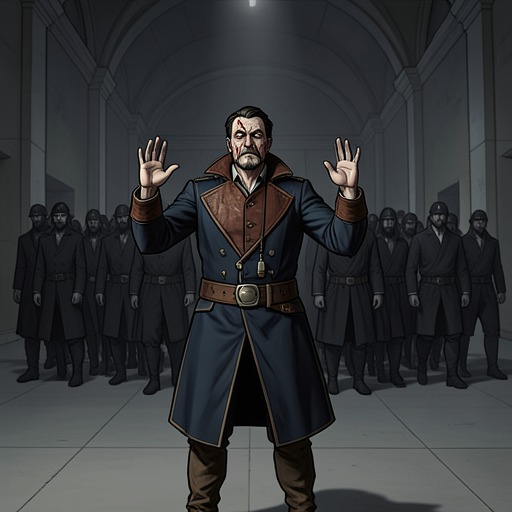
His later return to the physical world carries the same terrifying force but a different moral direction. When power floods through Theo during the confrontation with Tyraz, wings unfold, horns grow, fingertips curl into black claws, and the magical shock throws Tyraz backward. Malthios addresses the gathered Demons as someone returning from apparent death, demanding recognition from the forces that had continued acting in his absence. The scene restores his old presence while also placing him in conflict with the order he once led.
Malthios ultimately declares that he intends to end demonkind’s organized order so that Algeya can finally know peace and no more children will lose themselves to become heroes. The statement reverses the purpose that once defined him. The former Demon King no longer seeks to preserve his kingdom or resume conquest; he seeks to dismantle the system that turns children into instruments of war. His solution remains drastic, but its target has changed from the survival of his own power to the prevention of future sacrifice.
Theo and the Hidden Life in Leafel
Malthios’s years with Theo pass more slowly than any period he can remember, particularly after they flee hero training and settle in Leafel. The village offers a form of peace that unsettles him because its people show genuine kindness toward Theo, the prickly healer. Malthios watches Theo gradually become happier even when Theo does not openly display that change. The observation matters because Malthios, who once measured life through power and command, begins to value a transformation that cannot be achieved by force.
The people surrounding Theo also expose what Malthios has never received. Imani and Dale’s fussing makes him uncomfortable because he has no experience of parental love. He remains wary of friendship and of putting down roots, fearing the consequences if their identity is discovered. His fear is not irrational: the possibility of exposure could bring imprisonment, forced service, or death. Even while he sees Theo building a life in Leafel, Malthios tries to preserve emotional distance as a defense against losing it.
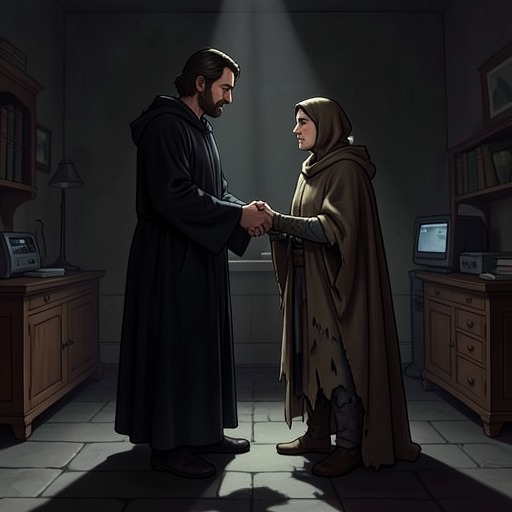
That defensive distance begins to fail when Malthios explains what Theo means to him. He says that he wants to protect Theo, that Theo reminds him painfully of the friends he lost, and that the bond resembles what being an older brother might feel like. He wants Theo to be safe and happy, and he admits that he tried to turn Theo away from the Hero because he feared the Hero would hurt him. Malthios’s protectiveness is therefore entangled with unresolved grief, but it is still a genuine movement away from possession and toward care.
The danger of disclosure remains present in Theo’s choices. When a portal offers a route toward those in power, Theo understands that crossing it will end his autonomy: authorities would know who he was and where he lived, and Camden would force him into the Hero’s party, where the truth could emerge at any moment. Malthios’s concern intensifies Theo’s anxiety, but Theo goes because Luc may die if he refuses. The decision shows how the shared life is governed by competing obligations. Concealment protects Theo and Malthios, while love and loyalty repeatedly draw them toward risks that could expose them both.
Public Return and Moral Reversal
Malthios’s reappearance makes the hidden history of Theo’s body impossible to treat as a private secret forever. When he takes control during the confrontation with Tyraz, the transformation announces him through horns, wings, black claws, and a blast of magic powerful enough to send Tyraz flying. His first words to Tyraz recall the apparent death from which he has returned and force the surrounding Demons to confront the former ruler they had continued to fear, serve, or replace. The scene is a resurrection in political as well as supernatural terms: the old Demon King comes back, but not to reclaim the order that once gave his power meaning.
Instead, Malthios declares that he will end demonkind’s organized order so that Algeya may finally know peace and children will no longer be lost by being made into heroes. The declaration turns his history against itself. The ruler who once sought conquest now identifies the cycle of Demon power and Hero sacrifice as the greater enemy. His proposed solution remains destructive, and it cannot erase the blood attached to his reign, but its aim marks a decisive ethical reversal: Malthios begins to use the authority of the Demon King to abolish the conditions that produced him.
Disclosure, Judgment, and Recognition
The revelation of Malthios’s identity changes the terms of every relationship around Theo. Theo’s fear that friendship cannot save him if anyone learns what he is is realized in the formal prospect of the Trial of the Demon King’s Host. The trial names the political problem directly: Theo is not judged only as an individual, but as the body carrying the soul of Algeya’s former enemy. The host bond makes guilt, danger, and personhood difficult for the surrounding authorities to separate.
Against that judgment, Leafel answers with collective presence rather than abstract argument. A mirror portal opens to the village square, where Micah stands at the front with his staff raised, joined by Imani, Dale, Dmitri and his parents, Nib, Amaya, and the people of Leafel. Hayden steps beside Micah and bows. Their appearance does not deny what Malthios has done; it demonstrates that Theo’s life with Malthios has produced bonds strong enough for a community to stand publicly against the demand that the host be reduced to the Demon King inside him.
Theo eventually presents the truth without disguising Malthios as a mere spell or passive curse. He introduces him plainly to the people around him, saying, "All right," before identifying the presence within him as Mal. The disclosure changes Malthios from an invisible threat into someone who must meet the judgment of living people face to face. It also gives Theo control over the story of his own body: rather than allowing officials or enemies to define the host, he names the shared life himself.
Life After the Crown
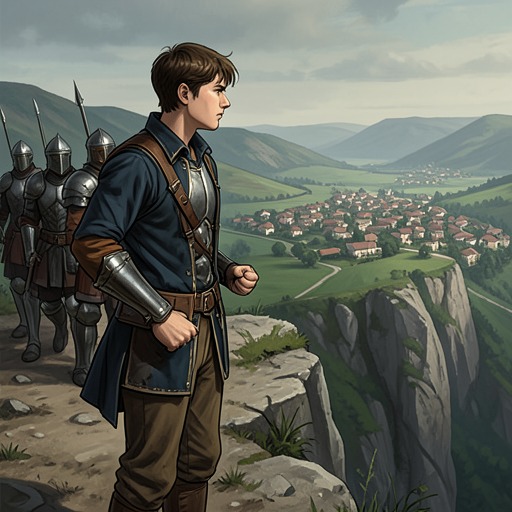
After the trial and the collapse of his former dominion, Malthios stands in the doorway of the healer’s cottage and looks toward the road leading to Leafel. For the first time in thirty years, or perhaps longer by his own honest reckoning, he has the freedom to decide what to do. The image is deliberately smaller than his throne, crown, or battlefield transformations. Freedom is no longer represented by armies or territory; it is the ability to take a first step without a kingdom demanding a direction.
That freedom is still shared. Theo remains present in Malthios’s mind and gently tells him to start small. Malthios experiences being alive as something astonishing, but he cannot immediately accept the welcome offered by the people of Leafel. When Amaya recognizes him as Mal and acknowledges that sharing one body must be challenging, he hopes he can live up to the trust being shown to him while admitting that he does not deserve their welcome after everything he has done. His remorse is therefore not presented as a clean absolution. The hospitality he receives remains meaningful precisely because it meets a person who still remembers the scale of his violence.
Malthios also has to learn ordinary cooperation. During another walk along Leafel’s borders, Hayden’s voice irritates him, and his old impatience survives even after his political transformation. The detail keeps his redemption from becoming a disappearance of personality. He is still proud, difficult, and capable of anger; what changes is not that these traits vanish, but that they no longer automatically determine his choices or justify domination.
Conflict at Leafel and Chosen Connection
Acceptance remains contested beyond the village. A male voice condemns the presence of a Demon beside the people of Leafel and calls Malthios not merely a Demon but the King of them all, declaring that the group has come to rid Algeya of its filth. The accusation compresses Malthios’s entire past into a name and a category. To the speaker, transformation, remorse, and shared life cannot outweigh the historical fact of his kingship.
Malthios responds to the danger by taking flight with Hayden and landing near the Leafel Watchtower, where the Leafel adventurer party, the Hero, Khal, and Veiv are preparing an assault. Luc reacts with alarm, while the Hero sees Malthios first and moves toward him with concern turning into anger. The encounter shows how precarious the new peace remains: even among allies, Malthios’s appearance can be read as an attack, and his body still carries the unmistakable signs of the power that once threatened Algeya.
Yet the day does not end in isolation. Malthios feels Theo take control and gratefully withdraws, resting after the strain of the confrontation and an awkward evening. The Hero’s face brightens when Theo returns, and the Hero pulls him into an intense kiss. Malthios does not complain, as he might once have done; instead, he is glad to rest. The moment is a quiet measure of his change. He can yield the body without treating the surrender as defeat, because Theo’s happiness is no longer a rival to his own existence.
Malthios recognizes that his former friends once had to force their way into his life, just as the people of Leafel and Luc forced their way into Theo’s. He has never been sociable, and his history has taught him to expect attachment to end in blood. Nevertheless, he can now acknowledge the value of connection and of a purpose not stained with blood. His survival inside Theo therefore becomes more than the continuation of an old tyrant: it becomes an unfinished practice of sharing, accountability, and belonging.
Narrative Significance
Malthios embodies the story’s central challenge to fixed moral identities. He begins as the Demon King remembered through centuries of fear, a conqueror whose soul survives by entering a human child. His body, voice, memories, and powers repeatedly place Theo between categories that the political world wants to keep separate: Human and Demon, victim and threat, child and vessel, healer and weapon. The shared body makes those contradictions physical. Theo can be endangered by Malthios, protected by him, and forced to confront the fact that both experiences are true.
His arc also reverses the conventional return of the defeated tyrant. Malthios does return from apparent death, but his return does not restore the old kingdom. The power that once made him Demon King reappears through Theo’s horns, wings, claws, sword, flames, and surging mana, while the purpose attached to that power changes. His final freedom is modest and relational: he stands at the cottage door, begins with small choices, accepts that welcome must be earned, and rests while Theo returns to the people they love.
For that reason, Malthios’s ending is neither a denial of his crimes nor a simple restoration of innocence. It is a form of coexistence in which the former Demon King remains present, remembers what he has done, and learns to inhabit a future that cannot be ruled by force. His most important victory is not the recovery of his throne or the display of his transformed body. It is the possibility that the soul once defined by conquest can remain alive without making every life around it submit.