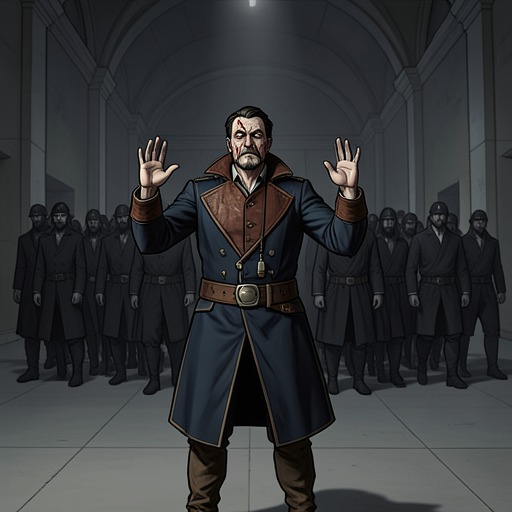
Malthios Defeats Tyraz and Destroys the Demon Fortress
The Reincarnated Demon King's Host Just Wants to Live in Peace, But the Hero Won't Leave Him AloneMalthios Defeats Tyraz and Destroys the Demon Fortress is the climactic reversal of the conflict between Malthios and Tyraz. In the courtyard of the Demon King’s Castle, Malthios reappears as the former ruler’s living counterpart and host-bonded self, defeats the Demon Lord in a public duel, takes back the crown, and immediately rejects the continuation of demon rule. The victory ends not merely with Tyraz’s death but with the destruction of the fortress and Malthios’s declaration that organized demonkind must end.
Causes and Background
The confrontation grows out of a political vacuum created by Malthios’s earlier defeat. Although Malthios had been overthrown, remnants of his army remained scattered across Algeya under the command of surviving Demon Lords, while the Hero’s party continued protecting ordinary people from them. The Demon King’s Castle therefore represents both the surviving center of demonic power and the unfinished history of Malthios’s reign. Tyraz’s presence makes that history personal: he is not simply an enemy occupying a vacant throne, but the Demon Lord who has taken advantage of Malthios’s absence and now seeks to make the usurpation permanent.
Malthios’s return is also inseparable from Theo. The two souls share one body, and Theo’s will has become stronger than Malthios expected. Theo has reminded Malthios that good things still exist in the world, and Theo is now the Hero’s lover as well as Malthios’s host and friend. That bond changes the meaning of power before the duel begins. Malthios does not return only to recover a title; he returns because Tyraz threatens Theo and the people Theo loves. The old Demon King’s authority is thus redirected through a relationship that the former ruler never imagined having.
The Challenge and Duel
The courtyard falls silent when Malthios rises and addresses Tyraz directly. The surviving demons tremble at the recognition of their true king, while Tyraz reacts with disbelief and asks how Malthios can be alive. Malthios answers that fate has brought him back and states that he will not allow Tyraz to continue hurting Theo and those dear to him. The exchange converts a supposedly impossible resurrection into an immediate political confrontation.
Malthios then names the terms of the reversal. He insists that Theo is not a diminutive or a possession but a brave, selfless, and kind person, and he expresses gratitude for having Theo as a host and friend. With his sword appearing in his hand, he challenges Tyraz to fight for the kingship, claiming the identity he held before his coronation: Malthios, strongest of all demons and leader of the Pentagram. He also declares that Theo’s presence has made him stronger than he was before. The challenge turns the crown from an inherited symbol into something Tyraz must defend by personal combat.
Tyraz accepts and launches into the air, his wings opening as he attacks. Malthios meets him above the courtyard, and their swords clash over the castle and surrounding mountains. Blue fire crawls across the crossed blades and burns Tyraz when it touches him, while Tyraz answers with shadows that try to entangle Malthios. Malthios repeatedly summons fire to clear them, establishing the duel’s central contrast between Tyraz’s multiplying darkness and Malthios’s controlled, destructive flame.
The fight also makes Theo’s contribution visible without separating it from Malthios’s body. Each time Tyraz’s sword cuts Malthios, Theo’s magic rises and bathes the courtyard in green, helping sustain the combatant who carries him. Tyraz’s wounds accumulate while Malthios remains dominant. Their history stretches back centuries, and the narration presents Malthios as superior from the outset; he toys with Tyraz, exposing his incompetence before the watching demons. That humiliation drives Tyraz toward desperation rather than victory.
Tyraz’s desperation takes the form of imitation. Copies of the Demon Lord suddenly emerge from the shadows with shining blades, attempting to overwhelm Malthios through numbers and confusion. Malthios responds by letting blue flames run over his wings until the red feathers glow, then spins into a tornado of fire that burns through the copies. The maneuver recalls one of Kamil’s favorite techniques, transforming a remembered bond with a lost companion into an element of the present battle. Malthios follows the attack by concentrating mana around his blade and cutting through the air; the real Tyraz barely evades the strike, and the impact destroys a tower of the Demon King’s Castle.
The duel ends when Tyraz tries to reduce Malthios’s return to subservience, calling him a human’s pet and warning that mortals will hunt Theo once they learn he is the Demon King’s host. Malthios answers that he has promised to protect Theo and that his word is his bond. He then recalls the old condition attached to Tyraz’s ambition: if Tyraz attempted to take the crown, Malthios would end him. The promise becomes action when Malthios drives his sword into Tyraz’s torso, pulls it free, and lets the Demon Lord fall to the stone courtyard.
Crown, Fortress, and Consequences
Before Tyraz’s body dissolves into shadows, Malthios removes the crown from his head. The watching demons cheer the return of their true king, but the image of the crown is already unstable. Its black points reflect broken pieces of Malthios’s face, and he observes that the crown always felt heavier when it rested on his own head. The moment resembles a restoration of monarchy while simultaneously exposing the burden and damage contained in that restoration. Malthios has won the throne, yet he no longer accepts the political order the throne represents.
His decisive statement comes immediately after Tyraz’s death. Asked what will happen next, Malthios declares that he will put an end to demonkind so that Algeya can finally know peace and no more children will lose themselves to become heroes. The goal changes from succession to abolition. Tyraz’s defeat therefore does not install a renewed Demon King’s regime; it removes the last rival, restores Malthios’s authority long enough for him to dismantle the system, and recasts the former enemy as the agent of its termination.
The consequences are visible at once. Tyraz’s death breaks the magic circle imprisoning the Hero’s party, freeing the group gathered around the wounded Luc. Malthios uses shadows to transport them back to the forest, away from the castle. Soon afterward, an explosion tears through the night, and a column of blue flames rises from the Demon Fortress. Malthios feels a weight lift from him and announces that the demons have ended. The destruction gives physical form to the decision he has just made: the fortress, once a seat of power and a monument to demonic continuity, becomes the site of that order’s erasure.
Narrative Significance
The event’s strongest reversal is not simply that the defeated ruler returns and wins. It is that the expected cycle of conquest, coronation, and renewed war is interrupted by an act of self-dismantling. Tyraz treats kingship as an object to seize and uses Theo’s vulnerability as proof that Malthios’s bond has made him weak. Malthios turns both accusations around. Theo is the source of strength rather than humiliation, and the crown becomes something to remove rather than preserve.
The scene also joins public spectacle to private transformation. The duel takes place before demons who recognize Malthios, making his victory a visible transfer of legitimacy, while Theo’s magic and emotional presence remain inside the body carrying out that victory. Malthios’s old identity is therefore neither simply recovered nor discarded. It is reworked through shared embodiment, memory of the Pentagram, loyalty to Theo, and grief for the friends whose faces return to him after Tyraz’s death.
The destroyed fortress and the later scrutiny surrounding Theo give the event a lasting cost. Malthios’s decision promises peace, but it exposes Theo as the host of the reincarnated Demon King and places their shared future under mortal suspicion. The victory closes the age of demon rule while opening the trial of the person who made its ending possible. In that sense, Malthios Defeats Tyraz and Destroys the Demon Fortress is both an ending and a threshold: the old enemy is defeated, the battlefield is erased, and the question of whether Theo can survive the political consequences of Malthios’s return becomes the next crisis.