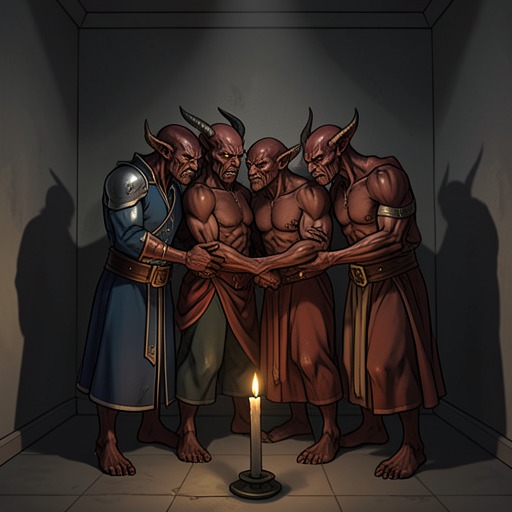
Malthios and Aym
The Reincarnated Demon King's Host Just Wants to Live in Peace, But the Hero Won't Leave Him AloneMalthios and Aym are bound first by comradeship, then by desire, and finally by loss. Within the Pentagram, Aym recognizes Malthios’s potential and accepts him into the group, while their later intimacy challenges his belief that demons are incapable of love. Aym becomes both a source of personal tenderness and the clearest proof that Malthios has something beyond power to lose.
Formation of the Bond
Malthios meets Aym when Kamil presents him to the other demons as a prospective member of the Pentagram. After the group has fought together and Malthios has demonstrated his destructive fire, Kamil asks Aym whether he is a good fit. Aym examines him carefully before judging that he has potential, and Kamil celebrates the moment by declaring the Pentagram assembled. The exchange establishes Aym as someone whose assessment matters: acceptance is not merely Kamil’s decision, but a recognition offered by the entire emerging group.
Their bond develops within a collective founded on mutual dependence. The Pentagram’s members rely on one another to survive and advance toward Demon Lord status, a principle that sharply contrasts with the competitive brutality of the Novice ranks. Aym, Torq, Foras, Kamil, and Malthios share missions, meals, training, and danger. That common life gives Malthios a form of belonging he has not previously known, even though he remains guarded and frequently chooses solitude, often spending his free time alone with a book.
Intimacy and Desire
The relationship becomes explicitly sexual after the Pentagram has risen to Demon Lord status and moved into the demon castle. The new accommodation is still the smallest in the castle, but it is a paradise compared with the Novice barracks; Malthios’s private washroom provides the setting for Aym’s unexpected visit. Aym appears in a silk robe, and the encounter moves from charged silence to physical urgency when Aym asks for whatever Malthios is willing to give. Their first sexual encounter is presented as immediate and unrestrained rather than carefully negotiated through declarations of romance. Afterward, however, Malthios remains with Aym, pulls the covers over them, traces Aym’s antlers, and hopes the experience will happen again.
The intimacy matters because Malthios has already begun to distinguish Aym from the casual sexual culture around them. Torq and Foras openly kiss after a shared meal, while Malthios watches with amusement and embarrassment. When Kamil teases him about joining them, he rejects the suggestion and insists that, if he wanted someone, it would not be either of them. He treats Kamil as something like a sibling, and the distinction makes his attraction to Aym more specific rather than merely an extension of demonic appetite. His desire is not simply sexual availability; it is directed toward one particular companion whose presence unsettles his practiced emotional distance.
Aym also notices that distance. Aym tells Malthios that although Torq, Foras, and Aym are his friends, he keeps all three at arm’s length while choosing Kamil’s company over everyone else’s. The observation exposes a pattern in which Malthios seeks attachment while protecting himself from its consequences. Aym’s directness draws him into a more vulnerable relation than he would have chosen through deliberate reflection, and the physical encounter allows feelings that he has not yet named to become undeniable through action.
Mutual Protection and Emotional Recognition
After the encounter, Aym’s attachment is not confined to private desire. When Malthios leaves a confrontation with the Commander, Aym waits outside the library with mana already sparking around their hands, prepared to come to his aid. Malthios responds by drawing Aym into a heated kiss. When Aym asks what the Commander wanted, Malthios dismisses the matter and turns his attention back to Aym. The scene reverses the usual direction of protection: Aym is not merely the person Malthios wants, but someone actively prepared to defend him.
The bond also helps Malthios reconsider the emotional assumptions of demon society and the mortals who condemn it. He knows that his parents did not love him, a conclusion suggested by the scars on his back, and he has no secure model for interpreting affection. Yet he sees the tenderness between Torq and Foras and recognizes his own feelings for the other four members of the Pentagram. Their relationships force him to question the mortal belief that demons are incapable of love. Aym is central to that uncertainty because the attraction between them develops alongside companionship, loyalty, teasing, and shared risk rather than replacing those forms of connection.
This tenderness exists under the shadow of Malthios’s hidden condition. He is secretly the Demon King’s host, and he knows that friendship cannot save him if anyone discovers what he is. Even when Malthios says that he would protect Aym, the Demon King responds that Malthios would really be protecting himself, exposing how completely self-preservation has shaped his understanding of attachment. Aym’s relationship with Malthios therefore becomes an intimacy built against anticipated betrayal and catastrophe: affection offers him belonging, but it also creates another vulnerability the world can use against him.
The Battle and Aym’s Death
The relationship ends in the battle that destroys the Pentagram. When a blast of magical energy tears across the battlefield, Aym is thrown into a tree and the transport circle disappears. Malthios survives the first impact with Torq, while Kamil manages to catch herself, but the Novices are killed and the demons are left exposed to the mortal assault. Aym rises with one wing bent at an unnatural angle, and Malthios moves toward them intending to carry them away.
Before he can reach Aym, the Hero appears beside them and drives a sword through their body. Malthios recognizes the body with devastating physical intimacy: it is the body he has known above and beneath him, a body whose strength and certainty he has experienced in private, now torn apart by the weapon. The battle narration turns his desire into grief without separating the two. He tries to scream but cannot produce a sound, and the shock briefly leaves him unable to act.
Malthios then fights the Hero while Torq and Foras attempt to protect one another. Aym’s wound is not an isolated casualty in the destruction of the Pentagram; it becomes the emotional center of the collapse of Malthios’s chosen family. The Hero cuts through Torq and Foras after Torq throws himself in front of Foras, while Malthios is forced into a desperate defense of his own life. Aym’s death thus joins intimate loss to collective devastation: the person who had accepted Malthios’s potential is killed at the moment the group’s shared future is destroyed.
Significance and Aftermath
Malthios and Aym’s relationship marks the point at which Malthios can no longer treat attachment as weakness or reduce intimacy to the ordinary sexual practices of demons. Aym is a friend, lover, and member of the group that gives Malthios a reason to act beyond solitary survival. Their bond makes his later suffering legible not only as political defeat or punishment, but as mourning for a person whose presence taught him that affection might be real.
The relationship also intensifies the tragedy of Malthios’s identity as the Demon King. He believes the demon’s power is natural within Theo’s body, yet he remains a prisoner of the host bond and of the consequences attached to his own existence. In the earlier life represented by the Pentagram, Aym’s acceptance helps him imagine a future based on shared advancement and reciprocal protection. The Hero’s sword destroys that future physically, while the knowledge that mortals regard demons as enemies turns the loss into evidence for Malthios’s growing conviction that love cannot survive the structures of demon and mortal violence.
Aym’s death therefore becomes more than a failed romance. It is the decisive demonstration that Malthios’s capacity for love has grown precisely where the world is least willing to recognize it. The relationship begins with Aym’s measured judgment that Malthios has potential, expands through shared work and unguarded desire, and ends when the body that embodied their intimacy is destroyed before him. Its arc gives emotional substance to Malthios’s later transformation: every claim that demons are empty of love is contradicted by the grief left behind when Aym is taken away.