Malthios’s Demon Army
The Reincarnated Demon King's Host Just Wants to Live in Peace, But the Hero Won't Leave Him AloneMalthios’s Demon Army is the organized military power of Malthios, the Demon King who sought to conquer Algeya and continue his reign after death through the transfer of his soul. It is not a homogeneous host: its ranks include ordinary Demonkin, magically empowered Novices, and Demon Lords whose immense power is tied to mass slaughter. Across the narrative, the army changes from an apparently unstoppable instrument of conquest into a force marked by internal bonds, battlefield uncertainty, and the consequences of its ruler’s increasingly troubled purpose.
Nature and Hierarchy
Malthios’s Demon Army operates within a demon society where blood and ancestry matter less than magical potential and military strength. Demonkin occupy the lowest position, possessing little or no mana and serving as common soldiers. A Demonkin who receives mana from a Demon Lord sponsor can become a Novice. The transformation is intensely painful, but it grants varying degrees of magical potential and formidable physical ability, making Novices the army’s ideal combatants. Above them stand the Demon Lords, who ascend after slaughtering large numbers of innocents; the act brings immense mana and the growth of wings. The still higher state of Demon King is reserved for a demon worthy of that power, and the means of attaining it are known only to Demon Lords.
Malthios’s own history exposes the human cost of this system from within. Abandoned when he was barely six, he survived by stealing food in a demon village until a Demon Lord named Fulton gathered children who had survived the gift of mana and trained them as Novices. The army therefore functions both as a system of coercion and as the only route to food, shelter, and recognition for some demon children. Malthios endured brutal training and contempt from higher-ranking Novices, while finding refuge in a library where he secretly tried to teach himself to read. His later command of armies rests on a structure that had first made him useful by subjecting his body to pain.
Command and Campaigns
At the height of Malthios’s rule, the army’s campaigns extend deep into mortal territory. The remnants of his forces remain active even after his defeat by Hero Eliza, led by the surviving Demon Lords, and the continuing danger is one reason the Hero’s party remains responsible for protecting Algeya’s common people. The political order of Algeya, in turn, has been shaped by this threat: humans and other mortal peoples have united under shared laws and cooperation partly because the demons provide a common enemy.
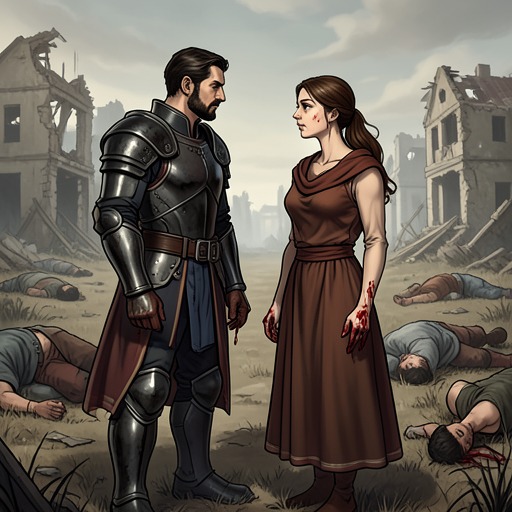
Malthios’s command is presented most clearly through the destruction of a village. Houses burn like blackened skeletons, smoke fills the air, and mortals and animals scream while those attempting to flee are killed by demon blades. The scene makes the army’s method unmistakable: terror, devastation, and the reduction of living communities to conquered ground. Yet the slaughter produces only mild satisfaction in Malthios. He regards mortals as a plague and despises their pleas, but the scene also reveals that his violence no longer gives him the fulfillment it once promised. His purpose remains conquest, while the desire that sustained it has begun to weaken with every passing decade.
The army’s command structure includes formidable Demon Lords serving as generals. During the village campaign, Keplo, one of Malthios’s four generals, asks whether the operation is complete, and Malthios orders the troops to move out. The exchange is brief, but it establishes the army as a disciplined force rather than an uncontrolled mob: soldiers receive orders through ranked commanders, and Malthios directs the movement of the entire formation from the center of the campaign.
The Pentagram Battalion
The army’s most distinctive elite formation is the Pentagram, placed in charge of a large battalion made up of Demonkin and Novices. Malthios serves as Commander, while Kamil, Aym, Torq, and Foras act as his seconds. Their unit has repeatedly destroyed towns and cities and advanced farther into mortal territory than any previous force, making the Pentagram both a military spearhead and an extension of Malthios’s personal authority.
The group’s effectiveness does not erase its intimacy. Malthios remembers Kamil’s laugh, Aym’s soft smile, Torq’s warmth, and Foras’s dry humor as the bright memories that later return to haunt him. Their closeness gives the army a counterimage to its official hierarchy: beneath the titles of Commander and seconds is a small circle whose members share warmth that Malthios finds nowhere else. The same force that carries out conquest also contains the relationships through which he can still recognize a life beyond hatred.
A mission against a small town exposes the limits of the battalion’s established tactics. The inhabitants, a mixture of mortal races, refuse to flee and fight back with axes, short swords, arrows, and even modest magic. Several Demonkin and a Novice fall. Torq, normally cheerful, recognizes that the resistance is unusual and advises withdrawing to attack from the air. Malthios accepts the danger and orders a retreat, requiring the troops to reach the transport circle within five minutes or be left behind; if necessary, the Pentagram itself will fly. Torq sounds the retreat horn, Aym opens the transport circle with glowing magic, Kamil prepares wind-directed knives, Foras gathers sparking mana, and Torq grips his war hammer while the troops converge on them.
The withdrawal shows Malthios acting as a commander concerned with preserving the force rather than merely displaying power. It also marks a reversal in the army’s usual relationship to mortals. The Demonkin and Novices have entered the town expecting terror to decide the battle, but the inhabitants’ refusal to break allows them to rally, and many Novices converge on the Hero. The army remains dangerous, yet it is no longer invulnerable; disciplined retreat becomes necessary when conquest meets organized resistance.
The Army’s Reach Beyond the Battlefield
The army’s influence extends into places that appear far removed from its campaigns. In Leafel, Theo’s knowledge of demon activity is part of the reason the town values its healer, while the local adventurer party protects the settlement from beasts and other threats. The contrast is revealing: the army’s violence helps define the wider security system of Algeya, even when no demon soldier is present. The Hero’s party is trained and eventually tasked with purging the remaining demons and protecting common people, turning the army’s continued existence into the justification for a permanent heroic military obligation.
The Demon King’s forces also remain a source of institutional fear after Malthios’s defeat. The court mage declares that a healer with Theo’s exceptional gift belongs in the Hero’s party rather than among private claimants, and the state intends to place him with the next Hero for training. This decision is presented as a response to the continuing demonic threat, but it also shows how the army transforms individual bodies into strategic resources. Theo’s healing magic is treated as something Algeya must assign to its war against demons, just as the demon hierarchy assigns mana, labor, and violence to its own campaigns.
Violence, Bodies, and Contradictions
The army’s warfare collapses distinctions between living beings and military resources. In one destroyed village, mortals and animals die together beneath demon blades, while blood sinks into the same soil. The image undercuts the ideological distance between the two sides: whatever their political or magical differences, both are vulnerable bodies in the same material world. Malthios himself observes this sameness without allowing it to become compassion. His contempt for mortal pleading and his belief that mortals are a plague make the army’s violence an expression of doctrine as well as command.
Its soldiers are likewise shaped by a system that treats pain as a route to usefulness. Demonkin can be trained as common soldiers, while Novices are created when a Demon Lord grants them mana. Their enhanced strength and magical potential make them valuable, but the process is painful and the resulting hierarchy is harsh. Malthios’s childhood demonstrates the contradiction at the center of the army: it rescues selected children from starvation by giving them food, shelter, and training, yet it does so by absorbing them into a structure founded on domination and combat. The army offers belonging only through service to power.
The same contradiction appears in the army’s treatment of its enemies. Its forces can reduce a settlement to smoke and corpses, yet a later battle shows mortal residents refusing the role of helpless victims. The inhabitants’ resistance kills Demonkin and a Novice and forces the Pentagram to retreat. In this reversal, military power no longer guarantees obedience. The army’s brutality creates the fear that normally enables its victories, but resistance becomes possible when that fear fails.
Collapse of Command and Historical Aftermath
Malthios’s defeat does not immediately erase the army. The remaining Demon Lords continue to lead remnants of his forces across Algeya, preserving the threat that had united the mortal races and sustained the Hero’s duty. The army therefore survives its sovereign as a political and military afterimage: even without Malthios’s direct rule, its generals, soldiers, and campaigns continue to shape the conduct of kingdoms and adventurers.
Yet the organization’s later history is inseparable from the weakening of the purpose that once drove its king. Malthios remembers the decades after his ascension as years in which bright personal memories were gradually replaced by darker ones. Kamil, Aym, Torq, and Foras become especially painful recollections because the army’s campaigns have turned companionship into something that can only be recovered through regret. The command structure that once made the Pentagram effective also binds those relationships to conquest, so remembrance cannot be separated from the violence carried out in their name.
The army’s legacy remains visible even after the central conflict moves elsewhere. Theo’s companions recount their encounters with bandits, dire wolves, ghosts, and the final battle with demons after returning to Leafel, while Theo refuses to describe what Tyraz did during his capture. The distinction matters: the army is remembered publicly as an enemy to be fought, but its violence also persists as private trauma in those who survive contact with the demon forces. Its campaigns alter not only borders and military duties but also the memories and bodies of the people who oppose it.
Narrative Significance
Malthios’s Demon Army is the institutional form of the book’s central conflict between imposed identity and chosen conduct. It begins as the machinery of a Demon King’s intended conquest, built from ranked bodies, sponsored power, and repeated slaughter. Its remnants make the Hero’s party necessary, its threat helps hold Algeya’s peoples together, and its methods place both mortals and demons inside a cycle in which protection and coercion resemble one another.
At the same time, the army is never reduced to an abstract evil. Its ranks contain abandoned children, coerced recruits, disciplined commanders, and a tightly bonded elite whose personal warmth survives inside a violent order. Malthios can command Keplo and entire battalions, but he cannot recover the uncomplicated life represented by Kamil’s laugh, Aym’s smile, Torq’s embrace, or Foras’s humor. The army’s deepest significance lies in that contrast. It is powerful enough to destroy towns and cities, yet unable to supply the purpose and human connection its ruler increasingly lacks.
By the end of the known arc, the forces that once defined Malthios’s reign have become part of the history from which the survivors are trying to return. Theo comes home to Leafel with Luc, where the community remembers the last battles without requiring every wound to be spoken aloud. The army’s defeat has not made its consequences disappear, but it has broken the assumption that military power, demonic hierarchy, or inherited duty must determine every life. Its final importance is therefore not only that it threatens Algeya, but that the story uses its organization to measure the possibility of refusing the role imposed by war.