Nested ghost
The Reincarnated Demon King's Host Just Wants to Live in Peace, But the Hero Won't Leave Him AloneNested ghost is a dangerous manifestation of prolonged haunting: a ghost that settles into corpses found in its surroundings and uses the resulting body to protect the spiritual source of the disturbance. Its destruction during the expedition to the abandoned well reveals that the creature is not simply one hostile apparition among many. It is the organizing center of a local supernatural crisis, and removing it offers the remaining ghosts a chance to pass out of unrest.
Definition and Conditions
A nested ghost forms when a ghost haunts an area for long enough to enter whatever corpses it can find. The result is a hostile, animated vessel rather than a disembodied spirit. Wicker explains that the other ghosts attacking nearby are stirred up by the nested ghost, making the creature both a monster and the cause of the wider phenomenon. Its apparent strength therefore comes not only from its corpse-body, but from the accumulated haunting around its source.
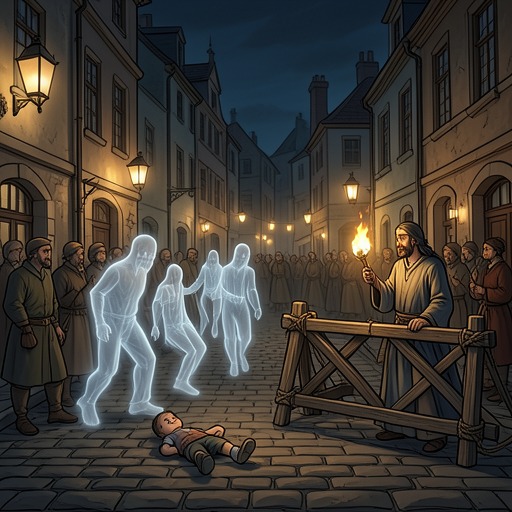
The timing of the encounter is significant. As dusk falls over the town, temporary fencing surrounds its central area and every window remains dark. The party already knows that the season encourages ghosts to appear, but the barriers and the silence suggest a more concentrated danger. Beyond a small glen, the abandoned well stands with its wooden winch and cover rotted away while its stone structure remains intact. A distant voice seems to call and scream from somewhere below or far within the darkness, creating uncertainty before the nested ghost is seen.
Appearance and First Encounter
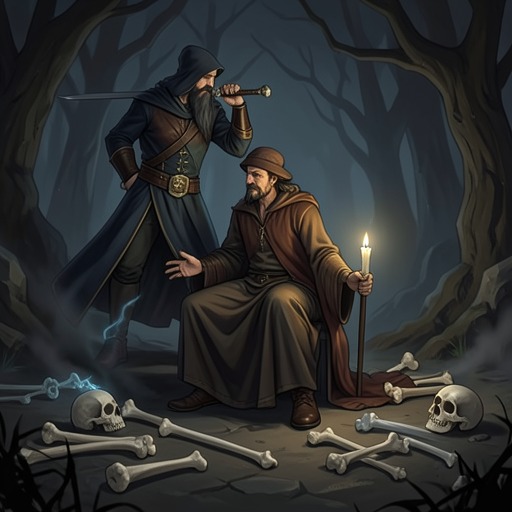
The nested ghost emerges from beside the well in a body assembled from incompatible remains. Its front is the decaying corpse of a deer, while its rear consists of the equally rotten legs of a bear. Bones protrude through flesh in unnatural places, the remnants of both furs are matted with old blood, and the stench is nearly enough to make Theo lose his supper. The creature’s body turns the idea of a corpse into a grotesque collage: not one dead animal restored to motion, but several kinds of death forced into a single shape.
The reveal moves from anticipation to physical revulsion. Cargo first warns the group with a snort, and the party crouches behind bushes as a large, lumbering shadow steps into the faint moonlight. Once the creature is exposed, the horror becomes immediate and bodily. Its head turns toward the hiding party after the wind changes, revealing empty eye sockets filled with maggots. That involuntary movement is the moment when concealment fails and the nested ghost recognizes its prey.
Function as the Haunting’s Source
The nested ghost protects the well and the spiritual source associated with it. Wicker states that the creature must be kept occupied while the others deal with the underlying ghostly disturbance. Cargo offers to help because he does not mind the taste of ghosts, but his confidence does not make the situation safer; the nested corpse is still an active, lumbering guardian whose attention must be managed.
The creature also weaponizes the dead through sound and apparition. When Theo enters the glen, a child’s voice begs to go home, adding an intimate human sorrow to the physical monstrosity. After the corpse is burned away, the boy’s clearer figure appears above the blackened remains, tears glittering on his cheeks as he repeats that he wants to go home and asks to be taken there. The nested ghost thus holds a victim inside the spectacle of its own body, making the exorcism a rescue as well as a battle.
Destruction by Fire
The party’s method depends on the nested ghost’s material vulnerability. Wicker says that the spoon used against ordinary ghosts will not work on this creature, but fire will. The halfling throws a lantern at its feet, coating the corpse in oil, then activates a torch marked with numerous fire-spell runes. Warm orange light spreads across the glen as the torch ignites, while Theo’s green magic rises beside it.
The attack is coordinated around distraction and exposure. Cargo stays with Theo because Wicker expects the ghost to focus its attention on him. Theo’s magic makes the nested beast flinch away, giving Wicker an opening to rush close and sweep the torch across its side. The oil catches; Wicker makes two further passes; and the corpse shrieks loudly enough that the sound seems capable of reaching the town. Rotten flesh and fur burn away until the creature is barely a skeleton, and the nested beast finally collapses as the fire consumes what remains.
Release of the Remaining Ghosts
The destruction of the corpse does not end the supernatural disturbance immediately. After the flames have consumed the nested beast, Theo sees a silvery glow join the orange firelight and the green radiance of his own magic. The clearer apparition of the boy rises above the blackened remains, transforming the scene from a defeated monster into the visible aftermath of possession. Theo responds by offering help and promising to take the child home, treating the ghost as a person in need of release rather than as another enemy to be destroyed.
Wicker continues to sense ghostly presences around the abandoned well even after the nested ghost has fallen. The halfling identifies them as the first ghost’s victims: weaker than the central manifestation, but still unrested. This confirms the nested ghost’s structural role in the haunting. It had stirred and gathered the dead around the well, yet its destruction merely makes their liberation possible; the remaining spirits still require a separate act of ritual care.
Ritual at the Abandoned Well
The cleansing of the well combines practical preparation with deliberate magical ritual. Wicker circles the rim counterclockwise while sprinkling salt from a jar, then places five lit sticks of incense between five different stones. The sweet, earthy fragrance offers a marked sensory contrast to the burned corpse and its lingering rot, while the five-point arrangement gives the work an ordered boundary around the place from which the voices had seemed to come.
Wicker then removes their gloves, exposing their bare bones, and raises the spoon used to summon their magic. Purple-black energy runs along the finger bones like flames as the halfling begins tracing runes in the air. The ritual is therefore not an improvised gesture after the battle but a second, more controlled stage of the response: fire destroys the animated vessel, while salt, incense, and rune-work address the spiritual remnants left at the well.
At Wicker’s instruction, Theo is to throw the torch into the well while the runes are being drawn. The action links the creature’s destruction to the source it guarded and directs the remaining fire into the abandoned structure itself. The evidence ends while this final cleansing is beginning, but the sequence establishes the intended consequence clearly: the nested ghost’s death opens the way for the other ghosts to be released from unrest rather than leaving the haunting only partially resolved.
Death, Memory, and Local Order
The nested ghost episode belongs to a broader concern with how the dead are handled. Earlier, Glefald’s funeral shows Leafel accommodating an elven preference for burial in the earth, with a tree planted over the body so that death can nourish new life. His grave is placed across from the Watchtower, allowing the future tree to become a second guardian of the village entrance, and the community preserves his memory by distributing the knitwear he made, including a specially prepared scarf intended as a solstice gift for Theo. These practices give the dead a place, a continuing meaning, and a relationship with the living.
The abandoned well presents the opposite condition. Its wooden covering and winch have rotted away, its surrounding town is fenced off at night, and the dead remain active through a grotesque body assembled from animal remains. The nested ghost represents death without proper containment: a spirit lodged in discarded corpses, a source of fear that disturbs other victims, and a hidden history that returns through a child’s repeated plea to go home. The party’s response restores distinctions that the haunting has collapsed—between deer and bear, body and spirit, aggressor and victim, and death and release.
In that contrast, the creature’s narrative significance extends beyond its horror. The nested ghost is frightening because it makes the dead materially mobile and spiritually contagious, but its defeat also reveals an ethic of rescue. Theo’s healing magic, Wicker’s ghost-lore, Cargo’s willingness to draw the creature’s attention, and the final well ritual all work toward the same end: not merely surviving the apparition, but returning the disturbed dead to peace.