Rebirth of the Demon King
The Reincarnated Demon King's Host Just Wants to Live in Peace, But the Hero Won't Leave Him AloneRebirth of the Demon King is the soul-transfer event that carries Malthios from defeat into a second existence inside a human host. It preserves his consciousness and ambition while stripping away his physical independence, creating the central condition of his later life: Malthios remains the Demon King in memory and power, but his continued existence depends on a human body whose owner can resist him. The rebirth therefore functions not as a simple resurrection, but as a reversal of power that makes identity, control, and moral change inseparable.
Death and the Soul-Transfer Spell
Malthios’s rebirth begins at the moment of his defeat by the Hero. During their battle, the Hero’s mana suddenly intensifies, shattering Malthios’s black blade and driving her sword into his stomach. She keeps the weapon embedded as he falls to his knees and orders him to die. Malthios refuses to treat the wound as an ending. While his crown slips from his head and his vision darkens, he reaches for the sigil inked on his forearm and forces his mana into it, declaring that the Hero has not seen the last of him. The sigil is the mechanism by which his consciousness escapes the death of his body.
The act preserves Malthios’s will but not the conditions that once made that will sovereign. He expects to return and make Algeya and its Hero cower before him, yet the spell does not restore his body or place him immediately upon a throne. Instead, it carries him into an existence dependent on another person. His apparent survival is consequently also a defeat: the Demon King evades death only by surrendering the bodily autonomy and absolute command that defined his former rule.
Awakening in a Human Host
When Malthios awakens, he experiences his new condition as weight, darkness, and enforced stillness. He feels as though he is floating, with limbs too heavy to move, while thoughts and emotions that are not his own press around him. His first clear view is through the perspective of an infant looking toward the beams of a cottage roof. A green-eyed human woman leans over him, and although he tries to attack, his body does not respond. The only movement available to him is the chubby hand that reaches for the woman’s braid.
Malthios quickly recognizes that the spell has succeeded: he has been reborn into a host. His first response is strategic rather than reflective. He imagines that the host might hear him and presents their union as a future partnership through which they will achieve great things. The promise reveals that he initially interprets rebirth according to the logic of conquest. The human body appears to him as an instrument waiting to be mastered, not as a separate life with its own claims.
The Limits of Control
The early years expose the restriction built into the rebirth. Malthios waits while his host grows into a functioning body, recognizing that the human possesses unusually strong magical potential. He repeatedly tries to persuade the host to perform actions that would test obedience, but the human proves stubborn. More importantly, Malthios cannot simply seize the body. He can take control only when the host suffers a lapse of control, and even then the host manages to force him back.
This limitation changes the meaning of the Demon King’s power. Malthios still possesses memory, magic, and the confidence of a former ruler, but he cannot convert those resources into direct action whenever he wishes. His rage comes from being present without being sovereign. The shared body makes every attempted command a negotiation or a struggle, and the host’s resistance prevents rebirth from becoming an uncomplicated continuation of the old reign.
The host’s individuality also confronts Malthios with the past he has tried to suppress. In appearance, the human recalls Kamil through lush auburn hair and fluorite-green eyes. In temperament, the host combines Aym’s reserved prickliness, Foras’s dry humor, and Tori’s stubborn resolve. These resemblances dredge up memories Malthios had not considered for years, adding personal grief and rage to the frustration of confinement. Even a minor conflict, such as the host fleeing village children who had bullied him, becomes a contest over control: Malthios urges violence, but the host resists his attempted takeover.
Rebirth, Judgment, and Responsibility
The consequences of rebirth eventually become public when the host is identified as Theo, and Malthios’s continued presence turns Theo into the Demon King’s host. During the trial, Theo is placed in magic-dampening handcuffs and transported to the capital through a portal opened with a rare portal orb. The court treats the shared existence as a matter of criminal responsibility rather than accepting the distinction between the human host and the entity within him. Theo is taken to the dungeons after confirming what he is, while Luc refuses to speak to him and Theo cannot meet his eyes.
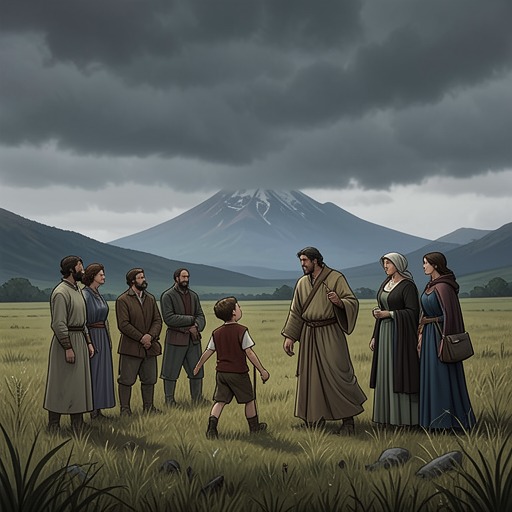
The trial nevertheless reveals that rebirth has produced more than a legal problem. Leafel’s people gather in the town square and use a mirror spell to appear before the king and council. Micah raises the staff that sustains the spell, while Imani, Dale, Dmitri and his parents, Nib, Amaya, Hayden, and the wider community stand behind him. Hayden demands Theo’s release on behalf of Leafel. Their intervention establishes that Theo is not regarded merely as a vessel for Malthios or as an extension of the Demon King’s crimes. The community’s willingness to defend him gives public form to the distinction that Malthios’s rebirth created: one body contains two identities, and the host’s choices and relationships cannot be erased by the presence of the former tyrant.
The final judgment rejects both total identification and simple absolution. Malthios admits that he destroyed the Demon Fortress and everyone within it, while acknowledging that lesser demons and demon-created monsters may still remain. He also states that there is no longer any need for a Hero. Luc answers the political and moral crisis through a distinction between duty and timing. He declares that, as the Hero, it is his duty to kill the Demon King, but insists that he may choose when that killing occurs. The sentence that follows names the result precisely: Malthios is sentenced to life in prison, while Theo Bladefoot is freed of all charges. Rebirth thus ends not with the Demon King’s restoration or immediate execution, but with a constrained coexistence in which responsibility is divided and future danger is managed rather than denied.
Narrative Significance
The concept joins a bodily metamorphosis to a moral and political reversal. Malthios begins as a ruler who expects defeat to be temporary and assumes that survival will restore his authority. The host bond denies that expectation at every level: his body belongs to someone else, his commands can be resisted, his memories are reopened by another person’s likeness, and his fate is decided in a public court rather than by his own will.
The rebirth also makes the story’s central conflict impossible to reduce to Hero against Demon King. The same body contains inherited violence, human vulnerability, magical capacity, and competing intentions. Theo’s community witnesses and contests the legal category imposed on him, while Luc’s decision to postpone execution turns the old heroic duty into an act of judgment rather than automatic punishment. The final arrangement does not erase Malthios’s crimes or pretend that the danger has vanished. It converts survival into an imposed second chance: Malthios remains alive under confinement, Theo remains free, and the future depends on whether the former Demon King can exist without making domination the condition of every relationship.