The Abandoned Well
The Reincarnated Demon King's Host Just Wants to Live in Peace, But the Hero Won't Leave Him AloneThe Abandoned Well is a ruined stone well in a forest glen and the source of a supernatural crisis encountered by Theo and the Hero’s party. More than a decayed landmark, it is a place where a childhood act of betrayal has remained materially and spiritually active: a boy was lowered into it by his older brother, abandoned there, and transformed by waiting, fear, hunger, and despair into a ghost whose unresolved longing spreads danger to others. The party’s response turns the well from a hidden container of grief into a site of recognition, cleansing, and deliberate closure.
Appearance and Setting
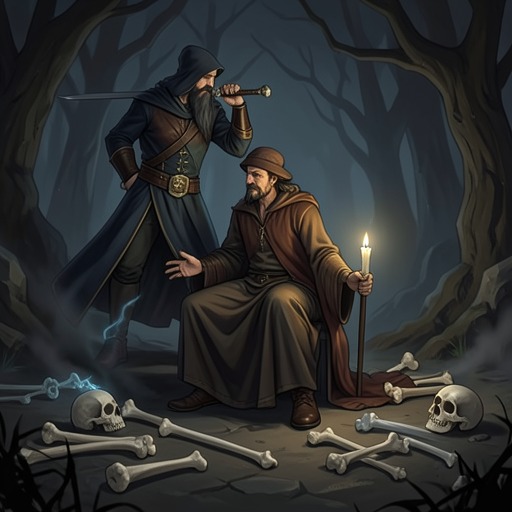
The well stands on the far side of a small glen, covered in moss and surrounded by the remains of a wooden winch and cover that have long since rotted away. The stone structure itself initially appears intact, but the faint sound rising from it—someone calling and screaming as though from a great distance—makes its decay feel less like ordinary abandonment than a warning. The party encounters it near a town placed under temporary fencing because of the season’s unusually strong ghost activity, with the darkened windows and barriers establishing a landscape already organized around fear of the dead.
The well’s position in the forest also separates it from the protected human settlement. The town’s inhabitants will not admit the travelers at night without proof that they can survive outside, and the party must investigate the surrounding danger rather than receive immediate shelter. In that context, the well becomes the most concentrated expression of the boundary between communal safety and the uncontained dead: a neglected place beyond the town’s defenses where an old wrong has been allowed to continue.
The Memory Preserved in the Well
When Theo places a hand on the well’s stone, the contact causes piercing pain and forces unfamiliar emotions and memories into him. The impressions move through a sequence of sunny woods, fear, darkness, repeated cries for help, hunger, thirst, and the despair of realizing that no one is coming. The well therefore does not merely house a ghost; it retains the emotional chronology of the death, making the location itself a vessel for memory.
Theo later explains that the first ghost was a child who admired his older brother. The brother exploited that trust, lowered the child into the old well while they were in the forest, and promised to return. He never did. The boy’s ghost remains fixed on the promise, still waiting for his brother to come back and take him home. This explanation changes the haunting from an apparently arbitrary act of revenge into the continuation of a child’s belief. The terror lies in the simplicity of the expectation: the dead child is not seeking a grand judgment but remains trapped in the ordinary hope of being brought home.
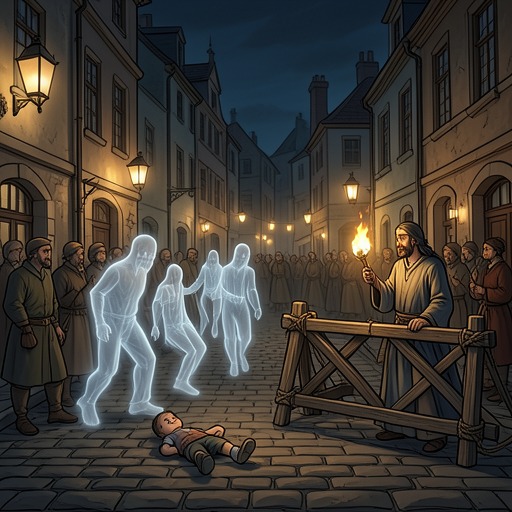
The well’s history also accounts for the presence of additional spirits. Wicker senses that the first ghost’s victims remain nearby, weaker than the primary apparition but still unrestful. The location has consequently become an accumulating structure of harm: one act of abandonment creates a powerful ghost, and the ghost’s continued existence leaves other dead unable to settle. Its danger is both personal and communal, extending beyond the original victim without erasing the original cause.
Cleansing and Destruction
The party confronts the nested corpse in the glen rather than leaving the well untouched. Wicker throws an oil-filled lantern at the creature, then ignites it with a rune-marked torch. The flames consume the rotten flesh and fur while Theo’s green magic drives the creature back. After the fire has reduced the beast almost to a skeleton, it collapses, and a silvery figure appears above the blackened remains. The boy is clearer in this form, with tears visible on his cheeks, and asks to be taken home. Theo answers by offering help and promising, in effect, a path toward release rather than another act of force.
The first cleansing does not resolve the whole site. Wicker continues to sense ghostly presences and performs a separate rite for the victims near the well. Salt is scattered counterclockwise around the rim, five sticks of incense are lit and placed between the stones, and Wicker uses a spoon to trace runes in the air with purple-black magic. The ritual treats the well as a contaminated threshold requiring careful boundaries, scent, fire, and inscription before the remaining spirits can be addressed.
Wicker initially plans to have Veiv destroy the well the following day, but Theo refuses to leave the work unfinished. Drawing on Malthios’s mana, he cracks the stones and brings them inward, then collapses the surrounding earth into the opening until only a bare mound of dirt remains. The destruction is therefore not a casual demolition. It is Theo’s direct intervention to prevent the site from generating more ghosts, coupled with a prayer to Arriss for the unknown child’s peace. His regret that he does not know the boy’s name reveals the limit of the victory: the haunting can be ended, but the victim cannot be restored to the life and recognition that were denied him.
Aftermath and Narrative Significance
Once the well has been buried, Theo says that he never wants to see another nested ghost and hopes he will be lucky enough to forget they exist. Wicker answers with a lighter recollection that the two of them worked well together and might have made such work their occupation in another life. The exchange preserves both responses to the supernatural encounter: Theo carries the moral weight of the dead, while Wicker converts shared danger into companionship without denying its horror.
The Abandoned Well also gains meaning through contrast with Leafel’s treatment of death. Glefald is buried in earth according to an elven custom, with a tree planted above him so that his body can feed new life and eventually guard the Watchtower. His funeral includes communal participation, a song, keepsakes made from his knitwear, and a scarf prepared specially for Theo. The well offers the opposite image of burial: a child hidden in darkness, separated from care, with memory left to rot until it becomes monstrous. Destroying the well does not make death disappear; it replaces an unmarked engine of unrest with a bounded mound and a prayer.
Across the wider world, death is repeatedly managed through collective structures. The capital trains magic users, knights, and members of the Hero’s party because the remnants of Malthios’s army and the Demon Lords still threaten ordinary people; its magical mirrors allow rulers to hold councils across Algeya without opening portals. Yet the abandoned well lies outside such formal systems of protection and remembrance. The party must supply the attention, ritual, healing, and physical labor that the site’s original community failed to provide.
Its final significance is therefore spatial and ethical. The well is a literal hole in the landscape, but also a breach in the promise that the living will return for the vulnerable. Theo closes it by listening to the memory embedded in its stone, helping the child’s spirit, assisting with the weaker dead, and physically returning the structure to the earth. The place remains a monument to betrayal, but no longer an active doorway through which that betrayal can reproduce itself.