The Hero's Party Assaults the Demon Fortress
The Reincarnated Demon King's Host Just Wants to Live in Peace, But the Hero Won't Leave Him AloneThe Hero's Party Assaults the Demon Fortress is the turning-point assault in which the Hero’s party penetrates the stronghold of the remaining Demon Lords to rescue Theo and confront the force that has taken him hostage. The attack transforms Theo from an isolated prisoner into the living stake of a public military crisis: Tyraz uses him as a sacrifice and a psychological weapon, while Luc’s determination to purge the demons is forced into direct conflict with his love for Theo. The fortress’s apparent security collapses under the assault, and the battle brings the competing claims of heroism, demonic succession, captivity, and chosen loyalty into the same courtyard.
Causes and Strategic Background
The assault occurs against the larger political reality of Algeya after Malthios’s defeat. The capital’s palace and training complex still treat the Demon King’s remnants as an active threat, because the remaining Demon Lords continue to lead forces scattered across the land while the Hero’s party protects ordinary people. The old war has therefore not ended with the former Demon King’s defeat; it has become a succession crisis in which another Demon Lord can attempt to inherit the title and consolidate the surviving military order.
Tyraz’s strategy depends on Theo’s captivity. Theo is held in a dungeon, restrained badly enough that the pressure of the shadows causes bruising and makes his consciousness flicker. When a Demon Lord arrives with news that the first legion has engaged the invading force and that Keplo was dueling the Hero, Tyraz does not treat the breach as an unexpected disaster. He explains that he had planned for such an attack and had taken the Hero’s lover precisely so the rescue would become a weapon against Luc. The fortress is thus defended not only by troops and magic, but by the assumption that Luc will be made powerless through fear for Theo.
The assault also follows a broader pattern of contested access and exclusion. The Hero’s party has already encountered communities whose fear makes them deny entrance, while the capital’s palace uses magic mirrors to bring rulers and councils together across Algeya without requiring physical travel. Against those controlled political spaces, the fortress represents a violently guarded territory in which entry is forbidden and prisoners are reduced to bargaining pieces. The invasion reverses that arrangement: the demons lose control of the boundary, and the supposedly secure interior becomes a battlefield.
Course of the Assault
The attack reaches Theo through the sounds of a military crisis rather than through any orderly announcement. A newly arrived Demon Lord reports that the first legion has engaged the attackers and that Keplo was fighting the Hero when the messenger departed. The report establishes that the Hero’s party has already broken into the fortress’s defenses and that the demons cannot hold them back for long. Tyraz’s response is confident rather than alarmed, because the hostage plan allows him to convert the party’s advance into a confrontation on his chosen terms.
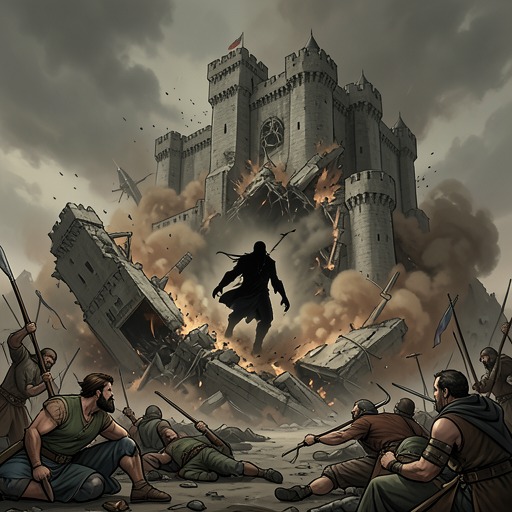
In the courtyard, the fortress has already become a killing ground. Many Demonkin and Novices are dead, and their bodies are beginning to dissolve into shadows, while the survivors attempt to contain the Hero’s party. The contrast is stark: the defenders are numerous but disintegrating, whereas the invading party is described as an unstoppable force. The dead do not remain as ordinary corpses, reinforcing the unnatural character of the fortress and making the battlefield itself seem to absorb the forces sacrificed for its defense.
Luc is the most visibly transformed figure in the courtyard. His sword flashes like red lightning as he duels a demon whose massive build rivals Khal’s and who carries a giant broadsword. Theo has never seen Luc fight with such complete abandonment of caution and humanity; every swing is directed toward killing. The sight shows both the power of the Hero and the danger of that power when it is driven by rage. Mal recognizes the resemblance between Luc’s present violence and Eliza’s earlier ferocity, warning that fighting in this state may allow Tyraz to win rather than save Theo.
Theo’s brief call to Luc interrupts the battle’s momentum. Luc hears him immediately, searches his body for injuries, and visibly experiences relief and anger at once. The exchange cannot become a reunion, because Tyraz orders the fighting to stop. Demon forces withdraw to the courtyard’s edges, leaving the Hero’s party at the center while Tyraz spreads his arms in a gesture of welcome. The apparent pause is therefore not peace but staging: Tyraz turns the invaded courtyard into a court of his own, with Theo displayed as the proof of his control.
Tyraz’s Claim and the Hostage’s Role
Tyraz identifies himself as the new Demon King, and the other demons cheer his declaration. His claim is made at the exact moment when his military position is visibly weakening, giving the title an unstable, performative quality. He lacks the uncontested authority of the former Demon King, yet he attempts to create legitimacy through public announcement and the approval of the forces gathered around him. The assault consequently becomes both a rescue operation and a challenge to a new regime.
Luc answers Tyraz by naming himself Hero Luca of Algeya and stating that his duty is to purge all demons from the land. He offers to consider a quick end for Tyraz if Theo is released, but the offer does not soften the underlying conflict. Luc speaks as the institutional Hero, while Tyraz speaks as a ruler using the language of possession, sacrifice, and emotional humiliation. The two roles collide because Theo is simultaneously Luc’s companion and the person Tyraz has made central to his defense.
Tyraz deliberately reframes Theo’s relationship with Luc as a source of suffering. He calls Theo Luc’s lover and claims that Theo has endured enough merely because Luc loves him, adding that the captivity has brought Theo to tears. Whether or not Tyraz’s description is intended as truth, it is unmistakably calculated to provoke Luc and shame Theo. Before Theo can answer, the shadow around his throat closes over his mouth, preventing him from speaking. The physical silencing makes the political logic of the fortress literal: Tyraz controls the hostage’s body so that Luc must negotiate with an image of Theo rather than with Theo’s own voice.
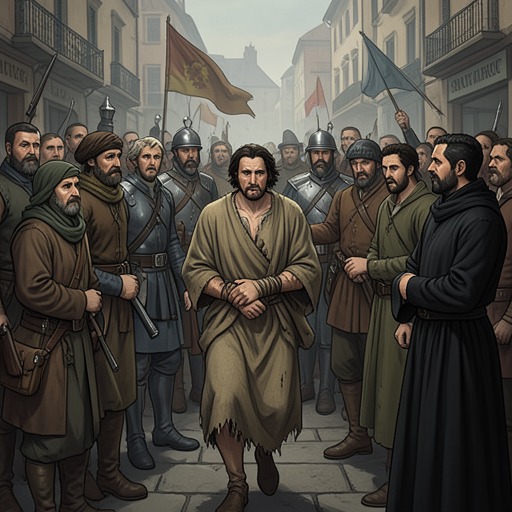
Tyraz then approaches Theo and uses shadows to unlock the restraints while immediately binding him again. Blood rushes back into Theo’s hands and arms, but the relief is inseparable from renewed control; shadows secure his arms behind his back and coil loosely around his throat. Tyraz calls Theo a sacrifice and proposes showing Luc how powerless the Hero is within the fortress. The gesture exposes the assault’s central value shift. The Hero’s party has entered expecting rescue and combat, but Tyraz attempts to turn their advance into proof that love can be used to defeat heroic power.
Immediate Consequences and Narrative Significance
The assault changes the fortress from a place of hidden imprisonment into a public arena where every major allegiance is visible. The demons’ bodies dissolve, the first legion is engaged, Keplo is occupied with the Hero, and Tyraz must personally reveal himself as the new Demon King. His claim emerges under pressure rather than after victory, suggesting that demonic authority is being asserted in the middle of collapse. The Hero’s party, meanwhile, is not merely fighting an enemy army; it is being forced to choose how to act when the enemy has made Theo the condition of the battle.
The event also clarifies the difference between Luc’s duty and Luc’s attachment. His declaration remains absolute in its language of purging demons, but his first practical demand is Theo’s release. Tyraz exploits the gap between those positions, presenting love as the source of Luc’s vulnerability. Luc’s feral fighting style confirms that Theo’s captivity has altered the Hero’s conduct before the formal confrontation even begins. The assault therefore does not simply test whether the party can defeat the fortress; it tests whether Luc can remain a Hero without allowing the role to erase the person he is trying to save.
Theo’s experience gives the invasion its emotional and bodily center. He survives the shadow pressure, hears Mal’s frantic warning, and remains conscious long enough to recognize the arriving forces and call to Luc. Yet the rescue has not secured his freedom. The fortress assault ends this phase with Theo still bound and Tyraz still able to parade him before the invading heroes. The attack wins entry and exposes the enemy, but its first visible result is an escalation: the battlefield is opened, the new Demon King is named, and Theo becomes the sacrifice around which the next confrontation must turn.