Theo and Luc
The Reincarnated Demon King's Host Just Wants to Live in Peace, But the Hero Won't Leave Him AloneTheo and Luc is the novel’s central love relationship, binding a healer who fears discovery as the Demon King’s host to the Hero whose public duty requires the destruction of demons. Its decisive significance lies in the way private attachment becomes a challenge to systems that define people by bloodline, magical status, and compulsory service: Luc eventually chooses a peaceful life with Theo over the continuation of the Hero’s lineage, while Theo’s guarded self-protection gradually makes room for trust, mutual care, and a future neither institution has assigned to them.
Identity and First Recognition
Their first meaningful encounter is marked by an imbalance of roles. Luc, appearing before Theo as the Hero, kneels and apologizes for the way his party has behaved, while expressing gratitude for Theo’s healing of their injured companion. Theo supplies his name, “Theo,” partly out of pity, and Luc answers with a smile whose brightness and softness leave Theo physically shaken. The attraction is immediate but not yet safe: Theo is already carrying the secret of his connection to Malthios, and he knows that friendship alone would not protect him if anyone discovered what he was.
The relationship therefore begins with two forms of recognition operating at once. Luc sees a healer whose aid deserves respect, while Theo sees a Hero who is unexpectedly humble and emotionally disarming. The scene does not erase the danger between them, but it gives that danger a human face. Luc is not initially reduced to the institution he serves, and Theo is not merely a concealed threat; each becomes, for the other, a person encountered before the full consequences of their identities are understood.
Courtship and the Struggle with Defensiveness
Luc’s courtship is persistent but framed by an explicit respect for Theo’s boundaries. When Theo worries that Luc’s actions or his friends’ teasing may have made him uncomfortable, Luc promises that a single word from Theo could end the contact permanently. At the same time, Luc admits that he intends to show Theo how special he is to him. The combination is characteristic of their early dynamic: Luc pursues, but he repeatedly places the decision in Theo’s hands; Theo is drawn toward him, but retreats behind caution and silence.
Luc also speaks openly about his past. He likes both men and women, and describes earlier relationships with a maid in training, a squire, and other lovers encountered during the Hero’s travels. Those relationships ended because of youth, separation, or the instability of Luc’s role. His explanation gives the romance a social and temporal problem larger than simple uncertainty. The Hero is always being moved toward the next obligation, while the people he loves remain in places he cannot stay.
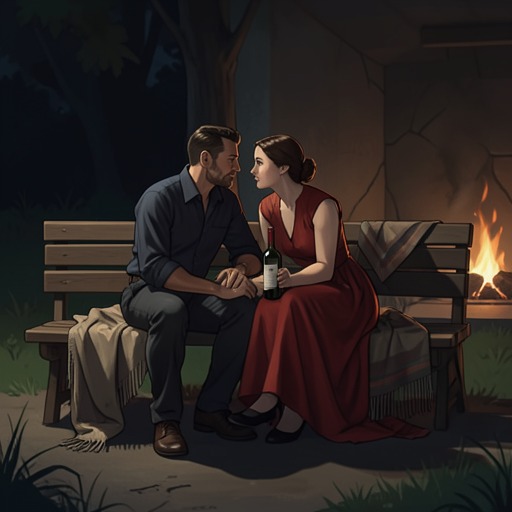
Against that pattern, Luc imagines a future that has not yet happened but already includes Theo. Once the demons are defeated and he can stop being the Hero, Luc wants to settle in a small village, grow and prepare his own food, and spend ordinary days with the person he loves. He tells Theo that Theo is already present in that future and asks whether Theo is willing to wait for him to catch up. This projected domestic life becomes the relationship’s governing promise: love is not defined by a single heroic gesture, but by the possibility of staying.
Secrecy, Care, and the Shared Burden of Danger
Theo’s guardedness is not mere shyness. Malthios’s presence in his mind and body makes intimacy dangerous because another consciousness knows his thoughts and feelings, while Theo cannot act without the Demon King becoming aware of it. When Theo refuses Malthios’s suggestions, Malthios responds with threats, insults, and fits that leave Theo bedridden with splitting headaches. Theo’s resistance is not presented as moral superiority; he simply rejects being controlled. That stubborn autonomy shapes his relationship with Luc as much as it frustrates Malthios.
The strain becomes visible during Theo’s illness. After weeks of little sleep, constant headaches, excessive work, and Malthios’s unstable persistence, Theo’s fever rises again. He wakes in darkness to Luc’s blue eyes, cool fingers touching his face, and a smile. Luc reminds him, “I’m here, Theo, I promised I would be.” The promise converts romance into care: Luc is not merely declaring a desired future but physically returning to Theo when Theo is weak, feverish, and unable to maintain his usual defenses.
Yet Luc recognizes that Theo remains emotionally enclosed. He tells Theo that he is still hiding behind his walls, naming the pattern without forcing an immediate confession. Theo continues to conceal the truth from the people around him, and even a question from Nib—the intelligent hog who asks whether Theo will ever tell them he is demon spawn—shows how precarious the secret has become. The relationship develops under the pressure of selective disclosure: Luc’s affection offers Theo a reason to risk being known, but discovery could still turn affection into evidence against him.
Their physical gestures carry what Theo cannot yet say aloud. When Luc sees Theo and hurries toward him, his expression changes from open brightness to concern. Later, after Theo pulls away, Luc cups his face and wipes tears from it with his thumb. These moments establish a reciprocal tenderness that does not depend on Theo becoming verbally transparent all at once. Luc reads distress, remains present, and offers contact; Theo allows the contact, even while concealing the larger truth.
Separation, Tokens, and the Choice to Return
The relationship is tested when the Hero’s party must leave. Luc studies Theo’s face as if trying to memorize it, unsure what to do in the moment of parting. Theo gives him a reminder of himself and tells him that he will be waiting if Luc returns. The exchange turns absence into an active bond. Theo is no longer only defending the walls around his private life; he is openly reserving a place within it for Luc.
Luc’s gift makes that promise tangible. He offers Theo a silver ring textured like scales, with a dark sapphire set into it. The object carries the visual language of danger and fantasy, but functions as a personal pledge and a durable reminder of the absent lover. Their connection is therefore preserved through both speech and material memory: Theo promises to wait, and Luc gives him something that can remain when Luc cannot.
The separation is not merely romantic inconvenience. When Theo learns that Luc may die, he faces the loss of autonomy that would follow from entering the portal to intervene. Crossing it would reveal where he lives and who he is; the authorities might force him back into the Hero’s party, and Camden could recognize him. Theo also understands the political expendability of Luc: if Luc dies, the authorities can raise another child to replace him. Theo nevertheless chooses the risk because Luc’s life matters more to him than the safety of remaining hidden. Love here becomes an action taken under coercive conditions, not an escape from them.
Conflict with Duty and the Ending
The final conflict places Luc’s relationship with Theo against the expectations attached to the Hero’s bloodline. A knight suggests that Luc is expected to continue that bloodline and sire the next Hero, something that cannot be achieved through either of the available male relationships. The statement exposes the institutional logic surrounding Luc: his body is treated as hereditary infrastructure, and his future is imagined as a means of reproducing the heroic office.
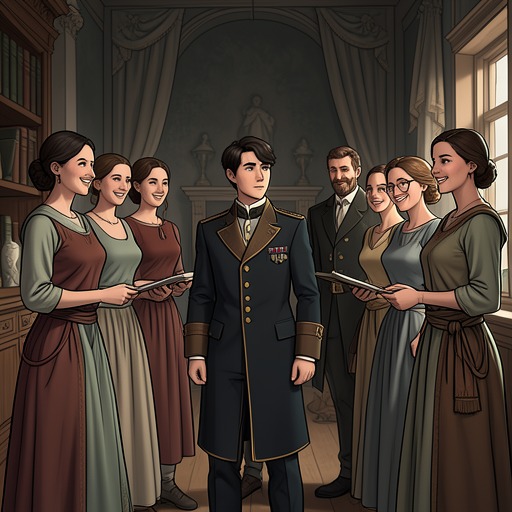
The Trial of the Demon King’s Host makes the private relationship public within a deadly political framework. When a large mirror spell opens, Micah stands in Leafel with his staff raised, while Imani, Dale, Dmitri and his parents, Nib, Amaya, Hayden, and the townspeople gather behind him. Leafel’s collective presence transforms Theo’s isolation into communal testimony. The people who know him as a healer and neighbor stand against the forces that would define him solely as a host worthy of judgment.
Luc’s final answer rejects both the inherited bloodline and the heroic script. When the older Hero asks whether he truly chooses to end their bloodline and throw away everything he has trained his whole life for, Luc replies, “The only choice I have ever made for myself,” and declares that he has chosen a quiet, peaceful life with the man he loves. His decision does more than secure a romantic ending. It imagines a world in which those born with the Hero’s gift may choose their fate rather than remain bound to duty.
The relationship’s ending thus joins personal commitment to social revision. Theo and Luc’s future is not valuable because it restores the old order or rewards obedience; it matters because it refuses the claim that love, family, and destiny must follow a prescribed reproductive and heroic sequence. Luc’s choice validates Theo as the person with whom he wishes to live, while Theo’s willingness to wait, risk exposure, receive care, and remain emotionally present gives that future its relational foundation. Together, they turn the language of duty from an instrument of coercion into a question each person may answer for himself.