Theo’s Flight from the Hero’s Path
The Reincarnated Demon King's Host Just Wants to Live in Peace, But the Hero Won't Leave Him AloneTheo’s Flight from the Hero’s Path is the turning-point action through which Theo abandons the life prepared for him as a healer attached to the Hero’s mission and disappears with Malthios into the north. His escape is not founded on heroic self-sacrifice or a superior moral code. Theo refuses because he resents being ordered about, understands that his identity as the Demon King’s host would make him vulnerable to execution, and wants the right to determine what happens to his own body and future. The flight therefore transforms an apparent failure to fulfill duty into the first sustained act of self-definition in his life.
The Fate Theo Refuses
Theo’s path toward the Hero’s party is established as a national obligation rather than a personal calling. While Theo is still being trained, rumors spread that a new Hero has been found to succeed Eliza, whose body is already showing the cost of Hero magic. That power burns rapidly through its wielder’s life, and Heroes on record have rarely survived beyond their twenties; Eliza’s battle with Malthios has accelerated the signs of her decline. The appearance of a successor makes Theo’s future concrete: he is expected to meet the young Hero, train alongside him until he comes of age, and then help purge the remaining Demons while protecting ordinary people.
Camden presents the Hero’s party as a source of profound friendship and promises that Theo will experience those bonds himself. Theo already knows that this future is impossible under the terms of his secret agreement with Malthios. He has no intention of entering a circle whose members might discover that the healer beside them houses the Demon King. The promised fellowship thus becomes an instrument of dramatic irony: what Camden sees as the beginning of belonging, Theo recognizes as the threshold of exposure.
The Flight North
On the day Theo turns sixteen, when the country’s law recognizes him as an adult, Camden tells him that guards will arrive the following morning to take him back to the capital. That night Theo packs his few belongings and food for the road. He leaves without a note, unable to formulate words that could explain why he is abandoning Camden or the role assigned to him. The silence of that departure is part of its risk: Theo does not negotiate with the institution, announce a protest, or ask permission. He simply removes himself before the state can reclaim him.
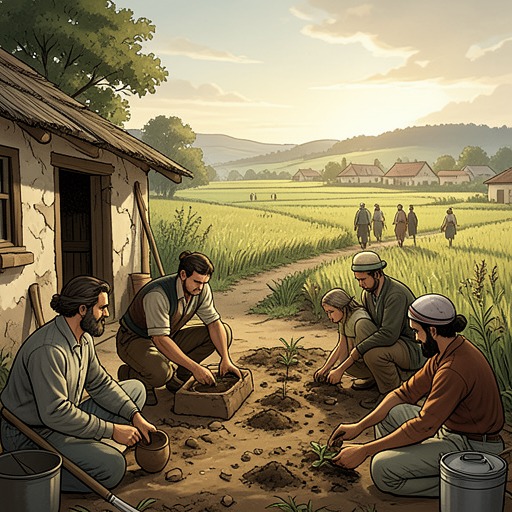
Theo and Malthios spend two years traveling north. They survive by taking odd jobs for people they meet along the way and by avoiding attention, steadily placing distance between themselves and the capital, the Heroes, and the expectations attached to both. Their destination is a small, peaceful village that appears to lie beyond the reach of Demons and Heroes alike. Theo’s hope that the village will provide permanent safety is immediately qualified by the realization that he was mistaken. The flight reaches its geographical destination, but not a condition of certainty; concealment remains a practice rather than a completed escape.
The Host’s Secret and the Cost of Safety
Theo’s choice is inseparable from his existence as Malthios’s host. Malthios’s magic feels terrifying in its raw power yet natural to Theo because it is also part of him. The arrangement gives Theo access to mana beyond that of any mortal being, helping him become a healer stronger than Camden while forcing him to conceal the source of that ability. He deliberately restrains his magic so that no one will suspect the truth. The secret is not merely a private embarrassment: discovery could place Theo before authorities as a threat to be contained or destroyed.
Theo and Malthios have negotiated an uneasy truce. Malthios will stop trying to take control of Theo’s mind and body, while Theo will permit him occasional control after training is complete, provided Malthios does nothing against Theo’s wishes and they remain far from the capital and the Heroes. Their shared body makes flight paradoxical. Theo is escaping an external system, but he cannot escape the consciousness inside him; Malthios knows every thought and feeling Theo has, while Malthios himself is imprisoned within Theo. Earlier resistance has provoked headaches so severe that Theo becomes bedridden, and Malthios has threatened the people Theo cares about, yet intimidation cannot make Theo accept a life chosen by someone else. The flight is consequently a negotiated form of shared survival, not a simple victory over Malthios.
Theo also understands that no amount of friendship can guarantee safety if his nature is discovered. That fear shapes his behavior after reaching Leafel. When Cargo later asks whether Theo will tell the others that he is “a demon spawn,” Theo freezes, and Malthios immediately presses forward in an attempt to defend them. The question exposes the permanent danger left behind by the escape: Theo has changed his location, but not the conditions under which his identity could be used against him.
Leafel as an Alternative Life
More than ten years after arriving in Leafel, Theo chooses to remain. He uses the money earned during his travels to buy a small, rundown house at the edge of town near the forest and repairs it into a shop. He treats everyday injuries with healing magic and sells herbs and potions that he gathers and prepares himself. He sleeps in the attic, while the potion room also serves as his kitchen. The arrangement is modest, improvised, and entirely his own, a direct contrast to the capital’s institutional plan for him.
Theo develops the practical skills required for independence: simple spells mend clothing and clean the house; he can cook, garden, bake, and manage minor repairs. His garden contains cooking herbs and flowers, with room reserved for produce he hopes to grow later. The shop is no longer collapsing around him, although one part of the roof still leaks and the main room’s floor creaks badly. He has savings for repairs, but he refuses to spend the money reserved for commissioning a future cottage except in an emergency and has reached only slightly more than half the necessary amount. These details make his escape tangible. Freedom is not represented as a grand new kingdom but as a leaking roof, a potion room kitchen, saved coins, and the gradual construction of a livelihood.
Reversal into Chosen Belonging
The flight initially appears to reject all bonds, yet its later consequences allow Theo to form relationships on terms different from those imposed by the Hero’s system. When Theo first meets Luc, the Hero’s smile affects him with startling physical force, freezing and then accelerating his heart. Luc introduces himself together with Khal, Avery, Emi, Genevieve, Bryony, Wicker, and Cargo, bringing Theo into precisely the kind of party community Camden once described. The difference is that this belonging grows from personal attachment rather than conscription, even though Theo continues to fear that intimacy will expose him.
Theo’s connection with Luc eventually becomes a reason to risk the capital rather than remain safely hidden. When the party obtains permission and a portal to bring Theo to Luc, Theo understands that stepping through the portal will end his autonomy. The court will know who he is and where he lives; Camden may recognize him; the authorities may force him into the Hero’s party; and the truth about Malthios may be discovered. Theo nevertheless goes because Luc may die without his help. Luc is expendable to the institution, which could simply raise another child to replace him, but he is not expendable to Theo. The logic of the original flight is thereby revised: Theo once fled to preserve himself, while later he chooses danger for the sake of someone he has chosen.
The same conflict appears in Luc’s history. Luc explains that the fate of the Hero has prevented lasting relationships, including a squire who ended their relationship when Luc was announced as the departing Hero. Later, Julius reveals that Hero Eliza ordered him to refuse Luc’s invitation to join the party and threatened to take everything from him, apparently because she wanted Luc to continue the Hero bloodline and sire the next Hero. Against that demand, Theo’s earlier flight acquires a wider significance. It rejects not only Theo’s own assigned service but also the reproductive and dynastic future imposed on Luc.
At the trial of the Demon King’s host, Theo’s escape is finally judged in public. He is taken to the capital in magic-dampening handcuffs and placed in the dungeons while Luc remains silent after Theo confirms what he is. Yet Leafel answers the accusation with collective resistance: Micah opens a powerful mirror spell, and Imani, Dale, Dmitri and his parents, Nib, Amaya, Hayden, and the people of Leafel demand Theo’s release. The village that began as a hiding place has become a community willing to identify itself with him.
Luc then refuses to define Theo solely as a danger. He describes Theo as Malthios’s prison and himself as Theo’s humble guard, promising not to let Theo out of his sight. When Eliza asks whether Luc is choosing to end their bloodline and discard everything for which he was trained, Luc answers that it is the only choice he has ever made for himself: he chooses a quiet, peaceful life with the man he loves and imagines a world in which those born with the Hero’s gift can choose their fate rather than remain bound to duty. Theo’s flight thus culminates not in isolation but in a shared future that challenges the Hero system’s authority over love, inheritance, and time.
Narrative Significance
As a plot action, Theo’s flight combines escape, maturation, and forbidden future-making. It begins with refusal: Theo will not be collected, trained, displayed, and eventually exposed according to a national schedule. It continues through concealment and labor, as two years of travel become a Leafel shop and a life built through ordinary skills. It later becomes an ethical choice, when Theo returns toward the power that could imprison him because Luc’s life matters more to him than the safety he has painstakingly constructed.
The action also reverses the conventional Hero’s journey. Theo does not accept the call to join the Hero’s party, defeat Demons, and return with sanctioned authority. He crosses the threshold by running away, and the eventual return to the capital does not restore the old order. Instead, Theo’s hidden identity is exposed, Leafel publicly claims him, and Luc rejects the bloodline duty that Eliza represents. The escape is therefore not a detour from the central story; it is the foundation for a different definition of heroism, one in which survival, chosen love, mutual protection, and the right to decide one’s future carry greater weight than obedience.