Theo’s Settlement in Leafel
The Reincarnated Demon King's Host Just Wants to Live in Peace, But the Hero Won't Leave Him AloneTheo’s Settlement in Leafel is the decisive turn in Theo’s life from fugitive travel to self-fashioned belonging. After leaving behind the capital and the Hero’s path, Theo and Malthios spend two years moving north, taking odd jobs and avoiding attention before settling in Leafel. There Theo builds a healing practice, a home, and a local identity strong enough to outlast the secret he fears will destroy him—though the village’s protection is eventually tested by the return of the powers he fled.
Flight from the Capital and Search for Safety
Theo’s settlement begins as an act of refusal. On the day he turns sixteen, Camden tells him that guards will take him back to the capital to meet the new young Hero and train for the future duty of purging the remaining Demons. Rather than submit, Theo packs his meager belongings and food, leaves without a note for Camden, and travels with Malthios. The journey lasts two years and is sustained by odd jobs performed for people along the road, with both companions deliberately avoiding attention as they move farther north.
The destination appears to offer exactly what Theo wants: a small, peaceful village beyond the reach of Demons and Heroes alike. The brief qualification that he thinks this is true—followed by the realization that he is mistaken—foreshadows the settlement’s central tension. Leafel is remote enough to let Theo disappear, but not so isolated that the political and supernatural conflicts of Algeya can never find him.
Leafel and the Healing Practice
Theo’s new life takes shape through work that is practical, local, and independent. Leafel is a small town where travelers rarely pass, although its reputation grows because of the unusually skilled healer living there. The townspeople openly praise Theo, alongside the leader of their modest adventurer party, whose swordsmanship helps protect the settlement from both monstrous and ordinary beasts. They call such protectors Heroes; Theo regards them as a nuisance, a judgment shaped by his determination to remain separate from the heroic institution that once claimed him.
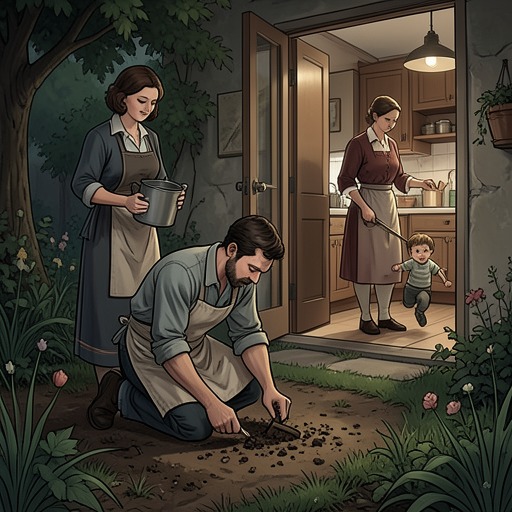
More than ten years after arriving, Theo has earned enough from his travels and healing to buy a small, rundown house at the edge of town, beside the forest, and convert it into a shop. His healing magic is only one part of the business. He also gathers and prepares herbs and potions for the everyday injuries of local people. The building is both workplace and residence: Theo sleeps in the attic, while the potion room also serves as his kitchen. The arrangement expresses his desire for self-sufficiency, but it also shows how narrowly his resources are stretched.
The shop is repaired enough to stand, though it remains visibly imperfect. One section of the roof still leaks despite his inability to discover why, and the floor of the main room creaks badly. Theo has learned ordinary spells for mending clothing and cleaning the house, as well as cooking, gardening, baking, and minor repairs. His garden contains cooking herbs and flowers, with room reserved for produce he hopes to grow. He has savings for repairs and improvements, but refuses to spend the money except in an emergency because he is still trying to save for a future cottage; even after years of work, he is only slightly beyond halfway to the required sum.
A Home Built Against Exposure
The shop matters because it is the first home Theo has truly possessed. When rain begins and the spring weather changes abruptly, he checks that the garden is prepared before entering. The shop front is crowded with potion shelves and hanging herbs. A short hallway leads to the garden, washroom, loft bedroom, and potion-room kitchen. To an outsider the building might look less rustic than dilapidated, but Theo sees the progress he has made and the labor invested in it. It is home because he built it himself, almost literally, rather than because it was granted to him by a royal, a Hero, or an institution.
That security is psychological as well as material. Theo keeps the possibility of flight alive, saving money and maintaining independence because he knows that friendship alone may not protect him if his nature is discovered. He is not merely hiding a personal secret: Malthios is the reincarnated Demon King, and Theo understands that the revelation could make him legally and politically expendable. Even when Malthios offers protection, Theo answers that Malthios would really be protecting himself, exposing the distrust that remains within their shared existence.
Leafel therefore becomes a space of selective belonging. Theo allows himself to be known as the village healer while withholding the identity that would transform every ordinary kindness into a potential accusation. His reputation is based on repeated acts of care, yet he believes that those acts may not matter once the feared name inside him is spoken aloud.
The Village, the Capital, and the Return of Power
The contrast between Leafel and the capital clarifies what Theo has escaped. The capital’s walls, tall buildings, crowds, palace, councils, and training halls represent surveillance and compulsory roles. The palace is divided between the royal residence and the institutions where magic users and knights are trained for royal service or for the Hero’s party. The continuing danger posed by the remnants of Malthios’s army gives that system its public justification, but Theo experiences the capital as a place where his body and magic can be examined, assigned, and controlled.
Leafel seems to reverse that arrangement. Its roads are quiet, its community is small, and its healer’s value is measured through direct service rather than court approval. Yet Theo’s later return to the capital proves that the village exists within the same political order. When Luc is gravely injured by a Demon, Theo agrees to go through a portal despite knowing that doing so will surrender his autonomy and reveal where he lives. He fears that the court will force him into the Hero’s party and expose the truth about him, but Luc’s life matters more to him than his own safety.
Once Theo is identified as Malthios’s host, the capital’s institutions reclaim the authority he had tried to evade. He is taken to the dungeons and later brought before a public trial. The throne room uses magic mirrors to display the proceedings across Algeya, turning Theo’s private identity into a spectacle before the court, the rulers, and the wider population. The home established in Leafel cannot prevent that machinery from reaching him; it can only provide the relationships that make his defense possible.
Leafel’s Collective Defense and Significance
The settlement’s greatest consequence is revealed when Leafel refuses to abandon Theo. During the trial, Micah casts a mirror spell from the town square, bringing Imani, Dale, Dmitri and his parents, Nib, Amaya, Hayden, and the people of Leafel into the court’s field of vision. Hayden speaks for the village and demands Theo’s release. The community that once praised Theo as its healer now publicly claims him even after learning that he is the host of the reincarnated Demon King.
This response reverses Theo’s expectation that discovery would erase every bond. His fear had defined Leafel as conditional shelter: a place safe only while nobody knew what he was. The villagers’ intervention demonstrates a different form of protection, one based not on concealment but on collective witness. Theo’s settlement thus changes meaning over the course of the story. It begins as a hiding place chosen by a fugitive, becomes a working home sustained by care, and finally proves to be a community capable of confronting the powers that would reduce him to a dangerous identity.
Theo’s life in Leafel also complicates the moral geography of the novel. The capital claims to defend ordinary people through councils, Heroes, knights, and laws formed against the Demons. Leafel’s people enact protection more personally and more vulnerably, standing behind a healer whom the official system has already judged. The village does not erase Theo’s danger or resolve the conflict with Malthios, but it establishes that belonging can survive the exposure of a stigmatized identity. In that sense, Theo’s Settlement in Leafel is not simply a relocation; it is the foundation of the chosen family and local loyalty that later challenge the authority of the Heroic order.