Tyraz
The Reincarnated Demon King's Host Just Wants to Live in Peace, But the Hero Won't Leave Him AloneTyraz is a Demon Lord defined by ruthless ambition, mastery of shadows, and an unusually direct willingness to betray the ruler he serves. Introduced as the former favorite to ascend to Demon King, he becomes Malthios’s second-in-command only after openly admitting that he would kill Malthios for the crown. Years later, he attempts exactly that through a campaign of coercion, kidnapping, and public spectacle, but his challenge ends with Malthios killing him and reclaiming the crown.
Identity and Rise
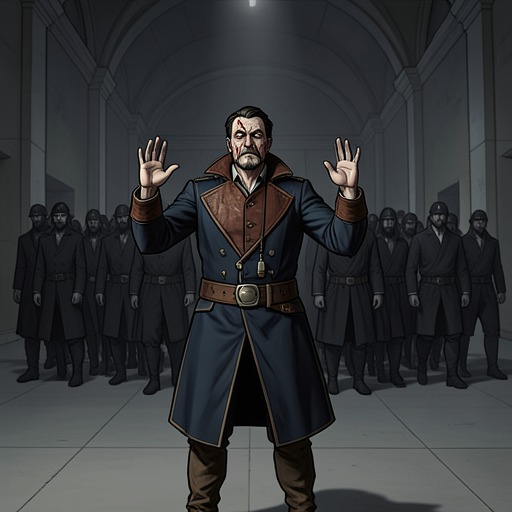
Tyraz enters the narrative after Malthios’s ascension, when the new Demon King is meeting the remaining Demon Lords and organizing the remnants of the demon forces. Fulton identifies him as the most likely previous candidate for the throne, explaining that Tyraz is a master of shadows. His appearance reinforces the menace of that reputation: he is tall, with long grey hair, grey wing feathers draped over his shoulders, yellow slitted pupils, and horns like the bleached bones of the dead. His handsome face is spoiled by an almost mocking smile, a visual contradiction that matches his polished manners and underlying malice.
Tyraz presents himself as courteous, greeting Malthios with formal praise and describing the new king’s unexpected ascension as a surprise. Malthios immediately tests the performance by asking whether Tyraz hopes to take the crown or has another motive for serving so closely. Tyraz answers without disguising his ideology. He says that demons want a world in which they control everything, with mortals reduced to toys or livestock, and argues that personal rank matters little if demons can do whatever they please. Fulton quietly advises Malthios to deal with him at once, recognizing that Tyraz’s frankness is not harmless candor but a declaration of principle.
Malthios then asks directly whether Tyraz would kill him and take the crown if given the opportunity. Tyraz smiles, shows his fangs, and answers that he would. Rather than executing him, Malthios offers him the position of second-in-command of all demonkind. Tyraz accepts immediately. The appointment establishes the central paradox of their relationship: Malthios chooses a declared enemy as his right hand, while Tyraz accepts service not through loyalty but through proximity to power and the hope that proximity will eventually create an opening.
Power, Methods, and Reputation
Years later, Tyraz remains Malthios’s right hand and is described as a truly ruthless demon. Malthios’s military structure also includes Keplo, who commands the battalions, Luvel, the assassin known as the Lord of the Invisible Blades, and Nissle, the young specialist in deadly poisons. Tyraz’s place at the top of this hierarchy is therefore not merely ceremonial. He stands above specialists in battlefield command, assassination, and poison, combining authority with a personal taste for cruelty.
Tyraz’s connection to shadow magic gives his violence a distinctive form. When Luvel attacks Theo, Malthios identifies the invisible-blade assassin as one of the best killers in the demon forces, but Tyraz is the figure Malthios almost fears. During the later assault on the Hero’s party, Tyraz approaches Theo from behind and closes a clawed hand around his throat. Theo recognizes him from Malthios’s memories by the same long grey hair, yellow eyes, bone-white horns, noble face, and twisted smile that marked his earlier appearance.
Tyraz’s reputation is also tied to torture. Before entering Theo’s cell, he sends shadows curling over the floor and up Theo’s body, forcing Theo’s head upward to meet his gaze. Tyraz admires the defiance in Theo’s eyes and recalls that Theo has already shown himself to be difficult to intimidate. Theo answers by demanding the return of his knives, refusing to surrender even the verbal ground of the encounter. The scene makes Tyraz’s method clear: he uses physical restraint, invasive magic, and taunting intimacy to turn captivity into a demonstration of control.
Conflict with Theo and the Hero’s Party
Tyraz’s most consequential act against Theo is not simply imprisoning him but using him as bait. After the Hero’s party breaks into the Demon Fortress, Tyraz explains that he took the Hero’s lover precisely because he had planned for such an intrusion. His shadows bind Theo’s arms behind his back and loop around his throat while Tyraz prepares to display him to Luc. Theo’s capture is thus both a tactical measure and a psychological weapon: Tyraz wants Luc to see the person he loves reduced to a hostage and to understand that the battlefield belongs to the Demon Lord.
The plan succeeds in forcing a confrontation. When Luc sees Theo, relief and anger break across his face, but Tyraz interrupts the reunion by ordering the fighting to stop. The demon forces withdraw to the edges of the courtyard, leaving the Hero’s party exposed at its center. Tyraz then introduces himself as the new Demon King, while the demons cheer and the heroes remain rigid and ready for violence. His proclamation is staged as a transfer of legitimacy before witnesses, with Theo’s captivity serving as proof of his power and Luc’s distress as part of the spectacle.
Tyraz’s claim is nevertheless unstable from the moment it is made. He possesses the aggression and authority to seize the title, but his kingship is founded on intimidation rather than recognized succession or loyalty. He treats Theo as a sacrifice and assumes that defeating or humiliating Luc will establish his own supremacy. The confrontation instead summons Malthios, whose identity has survived inside Theo and whose bond with Theo gives him a reason to fight beyond the recovery of a throne.
Rivalry with Malthios
Malthios answers Tyraz’s claim by declaring that he is still Malthios, once the strongest of all demons and leader of the Pentagram before becoming king. He adds that, because of Theo, he is stronger than before. Tyraz accepts the challenge, promising that it will give him pleasure to send Malthios to join the rest of his former group. His response reveals both confidence and contempt: he treats the duel as an opportunity to erase the old king and symbolically bury the Pentagram with him.
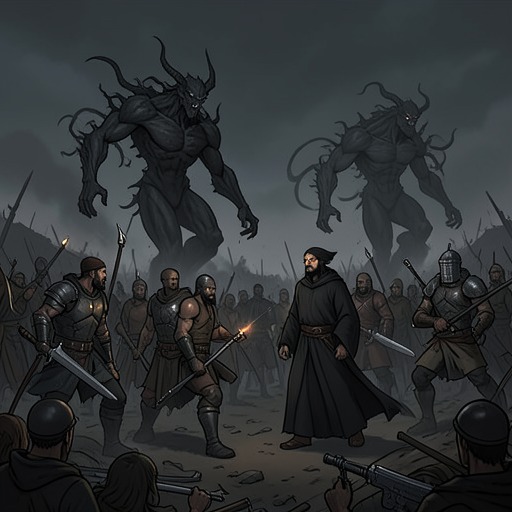
The duel takes place in the air above the courtyard. Their swords clash across the surrounding mountains as Malthios’s blue fire crawls over the crossed blades and burns away Tyraz’s shadows. Tyraz can still wound Malthios, but every cut is met by Theo’s green healing magic, which rises through the shared body and bathes the courtyard in green light. Tyraz has no comparable protection. His wounds accumulate, and the fight gradually exposes the difference between their powers. Malthios is stronger from the beginning, yet he deliberately toys with Tyraz, making the rival’s incompetence visible to the watching demons.
Tyraz’s desperation eventually shifts from combat to threat. He argues that mortals will kill Theo once they learn that Theo is Malthios’s host, leaving Theo nowhere to hide and bringing about Malthios’s destruction as well. The threat is calculated against the secret that has governed Theo’s life: Theo knows that friendship may not save him if anyone discovers what he is, and even his own community cannot guarantee protection against the political order that defines a Demon King’s host as an enemy. Tyraz attempts to turn that fear into a wedge between Theo and Malthios, presenting exposure as an inevitable consequence of their bond.
Malthios rejects the threat because the relationship Tyraz treats as a vulnerability has become the basis of his resolve. He tells Tyraz that he promised to protect Theo and that his word is his bond. The promise transforms the duel from a contest for succession into a defense of a person whom Tyraz has tried to reduce to leverage. Tyraz’s widened eyes suggest that he recognizes the old vow too late. Malthios drives his sword into the Demon Lord’s torso, pulls it free, and watches Tyraz fall onto the stone courtyard.
Death and the Collapse of His Claim
Tyraz dies at the precise moment when his public kingship is supposed to become undeniable. Before the body dissolves into shadows, Malthios removes the crown from Tyraz’s head. The watching demons cheer the return of their true King, turning Tyraz’s attempted succession into a failed interlude rather than a lasting change in the demon hierarchy. The crown’s black points reflect fragments of Malthios’s face, making the recovery of authority visually inseparable from the violence required to reclaim it.
Tyraz’s death also closes a rivalry that began before the main confrontation. He had once been the Demon Lord most likely to become Demon King, served as Malthios’s second-in-command after openly admitting his intention to kill him, and finally acted on the ambition he had never concealed. His advancement therefore contains its own reversal: Malthios’s decision to place a declared enemy beside the throne gives Tyraz access to the power he later uses against him, but that same access brings Tyraz close enough for Malthios to destroy him personally.
Character and Narrative Function
Tyraz is written as a concentrated image of demonic hierarchy at its most predatory. His stated desire is not merely to rule but to make mortals into toys or livestock, and his conduct consistently turns people into instruments: Theo becomes a hostage, Luc becomes an audience for humiliation, and the assembled demons become witnesses whose approval is sought through spectacle. His polished courtesy never moderates this worldview. Instead, the formal bows, courtly address, and smooth declarations make his brutality appear deliberate rather than impulsive.
His shadow magic functions as an extension of that politics. Shadows pierce, restrain, invade, and display control over the bodies of others. In Theo’s cell they force the healer’s face upward; in the courtyard they bind him for Luc to see; during the duel they attempt to tangle Malthios in the air. Yet the same methods fail when confronted with the combined powers of Malthios and Theo. Malthios’s blue fire burns through the shadows, while Theo’s green magic repairs the wounds that Tyraz inflicts. The contrast gives Tyraz’s defeat a structural meaning: solitary domination cannot overcome a bond whose strength is distributed between two wills and two forms of magic.
Tyraz also sharpens the book’s treatment of secrecy and stigma. Theo has lived with the knowledge that no amount of friendship could save him if others discovered that he is the Demon King’s host. Tyraz understands that fear and tries to make public exposure into a weapon. The danger is real: when Theo’s identity is eventually revealed, he is taken to the capital in Magic-Dampening Handcuffs, placed on trial, and named before the court as Malthios’s host. The trial confirms that Tyraz’s threat was not empty, even though Tyraz himself does not survive to see its consequences.
The political spaces surrounding Tyraz reinforce this pattern of exposure and control. The capital’s palace contains both the royal court and the training grounds for magic users and knights, while mirror spells allow rulers across Algeya to observe the proceedings without gathering physically. Tyraz creates a darker counterpart to that institutional visibility in the Demon Fortress: he forces the Hero’s party into a courtyard, places Theo at the center of the confrontation, and announces his claim before demon forces and heroes alike. His authority depends on making private vulnerability publicly legible.
The aftermath exposes the limit of that strategy. In the capital, Theo’s trial is broadcast through a magical mirror to towns, villages, and cities across Algeya, and the court initially agrees that he is guilty for protecting Malthios. Yet the people of Leafel answer through another mirror. Micah raises his staff, Hayden speaks for the village, and Imani, Dale, Dmitri, Nib, Amaya, and the wider community demand Theo’s release. Tyraz had assumed that discovery would isolate Theo; the later response demonstrates that knowledge can also produce solidarity. His attempt to define Theo solely as a dangerous host is defeated not only by Malthios’s sword but by the community Tyraz failed to imagine.
Significance
Tyraz’s arc follows a rise-and-reversal pattern built on ambition, rivalry, and failed usurpation. He begins as the obvious alternative to Malthios, accepts subordinate rank while preserving the right to betray, and eventually claims the crown through coercion. The crown does not make him the true Demon King, however, because his authority lacks the loyalty and bond that Malthios regains through Theo. Tyraz can seize a title, but he cannot reproduce the relationship that gives Malthios’s power its renewed force.
For that reason, Tyraz is more than a defeated antagonist. He is the hostile answer to the possibility that demons and mortals might be connected by care rather than arranged solely by domination. His worldview makes affection a weakness and persons into property; Malthios’s promise to Theo reverses both assumptions. Tyraz’s final failure shows that the secret host bond he tries to exploit has become the source of resistance, and that a ruler who governs through fear can be overthrown by the very human connection he dismisses.