Wicker
The Reincarnated Demon King's Host Just Wants to Live in Peace, But the Hero Won't Leave Him AloneWicker is a masked halfling necromancer whose apparent strangeness conceals neither fragility nor distance, but a resilient and practical form of belonging. Introduced as the smallest figure among a bloodied group of adventurers, Wicker wears a patched black coat, a hood, and a leather beaked mask with blank dark-glass eyes. Their presence initially reads as uncanny, yet their cheerful irreverence, technical knowledge, and willingness to stand beside vulnerable companions gradually make them one of the Hero’s party’s most dependable members. Wicker’s story is defined by the refusal of simple categories: they are neither fully alive nor fully undead, neither formally recruited nor peripheral, and neither merely comic relief nor only a practitioner of frightening magic.
Identity and Appearance
Wicker first appears at Theo’s cottage among the adventurers who arrive soaked and bloody after a fight. Unlike the other party members, their face is hidden behind the beaked leather mask, and their patched black coat and hood make their silhouette difficult to read. The mask turns them into an immediate visual mystery, while their halfling stature places them physically at the edge of a party otherwise composed of larger and more conventionally heroic figures. The concealment is not simply decorative. Wicker’s body and history are both connected to the boundary between life and death, so the covered face becomes an appropriate public surface for a person whose identity cannot be reduced to an ordinary living adventurer.
Wicker’s first social impression, however, is much warmer than the mask suggests. When Luca introduces the party, Wicker is named among Khal, Avery, Emi, Genevieve, and Bryony, but Cargo complains that the talking pig is always forgotten. Wicker’s later behavior confirms that they are comfortable with interruption, absurdity, and self-invention. They wave cheerfully when others react with alarm to the story of their necromancy, and they treat bodily horror with the same casual directness that Cargo brings to his jokes. This contrast between frightening appearance and open, almost childlike sociability is central to their characterization.
Origins and Place in the Hero’s Party
Wicker is the newest member of the Hero’s party, joining two years after the group began its quest. Their entrance into the party is itself unconventional. Wicker saved the adventurers when they were ambushed by the reanimated corpse of a Demon Lord who controlled an army of undead, but the party did not formally invite them to join. Wicker simply began following the group, and continued doing so until shared danger and companionship transformed the arrangement into genuine membership. Their place in the party therefore rests less on institutional recognition than on demonstrated loyalty and mutual attachment.
The story of the party’s formation presents Wicker as the companion who arrives after the group already has a history, but who nevertheless becomes part of its emotional core. Theo compares the new party with the original Hero’s party described by Camden and recognizes that these adventurers are unusually close: true friends who would do anything for one another. Wicker’s informal recruitment embodies that closeness. They do not need a ceremonial invitation because their actions have already established the basis of trust.
That trust is tested repeatedly. When the Council’s orders create a division within the party, Bryony makes clear that only Avery and Emi are under orders, while the others volunteered to serve with the Hero’s party and do not belong to the Council. Wicker stands with Bryony and Cargo in rejecting the idea that political authority can dictate every decision. The moment shows that Wicker’s loyalty is directed toward companions rather than hierarchy. Later, when Theo is forced toward the capital and the danger of his identity being exposed, Wicker remains among those whose support is personal rather than conditional.
Necromancy and the Body Between States
Wicker eventually explains that they are a necromancer whose magic took part of them when they died, allowing them to continue living until nothing remained. They describe themself as neither truly undead nor fully alive. The condition is not presented as a temporary curse awaiting correction. It is an ongoing mode of existence, with physical consequences that Wicker accepts as part of their history.
The revelation becomes concrete when Wicker removes one glove and exposes a bare white-bone wrist. Their heartbeat was the first thing to disappear. They had been a sickly youngling who was not expected to live long, and later lost their hands one after another when people tried to kill them. Wicker remarks that the attackers had, in a sense, succeeded. The statement is delivered casually, almost as though it concerns an ordinary inconvenience, but its details establish a history of illness, violence, death, and magical persistence. Their humor does not erase the severity of that history; it is the manner in which Wicker controls the terms on which others encounter it.
The gloves, mask, coat, and spoon together form a practical vocabulary for this liminal body. Wicker can conceal their bones when they choose, reveal them when explanation is necessary, and direct necromantic power through the spoon as an instrument of craft. Their condition is therefore neither merely an emblem of monstrosity nor a problem that the narrative asks other characters to solve. Wicker acts, travels, jokes, fights, researches, and organizes while inhabiting an unstable relation to ordinary bodily life. The party’s acceptance also contrasts with the suspicious reactions of outsiders, showing that social belonging depends less on physical normality than on the relationships built around shared risk.
Tactics, Magic, and Field Leadership
Wicker’s competence appears most clearly in crisis. During the dire-wolf attack, they call out “Plan E,” only to reveal that the plan is to climb a tree. When Theo complains that no one has explained the plans, Wicker answers with the blunt instruction to climb. Their apparent improvisation is not proof of disorder; it is part of a larger system of contingency plans. Wicker explains that Plan A is basic attack formation, Plan B is falling back, and Plan C is a fire attack. Plan F is waiting for rescue, while Theo jokingly proposes Plan L, listening to Theo, and Mal adds Plan M, allowing Mal to take over.
This exchange captures Wicker’s style of leadership. Their plans are practical, modular, and ready to be adapted when the intended formation collapses. The humor keeps fear from paralyzing the group, but the underlying purpose is serious: Wicker gives companions a shared language for changing circumstances. Even the absurd numbering turns panic into sequence and choice. Wicker does not present themself as an invincible warrior; instead, they make survival possible by recognizing the available options faster than danger can close around the party.
Wicker’s necromantic knowledge also makes them essential in supernatural investigations. During the haunting at Ashenhave, Wicker divides the party according to function. Emi and Bryony remain in town with Garris and his men, while Veiv, Khal, Avery, and Luc defend the farmlands. Wicker, Theo, and Cargo are assigned to locate and destroy the source of the ghosts. The arrangement reflects both tactical judgment and confidence in Theo’s healing abilities.
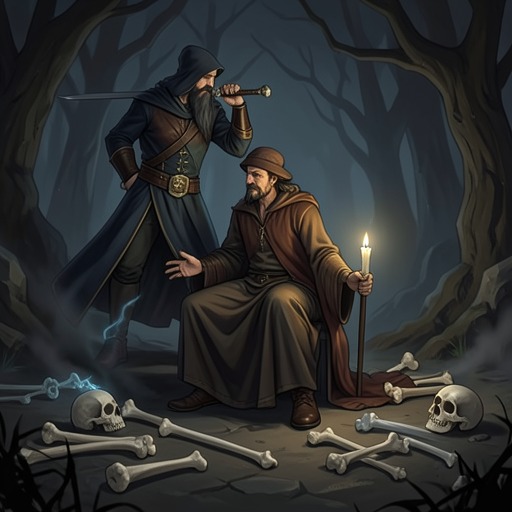
At the abandoned well, Wicker continues working after the principal ghost has been dealt with because they can still sense the presence of its victims. These ghosts are weaker, but Wicker refuses to leave them unrested. They hand Theo the torch, sprinkle salt counterclockwise around the well’s rim, place five burning sticks of incense between the stones, remove their gloves to expose the bones of their hands, and summon purple-black magic through the spoon while tracing runes in the air. The sequence gives their magic a ritual precision that contrasts with the frantic comedy of the dire-wolf escape. Wicker’s power is frightening, but it is also ordered toward release: the dead are not simply enemies to be destroyed; they are presences that deserve resolution.
Relationships and Emotional Function
Wicker becomes one of Theo’s most immediate sources of companionship. They sit beside him on his back porch while emptying their pockets to display collected curiosities, a small domestic action that brings strangeness into the ordinary space of Theo’s home. When Wicker gives Theo a small spear of green fluorite and says that it matches his eyes, the gift becomes a quiet sign of recognition. The moment is intimate without being possessive: Wicker notices Theo, offers him something personal, and allows friendship to take material form.
Their closeness also depends on mutual recognition of hidden conditions. Cargo openly asks Theo whether he will tell the others that he is a demon spawn, forcing Theo to confront the danger of disclosure. Wicker, by contrast, knows that being visibly or spiritually different does not automatically end a person’s claim to companionship. Their own revelation about necromancy provides an implicit counterpoint to Theo’s secret. Wicker has survived by controlling how others understand their body; Theo has survived by concealing what inhabits his. Both characters occupy identities that the surrounding society can interpret as threats, but Wicker’s presence helps make room for a more complex response than immediate rejection.
Wicker is also closely aligned with Luc’s party as a whole. They hug Theo when he rejoins the group after the King’s decree, stand with Bryony against the Council’s authority, and participate in the party’s efforts to protect Luc. When Luc is injured, Wicker remains part of the circle that stays near him while Theo heals him. Their loyalty is not abstract. It is expressed through physical presence, tactical labor, jokes during danger, and a willingness to remain when departure would be simpler.
The party’s acceptance of Wicker is reciprocated through active care. Wicker helps transform a collection of questing specialists into a community capable of surviving fear, exhaustion, political coercion, and supernatural violence. Their masked appearance might suggest emotional distance, but their behavior repeatedly moves toward connection. They wave, joke, embrace, share maps, volunteer information, and make space for others to rest. The mask hides a face, not a commitment.
Disclosure, Choice, and Ending
Wicker’s most important disclosure is not treated as a dramatic collapse of identity. After explaining their condition, they remain casual, continuing to speak as though the details of death and bodily loss are part of a life that can still include dinner, travel, friendship, and work. This steadiness changes the party’s understanding without making Wicker suddenly different from the companion they already trusted. The revelation confirms that their strangeness has always been real, but it also demonstrates that trust can precede complete knowledge.
By the end of the story, Wicker makes an explicit choice about where to belong. After Theo is defended by the people of Leafel and Luc announces his intention to remain with him, Wicker steps forward to say that they will also stay in Leafel. They are working to register with the Adventurer’s Guild so they can become head of the guild’s Leafel post. This decision turns the formerly unofficial follower into a civic and organizational anchor. The person who once joined a party without invitation now claims a recognized role through personal choice and useful service.
Wicker’s decision also gives their arc a different form of return. They do not simply continue traveling after the quest, nor do they retreat into secrecy. They settle in a place where Theo, Luc, and the wider community have established a more expansive idea of family. Their new position allows them to connect future adventurers with the town while preserving the practical, protective values learned on the road. Staying is not an abandonment of adventure; it is a decision to make belonging durable.
Narrative Role and Significance
Wicker serves as the party’s trickster, necromancer, investigator, and emotional bridge, but none of these roles cancels the others. Their jokes puncture military seriousness, their masks and exposed bones complicate conventional ideas of the living body, and their field plans convert terror into action. Even their final comic exchange about shaggy ink caps preserves this balance: Wicker finds them more impressive when they become black and dripping, while Veiv warns that they can no longer be eaten. The grotesque and the domestic coexist in Wicker’s world without requiring a choice between horror and humor.
Their characterization also sharpens the book’s treatment of stigma and disclosure. Theo fears that no amount of friendship will save him if the truth about him becomes known, while Wicker’s own history shows that a dangerous or unsettling identity can be met by recognition rather than erasure. The contrast is not simple, because Wicker’s condition is disclosed within a trusted party, whereas Theo’s identity is exposed before the court and produces imprisonment. Wicker therefore helps establish the emotional possibility that the court refuses: a person can be frightening, compromised, or socially unintelligible and still remain a friend, a worker, and a member of a community.
Wicker’s lasting significance lies in the way they turn liminality into practice. They live between life and death, move between comic and macabre registers, enter the Hero’s party without formal permission, and end by accepting a public role in Leafel. Their story does not resolve difference by making Wicker ordinary. Instead, it shows difference becoming part of the group’s ordinary life, and then becoming a source of competence, protection, and chosen belonging.