Amaya
The Reincarnated Demon King's Host Just Wants to Live in Peace, But the Hero Won't Leave Him AloneAmaya is the fox beastkind owner of Fox Tales, Leafel’s café and daytime gathering place, and one of the village’s clearest embodiments of chosen belonging. Her importance lies less in combat or political authority than in the practical welcome she extends: she feeds people, respects their boundaries, remembers their needs, and treats even a former Demon King as someone capable of becoming part of a family.
Identity and Place in Leafel
Amaya runs Fox Tales, the café where Leafel’s residents gather during the day, in contrast to the Broken Blade, the village tavern that becomes busiest in the evening. When Theo and Nib enter the café in the late afternoon, the morning crowd has faded, but the shop still carries the scent of freshly baked bread and sugar. Amaya greets Theo as the village’s “specter,” a teasing nickname that marks familiarity rather than exclusion. She is among the few people in Leafel willing to tease him, and her restraint is as meaningful as her affection: although fox beastkind are strongly inclined toward physical contact, she holds back from hugging Theo unless he gives permission. Her awareness of that boundary makes her warmth feel deliberate rather than possessive.
Amaya’s appearance reinforces her distinct identity without reducing her to it. She has a curvy figure, long copper-colored hair, and white-and-black-tipped ears emerging beside her head. She wears a silk robe beneath her apron, bringing a touch of personal style into the ordinary work of running the café. The setting around her is domestic and communal, but her role within it is active. Fox Tales is not merely a business; under Amaya’s care, it becomes a place where residents can be seen without being interrogated.
Hospitality as Daily Care
Amaya’s care is expressed through specific acts rather than declarations. For Theo and Nib, she serves Nib coffee decorated with a milk-leaf pattern and chocolate cake, while Theo receives iced black tea with brown sugar syrup and a cinnamon bun. Theo’s private complaint that she is meddlesome does not prevent him from eating the bun and finding it delicious. The exchange captures Amaya’s method: she interferes just enough to make affection tangible, while allowing the recipients to pretend that they remain independent.
Her relationship with Theo deepens after his illness. When he resumes his errands, townspeople repeatedly tell him how glad they are that he has recovered, and Amaya nearly cries when he hugs her and thanks her for the baked goods she has provided. This time she does squeeze him tightly, and Theo experiences the physical warmth of another person as something unexpectedly overwhelming. His emotional response reveals what Amaya’s ordinary generosity has accomplished: repeated meals and baked goods have helped create a bond strong enough to weaken the defensive walls he has spent much of his life maintaining.
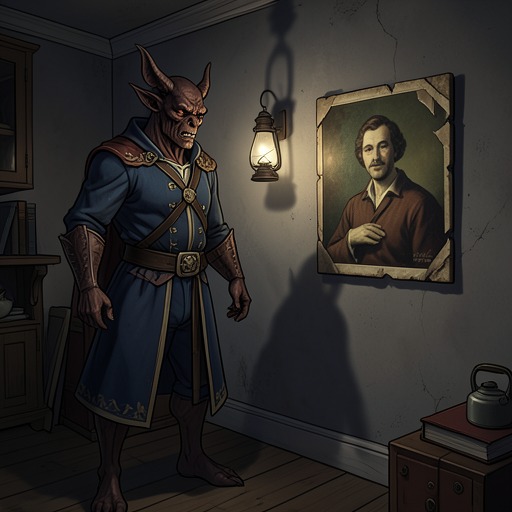
Amaya’s welcome extends beyond Theo. When Malthios visits Fox Tales in his demonic form, with horns, wings, tail, and claws openly visible, he expects rejection and tries to make himself unobtrusive. Amaya instead tells him to sit wherever he is comfortable. She recognizes him as Mal, acknowledges the difficulty of two people sharing one body, and treats his visit as a normal social occasion rather than a threat. Her response is especially significant because Malthios approaches the café burdened by the knowledge of what he has done and by the fear that Leafel’s acceptance may not include him.
Conversation with Malthios
Amaya does not stop at serving Malthios tea and three muffins. To his surprise, she sits opposite him and asks why he prefers muffins to her other pastries. His answer, that he favors tart flavors in sweets, opens a conversation grounded in taste, memory, and personal history rather than guilt. The small question gives him room to speak as an individual, not as the former Demon King or as the consciousness sharing Theo’s body.
She also tells Malthios about herself. She misses the cherry trees of her earlier home and still looks for them every spring, but she believes she could not have achieved the same success with her café had she remained there because of the competition. Her decision to leave shocked her parents, particularly because she was the eldest and fox beastkind are deeply family-bound. The disclosure creates a quiet parallel between them: both have left an earlier identity behind, and both must determine whether a new community can become home.
When Malthios says he hopes he can contribute to Leafel but does not deserve its welcome after everything he has done, Amaya answers without denying his history. She explains that the village does not hold him to the mistakes of his past and asks whether he thinks he is the only person escaping something. She names other residents’ painful histories, including Imani’s escape from an arranged marriage and Hayden’s killing of an abusive mentor, before describing Leafel as a place that takes in those who have nowhere else to go and helps them heal. Her argument is not that past actions are meaningless; it is that a person’s past does not exhaust the meaning of the person.
The conversation becomes physically intimate when Amaya places her hand over Malthios’s clawed one. Later, as memories of Kamil, Torq, and Foras return to him, Malthios grips her hand so tightly that his claws cut her skin. He releases her immediately and apologizes, expecting punishment. Amaya instead licks the cuts and smiles sadly, then tells him that grief takes time to heal, especially when it has been suppressed for too long. Her compassion does not erase his grief, but it gives it a form that can be acknowledged without destroying the present.
Community, Stigma, and Protection
Amaya’s actions gain further force when set against Theo’s fear of disclosure. Theo knows that friendship alone would not save him if people discovered what he was, and even Malthios’s promise to protect him cannot resolve the danger because Theo understands that Malthios would also be protecting himself. Cargo later identifies Theo as demonic offspring, freezing him in terror and prompting Malthios to try to take control. These moments establish the threat surrounding the shared identity that Amaya approaches through ordinary hospitality rather than suspicion.
That threat becomes institutional when Theo is taken to the capital, identified as Malthios’s host, and placed on trial. The court’s proceedings treat his connection to Malthios as grounds for punishment, while Leafel responds through collective resistance. Micah opens a mirror spell from the village square, with Imani, Dale, Dmitri and his parents, Nib, Amaya, Hayden, and the wider population gathered behind him. Hayden demands Theo’s release on behalf of Leafel. Amaya’s presence in that delegation confirms that her care is not limited to private kindness in the café; she stands with the community when its chosen family is threatened by official judgment.
The contrast between the capital and Fox Tales defines Amaya’s narrative function. The court sees a dangerous category and seeks to contain it. Amaya sees a person arriving anxiously for a snack, asks what flavors he likes, and offers him a seat. Her welcome does not depend on ignorance: she understands that Malthios carries guilt and grief, and she knows that Theo and Malthios share one body. Acceptance, in her hands, is an informed decision to leave room for healing.
Change and Narrative Significance
Amaya’s own account shows that belonging is something made rather than inherited. She left her family despite the expectations attached to being the eldest, mourns the cherry trees of her earlier life, and nevertheless calls Leafel her family because its people welcomed her and allowed her to give back. This history explains why she can recognize escape in others. She is not offering an abstract moral lesson; she is speaking from a life in which displacement, adaptation, and contribution have become connected.
Her final conversation with Malthios produces a visible change in him. He leaves Fox Tales with the taste of floral tea and his last muffin still with him, but more importantly with a renewed desire and a purpose. Amaya has not absolved him, solved his grief, or promised that the village will erase the consequences of his past. She has offered a structure in which remorse can lead somewhere other than self-condemnation.
Amaya therefore represents the everyday architecture of Leafel’s second chance. Her café, baked goods, permission-conscious affection, candid self-disclosure, and willingness to touch a wounded hand all turn welcome into repeated practice. Against the fear of exposure, the violence of institutional judgment, and the isolation produced by buried grief, she supplies a smaller but more durable power: the insistence that people may be known in their complexity and still be invited to sit down.