Demon Kinghood
The Reincarnated Demon King's Host Just Wants to Live in Peace, But the Hero Won't Leave Him AloneDemon Kinghood is the office and transformed state Malthios assumes after killing Naamah, marked by his blood-red wings, command over the demon hierarchy, and responsibility for a war against the mortal races. It first appears as the culmination of his grief and violence; later, when Malthios lives within Theo, the title becomes a contested destiny rather than simple freedom to rule. The contrast between the king’s public authority and his private dependence on a human host makes Demon Kinghood one of the story’s central measures of power and restraint.
Definition and Accession
Before Malthios’s rise, he had been defeated, but the danger associated with the title had not disappeared. Remnants of the Demon King’s army remained across the land under the remaining Demon Lords, while the Hero’s party protected ordinary people. The Capital’s palace also embodied the human side of that conflict: its adjoining halves housed the royal family and political gatherings on one side, and the training of magic users and knights on the other, including people who might serve the royals or join the Hero’s party. Malthios, present within Theo, reacts intensely when they cross the city walls; the place represents the authority that had defeated him and the destruction he had once wanted to unleash.
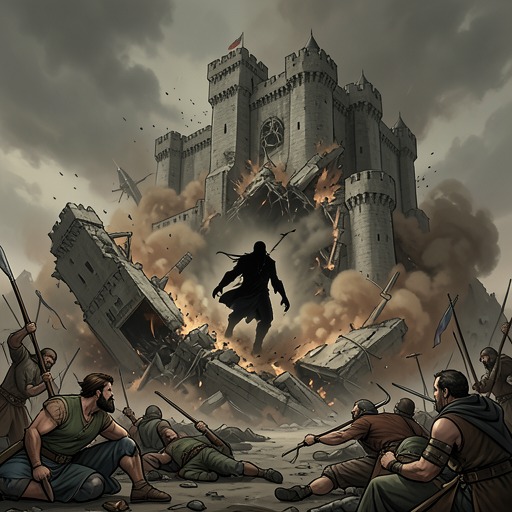
Malthios’s later accession follows the destruction of the Pentagram. Facing Naamah, he blames her for knowingly allowing the group to walk into the Hero’s presence and for the deaths that followed. Naamah answers by disparaging the Pentagram’s strength and denying that its members were fit to become Demon King. Malthios kills her, and her body is consumed by fire until only scattered ashes remain. As he watches, his mana surges with the force of his earlier ascension to Demon Lord. Blood on his skin and clothes sinks away, his wings open to their full span, and their glossy black feathers turn dark blood red. The change is visible to the assembled witnesses, many of whom have anticipated it as he kills his own kind: a new Demon King has risen.
Rule and the Demon Army
Malthios’s first month as king goes more smoothly than he expected, despite beginning with the killing of a Demon Lord and a dozen Novices. He regards the office as an enlargement of his former command, not an entirely different occupation: kingship means exercising authority on a broader scale. The obsidian-shard crown rests heavily on his head, a concrete emblem of the position and its burdens.
His rule takes shape through generals who carry out much of the military work. Tyraz becomes his right hand, described as ruthless; Keplo leads battalions with a firm hand and level head; Luvel serves as an assassin; and the young Nissle specializes in poisons. Malthios usually leaves the work to them, going out himself when restless or when a Hero might be present. A dozen or so Heroes have appeared over the years, but they have exhausted themselves fighting Novices or Demon Lords, and Malthios has not yet personally encountered another. His kingship thus combines delegated military rule with the expectation that he himself will meet the greatest threat.
The title also hardens Malthios’s purpose. As years pass, memories of his friends, including their voices and faces, fade. He shoulders the role of Demon King and lets the desire to crush the mortal races fuel him. In the village he returns to after his accession, he finds that the mortals are already mourning the people who fought his friends; their power in that battle has consumed their mana and life force. Malthios takes satisfaction in slaughtering the survivors and burning the village to ash. The scene presents kingship not as an abstract rank but as a power that permits—and, at this point, intensifies—his vengeance.
Kingship Within Theo
When Malthios later shares Theo’s body, Demon Kinghood becomes a source of conflict between the king’s inherited expectations and the life Theo has made. Theo knows that friendship cannot protect him if people discover what he is, and he prepares to run in case the secret is exposed. When Cargo directly asks whether he will tell the others that he is demon spawn, Theo freezes; Malthios presses forward inside him, ready to take control and defend them. The moment shows both the danger of disclosure and the king’s continuing instinct to answer danger with force.
That tension becomes visible during the attack by Luvel. Malthios and Theo deflect invisible blades while hovering just below the tree line; one strikes their thigh, and Theo’s healing magic repairs the injury. Luvel condemns the Demon King for being controlled by a mere mortal, turning away from the destiny of his crown, and hiding behind the mask of his lover. Malthios answers that the immediate problem is Luvel, not the possibility of a future Hero discovering him. He then attacks, counters Luvel’s magic with his own, and kills them. The episode confirms that Malthios retains lethal power, but also that enemies interpret his bond with Theo as a surrender of kingly autonomy. His reply focuses on the immediate threat rather than denying the underlying change.
Exposure and Significance
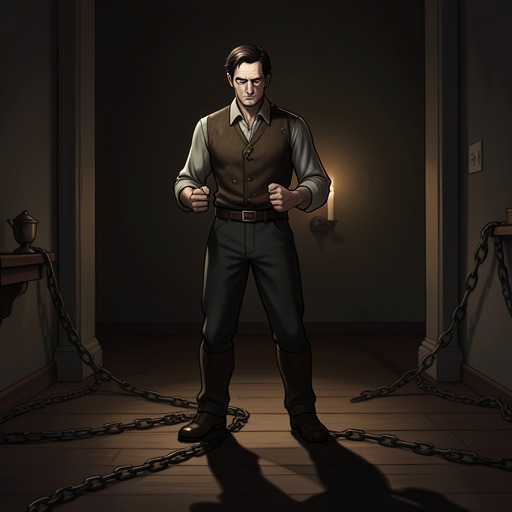
The secret eventually becomes public through Theo’s arrest and trial. A message sent by Avery reaches the court mage, and the party uses a rare Portal Orb to travel to The Capital. Theo is placed in magic-dampening handcuffs and taken to the dungeons. At the trial, the room is crowded with court members and figures from the Hero’s party; magic mirrors let distant rulers and other meeting rooms witness the proceedings. The court mage identifies Theo as the healer who has been revealed as host to the reincarnated Demon King, turning their shared-body state into a public charge.
The mirror above the throne makes that judgment visible beyond the palace, to towns, villages, and cities throughout Algeya. The exposure carries the threat of collective consequences for Leafel, and Theo fears that the village will suffer because of him. Yet the response from home reverses his expectation of abandonment: Micah opens a large mirror spell from the town square, with Imani, Dale, Dmitri and his parents, Nib, Amaya, and other villagers gathered behind him. Hayden speaks for them and demands Theo’s release. The scene does not resolve the trial, but it changes what public knowledge means: the host’s identity is no longer a secret borne by Theo and Malthios alone, and revelation does not automatically erase the bonds that make Theo more than a vessel.
Demon Kinghood therefore shifts from a visibly acquired crown and military office into a disputed relation among power, destiny, and consent. Malthios’s accession is accomplished through killing and witnessed transformation; his later existence within Theo makes that authority difficult to separate from another person’s life. The court can name Theo as the king’s host, and Luvel can call their coexistence a loss of sovereignty, but the people of Leafel respond to Theo as their healer and demand that he be freed. The title retains its political menace, while the story tests whether its meaning must be defined only by conquest and the expectation that a king will rule without restraint.