Demon Lord hierarchy
The Reincarnated Demon King's Host Just Wants to Live in Peace, But the Hero Won't Leave Him AloneDemon Lord hierarchy is the governing order of the demon forces, arranging Novices, commanders, Demon Lords, and the Demon King into a chain of power whose highest office is won rather than peacefully inherited. The hierarchy gives the remnants of Malthios’s army a structure capable of threatening Algeya, but its dependence on strength also makes the system unstable: promotion is tied to destructive might, loyalty is conditional, and every ambitious Demon Lord can become a potential successor or enemy.
Structure and Political Function
The hierarchy operates through military and courtly offices. After Malthios’s defeat, remnants of the Demon King’s army remained scattered across Algeya under the command of surviving Demon Lords, while the Hero’s party continued protecting mortal communities from them. Within the demon realm, Novices formed a lower rank trained under commanders and Demon Lords, while commanders supervised forces and served as political intermediaries. The throne hall gathered Demon Lords and Novices as a visible court, turning military power into a formal political order.
This organization parallels the human political institutions centered in the capital. The capital’s palace contains both the royal residence and the academy where magic users and knights are trained for royal service or for the Hero’s party, whereas the demon throne hall gathers those who have risen through demonic power. Human authority is presented through councils, royal courts, and magically connected mirror chambers; demonic authority is embodied in ranks, armies, personal allegiance, and the threat of violence. Both systems organize protection and command, but the demon hierarchy remains more directly exposed to physical power as the measure of legitimacy.
Advancement and the Demon King’s Office
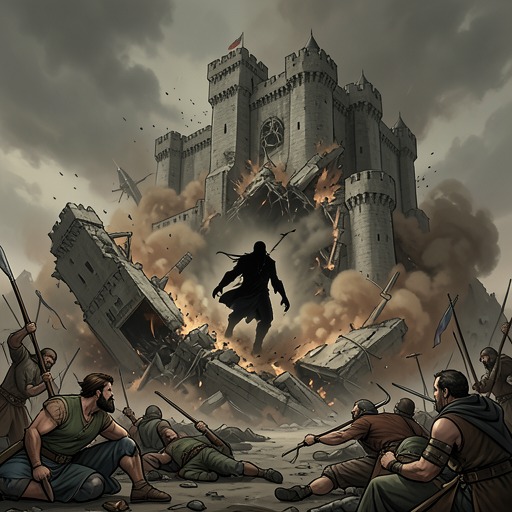
The hierarchy is shown most clearly through Malthios’s ascent. After returning to the throne hall wounded, bloodied, and carrying a drawn sword, Malthios confronted Naamah over the destruction of the Pentagram. Naamah argued that the group had been too weak to deserve ascension to Demon King, treating advancement as a judgment of battlefield strength rather than loyalty or moral worth. Her insult toward Aym provoked Malthios’s decisive attack, and he killed her despite being outnumbered by her Novices.
Naamah’s death became the immediate trigger for a higher transformation. As Malthios stared at her ashes, his mana surged as it had when he had previously ascended to Demon Lord. His wings opened to their full length, and their glossy black feathers turned dark blood red before the watching court. The hierarchy therefore makes succession a bodily and magical event: the new Demon King is recognized not by ceremony alone but by a visible alteration that confirms superior power. Malthios’s rise demonstrates that the highest rank is effectively claimed through overwhelming force, with political recognition following the transformation.
The succession also exposes the system’s circular logic. Naamah’s accusation that the Pentagram was unfit to ascend helps provoke the violence that produces Malthios’s own ascension, while Malthios’s victory proves the very principle she invoked. In this order, the ability to defeat rivals establishes the right to rule, and the right to rule is then used to organize further military power.
Command, Trust, and Rivalry
Once Malthios became Demon King, the hierarchy did not provide him with security. Naamah’s betrayal left him distrustful of the commanders and other Demon Lords around him, yet he could not rule without an inner circle. Commander Fulton, who had sponsored him, offered his council, and Malthios accepted that support. He sent the commanders and Novices he had trained with on long missions framed as campaigns of destruction, ordering them to spread word of the Demon King’s rise and search for signs of a new Hero. These assignments extended the hierarchy’s reach while also keeping potentially dangerous subordinates away from the center of power.
Malthios then began meeting Demon Lords he had not previously known in the hope of finding allies. The process is political rather than merely social: every new encounter tests whether a powerful subordinate can be incorporated into the regime or may eventually challenge it. Fulton introduced Lord Tyraz as the Demon Lord most likely to have ascended before Malthios. Tyraz is a master of shadows, physically imposing, and marked by a mocking expression, yellow slit pupils, grey wings, and horns resembling bleached bones. His courtesy toward Malthios carries an undertone of rivalry, because his introduction establishes him as the defeated candidate for the throne and therefore as a latent competitor within the new order.
Over the years, Malthios settled into the role of Demon King and allowed the desire to crush the mortal races to fuel his rule. His generals included Tyraz as his right hand and a ruthless subordinate, Keplo as the disciplined leader of his battalions, Luvel as a deadly assassin, and Nissle as a young assassin specializing in poisons. Malthios delegated much of the work to them and intervened personally when restless or when a possible Hero appeared. The hierarchy thus divides sovereignty from administration: the Demon King embodies supreme power, while generals execute the ongoing military and political labor of demon rule.
The Hierarchy in Conflict with Mortal Society
The demon hierarchy exists within a larger continental order shaped by opposition to it. Algeya’s mortal races maintain separate kingdoms, while allowing people to live and travel across borders; their cooperation was made possible in large part by the shared threat of the demons. The common enemy encouraged humans, dwarves, elves, and other peoples to establish joint laws and cooperate rather than suppress one another. Demon Lord rule therefore has consequences beyond demon society: its organized threat helps produce unity among otherwise distinct mortal communities.
That conflict reaches ordinary settlements through repeated attacks, demonic creatures, and the need for specialized protection. A venomous demon spawn leaves a member of the Hero’s party badly injured when no party healer can help, and the village healer Theo is sought because local people believe he works miracles. In another crisis, ghost-touch fills an inn with victims whose exposed skin has turned grey and blue; the threat is treated collectively through healing, ghost wards, and investigation. Even when a village refuses entry and demands that visitors survive the night outdoors before negotiations, fear of supernatural danger shapes access to communal space. These episodes show the hierarchy’s wider shadow: demon-related violence and magical threats make healing, border control, warding, and organized defense necessities of daily life.
The same political contrast appears in the capital’s institutions. Royal councils can meet through magic mirrors that display the reflections of rulers from across Algeya, avoiding the burden of portal travel, while the human court monitors the trial of Theo as the host of the reincarnated Demon King. The demon hierarchy and the mortal alliance are therefore connected by surveillance and emergency governance. The threat posed by demon authority justifies the coordination of mortal kingdoms, even as it leaves individuals vulnerable to being judged by the identity of the power within them.
Narrative Significance
Demon Lord hierarchy turns power into both a ladder and a trap. It gives Malthios a route from commander to Demon Lord and finally to Demon King, but each ascent deepens the violence required to maintain his position. The deaths of the Pentagram, Naamah’s betrayal, the recruitment of Tyraz, and the delegation of authority to generals all reveal a structure in which affection and trust are repeatedly subordinated to military usefulness.
The system also creates a deliberate contrast between inherited or institutional authority and authority proven through transformation. Human kingdoms use thrones, councils, academies, guards, and mirror-linked courts; demons use rank, armies, sponsorship, and combat. Yet neither order is morally simple. Mortal unity depends on fear of the demons, while demonic unity depends on fear of the ruler and the ambition of those beneath him. By making Malthios’s wings change color at the moment of ascension, the narrative gives this political principle an unmistakable physical image: hierarchy is not an abstract chart but a force written into the body, confirmed by blood, and sustained by the next possible challenger.