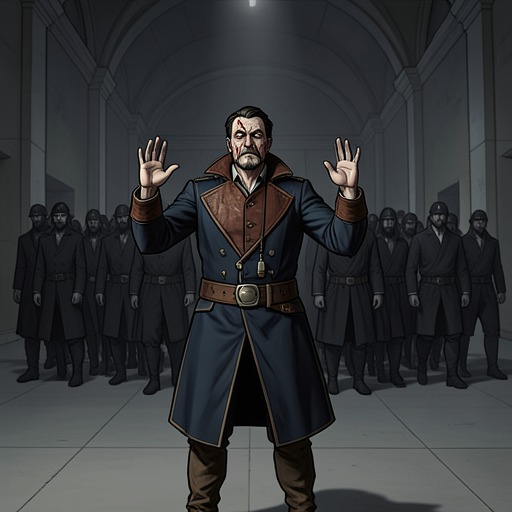
Demon Nature
The Reincarnated Demon King's Host Just Wants to Live in Peace, But the Hero Won't Leave Him AloneDemon Nature is the governing belief that demons cannot escape the instincts and institutions of their kind. In demon society, blood ties carry little value, power determines worth, and survival is organized around magical advancement. The concept begins as the explanation for Malthios’s cruelty and isolation, then becomes the central claim his life disproves: a demon shaped by violence can choose loyalty, protection, and peace.
Definition and Social Order
Demon Nature is presented first through the structure of demon society. Malthios does not remember his parents’ faces, and his earliest memories are marked by pain and scars. His parents abandon him before he is six, leaving him to steal food in a demon village. The society around him treats this abandonment as ordinary rather than exceptional, because demons have no secure family structure and regard blood as less important than magical potential. A child’s value is measured by usefulness, not by kinship or inherent dignity.
The hierarchy reinforces that principle. Demonkin occupy the lowest level, possessing little or no mana and serving primarily as common soldiers. Novices are Demonkin granted mana by a Demon Lord sponsor; the gift can produce formidable physical strength and varying degrees of magical ability, making Novices valuable combatants. Demon Lords gain immense mana and wings after massive slaughter of innocents. Above them stands the Demon King, a rare form whose method of ascension is known only to Demon Lords and which requires the demon to be worthy of the power. By the time of Malthios’s youth, no Demon King has existed for many years, making the title both political summit and nearly lost possibility.
Malthios’s Formation and Belief
Malthios survives the painful mana-gifting performed by Fulton, then endures harsh training among Novices who look down on him. The system gives him regular food and a bed, but it does not give him belonging. His effort to teach himself to read in the library, despite not being permitted to enter, reveals an early desire that does not fit the narrow demon ideal of strength through violence. He seeks knowledge while the institution trains him to become useful in battle.
That contradiction becomes explicit after other Novices rescue him during a fight. Malthios asks how demons can go against their nature, because he believes demons possess no family or friends, only means to an end. He also assumes that Fulton will discard him as soon as he stops being useful, which explains his relentless training and determination to stand alone. The other Novices answer that demons rely on one another in order to advance toward Demon Lord status and cannot win if they fight for nothing. Their response does not erase Malthios’s suspicion, but it introduces the possibility that cooperation and attachment can exist inside demon society even when its official values deny them.
The cost of advancement troubles the group. Aym calls the killing excessive and condemns the fact that it is the only recognized way for demons to evolve; Kamil agrees that the system seems outdated and that mortals possess advantages demons lack. Malthios refuses to admit that he shares their doubts. He insists that a demon cannot change their nature, while Aym argues that, if anyone could do so, it would be him because of his stubbornness. The exchange establishes Demon Nature as an imposed certainty that the younger demons can already recognize as morally and historically obsolete.
The Doctrine Tested by Human Attachment
Malthios’s later existence inside Theo places Demon Nature against a human environment organized around friendship, mutual care, and chosen family. Theo knows that no amount of friendship will save him if people discover what he is, and Malthios promises to protect him. Theo rejects the promise with the terse observation that Malthios would be protecting himself as well, exposing how thoroughly both souls understand the danger of their shared identity. Their relationship therefore begins under the shadow of concealment, not uncomplicated trust.
The danger becomes concrete when Cargo asks whether Theo will tell the others that he is a demon host. Theo freezes, and Malthios immediately tries to push forward to defend them. The reaction shows that Demon Nature has not vanished: secrecy remains necessary, self-preservation remains immediate, and Malthios is still prepared to seize control when exposure threatens them. Yet the same instinct now serves protection rather than domination. The old survival response has been redirected by attachment.
When Theo is summoned to the capital to help Luc, he understands that answering the call may end his autonomy. The authorities will learn who he is and where he lives, and the Hero’s party may force him into its ranks, exposing the truth about Malthios. Theo goes because Luc may die if he refuses, even though the political system treats heroes as expendable and can simply raise another child to replace one who is lost. The choice places responsibility above safety and makes Theo’s compassion the force that brings the hidden demon closer to judgment.
Reversal of the Demon Ideal
Malthios eventually acknowledges the violence that made him powerful. He has killed many demons of his own kind because demon advancement requires such killing, and he calls the process barbaric while recognizing the hypocrisy of demons condemning mortals for heartless choices. The admission turns Demon Nature into a historical cycle: demons explain their brutality as inherent, yet their institutions repeatedly teach and reward it.
The decisive reversal occurs when Malthios confronts Tyraz. He admits that he never expected his host’s will to be stronger than his own, nor that Theo would remind him that good things exist in the world. He also recognizes that Theo’s love has altered the direction of his life. When Tyraz calls Theo a human attachment and a sign of weakness, Malthios rejects the reduction, naming Theo as brave, selfless, and kind, and describing him as a host and friend.
Malthios then describes his new condition as peaceful. Theo places no expectation upon him, allowing him to be himself rather than the figure created by the crown and by the loss of his friends. His statement that a human who can change a demon’s heart might change what is wrong with the world transforms the concept from an individual dispute into a political challenge. Demon Nature is no longer merely Malthios’s private wound; it is the justification for an entire order, and Theo’s influence demonstrates that the order can be resisted.
Consequences and Thematic Significance
Tyraz counters that mortals will kill Theo once they learn he is Malthios’s host, and that both of them will be hunted. The threat reveals the second system enforcing Demon Nature: humans also define demons as irredeemable and treat association with them as grounds for punishment. Theo’s identity becomes a contested border between species, while Malthios’s promise to protect him becomes an ethical commitment stronger than the inherited rules of demon power.
Malthios’s final decision is correspondingly radical. After defeating Tyraz, he declares that he will end demonkind so that Algeya can know peace and no more children will lose themselves in the heroic system. His aim is not presented as simple triumph or revenge. He has once sought power and revenge after watching his friends slaughtered by a Hero, but Theo restores his memory of peaceful life, good food, and true friendship. Malthios chooses to destroy the institution that made him rather than preserve it for his own return to authority.
The human authorities continue to insist that Demon Nature cannot change. During Theo’s trial, Eliza argues that a demon’s nature is immutable and challenges Theo to defeat her without transforming, threatening to kill him if Malthios takes over. Her judgment shows how the doctrine survives even after Malthios has disproved it through action. Against that verdict stands Leafel, whose people publicly demand Theo’s release rather than abandoning him when his identity is revealed. The contrast separates social fear from lived relationship: the capital treats the host bond as evidence of guilt, while Theo’s community treats loyalty as evidence of personhood.
Demon Nature thus operates simultaneously as biology, ideology, hierarchy, trauma, and accusation. Malthios is formed by a world that equates strength with slaughter, but he is not finally defined by it. Theo does not erase the violence in Malthios’s past, and Malthios does not deny the deaths through which he rose. Instead, their shared life produces a different model of demon existence, one in which power can be used to protect rather than dominate and in which friendship is not proof of weakness. The concept’s decisive significance lies in that contradiction: what demons call nature is shown to be a tradition maintained by fear, reward, and repetition, and therefore something that can be broken.