Former Demon King status
The Reincarnated Demon King's Host Just Wants to Live in Peace, But the Hero Won't Leave Him AloneFormer Demon King status describes Malthios after his reign and organized demonic power have ended, but before his past has ceased to shape the present. The title is more than a record of former authority: it remains a source of danger for Theo, a rallying point for those who hate Demons, and a test of whether Malthios can inhabit a life beyond the violence by which he rose to power.
Identity and Origins
Malthios’s kingship did not come from a royal lineage. He explains that Demons have no royalty and that rank is won through death and power; becoming Demon King requires a candidate to be worthy of that power. His own childhood began on the streets after his parents abandoned him. He might have died there had a Demon Lord not sponsored him, an early rescue that led into a society where advancement is inseparable from violence.
His rise to the throne followed the deaths of his comrades. Malthios describes his ascension as an unintended consequence of avenging them rather than a position he deliberately chose. The transformation marked his body: before becoming Demon King, his wings were black like his hair; after killing many of his own kind to ascend, they turned red, a lasting reminder of the bloodshed behind his authority. The former king therefore carries his political history visibly, even when the throne and fortress no longer define his daily life.
A Dangerous Identity to Conceal
The continuing risk of the title first appears through Theo’s fear of disclosure. Theo knows that friendship cannot guarantee safety if anyone discovers what he is, and he keeps preparations for escape. When Cargo directly asks whether Theo will tell the others that he is Demon spawn, Theo freezes so completely that he nearly drops the basket he is carrying. Malthios immediately presses forward within him, ready to take control and defend them. The moment shows that Malthios’s identity is not merely a past title: its exposure can trigger an immediate threat to Theo’s body and freedom.
That threat becomes concrete when Theo is summoned to The Capital to help Luc. Theo understands that crossing the portal would surrender his autonomy: powerful people would learn who he was and where he lived, and Camden would recognize him even if the court mage did not. They could force him back into the Hero’s party, where his secret might be exposed. Theo nevertheless goes because Luc might die, refusing to treat him as expendable even though the institutions around the Hero could replace him with another child. Malthios’s concern stirs within Theo, but it does not erase Theo’s decision to risk exposure for someone he loves.
The Former King as a Continuing Threat
Malthios’s defeat of the Demon Fortress does not make the consequences of his rule disappear. He acknowledges that he destroyed the fortress and everyone there, while allowing that lesser Demons and demon-created monsters might remain. In his view, the organized enemy has been broken and competent adventurers can handle what is left; there is no longer a need for a Hero. The claim marks the end of the conflict’s central military structure, even as it cannot undo the lives already lost or settle how the world should respond to him.
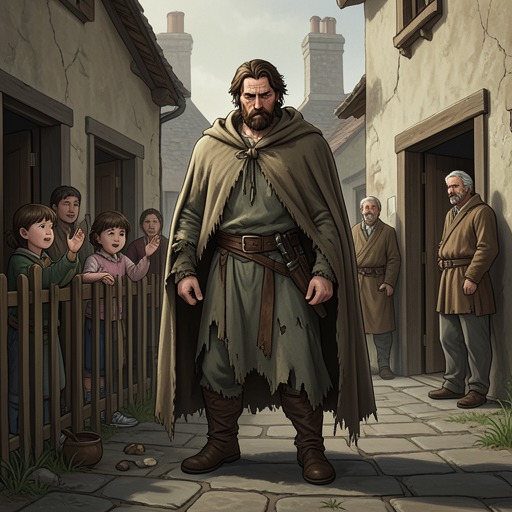
In Leafel, the former king’s presence changes the village’s prospects. Malthios walks the county boundary with Hayden, who is helping watch for danger. Although Leafel has occasionally faced monsters and lies away from the usual bandit routes, Malthios expects more enemies now that the former King of Demons and a retired Hero live there. He anticipates people, including Humans and members of other races, arriving for revenge or to prove themselves. When Hayden asks whether the village’s safety matters to Theo or Malthios, Malthios answers that it matters to both. His former status now creates danger for the community, but it also gives him a reason to help protect it.
That danger is not abstract. Armed attackers ambush Malthios and Hayden, calling Malthios the King of the Demons and Algeya’s filth. Hayden steps between him and the attackers and urges Malthios to get Theo to safety and summon help. The encounter makes plain how the former king’s name can turn a quiet boundary patrol into a confrontation, and how Hayden’s defense of him places another person at risk.
Trial, Judgment, and Community
Malthios’s status reaches its sharpest political test at the trial of the Demon King’s host. Theo is taken to the dungeons in The Capital after the court mage orders his arrest, and Luc cannot bring himself to speak as Theo is led away. The trial’s judgment concerns both Malthios and the healer whose body he shares: King Alexis concludes that Malthios is sentenced to life in prison, while Theo is free of all charges. The distinction separates the former ruler’s responsibility from Theo’s identity, even though the two remain bound together.
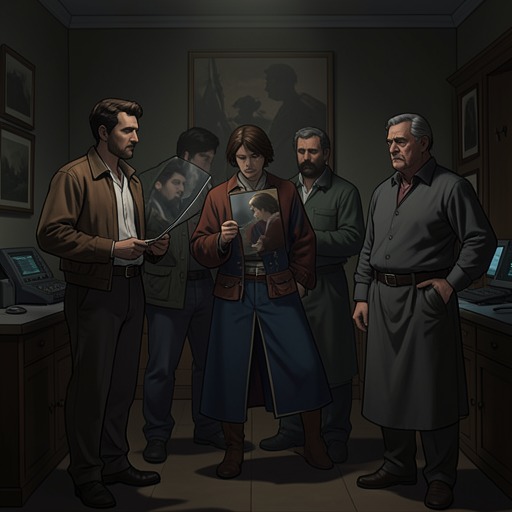
The proceedings also expose the limits of the court’s authority to define Theo for the people who know him. As the court moves toward a finding that Theo is guilty for protecting Malthios, Micah opens a mirror spell onto Leafel’s town square. The gathered villagers, including Imani, Dale, Dmitri and his parents, Nib, and Amaya, stand behind him; Hayden steps forward to demand Theo’s release. Theo realizes that the people he feared would reject him have instead come to defend him. Their presence challenges the assumption that his connection to the Demon King makes him their enemy, without pretending that Malthios’s history or the dangers surrounding them have vanished.
Life Beyond the Throne
The later description of Malthios as the former King of Demons places him in a markedly different setting: flying above Leafel and its surrounding farmland and forest with Theo. The flight recalls Kamil, who used to take Malthios flying; memory brings an ache, while Theo’s presence soothes it. Malthios understands that Theo’s healing reaches beyond magic, and that his closeness can comfort others as well. The scene does not erase the blood-marked wings or the history they signify. Instead, it puts that history beside a shared, living present in which Malthios can be a companion and protector as well as a former ruler.
The title thus holds two truths together. Malthios’s ascent depended on killing members of his own kind, and his former position continues to draw hostility toward him and those around him. Yet his authority has ended, the fortress has fallen, and his bond with Theo ties his remaining life to care for a community rather than rule over Demons. Former Demon King status is consequently both a burden inherited from past violence and a measure of the distance between the ruler he was and the life he is trying to build.