Healing Cannot Reverse Death
The Reincarnated Demon King's Host Just Wants to Live in Peace, But the Hero Won't Leave Him AloneHealing Cannot Reverse Death is the central boundary governing Theo Bladefoot’s practice as a healer. His magic can brighten a room, ease pain, slow the progress of Lung Rot, and protect the living from the consequences of injury, but it cannot turn death into a curable condition. The rule gives healing its moral shape: Theo’s task is not to defeat mortality, but to extend meaningful life where possible, reduce suffering when cure is impossible, and respect a patient’s choice when the end has come.
Definition and Limits
Healing in this world is powerful enough to make Theo a coveted resource of the state. After his magic test revealed an extraordinarily strong gift, the court mage declared that someone with such talent belonged in the Hero’s party and ordered him to study under Algeya’s greatest healer before entering Hero training. The assignment presents healing as a strategic weapon in the kingdom’s war against Demons, yet the later course of Theo’s life shows that even exceptional magic has a fixed limit. It can preserve a body, but it cannot reverse the fact of death.
That distinction separates healing from resurrection. Theo’s own fear repeatedly turns the limit into a personal accusation: whenever someone remains ill or dies, he feels that his failure as a healer has caused the outcome, even when the illness is incurable or the patient has reached the end of life. The rule therefore restrains both the magic system and the healer’s conscience. No amount of effort can convert every loss into a medical victory, and the inability to do so is not, by itself, proof that Theo has neglected his duty.
Glefald’s Illness and Theo’s Care
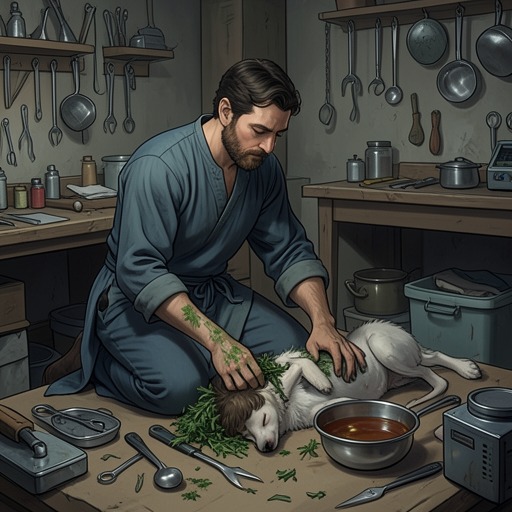
Glefald’s prolonged illness provides the clearest demonstration of the rule. The elf had struggled for years with an unknown disease that caused breathing problems and occasional coughing of blood. Malthios identified it as a disease created by Demons that caused rot in the lungs. It was incurable, but Theo managed to heal the worst of its damage and developed an infusion that could be added to boiling water to create healing steam. The treatment slowed the return of the rot rather than eliminating it, allowing Glefald to live longer without changing the final prognosis.
Theo’s treatment is therefore both effective and limited. His intervention does not accomplish nothing: it slows the disease, extends the period before death, and gives Glefald additional time in Leafel. Yet it does not promise indefinite survival. While townspeople suspected that something was wrong, they did not know that Glefald’s remaining days had fallen to single digits. Theo’s repeated healing had extended his original estimate of one month to nearly twice that span, but he could feel the elf weakening. Glefald had decided that he would soon choose a day to die if the Lung Rot did not take him first, while Isabelle prepared to tell the people of Leafel so they could say goodbye without overwhelming the Watchtower with constant visitors.
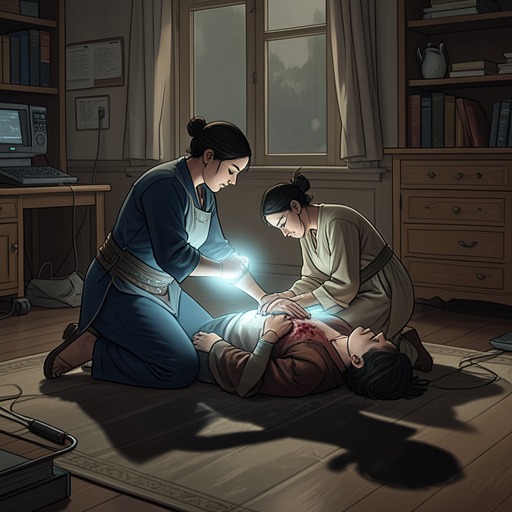
When Glefald’s condition worsened, Theo responded according to the responsibilities of care rather than the fantasy of a miracle. He followed Micah to the Watchtower, found Glefald skeletal beneath the quilt and pale against the pillow, and moved his hand over the elf’s chest while his magic lit the room. He ordered Micah to prepare throat-cure tea with plenty of honey and a splash of whiskey. The scene places magical healing beside ordinary nursing: the healer examines, treats symptoms, and organizes comfort while acknowledging that the disease itself cannot be conquered.
Theo nevertheless experiences Glefald’s decline as guilt. He had avoided visiting because of Hayden, believed he should have noticed the relapse sooner, and blamed himself for sheltering the being responsible for the elf’s suffering. His despair became so extreme that he imagined he should have killed himself after discovering that he was the Demon King’s host. Glefald’s response directly reframes the situation. Holding Theo’s wrist, he told him that he was ready, that death was merely the ending of a chapter, and that Theo should understand this as a follower of Arriss. The patient thus becomes the person who teaches the healer how to interpret the limit of healing.
Death, Choice, and Aftercare
Glefald died three days later. Theo spent almost twenty-four hours at the Watchtower, attempting to ease the elf’s suffering while Muffins remained at his side and Isabelle, Micah, and Cade brought food and supplies. Hayden kept watch from a chair by the door. At dawn, Theo noticed that Glefald’s chest had stopped moving and stated simply that he was gone, adding that everyone should rest. The long vigil demonstrates the practical meaning of healing’s boundary: once death arrives, the healer’s work changes from prolonging life to witnessing its end and caring for those who remain.
Glefald’s funeral further distinguishes acceptance of death from surrender to meaninglessness. Most burials in Algeya were bonfires intended to free the departed soul through smoke and sparks, but Glefald had chosen burial in the earth with a tree planted over his body so that his remains would feed new life. Leafel honored the traditional elven custom by burying him across from the Watchtower. The future tree would become a second guardian of the village entrance, transforming the place of burial into an enduring sign of protection and renewal.
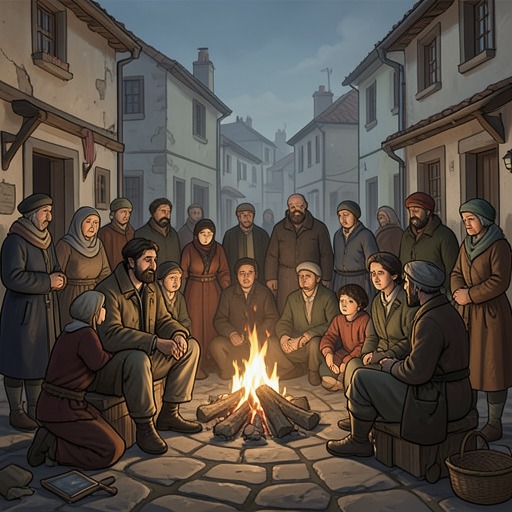
The funeral also makes death communal rather than private. The adventuring party lowered Glefald into the ground, while Micah, too slight to help, stood at the grave clutching his staff with tears on his face. Each person took a turn with the shovel, including Theo when Cade offered it to him. Liffey, Raf’s wife and the village’s only other elf, sang in her own language. Theo could not understand the words, but he understood their emotion; touching the Arriss pendant around his neck, he could not pray for himself but prayed for Glefald and hoped that the elf had found peace. He remained uncertain about a better place after death, yet felt that nowhere could be better than Leafel. The rule’s consequence is not merely biological finality but a demand that the living create meaning around an irreversible loss.
Teaching Micah the Boundary
After Glefald’s death, the rule becomes part of Theo’s relationship with Micah. Micah wants to study healing magic because he wants to help people as Theo does, heal them when they are hurt, and save them from death. Theo answers with a necessary correction: Micah cannot cheat death, and Glefald’s death was his time to pass because Glefald chose it. The lesson does not dismiss Micah’s desire. Instead, it distinguishes saving someone from death from helping a person live longer, endure less pain, and remain present for the people they love.
Micah understands this distinction. He explains that Theo eased Glefald’s suffering, allowed him to live longer and enjoy life, and demonstrated a form of healing worth learning. Micah also wants the practical ability to protect Hayden, Isabelle, and Cade when they are hurt during adventuring. At nine years old, he already carries a heavy responsibility, but his motivation shows that the limit does not make healing futile. It gives the practice a more precise purpose: protection, relief, extension, and accompaniment rather than mastery over mortality.
Theo agrees to take Micah under his wing only after requiring permission from Micah’s party and the completion of paperwork. That condition reinforces the rule’s ethical dimension. Healing is not an uncontrolled power imposed on another body; it is a disciplined practice involving consent, responsibility, and recognition of the patient’s circumstances. Micah’s apprenticeship begins not with a promise of limitless rescue but with an honest account of what a healer cannot do.
Wider Consequences and Significance
The boundary also clarifies why the book repeatedly contrasts healing with violence. The court treats Theo’s gift as an asset for the Hero’s party, where injured fighters are expected to return to duty. The same system turns bodies into instruments: Theo is assigned to the Heroic duty system as a child, while the Hero’s role is defined by the purging of Demons and protection of common people. Yet the scenes surrounding Glefald insist that a person is more than a body to be repaired and redeployed. A healer must listen to the patient, recognize incurability, and allow an ending that cannot be prevented.
The rule remains relevant when Theo confronts the consequences of the Demon King’s violence and when his identity is placed on trial. The court eventually condemns Malthios to life in prison and declares Theo free of all charges, but that judgment does not erase the dead or make past suffering reversible. Leafel’s intervention, led by Micah and supported by Hayden, Imani, Dale, Dmitri and his parents, Nib, Amaya, and the rest of the village, changes the political outcome by demanding Theo’s release; it does not undo the injuries that created the trial. Likewise, when Malthios states that the Demon Fortress has been destroyed and that there is no longer any need for a Hero, the end of an institution’s necessity is not the resurrection of those lost to it.
Healing Cannot Reverse Death therefore functions as both a rule of magic and a principle of narrative ethics. It prevents Theo from becoming an unlimited solution to every crisis, forces him to confront the difference between cure and care, and gives Glefald authority over the manner and timing of his own end. Its deepest significance lies in the transformation of healing from a promise to defeat death into a practice of sustaining life honestly. Theo’s greatest success with Glefald is not that he saves him forever, which he cannot do, but that he extends his life, eases his final suffering, honors his choice, and helps Leafel remember him as part of the village’s continuing life.