Hero Magic
The Reincarnated Demon King's Host Just Wants to Live in Peace, But the Hero Won't Leave Him AloneHero Magic is the defining supernatural discipline of the Hero in Algeya: unlike Theo’s healing or Malthios’s demonic mana, it is expressed principally through the body. It grants resilience, speed, strength, accelerated healing, and resistance to magic, making its wielder an exceptional combatant and the one force ordinarily capable of confronting the Demon King. Yet the same power that creates a near-unstoppable champion consumes the body that bears it, turning heroic protection into a form of shortened service and making succession an unavoidable part of the institution.
Nature and Capabilities
Hero Magic is described as entirely physical in its operation. Its wielder can endure punishment beyond ordinary human limits, move with extraordinary speed, strike with exceptional strength, recover from injury more quickly, and withstand magical attacks. These abilities are not presented as effortless gifts: like other magic, they must be honed through training, often beginning in childhood. Eliza started training at twelve, while Luc began at five, suggesting that the power’s effectiveness depends on long preparation as well as innate heroic status.
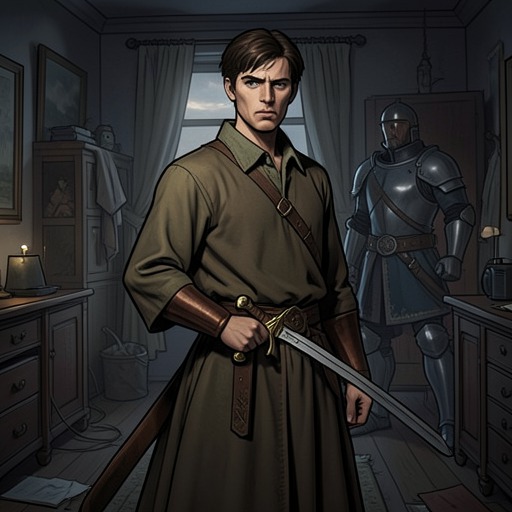
The battlefield presentation of Hero Magic gives the ability a visible, almost emblematic form. The Hero appears as a hardened warrior whose presence can be felt across the field, with a glow resembling sunlight coming from the skin and a sword of unmatched quality in hand. When the Hero enters the battle, the response is immediate: Malthios orders his troops to intensify their attack, while Kamil warns that only a Demon King can stand against a Hero. The contrast establishes Hero Magic not merely as a strong combat technique but as the military answer to demonic supremacy.
Cost and Succession
Hero Magic carries a biological cost that sharply limits the lifespan of its users. Its power burns through the body so quickly that every recorded Hero has barely survived into their twenties. This limitation transforms the heroic office into a succession system rather than a permanent vocation. When Theo is fourteen, rumors spread that a new Hero has been found and is being trained to replace Eliza. Eliza is already showing signs that her time is running out, and her fight with Malthios has taken a substantial toll. Her search for a successor therefore follows the established cost of Hero Magic rather than simple political preference.
The lifespan constraint also creates a grim contrast between public legend and private endurance. The Hero is celebrated as the defender capable of overcoming the greatest supernatural threat, but the magic steadily consumes the defender’s own body. Eliza’s declining condition makes the cost visible, while the prospect of a replacement reveals how the heroic system preserves its function by passing the burden from one short-lived champion to another.
Combat and the Demon King
Luc demonstrates the fullest martial expression of Hero Magic when he fights in Leafel. His body flows from one movement to the next, his sword behaving like an extension of his arm, while his speed and footwork make him seem almost weightless. Theo instinctively studies his forms and memorizes his fighting style, recognizing that Luc’s physical ability is far beyond ordinary training. Malthios judges Luc superior to Eliza, calling him a truer Hero because of his boldness, fearlessness, and near-reckless commitment to combat.
Malthios’s assessment also distinguishes Luc from Eliza in moral as well as physical terms. Eliza could care for her companions yet place the mission above their lives; Luc fights with his heart and may refuse that sacrifice. His attachment makes him stronger because it gives his courage personal meaning, but it also creates a vulnerability that a purely mission-driven Hero might avoid. Hero Magic thus amplifies not only bodily power but the consequences of the wielder’s character.
The relationship between Hero Magic and the Demon King reaches its clearest statement when the Hero appears on the battlefield against Malthios. Malthios immediately draws his sword and orders the attack doubled, while Kamil insists that the troops must flee because only a Demon King can withstand a Hero. Malthios chooses to hold the Hero off himself so the others can evacuate. The scene makes the opposition structurally reciprocal: Hero Magic is the weapon designed to destroy demonic rule, while Demon Kinghood is the one demonic state capable of meeting it directly.
Duty, Judgment, and Choice
Hero Magic is inseparable from an institutional duty to kill the Demon King. During the trial of the Demon King’s Host, Luc declares that, as the Hero, it is his duty to kill Malthios. The statement reflects the legal and cultural expectation attached to the power, not merely a personal desire for revenge. It also shows how Hero Magic can turn a moral decision into an inherited command: the bearer is expected to act because the role demands it.
Luc nevertheless separates duty from immediate obedience. After stating that the Demon King must eventually be killed, he adds that he can choose when that will happen. This distinction becomes the central ethical limit placed on Hero Magic. The power gives Luc the ability and authority to end Malthios’s existence, but it does not erase his judgment or force him to treat execution as the only possible present action. His decision postpones the prescribed punishment while preserving the stated duty, creating space for responsibility, restraint, and a future choice.
The trial’s outcome confirms that Hero Magic does not automatically determine justice. Malthios is sentenced to life in prison, while Theo Bladefoot is freed of all charges. The ruling follows public intervention from Leafel, whose people appear through a mirror spell to demand Theo’s release, and Luc’s decision to delay execution. The Hero’s power remains available, but its use is redirected from immediate killing toward controlled judgment. In this resolution, the most consequential act of the Hero is not a strike but a refusal to make violence the only expression of heroic authority.
Narrative Significance
Hero Magic embodies the tension between power and its price. It is the clearest physical counterforce to the Demon King, and its manifestations—sunlike radiance, impossible speed, formidable strength, rapid healing, and resistance to magic—give the Hero a mythic presence on the battlefield. At the same time, its consumption of the body prevents that mythology from becoming uncomplicated triumph. Every Hero is powerful because every Hero is temporary.
The concept also complicates the conventional heroic pattern. Hero Magic supplies the champion with the means to defeat the central enemy, but the story’s resolution depends on whether that champion will use the means immediately. Luc’s attachment to others, especially Theo, becomes not a distraction from heroism but the basis for a more deliberate interpretation of it. By choosing when to fulfill the duty rather than denying that the duty exists, he exposes the gap between a system’s command and the conscience of the person empowered to carry it.
Hero Magic therefore functions as both weapon and institution. It sustains the world’s defense against the Demon King, organizes the succession from Eliza to Luc, and gives the Hero overwhelming combat superiority. Its cost, however, reveals the violence built into that system: the world protects itself by spending the lives of its protectors. The final judgment does not abolish the power or its obligation, but it places a human decision between the rule and its execution, making restraint part of what heroic strength can mean.