Host Consent Restriction
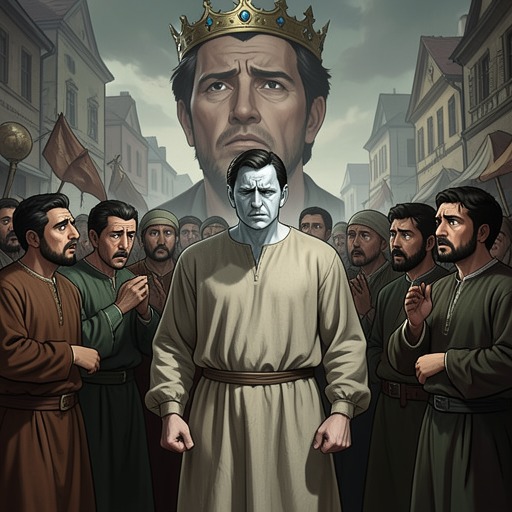
The Reincarnated Demon King's Host Just Wants to Live in Peace, But the Hero Won't Leave Him AloneHost Consent Restriction governs the relationship between Theo and Malthios by placing the Demon King’s immense power behind the host’s consent. Malthios can inhabit Theo and influence him, but he cannot simply seize the body or act freely whenever he wishes. This limitation is the practical foundation of Theo’s autonomy, his flight from the Hero’s system, and the later conflict over whether protecting Malthios makes Theo legally or morally responsible for the Demon King’s actions.
Definition and Operation
The restriction emerges when Malthios tries to begin shaping Theo toward evil at the age of two, after Theo has learned to walk, speak fully, and begun reading and writing. Malthios intends eventually to take over Theo’s body and return to the throne of demon kind, but the plan fails because Theo’s will is stronger than expected. Malthios cannot control Theo’s body or use his magic without Theo’s permission. The only exception is a lapse of control brought on by an intense, sudden emotion such as anger or fear.
Those lapses occur only once or twice during Theo’s childhood, usually when other village children bully him. Theo is small for his age and considered strange, and the pressure of those encounters briefly loosens his restraint. When control slips, Malthios’s demonic form begins to surface: horns grow from Theo’s head, wings emerge from his shoulders, and a tail appears at the base of his spine, while his eyes bleed black, their pupils narrowing into red-glowing slits. Theo manages to escape before the transformation fully exposes him. The rule therefore protects his agency without making him invulnerable; emotional shock remains a direct route through which Malthios’s power can break into the visible world.
Theo’s Self-Discipline and Bargain
Theo experiences Malthios’s magic as terrifying in its raw power, yet also as natural, as though it belongs to him. His awareness that he is the Demon King’s host makes control both a physical necessity and a central part of his identity. He learns to clamp down on the being inside him, treating emotional regulation as concealment and defense rather than merely personal composure.
After Theo’s magic test, Theo and Malthios establish a negotiated arrangement. Malthios agrees to stop trying to take over Theo’s mind and body. In exchange, Theo promises occasional control once his training is complete and the pair are far from the capital and from past and present Heroes, provided Malthios does nothing against Theo’s wishes. The bargain converts the restriction from a purely defensive condition into a form of shared governance. Theo does not grant Malthios unrestricted possession; he preserves a veto over the demon’s conduct while allowing limited, delayed access under circumstances he can choose.
The arrangement also explains why Theo refuses the expected path assigned to him. On his sixteenth birthday, Camden tells him that guards will arrive to take him to the capital, where he will meet the new young Hero and train until the Hero reaches adulthood. Their future duty will be to purge the remaining Demons and protect commoners. Rather than submit to that system, Theo packs his belongings and food, leaves without a note for Camden, and travels with Malthios for two years, taking odd jobs while moving steadily north. The Host Consent Restriction makes escape possible, but it also makes distance necessary: the farther Theo travels from official scrutiny, the less likely the truth about his body will be discovered.
Secrecy, Disclosure, and Institutional Control
Theo understands that friendship alone cannot save him if anyone learns what he is. His fear is not abstract embarrassment but the expectation that discovery will erase ordinary protections and make him answerable for Malthios’s existence. When Cargo later asks whether Theo will tell the others that he is “a demon spawn,” Theo freezes, and Malthios immediately presses forward, trying to take control in order to defend them. The episode shows the restriction under stress: Theo’s fear activates the very emotional vulnerability that can permit Malthios to emerge, while Malthios’s protective impulse threatens to replace Theo’s agency.
The same danger becomes unavoidable when Bryony asks Theo to return through a portal to help Luc, who may die without his healing. Theo recognizes that entering the capital will end his autonomy. Those in power will know who he is and where he lives; even if the court mage fails to recognize him, Camden may do so, and the authorities could force him into the Hero’s party, where the truth about Malthios might be exposed at any moment. Theo nevertheless goes because Luc is not expendable to him, even though the political system can replace a dead Hero by raising another child.
The state treats Theo’s body as an instrument before it treats him as a person. The court mage declares that his exceptional healing gift belongs in the Hero’s party, sending him to learn from the greatest healer in Algeya and then enter Hero training. Later, after Theo’s identity is confirmed, orders from the court mage and Hero Eliza place him in magical-dampening handcuffs. The restraints answer the authorities’ fear by suppressing Theo’s capacity to act, but they do not distinguish between Theo’s choices and Malthios’s presence. The legal response effectively converts the host-consent problem into a presumption of danger.
Trial and Consequences
The formal trial is titled “Trial of the Demon King’s Host,” a designation that defines Theo through his condition rather than through his conduct. A magic scroll carries messages to the court mage, and a rare Portal Orb brings the party to the capital; once Theo puts on the cuffs, the group reaches the capital courtyard within ten minutes. A dozen knights and the court mage await him, and she orders him taken to the dungeons. Theo cannot look at Luc after confirming what he is, experiencing the separation as a wound that his healing magic cannot repair.
The court then asks whether Healer Theo is guilty for protecting Malthios. Before the judgment can proceed, Micah opens a new mirror spell showing Leafel’s town square, with Imani, Dale, Dmitri and his parents, Nib, Amaya, and the townspeople gathered behind him. Hayden speaks for Leafel and demands Theo’s release. Their intervention changes the meaning of the restriction: Theo’s concealed condition does not automatically make him an enemy to those who know his actions and relationships. The people of Leafel refuse the capital’s assumption that the host is merely an extension of the Demon King.
The dispute also exposes the difference between institutional duty and personal responsibility. Theo condemns Eliza for turning Luc into a weapon and rejects the idea that duty excuses the use of children. Eliza answers that Theo fled his own duty, but the accusation fails to settle whether a host can be blamed for the being within him when the host’s consent is itself the boundary preventing possession. King Alexis ultimately states that the court and council do not decide Theo’s fate: the choice belongs solely to Hero Luca. The ruling leaves the Host Consent Restriction embedded in a larger question of agency, loyalty, and who has the authority to judge a life shared by two souls.
Narrative Significance
Host Consent Restriction is both a magical rule and a social condition. Mechanically, it prevents Malthios from becoming an all-powerful possessor and gives Theo the decisive ability to refuse him. Dramatically, however, the rule demands constant vigilance. Theo must suppress fear and anger, conceal visible transformations, calculate whom he can trust, and weigh every request for help against the possibility that entering public life will place his body under official control.
The rule also produces an ironic reversal in the story’s moral structure. The authorities fear Theo because he contains the Demon King, yet Theo’s will is precisely what prevents Malthios from acting without permission. The same host who is treated as a security threat is the person maintaining the strongest barrier against that threat. His protection of Malthios is therefore not simple submission: it is the difficult consequence of a negotiated coexistence in which Theo remains the final authority over the shared body.
By linking power to consent, the rule makes Theo’s resistance more than an escape from Hero training. It establishes his body as the contested site where demonic inheritance, human law, emotional vulnerability, and chosen loyalty meet. The later appearance of Leafel before the court confirms the rule’s deepest consequence: Theo’s identity cannot be reduced to the danger he carries, because the people who know him judge him by the agency he exercises under that danger.