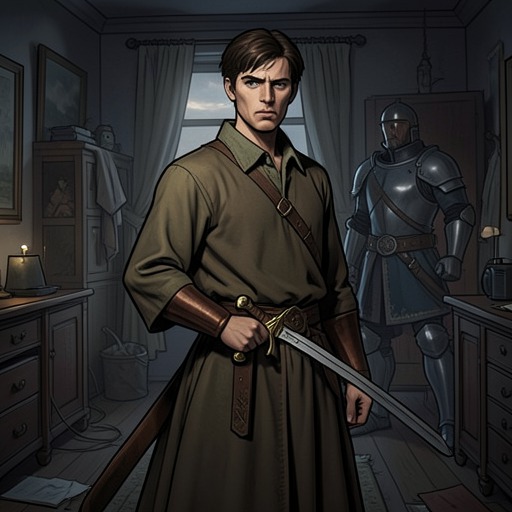
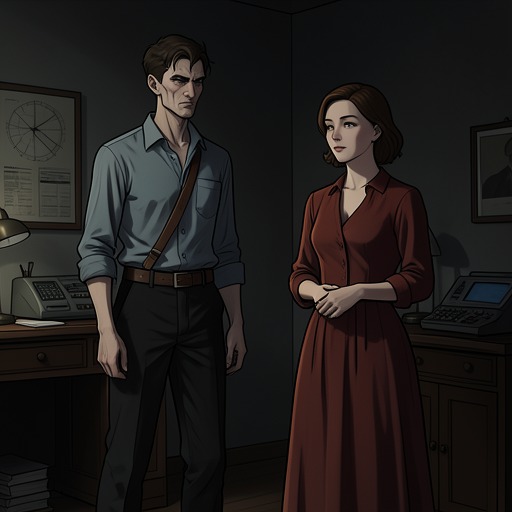
Luc Rejects Eliza’s Control
The Reincarnated Demon King's Host Just Wants to Live in Peace, But the Hero Won't Leave Him AloneLuc Rejects Eliza’s Control marks the moment Luc turns a private refusal into a public break with Eliza: he will complete the fight against the demons, but he will no longer let her determine what his life is for. His declaration joins two conflicts that have been gathering around him—the Hero’s inherited obligations and his right to choose a life with Theo—and sets the terms for the choices he later makes before the court.
Background: A life treated as a duty
Luc’s departure from Eliza’s control is sharpened by the life the Hero’s role has already cost him. Earlier, he tells Theo that his first sustained relationships were with people in the capital where he grew up. One was a maid in training, when they were both very young; the other was a squire who trained with him. That relationship ended when Luc’s departure was announced. Luc had asked the squire to come with him, but the squire broke things off. Later relationships formed during the party’s stays in towns, but none lasted. Luc presents this pattern as the fate of the Hero: movement and duty repeatedly interrupt the possibility of a lasting home.
His bond with Theo offers a different prospect, but it is not free of the past. Luc gives Theo a silver ring textured like scales and set with a dark sapphire, explaining that it belonged to his father and is all he has of him. His father died after saving his adventuring party from a demon attack. Luc places the ring on Theo’s marriage finger. The gesture connects the life Luc wants to build to a family history shaped by sacrifice, without making that sacrifice a command that Luc must reproduce. In the later confrontation, Eliza’s insistence on destiny and bloodline presses against this more personal promise of a chosen future.
The conflict also extends beyond Theo. Before Luc’s break with Eliza, Julius tells Theo that he had been happy when Luc asked him to join the party, but Eliza ordered him to refuse. She told Julius that Luc needed no distractions and threatened to take everything from him if he did not let Luc go. Julius believes Eliza wants Luc to sire the next Hero and continue their bloodline, something Julius and Theo could not provide. His account reveals that Eliza’s influence has already reached into Luc’s intimate relationships, and that her idea of his future includes an expectation of reproductive succession.
The departure: Refusal made public
At the party’s departure, Eliza is present alongside the court mage, Syvia. Theo sees her glance toward him before she gestures for Luc to join her off to one side. Her presence brings together the political authority surrounding the Hero and the personal harm she has caused him. Theo feels fear and anger, and wants to shield Luc, while Wicker offers a reassuring touch. The others gather with their packs, ready to leave; the scene begins as a send-off but quickly becomes a confrontation over who has the right to direct Luc’s life.
Luc returns to the group visibly angry and speaks loudly enough for them to hear. He thanks Eliza for what she has done for him, but declares that their arrangement ends: once the demons are defeated, he is done, and his life is not hers to control. The qualification matters. Luc does not abandon the immediate campaign or deny the work he has undertaken; he draws a boundary around what follows it. He will fulfill the present task without consenting to an endless duty that Eliza can define on his behalf.
Eliza’s expression remains controlled, though her eyes flash with rage. She frames Luc’s decision as throwing away his great destiny and duty for a whim of the heart. Luc answers by contrasting her concern for bloodline with her own capacity to have children, then turns away. His insult is deliberately personal, and the exchange exposes how completely their disagreement has moved beyond the campaign: Eliza invokes the continuation of the Hero’s line, while Luc rejects the presumption that his life must serve that purpose. He walks back to the party rather than waiting for permission to leave. When he takes Theo by the wrist and leads him toward the gate, the others scramble after them. Eliza does not stop him, but her cold stare toward Theo promises that the dispute is not over.
The choice and its consequences
For Theo, Luc’s declaration is both an act of independence and a source of danger. Theo has already warned Julius that he will not be scared away from Luc. At the departure, he recognizes Eliza as someone who has hurt Luc and feels the impulse to protect him; after Luc turns his back, Theo briefly fears that he has left himself exposed to an enemy. The moment does not make the conflict disappear. Instead, Luc’s choice makes it explicit and visible to the party, while Eliza’s unspoken threat carries the struggle beyond the gate.
The break also changes the meaning of the party’s journey. Khal welcomes Theo and remarks that Luc has been moody for the past six months whenever the party left Leafel; Avery hopes that Theo’s presence will help Luc focus on the quest. Their comments show that Luc’s attachment to Leafel and his longing for Theo have been apparent to the group. But the departure is not simply a return to adventure with a lover alongside him. Luc has announced that the campaign has an endpoint, and that his life afterward cannot be assigned to him by Eliza. Syvia’s parting warning that the King’s will can change with the seasons leaves the party’s position politically uncertain, even as Luc proceeds.
Echo at the trial: Duty on his own terms
Later, during the trial concerning Theo’s protection of Malthios, Luc’s earlier refusal takes a more consequential form. Once Theo’s identity is exposed, Luc is silent as Theo is taken to the dungeons in the capital. Leafel’s people then appear through a mirror spell, with Micah casting and Hayden demanding Theo’s release on their behalf. Their intervention makes clear that Theo has not been abandoned by the community he chose as home.
When Luc later asks whether Malthios destroyed the demons, Malthios confirms that the fortress and those inside it were destroyed, and says there is no longer any need for a Hero. Luc nevertheless declares that, as the Hero, it is his duty to kill the Demon King—but immediately adds that he gets to choose when. He describes Theo as Malthios’s prison and himself as its humble guard, then tells Eliza that choosing a quiet, peaceful life with the man he loves is the only choice he has ever made for himself. He also imagines a world in which those born with the Hero’s gift can choose their fate rather than being bound to duty.
That later exchange clarifies the departure scene’s lasting significance. Luc does not claim that duty has no force; he refuses Eliza’s claim to be the person who decides its limits and his future. The court ultimately sentences Malthios to life in prison and frees Theo of all charges. Luc’s break with Eliza thus leads into a wider argument about obligation, consent, and the right to choose a life beyond inherited roles. What begins at the gate as a declaration that his life is not Eliza’s to control becomes, before the court, a defense of choice for every bearer of the Hero’s gift.