The Hero's Party Disbands and Escorts Theo Home
The Reincarnated Demon King's Host Just Wants to Live in Peace, But the Hero Won't Leave Him AloneThe Hero's Party Disbands and Escorts Theo Home marks the transition from a quest organized around the destruction of the Demon King to a future organized around chosen family, accountability, and ordinary life. Its decisive significance lies in the party's refusal to remain bound together by the old heroic mission: Luca keeps his duty but claims the right to decide when and how it will be fulfilled, while Theo leaves the court not as a condemned host but as a healer cleared of every charge. The return to Leafel is therefore both a physical homecoming and a rejection of the institutions that defined them.
The Trial’s Resolution
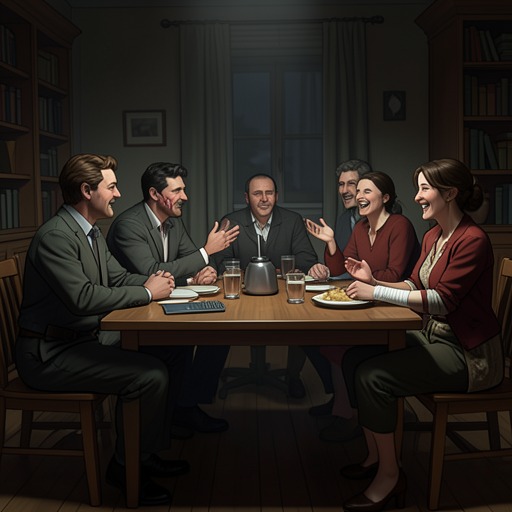
The disbanding follows the trial of the Demon King's host, which is conducted in the capital after Avery uses a message scroll and the party breaks a Portal Orb to reach the court. Theo is taken to the dungeons in Magic-Dampening Handcuffs, and the proceedings initially place him in the position of a criminal because he protected Malthios. The judgment changes when Micah opens a mirror spell from Leafel and shows the town gathered behind him: Imani, Dale, Dmitri and his parents, Nib, Amaya, Hayden, and the wider community demand Theo's release. Their intervention makes visible the local bonds that the court's accusation had ignored. Theo understands that Leafel has not abandoned him, and that the people there regard him as one of their own.
The court also receives a direct account of Malthios's actions. Malthios admits that he destroyed the Demon Fortress and everyone inside it, while warning that a few lesser demons and demon-created monsters may remain. He concludes that there is no longer any need for a Hero, but Luca does not accept that conclusion as permission to erase his own role. He declares that, as the Hero, it is his duty to kill the Demon King; he immediately qualifies that statement by insisting that he can choose when the killing occurs. This distinction allows the verdict to recognize danger without reducing every question of justice to immediate execution.
King Alexis finally announces the sentence: Malthios is condemned to life in prison, while Theo Bladefoot is free of all charges. The result is neither simple acquittal nor uncomplicated forgiveness. Malthios remains answerable for the destruction he caused, but Theo is not treated as identical with the will housed within him. The court's decision separates host from Demon King and makes room for a controlled, continuing existence rather than an automatic death sentence.
Luca’s Choice and the Party’s Fracture
The verdict exposes the conflict between Luca's private future and the hereditary demands placed upon him. Earlier, Luca had explained that the fate of the Hero made lasting relationships difficult: partners were left behind when the party moved on, and even a squire who had trained with him ended their relationship when Luca was announced to be departing. His relationship with Theo breaks that pattern through an explicit promise to wait, symbolized by Theo's Arriss Pendant and by the silver, scale-textured ring set with a dark sapphire that belonged to Luca's father. Luca places the ring on Theo's marriage finger, joining personal inheritance to a future that is not controlled by the Heroic duty system.
That future directly opposes Hero Eliza's expectation that Luca should continue the bloodline and sire the next Hero. Julius reveals that Eliza had threatened to take everything from him unless he abandoned Luca, believing that Luca required no distraction from his assigned purpose. At the trial, Eliza frames Luca's decision as the destruction of their bloodline and the waste of everything for which he trained. Luca answers that choosing a quiet and peaceful life with the man he loves is the only choice he has ever made for himself. He further imagines a world in which people born with the Hero's gift can choose their fate rather than remain bound to duty. The escort home thus begins as an act of political and emotional refusal: Luca declines the reproductive future prescribed by Hero Eliza and chooses a non-hereditary household with Theo.
The party does not dissolve because its members cease to matter to one another. It separates because each member must respond to the consequences of the journey. Emi leaves after Eliza, without waiting for Luca's request, signaling a loyalty that remains with the older Hero. Bryony turns her back and refuses to escort Theo, a rejection shaped by her gravely injured brother and by her inability to accept that the person responsible can walk free. Her refusal hurts Luca, but he recognizes why she cannot offer solidarity on those terms. Avery also declines, though for a different reason: he must return to the academy for the spring semester if he is to continue his studies and become a magic researcher. His departure is not a denunciation. Luca embraces him, tells him he is proud, and asks him to write, transforming separation into an acknowledgment of an independent future.
The Escort Home
Luca does not assume that the remaining companions will continue with him. He admits that he has no right to ask, then appeals to the party's shared beginning and says that he would like to finish together by having them escort him and Theo home. Khal accepts, calling it an honor; Veiv beams, and Wicker claps their gloved hands. Their response restores a form of fellowship after the court has divided the group, but it is fellowship chosen freely rather than imposed by a mission decree.
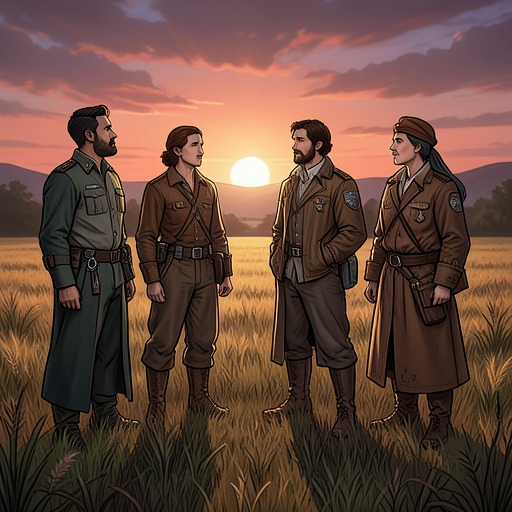
The group that leaves is deliberately smaller and more intimate: Theo and Luca, Khal, Veiv, Wicker, and Cargo. As they reach the door, Luca picks up the Hero's sword while keeping hold of Theo's hand. The gesture preserves the visible symbol of the Hero without allowing it to dictate the couple's direction. The sword travels with them, but the institution and the inherited expectations surrounding it no longer command the scene. Luca and Theo leave together, accompanied by those who consent to the journey, while the other members take separate paths.
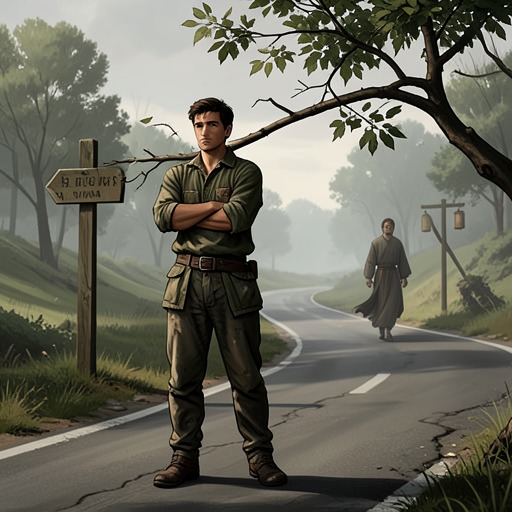
Their destination is Leafel, where the mirror spell has already shown a community prepared to defend Theo. Luca tells the people that, if the roads are clear, they should arrive home before spring. The seasonal promise gives the return a practical horizon, but it also contrasts with the endless itinerancy that defined the Hero's life. This is not another departure toward an unspecified battle. It is a journey toward a town, a household, and a community that has publicly claimed them.
Consequences and Narrative Significance
The event resolves several competing meanings of heroism. Luca remains willing to acknowledge the duty to kill Malthios, but he refuses to let that duty determine every moment of his life or require Theo's immediate death. His statement that Theo is Malthios's prison and that he will not let Theo out of his sight reframes protection as an ongoing responsibility. The Demon King is constrained, Theo is released, and Luca accepts the burden of guarding the arrangement rather than pretending that the danger has vanished.
The ending also distinguishes personal attachment from public repair. Leafel's intervention supplies communal recognition, King Alexis supplies a legal judgment, and Luca supplies a personal decision about the future. None of these replaces the others. Malthios's life sentence acknowledges punishment; Theo's release acknowledges the limits of host culpability; the escort acknowledges the relationships formed through shared danger; and Luca's rejection of compulsory succession challenges the system that made heroic violence appear inevitable.
At the threshold of departure, Theo tells the leaders of Algeya that Malthios may be reformed, but that he will still retaliate if anyone threatens them or their people. No one answers. Luca simply slips his hand into Theo's, and together they leave. The silence closes the court's authority over them. The Hero's Party has not ended in a single ceremonial farewell but in a series of distinct choices: Emi follows Eliza, Bryony refuses, Avery returns to study, and Khal, Veiv, Wicker, and Cargo accompany Theo and Luca home. What survives is not the old party as an instrument of duty, but a chosen network capable of carrying the characters beyond the war.