The Heroic duty system
The Reincarnated Demon King's Host Just Wants to Live in Peace, But the Hero Won't Leave Him AloneThe Heroic duty system is the institution through which Algeya claims the bodies, talents, and futures of those born with the Hero’s gift. Its decisive contradiction is that it calls compulsory service a duty while denying the people recruited into it any meaningful choice. Theo’s flight from the system, Luc’s eventual rejection of it, and their defense of a peaceful life together transform the story’s conflict from a battle against demons alone into a challenge to the political order that creates heroes.
Structure and Ideological Claim
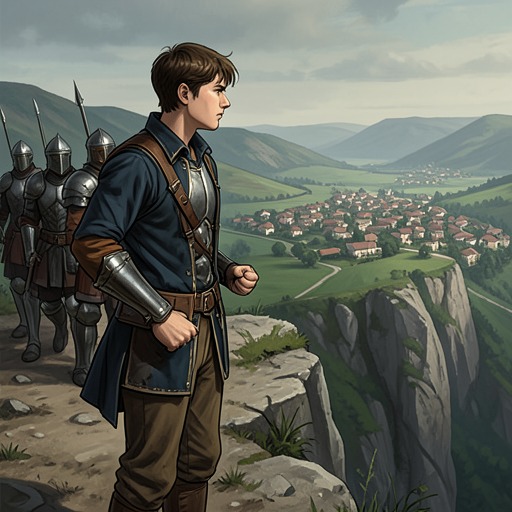
The system treats heroic ability as a public resource rather than a personal capacity. When Theo was evaluated for magic at eight, his unusually high ability attracted competing offers of apprenticeship, but the court mage declared that someone of his talent had only one proper destination: training under Priest Camden. Theo was not permitted to choose the course of his magical education. At sixteen, he was then told to return to the capital and train with the Hero and the rest of the Hero’s party, making his future another decision imposed by authorities rather than a path he had selected.
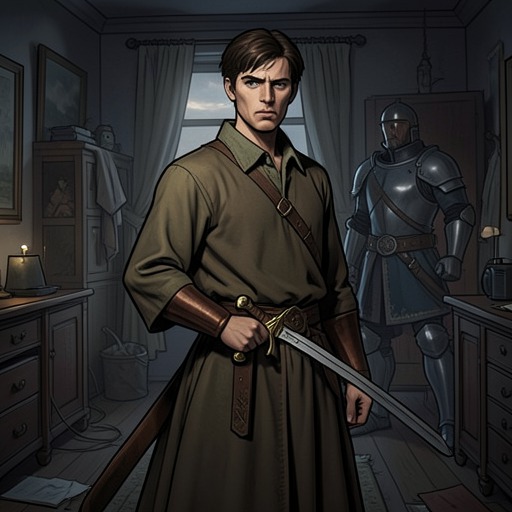
The same logic governs Luc. His first long relationships ended because his life as the Hero required constant departure. A childhood relationship with a maid in training only partly counted to him, while a squire who trained with him broke things off when Luc was announced as a departing hero, despite Luc asking him to come along. Later relationships could not survive the party’s movements between towns. Luc describes this pattern as the fate of the Hero: the system converts intimate attachment into another cost of service, treating mobility, danger, and emotional loss as normal obligations.
The system also defines duty through bloodline. Julius explains that Eliza wanted Luc to continue their heroic bloodline and sire the next Hero, a future that could not be achieved through either of Luc’s male relationships. Heroic service therefore extends beyond present military campaigns into an expectation of reproduction and inheritance. Luc’s body is valued not only as a weapon against demons but as a vessel for preserving the institution itself.
Theo’s Resistance and Escape
Theo’s refusal begins as a refusal to surrender authorship of his own life. He says that his parents pushed him to improve himself for their benefit and thereby robbed him of childhood; the authorities likewise chose his magical path without giving him the chance to decide. He leaves rather than return to the capital, travels for two years earning his living on the road, and finally settles in Leafel, believing distance might protect him from both Heroes and demons.
His resistance is not merely fear of danger. When King Alexis asks why he ran from Priest Camden’s care, Theo answers that he wanted freedom. He condemns a state that made a five-year-old accept a life of danger and pain before the child could make an informed decision, and he rejects the idea that gifted people must be manufactured to fight the kingdom’s wars. His chosen alternative is practical rather than evasive: he takes his magic to Leafel, where it can serve the sick and vulnerable directly as healing.
Eliza represents the system’s most personal and uncompromising face. She calls Theo a coward for abandoning his assigned duty and insists that she has the right to watch over Luc because he is her blood. Theo answers that she turned a child into a weapon and that the heroic order would replace Luc if he died. In his view, the system treats heroes as expendable instruments, while the people who love them experience them as irreplaceable human beings. His defense of Luc therefore becomes an indictment of the system’s moral vocabulary.
Duty Versus Care
The system’s language of duty is challenged by a competing ethic of care. Theo is a healer, yet he initially refuses to let others care for him. When Imani finds him feverish and exhausted in his bed, she checks his temperature and tells him that he has pushed himself too far. When he tries to dismiss her efforts, she asks when he will let other people care for him. Theo recognizes that Camden, Imani, Dale, Nib, Amaya, and Luc already care for him, but he fears that discovery of his secret could make them turn against him. His inability to receive care reveals another injury produced by compulsory service: self-protection has become indistinguishable from isolation.
As a party healer, Theo reverses the system’s priorities from endurance to sustainability. After joining Luc’s party, he observes that its members sleep too little, eat poorly, and push themselves toward collapse. He identifies Luc’s need for substantial food because his physical magic consumes energy; Avery’s untreated weak lungs; Veiv’s inflamed hand joints; Bryony’s inadequately healed leg injury; and Emi’s severe muscular tension in her back and shoulders. Theo insists that healing includes proper food, rest, washing, and maintaining the party’s condition, not merely restoring combatants after they have been damaged. His practice exposes the heroic system’s dependence on invisible care while refusing to value the labor that makes heroic violence possible.
The contrast continues in Leafel. Luc learns gardening over the summer, even though he lacks patience for it, and helps when necessary. In autumn, Theo harvests the garden and forages in the forest to fill his stores before winter; Raf and Liffey lend Dmitri to help with the work while Micah trains with Wicker. The ordinary labor of food, medicine, and household maintenance becomes the future that the heroic system had treated as an unacceptable abandonment of duty. Care is not presented as withdrawal from responsibility but as responsibility redirected toward sustaining actual lives.
Institutional Crisis and Public Judgment
The system reaches its legal crisis in the trial of the Demon King’s Host. After Theo’s identity is confirmed, the party uses a rare Portal Orb to reach the capital, where knights and the court mage receive them. Theo is taken to the dungeons, while the court prepares to judge him for protecting Malthios. The procedure reveals how quickly the heroic order converts a person into a security threat: his history, choices, and relationships are subordinated to the category of host.
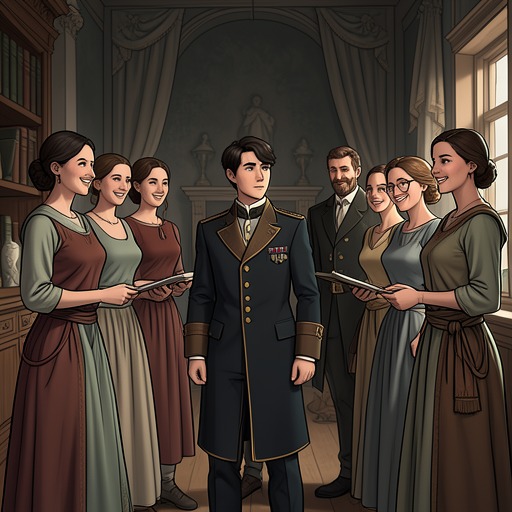
Yet the judgment cannot remain confined to the court. A mirror spell opens beside the court mage, showing Leafel’s town square and its gathered people. Micah casts the spell, with Imani, Dale, Dmitri and his parents, Nib, Amaya, and the people of Leafel standing behind him. Hayden speaks for the town and demands Theo’s release. Their intervention changes the meaning of belonging. Theo had feared that the people he loved would hate or abandon him, but their collective appearance demonstrates that communal loyalty can oppose the state’s classification of him as guilty.
Luc’s position also changes from instrument to political actor. When Eliza continues trying to control his future, he declares that he will end their relationship after the demons are defeated and that his life is not hers to control. At the trial, he refuses to let Theo be reduced to a prison or a threat. He describes himself as Theo’s humble guard and makes clear that he will not leave Theo out of his sight. The statement turns the heroic role inward: protection is no longer obedience to the court but a voluntary commitment to another person.
Rejection and Rewriting of Heroism
Eliza asks whether Luc will end their bloodline and discard everything for which he was trained merely to live with the man he loves. Luc answers that this is the only choice he has ever made for himself. He chooses a quiet and peaceful life with Theo and imagines a world in which people born with the Hero’s gift can choose their fate instead of being bound to duty. The system’s central premise is thereby reversed: heroic power does not create an obligation to surrender one’s life, and refusing compulsory service does not make a gifted person selfish or cowardly.
Theo’s challenge is equally important because he does not abandon responsibility itself. His responsibility remains in Leafel, where people depend on his healing and where his work is measured by recovery, nourishment, shelter, and trust rather than battlefield victories. The contrast between Theo’s chosen vocation and the court’s demand for his service distinguishes duty freely undertaken from duty enforced through childhood conditioning, family pressure, political authority, and the threat of punishment.
The epilogue gives this alternative order a durable form. Theo works at his shop, writes labels, harvests the garden, and gathers ingredients for winter while Luc playfully distracts him. Luc’s heroic gift remains part of him, but it no longer determines every movement of his life. Their shared domestic routine makes visible the future Luc defended at the trial: a hero can survive outside the heroic machine, and a life organized around mutual affection and practical care can be more ethically demanding than obedience to inherited duty.
Narrative Significance
The Heroic duty system supplies the book’s principal institutional antagonist. Demons are an external enemy, but the system explains why children are trained for danger, why heroes are denied stable relationships, why bloodline is treated as public property, and why Theo must defend his right to use his power on his own terms. Its violence is often expressed through ordinary words such as duty, training, service, and blood, which makes coercion appear like common sense rather than force.
The narrative dismantles that appearance through repeated contrasts. Eliza sees Luc as the continuation of a bloodline; Theo sees him as a beloved person. The court sees Theo as a host who must be confined; Leafel sees him as its healer and neighbor. The party’s old method consumes bodies through insufficient rest and food; Theo’s method preserves them through care. Against a system that demands a predetermined future, the characters construct a chosen one: Luc refuses hereditary heroic succession, Theo remains in Leafel, and their relationship makes freedom a shared social practice rather than a solitary escape.