Theo Bladefoot–Imani
The Reincarnated Demon King's Host Just Wants to Live in Peace, But the Hero Won't Leave Him AloneTheo Bladefoot–Imani is a mother-son-like family relationship whose importance lies in making care stronger than stigma. Imani recognizes Theo not as the hidden danger beneath his skin, but as the frightened young healer who arrived in Leafel, learned to belong, and repaid belonging through healing and devotion. Her attachment gives the abstract idea of chosen family a domestic form: she worries over him, tends him when he collapses, speaks for him when authorities condemn him, and finally receives him home as a son.
Identity and Foundation
Imani’s relationship with Theo is grounded in the community he found after believing that no one could safely care for him. Theo’s fear is not simple solitude. He knows that friendship cannot save him if people discover what he is, and he therefore prepares himself to run again rather than risk the pain of being rejected. Even when Malthios promises protection, Theo answers with distrust, implying that a promise from the hidden power inside him cannot guarantee safety. Imani’s importance emerges against this defensive habit: she belongs to the group Theo loves but refuses to rely upon.
The relationship is also shaped by Theo’s public role as a healer. He gives care freely, while withholding access to his own vulnerability. Imani’s later account of his arrival in Leafel describes him as a child who thought that nobody could care for him, yet who welcomed the village and repaid its welcome with love and care in his own way. Her description turns his healing from a professional function into a reciprocal moral practice. Theo did not merely treat villagers; in Imani’s understanding, he became part of their lives.
Care and Reversed Dependence
Imani’s care becomes visible when Theo pushes himself beyond his limits and collapses. He wakes in his own bed, feverish and disoriented, with Imani seated beside him and checking his temperature by removing a cool cloth from his forehead and brushing her fingers across his face. She tells him that he has pushed himself too hard. When he tries to dismiss the trouble and rise, her glare stops him; the sadness behind it makes the rebuke more than irritation.
Her central question is when Theo will allow other people to care for him. The question identifies the emotional structure of their bond. Theo can care for Camden, Imani, Dale, Nib, Amaya, and Luc, but he believes that accepting their care would expose him to catastrophic loss if they turned against him. His refusal is therefore both self-protection and self-denial. Imani challenges that logic by treating dependence as something he is entitled to receive, not a weakness that compromises his usefulness.
The scene also reverses the expected direction of healing. Theo is the person who normally restores others, but illness places him in the bed while Imani performs the immediate, attentive labor. Her care does not cure the fear governing him, yet it makes that fear visible and gives the relationship its parental texture. She does not wait for Theo to request comfort; she enters the role of caretaker before he can defend himself against it.
Loyalty Under Judgment
When Theo is taken to the capital for the trial of the Demon King’s host, the danger to his relationship with Imani becomes political as well as personal. He understands that entering the portal will end his autonomy: people in power will know where he lives, and the Hero’s party may force him back into its ranks while the truth about him remains discoverable. He goes because Luc may die, but the decision exposes Leafel and everyone connected to him to official suspicion.
During the trial, Micah opens a mirror spell from Leafel, revealing Imani, Dale, Nib, Amaya, and the gathered people of the village standing behind him. Hayden declares that the people of Leafel demand Theo’s release. When the court threatens to treat them as traitors, Imani speaks directly to the authorities. She remembers Theo as lost and young, someone who believed that nobody could care for him, and says that Leafel welcomed him and that he repaid the welcome with love and care.
Imani’s testimony is crucial because it answers the court’s accusation through lived knowledge rather than magical status. Nib speaks of the people who can live because Theo healed them, while Hayden acknowledges his stubbornness and cutting tongue but still calls him a good person. Imani supplies the emotional history behind those judgments. Her evidence is not that Theo is harmless by nature; it is that his sustained actions have made him trustworthy within a community that knows him.
Return and Recognition
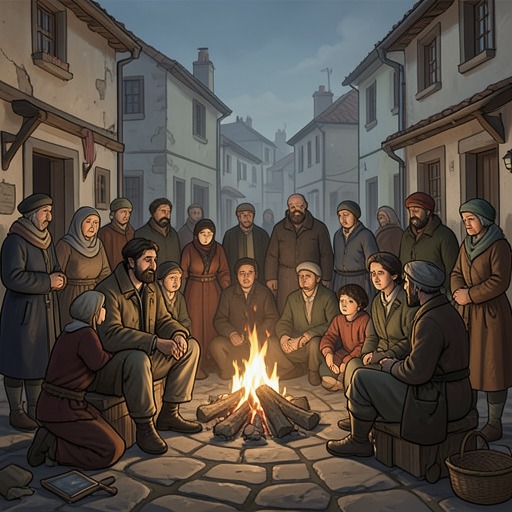
After the trial, Theo returns to Leafel fearing that the villagers may see only the monster under his skin. The crowd gathered by the Watchtower initially leaves him suspended between hope and dread, but Micah breaks away first and runs into him, sobbing that he had been terrified they would take Theo away. Imani and Dale then close around him, sandwiching him in a tight embrace.
Imani calls him their dear Theo, presses a kiss to his temple, and tells him that they are proud of him. Dale welcomes him home as a son, but Imani’s gesture gives the welcome its most explicitly maternal shape: public reassurance is expressed through touch, tears, and the restoration of physical closeness. Theo, who has spent years repressing the need to be cared for, collapses into their embrace and cries. The ending does not merely confirm that Leafel has forgiven him; it shows him finally receiving the care he had believed was too dangerous to accept.
Narrative Significance
Theo and Imani’s bond is one of the story’s clearest contrasts between inherited identity and lived relationship. The court treats Theo according to the identity attached to him by Malthios, while Imani judges him through the history of what he has done for actual people. Her testimony therefore opposes institutional classification with communal memory.
The relationship also widens the meaning of family beyond blood and prescribed succession. Luc is pressured to continue the Hero’s bloodline and produce the next Hero, but he chooses a peaceful life with Theo instead. Against that demand for biological continuity, Imani’s relationship with Theo demonstrates a family created through welcome, labor, protection, and repeated recognition. Her final address to him as a son makes that alternative kinship explicit without requiring blood descent.
Imani’s role is especially significant because Theo’s identity conflict is not resolved by concealment. Cargo eventually asks whether he will tell others that he is demon spawn, and Theo’s instinct is still to freeze and defend the secret. Yet the people of Leafel, with Imani among their most articulate representatives, respond to disclosure by affirming the person formed through his choices. The bond between Theo and Imani thus gives emotional proof to the story’s larger claim that a feared nature does not erase a chosen life, and that accepting care can be as transformative as giving it.