Theo Bladefoot–Tyraz
The Reincarnated Demon King's Host Just Wants to Live in Peace, But the Hero Won't Leave Him AloneTheo Bladefoot–Tyraz is a relationship of captivity and defiance forged when Tyraz seizes Theo during the assault on the Demon Fortress. The Demon Lord uses shadows, physical restraint, threats, and Theo’s love for Luc as instruments of control, but the imprisonment never becomes submission. Theo answers Tyraz’s calculated cruelty with concealment, improvisation, verbal resistance, and finally an act of bodily sacrifice: when Tyraz raises his sword over Luc, Theo breaks free and throws himself between them.
Definition and First Confrontation
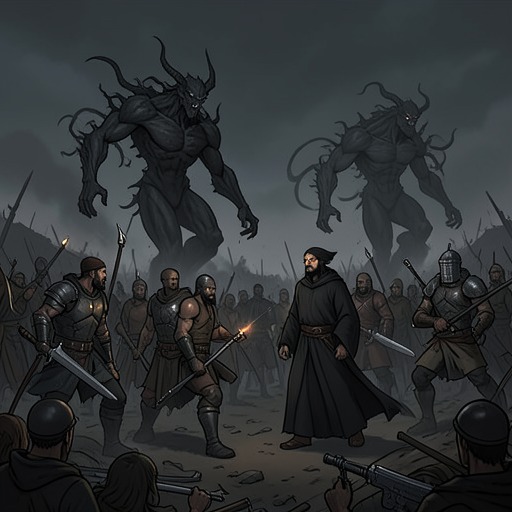
The relationship begins in a moment when the battle has already become dangerously unbalanced. At least thirty Novices emerge from the trees, separating Theo from the rest of the Hero’s party while stronger demons and better weapons intensify the threat. The exhausted party faces the new force in a suspended standoff, but Tyraz does not wait for the larger fight to resolve. He approaches Theo from behind, wraps a clawed hand around his throat, and takes advantage of the confusion to isolate him.
Theo recognizes Tyraz through Malthios’s memories before seeing the Demon Lord clearly. Tyraz has long grey hair, yellow slit pupils, horns resembling bleached white bone, and a handsome noble face distorted by a smile that expresses pure evil. His appearance carries particular weight because he is the one demon Malthios had almost feared. That remembered hierarchy makes Tyraz more than another battlefield opponent: his arrival brings an old terror from Malthios’s past into direct contact with Theo’s vulnerable present.
Tyraz’s manner intensifies the threat. His voice resembles Malthios’s in its deep, husky quality, but its softness makes it more menacing rather than less. As shadows gather around Theo, Tyraz tightens his grip until his claws draw blood. Theo holds back his magic because he does not know how Tyraz will react and does not want Luc to witness the full danger surrounding him. Luc runs toward him while the Novices close around the Hero’s party, but Tyraz’s shadows muffle every sound except the Demon Lord’s quiet laughter.
Captivity as Psychological Warfare
Tyraz presents the abduction as a private claim upon Theo. He calls him a “little healer” and says that the two of them have more important matters to attend to, separating Theo from the battle and from Luc through both language and magic. The shadows press around Theo like water, making breathing difficult while Tyraz’s body remains the only solid presence. When the shadows clear, Theo collapses, and Tyraz interprets his physical weakness as evidence that the captive has been properly subdued.
Instead of treating Theo as an independent opponent, Tyraz defines him through Luc. He refers to Theo as the Hero’s rumored lover and suggests that Theo may be the person he intended to capture. His threat is deliberately intimate: he promises that Theo would prefer death to the treatment he has planned, turning captivity into an attack on both Theo’s body and Luc’s emotional security. The relationship therefore operates on two linked levels. Tyraz wants a prisoner he can torment, but he also wants a weapon capable of making Luc feel powerless.
Theo’s first escape attempt shows that resistance survives even when the physical balance is hopelessly unequal. When shadows begin curling around him again, he summons light magic and draws one of his knives in the same motion. He twists and throws with lethal intent, but Tyraz’s reflexes save him; the blade lodges in the Demon Lord’s shoulder rather than his throat. Theo then runs through black-stone corridors lit only by pale glowing crystals, passing empty doorways in a maze without windows. The setting turns escape into a desperate movement through an enclosed world, while Malthios urges Theo to surrender control so that he can fight.
Theo’s Resistance and Malthios’s Intervention
Theo’s refusal to let Malthios take over is not simple distrust. The fear that his secret will be discovered rises alongside his fear of Tyraz, and he feels Malthios struggling harder than ever to protect him. Malthios’s fear and protective drive are so intense that they seem to belong to Theo as well, yet Theo still cannot release control. In a situation where every external freedom has been removed, his own body remains the last territory he can govern. Surrendering it, even to an ally within him, feels like losing the final form of agency available to him.
Tyraz captures Theo again through shadow rather than direct pursuit. Vines of darkness wrap around Theo’s limbs, lift him from the ground, and turn him face-to-face with the Demon Lord. Theo’s knife falls onto the stone, still coated in Tyraz’s blood. The wound has stopped bleeding, but the feathers of Tyraz’s right wing remain matted where the blade cut them, marking the encounter as one in which the captive has already drawn the captor’s blood. Tyraz’s anger replaces his earlier smile, and his snarled question about how many knives Theo possesses recognizes, however grudgingly, the healer’s resourcefulness.
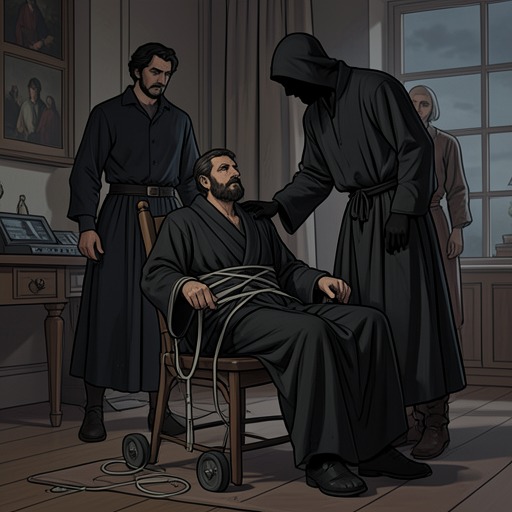
In the cell, the pattern becomes ritualized. Tyraz enters with fangs visible and shadows sliding from his boots toward Theo, while another shadow climbs Theo’s body and forces his head upward. Tyraz praises the captive’s defiant eyes and recalls how “feisty” Theo was during their first encounter. Theo answers by demanding his knives back and promising to demonstrate that defiance directly. The exchange does not erase the asymmetry of imprisonment, but it prevents Tyraz from controlling the meaning of the scene: Theo remains frightened and restrained, yet he refuses to perform gratitude, fear, or obedience for his captor.
Tyraz’s cruelty then becomes explicitly possessive. He tells Theo that, after disposing of Luc, he intends to keep Theo for his own entertainment, describing prolonged bodily violation as the punishment for loving the Hero. The threat is not merely an attempt to extract information or weaken an enemy. Tyraz wants to convert Theo’s relationship with Luc into evidence of ownership, so that Luc’s death would be accompanied by the knowledge that Theo had been taken from him. Theo refuses the terms of that fantasy by spitting in Tyraz’s face. The gesture provokes visible disbelief in the Demon Lord, whose power over the cell cannot compel the emotional submission he expects.
Theo’s verbal counterattack also strikes at Tyraz’s political insecurity. He declares that “There is only one Demon King and that is Malthios,” reducing Tyraz to a “pathetic wannabe who can’t ascend.” The insult identifies the central fault line between them: Tyraz is not only a torturer holding a prisoner, but an ambitious Demon Lord whose claim to ultimate authority remains incomplete. Theo’s knowledge of Malthios’s history lets him attack that ambition directly, and his defiance turns captivity into a contest over legitimacy as well as endurance.
The Hostage and the Rescue Attempt
Tyraz later reveals that Theo was taken as part of a larger contingency plan. When his followers report that the intruders have entered and will not be held back for long, Tyraz explains that he had anticipated such a breach and had taken the Hero’s lover for precisely this reason. Theo is therefore positioned as a hostage to be displayed before Luc, not simply as an isolated prisoner. Tyraz unlocks Theo’s cuffs while immediately replacing their restraint with shadows, binding Theo’s arms behind his back and looping darkness around his throat. The removal of the cuffs restores circulation but does not restore freedom; the change of restraint makes the control more theatrical and more directly attributable to Tyraz’s magic.
Tyraz then announces his intention to bring Theo before Luc and demonstrate how powerless the Hero is inside the fortress. The proposed encounter exposes the logic of their relationship at its most vicious. Tyraz measures victory not only by defeating Luc physically, but by forcing Luc to witness Theo’s helplessness. Theo’s body becomes the selected site on which Tyraz intends to prove the limits of heroic power, while Theo’s love becomes the connection Tyraz believes can be exploited most effectively.
That calculation fails because the bond Tyraz uses as leverage also supplies Theo with his decisive motive. After seeing Luc endangered, Theo feels Malthios’s power flood through him while retaining control of his own body. He punches the barrier holding him, sending magic down his arm like a lightning bolt and shattering the circle that imprisons him. The escape is deliberately devoid of preparation: Theo has no plan and no weapons. What drives him is desperation to save the man he loves, even at the cost of everything he possesses.
The final confrontation reverses Tyraz’s intended spectacle. Rather than allowing the captive to be displayed as proof of Luc’s powerlessness, Theo breaks free and runs toward the danger. When Tyraz raises his sword over Luc, Theo throws himself between them, placing his own body in the path of the blow. The act completes the movement from constrained resistance to chosen sacrifice. Tyraz had treated Theo as a tool for hurting Luc; Theo turns that same connection into an action Tyraz cannot control, making himself the immediate shield through which Luc may survive.
Power, Agency, and Meaning
The relationship is structured by extreme physical inequality, but the narrative distinguishes physical captivity from total domination. Tyraz controls space through shadow, cuts off sound, restricts breathing, immobilizes Theo in the air, confines him in a cell, and replaces magical restraints as soon as they are removed. Yet each technique produces a corresponding form of resistance: Theo withholds his magic, preserves control of his body, throws a knife, refuses to avert his eyes, answers threats with mockery, and finally breaks the prison barrier. Resistance here is not presented as the absence of fear. Theo is frightened, struggles to breathe, and hesitates because exposure of his secret threatens his already fragile sense of self. His agency consists in acting while those pressures remain present.
Malthios’s presence complicates the conflict further. The Demon King exists within Theo and repeatedly offers protection, but Theo does not simply surrender himself to the stronger force. During the first attack, Malthios warns him and tries to take control; Theo feels Malthios’s fear and protective impulse as though they were his own, yet refuses to relinquish bodily authority. Later, when the barrier must be broken, Malthios’s power passes through Theo without displacing him. The contrast establishes a crucial distinction between shared strength and possession: Theo can accept assistance while still making the decision and bearing the risk himself.
Tyraz’s language repeatedly attempts to collapse Theo into someone else’s definition: a “little healer,” the Hero’s rumored lover, and a prospective possession. Theo’s replies restore the identities Tyraz tries to erase. He remains a healer capable of light magic, a fighter carrying multiple knives, Malthios’s host without being reduced to Malthios, and Luc’s lover whose attachment generates courage rather than shame. Even the wound in Tyraz’s shoulder and the blood on the fallen knife materialize this refusal. The captive does not defeat the Demon Lord in equal combat, but he leaves a mark on the body of the man who claims complete control.
The relationship’s decisive meaning therefore lies in its reversal of hostage logic. Tyraz assumes that love creates vulnerability that can be converted into obedience. Instead, love gives Theo a reason to reject every safer compromise, including surrendering control to Malthios, and to place himself between Tyraz’s sword and Luc. Captivity remains real, and Tyraz’s threats remain terrifying, but they fail to define the ending of the encounter. Theo’s final movement transforms him from the object of a Demon Lord’s plan into the person who chooses what his body will do.