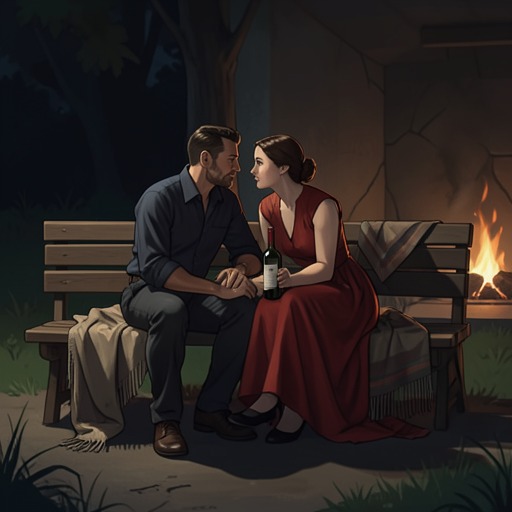
Theo and Luc’s Union
The Reincarnated Demon King's Host Just Wants to Live in Peace, But the Hero Won't Leave Him AloneTheo and Luc’s Union is the turning point at which their relationship becomes an openly chosen partnership rather than an uncertain attraction. After Theo returns alive from confronting Luvel, Luc’s fear of losing him breaks through restraint: he kisses Theo with complete abandon, confesses that he wants Theo to be his “now and after I defeat the demons,” and rejects the idea of any future that does not include him. Their union therefore joins intimacy to defiance. It promises a private life together while placing that promise against the public demands of the Hero’s role, inherited duty, and the expected continuation of Luc’s bloodline.
From Fear of Loss to Open Confession
Luc’s emotional change begins at the Leafel Watchtower, where Theo emerges from the forest bloodied but alive. Luc has been waiting outside with the adventurer party and other familiar figures, visibly strained by lack of rest and angrily confronting Hayden before Theo appears. The moment Luc sees Theo, his attention breaks away from every other conflict. Theo returns Luc’s pendant, and Luc responds by crushing him in a hug so forceful that it lifts Theo’s feet from the ground. His immediate concern is not an explanation of how Theo survived a battle with a demon of Luvel’s level, but whether Theo is physically safe; he runs his hands over Theo’s body and urgently asks whether he is all right.
The reunion becomes their first kiss. Luc grips the back of Theo’s neck and kisses him with a force that makes the surrounding world disappear, while Theo, who has never been kissed before, freezes in uncertainty before yielding to the experience. The scene’s value shifts from threatened loss to embodied certainty. Luc’s exhaustion, physical urgency, and fear pass directly into the contact between them, while Theo’s racing heart and inability to breathe register a response that has not yet been organized into a declaration. Their connection is recognized first through the body and only afterward through language, making the kiss the emotional and structural bridge between peril and commitment.
The Commitment Is Named and Accepted
When Theo asks what has overcome him, Luc gives the feeling a clear form. He says that he thought he would never hold Theo again or see him smile, and that he no longer wants to hold back. He declares that he wants Theo to be his after the defeat of the demons and insists that there is no one else for him. The confession is not merely an admission of affection; it is a claim about the future. Luc places Theo inside the life he intends to continue beyond the war, while Theo recognizes that Luc has already made a place for himself in Theo’s heart.
Theo answers with caution rather than effortless romantic confidence. He explains that he has never done this before and that physical intimacy may take time to become comfortable. This hesitation does not undo the confession. Instead, it establishes that acceptance will include Theo’s limits as well as Luc’s desire. Luc then asks directly whether Theo accepts the confession and agrees to be his from that day onward. Theo answers by touching the pendant he gave Luc and recalling that he had promised to wait for him. The pendant thus becomes a reciprocal sign: Luc has carried Theo’s token, while Theo treats that earlier promise as his own prior act of choosing Luc.
Luc seals the commitment with his father’s ring. The ring is silver, textured like scales, and set with a dark sapphire; it is the only thing Luc possesses from his father, an adventurer who saved his party from a demon attack but died in the process. Luc places the ring on Theo’s marriage finger, where it unexpectedly contracts to fit. The gesture makes their union both personal and symbolic. Luc gives Theo an inheritance tied to sacrifice and heroic history, but redirects its meaning toward a relationship chosen in the present. When Theo worries that he is difficult to love and might hurt Luc unintentionally, Luc answers that loving Theo has been the easiest thing he has ever done. Their engagement is consequently founded not on an idealized promise of safety, but on Luc’s conscious acceptance of Theo’s danger and complexity.
A Love That Rejects the Heroic Script
The union carries a political conflict because Luc’s family and institution treat his body and future as instruments of Hero continuity. Julius reveals that Hero Eliza once ordered him to refuse Luc’s invitation to join the party, threatening to take everything from him if he did not let Luc go. Julius believes Eliza wants Luc to continue their bloodline and sire the next Hero, something that could not be achieved with either Julius or Theo. This revelation defines the obstacle facing Theo and Luc as more than personal jealousy or social disapproval: their relationship threatens a succession system built around reproduction, inherited power, and compulsory service.
Luc’s choice is later challenged openly by Eliza before the court. She asks whether he is truly choosing to end their bloodline and throw away everything for which he has trained his whole life. Luc answers that this is the only choice he has ever made for himself. He chooses a quiet and peaceful life with the man he loves and imagines a world in which those born with the Hero’s gift can choose their fate instead of being bound to duty. Theo stands beside him while Luc keeps an arm around his waist, transforming their private commitment into a public declaration. The union therefore opposes a linear heroic future—training, service, reproduction, succession—with a different future based on shared domestic life and self-determination.
Domestic Promise and Lasting Consequences
After the confession and exchange of tokens, Theo and Luc continue their intimacy in a deliberately ordinary setting. They kiss again and have to stop when their physical desire becomes difficult to ignore. Theo then pulls Luc from bed to show him the garden, while Luc refuses to put on a shirt and instead drapes it over Theo. The flock is still outside, and even the difficult hen named Two takes to Luc, allowing him to scratch her head. Luc remarks that the place feels newly alive and asks whether Theo has abandoned the plan to build a cottage. The garden, the flock, and the unfinished cottage offer a concrete image of the future Luc has chosen: not merely a declaration made under the pressure of danger, but a shared life rooted in Leafel.
The consequences extend beyond the scene itself. Luc’s promise to remain with Theo later becomes an answer to the accusation that Theo is controlled or merely possessed by the Demon King. Luc identifies Theo as the Demon King’s prison and himself as Theo’s humble guard, promising not to let Theo out of his sight. In court, Eliza interprets Luc’s decision as the destruction of the family line, whereas Luc interprets it as the beginning of a broader freedom for future Heroes. Theo’s union with Luc thus changes the meaning of both men’s identities: Theo is no longer approached only as a dangerous host, and Luc is no longer defined solely by heroic inheritance.
The event’s decisive significance lies in its double movement from private tenderness to public refusal. Luc’s past relationships were limited by travel and by the fate assigned to a Hero, but his commitment to Theo is presented as the relationship that can endure beyond those conditions. Theo’s returned pendant, Luc’s father’s sapphire ring, the kiss after presumed loss, and the choice of a quiet life all convert desire into an oath. Their union does not erase the dangers surrounding them; it gives those dangers a shared answer. Love becomes the means by which Luc rejects compulsory bloodline duty and claims a future with Theo on chosen terms.