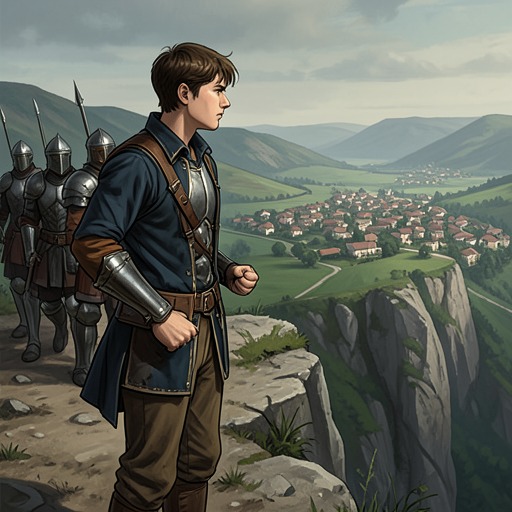
Theo’s Escape from Hero Training
The Reincarnated Demon King's Host Just Wants to Live in Peace, But the Hero Won't Leave Him AloneTheo’s Escape from Hero Training is the turning point at which Theo refuses to become part of Algeya’s inherited heroic machinery. On the day he reaches legal adulthood, he is expected to return to the capital, meet the new Hero, train beside him, and eventually accept responsibility for purging Demons and protecting ordinary people. Instead, Theo leaves without a note, travels north with Malthios for two years, and begins the hidden life that will lead him to Leafel. His escape is not a rejection of danger, but a refusal to let institutions decide what his life, body, and future must be used for.
Causes and Background
Theo’s flight grows out of the impossible condition of being the Demon King’s host. Malthios’s magic feels terrifying yet instinctively familiar because it is part of Theo, but the bond also makes both of them prisoners. Theo can neither think nor feel without Malthios knowing it, while Malthios cannot simply abandon the body: the spell that brought him into Theo took more than a human lifetime to prepare, and Theo’s death would kill him as well. Malthios responds to Theo’s disobedience with threats, insults, and fits of rage severe enough to leave Theo bedridden with splitting headaches, yet intimidation never produces obedience. Theo follows his own refusal rather than a higher moral ideal; he hates being ordered around and sees no reason to carry out Malthios’s destructive suggestions.
Their eventual bargain creates the immediate foundation for the escape. Malthios agrees to stop trying to seize Theo’s mind and body, while Theo permits him occasional control on the condition that he do nothing against Theo’s wishes. The arrangement is explicitly postponed until Theo completes his training and gets far from the capital and both past and present Heroes. Escape therefore becomes a negotiated form of coexistence: Theo does not free himself by eliminating Malthios, and Malthios does not secure freedom through domination.
The pressure to remain hidden is intensified by Theo’s knowledge that his identity could destroy him. He believes that no amount of friendship would save him if anyone discovered what he was. Even when Malthios claims he would protect Theo, Theo answers that Malthios would really be protecting himself. This suspicion reveals the emotional logic of the flight: trust is dangerous because every attachment can become a vulnerability, while the public heroic system would treat the host of the Demon King as an enemy to be exposed and destroyed.
The Obligation Theo Refuses
By the time Theo is fourteen, rumors circulate that a new Hero has been found and trained to replace Eliza. Hero magic consumes its wielder’s body with extraordinary speed; recorded Heroes rarely survive beyond their twenties, and Eliza is already showing the cost of her battle with Malthios. The search for a successor is thus both political succession and bodily replacement. Theo understands that the new Hero will not simply be another young person: he will be the center of a system demanding training, demon purging, public protection, and eventually the continuation of the heroic line.
Camden speaks warmly of the Hero’s party and promises that Theo will one day experience its bonds of friendship. Theo already knows that this future is unavailable to him under the terms of his pact with Malthios. His private plan directly contradicts Camden’s vision: instead of joining the new Hero’s companions, Theo will finish his preparation, disappear from the capital’s reach, and avoid both the institutional role and the relationships attached to it.
On Theo’s sixteenth birthday, Camden tells him that the time has come. Guards will collect him the next morning and take him to the capital, where he will meet the young Hero and the other companions. They are to train together until the Hero reaches adulthood, after which the duty of cleansing the remaining Demons and defending common people will pass to them. The timetable makes the coercion plain. Theo is not being invited to discover a vocation; he is being transferred into a predetermined succession, with his adulthood marking the moment at which the state can claim his labor.
The Journey North
That night, Theo packs his bag with his few belongings and enough food for the road. He leaves no note for Camden because he does not know what explanation could contain the truth. The absence of a farewell is itself part of the escape: Theo cannot make a public argument for his departure without exposing the identity that makes departure necessary.
Theo and Malthios travel for two years, taking odd jobs from people they meet along the way and deliberately avoiding attention. Their route carries them farther and farther north, away from the capital and from the Heroes who might recognize the danger of Theo’s condition. The journey is practical rather than triumphant. They do not cross the country as celebrated adventurers; they survive by becoming unremarkable, using temporary work and distance as protection.
At last they find a small, peaceful village that seems beyond the reach of both Demons and Heroes. Theo believes he has found the obscurity he sought, though the brief confidence is undercut by the immediate recognition that he may be wrong. The village becomes the beginning of his life as Theo Bladefoot, Healer of Leafel, but the escape never completely removes the threat it was designed to evade. His later fear of discovery, including Cargo’s blunt question about whether he will tell the others that he is demon spawn, shows that the danger has been displaced rather than erased.
Consequences and Reversal
The escape gives Theo years in which to develop a self outside the Hero’s training structure. He becomes a fast learner and a healer stronger than Camden because he can draw on Malthios’s mana, while deliberately restraining his ability so that no one becomes suspicious. He also studies with Malthios, whose long life and travels across Algeya give him extensive knowledge, and learns hand-to-hand combat and knife work from Sasin. These skills complicate the meaning of flight: Theo is not abandoning competence or responsibility, but choosing what kind of competence to cultivate and for whom it will be used.
His hidden life eventually brings him into contact with Luca and the Hero’s party, making the future he once believed impossible appear in another form. Luca’s history exposes the personal cost of the heroic role: his early lovers remained in the capital, another relationship ended when he was required to leave, and shorter relationships could not survive the Hero’s itinerant fate. Later, Hero Eliza attempts to control Luca’s future more directly, wanting him to continue their bloodline and sire the next Hero. Theo’s escape therefore stands in contrast to the reproductive and dynastic future demanded of Luca. What Theo fled as a child becomes the same system from which Luca must eventually break free.
The reversal is especially clear when Luca recognizes that bringing Theo back means dragging him into the control he once escaped. Theo nevertheless chooses to return rather than let Luca die, accepting that the decision may expose him. The act does not cancel the original escape; it proves that Theo’s later choices belong to him. He can refuse imposed duty and still accept a freely chosen obligation to the person he loves.
Narrative Significance
The event begins as a classic escape plot but overturns the expected heroic journey. Theo passes beyond the threshold not to claim a public destiny, but to refuse one. His northward movement is an anti-initiation: distance from the capital allows him to become a healer, combatant, partner, and friend before the world can reduce him to a host or a recruit.
That refusal ultimately reshapes the meaning of heroism. When Eliza asks whether Luca will sacrifice the Hero bloodline and everything he trained for, Luca calls his decision to live peacefully with Theo the only choice he has ever made for himself and imagines a world in which those born with the Hero’s gift can choose their fate rather than remain bound to duty. Theo’s escape is the earlier, concealed version of the same claim. Together, their choices replace inherited bloodline, compulsory service, and linear heroic succession with a self-chosen household and a future organized around life rather than obligation.